
Sheet M09 Revision 1 Checked 15 October 2026
150 free spins no deposit
Fifteen pounds on the front, £14.40 of average winnings underneath, and a forty times requirement that turns those winnings into £576.00 of turnover, £23.04 of expected cost and four hours at the fastest pace a British licence permits.
£14.40 of credit, £23.04 of cost, four hours to pay it
What the conditions leave
Every destination on this spike is bought advertising. The site takes a fee if a reader goes on to register, and no figure printed below moves because of it.
The Spin Sheet
Till receipt No 01
Betportal
Lowest multiple here
For every €1 of spin credit at face per €1
Credit
Debit
No Great Britain licence
Licensed in Anjouan, Comoros, run by BetPortal Gaming Ltd, with Excite Ultra Media Ltd, reference ALSI-202601040-FI2.
Terms read 15 October 2026
Open the offer at Betportal, opens in a new tabThe Spin Sheet
Till receipt No 02
WinBeast
Five staged matches
For every €1 of spin credit at face per €1
Credit
Debit
No Great Britain licence
Licensed in Curaçao, operator not named on the site.
Terms read 15 October 2026
Open the offer at WinBeast, opens in a new tabThe Spin Sheet
Till receipt No 03
EliteSpin
Longest spin window
For every £1 of spin credit at face per £1
Credit
Debit
No Great Britain licence
Licensed in Costa Rica, run by PrimeTier Limited.
Terms read 15 October 2026
Open the offer at EliteSpin, opens in a new tabThe Spin Sheet
Till receipt No 04
Crown Jewelz
Multiple unpublished
No total struck
Credit
Debit
No Great Britain licence
Licensed in Curaçao, number not verified, operator not named on the site.
Terms read 15 October 2026
Open the offer at Crown Jewelz, opens in a new tabThe figure at the foot of a receipt is this site's own arithmetic and nothing an operator has published: the credit, less the share a spin gives back at 96 per cent return to player, less what playing the wagering through costs at the same return. It describes the offer, not one reader's afternoon. Where the conditions price above the credit the receipt prints nothing rather than a negative sum, and where a figure the sum needs is unpublished it prints the condition in the operator's words instead.
Three words stand in the amount column where no figure can. Noted is a published condition that takes value away without leaving the sum a figure to take. Unpriced is a condition whose figure nobody has published, or a credit that is not a sum until a deposit of your own sets it. Own money is money of yours, which is never part of a total.
Not one of the operators printed above holds a Great Britain licence, so the duties that licence carries do not reach them. Every online gambling company licensed in Great Britain has to be part of Gamstop Online, and a reader who has shut themselves out through the scheme is therefore not shut out here. The ceiling of ten times the bonus funds on a wagering requirement, in force since 19 January 2026, is a condition of that licence and binds the companies that hold one. Where a dispute goes instead is a matter for the authority named on the receipt, and the Gambling Commission describes what a reader faces without a British licence as a lack of recourse if things go wrong. Nobody under 18 may hold an account at any of them.
Every term printed on a receipt is the operator's own, and each receipt carries the day it was read. The oldest of those readings is 15 October 2026. What binds a reader is the operator's own full terms, and not a line printed here.
1
A hundred and fifty cycles, and the fourteen pounds behind them
A hundred and fifty is a headline chosen to look like a lot without quite being a round number, and it behaves exactly as any other count does once the conditions are priced. Larger counts do not buy a better rate. They buy more of the same rate, and more hours in which to collect it.
At 10p apiece, a hundred and fifty cycles are worth £15.00 as advertised. Advertised is not paid. A cycle pays out whatever its cabinet returns, and at 96 per cent the cabinet keeps four pence of each pound crossing it, so the count averages £14.40 of winnings. Sixty pence has been collected before anything in the terms takes effect.
From here on the credit is £14.40, and the count itself plays no further part. Everything below is a proportion of that figure.
What a cycle is worth in pence is unregulated, so the figure used here is declared rather than discovered. No rule published in Britain fixes it, identifies who sets it, or obliges anyone to disclose it. A higher value lifts the credit and the obligation by the same factor, which is why the proportions on this sheet are the useful part and the pounds are only an illustration of them.
The requirement throughout is forty times. That is the kind of demand attached to no deposit counts out here. It is quadruple the ten a British licence tolerates, and the regulator put requirements of sixty times on record as being in use before any limit existed.
Named inputs, so that any one of them can be altered and the sheet rerun:
- A count of a hundred and fifty at 10p, giving £15.00 advertised against £14.40 in hand.
- Theoretical return set at 96 per cent, leaving the cabinet four pence out of each pound.
- W at forty, with six values tried in part 3.
- Contribution at the full pound, right up to part 6.
- No deposit, which keeps the credit as the only exposure.
2
Fourteen pounds forty through the expression
Everything struck at the foot of this part comes out of a single expression. B is the credit, W the requirement, RTP the theoretical return written as a share of one, and g the portion of a staked pound that counts towards the requirement. E, in pounds, is what the credit should leave.
E = B × (1 – (W × (1 – RTP)) / g)
Substituted on this count:
E = £14.40 × (1 – (40 × 0.04) / 1)
E = £14.40 × (1 – 1.60)
E = -£8.64
Read the same thing as two sums and it is harder to argue with. Forty lots of £14.40 is £576.00 that must be wagered before any withdrawal, and four pence from every pound of that is expected to remain with the house, which comes to £23.04. Against £14.40 of credit, the cost is £8.64 too large.
That eight pounds sixty-four is not a debt anybody collects. Nothing was deposited, so the balance cannot fall under nought, and the credit gives out partway along the £576.00. The negative sign measures the overhang: the amount by which the condition exceeds the thing it was fastened to.
£576.00 of turnover owed on £14.40 of winnings
Compare the two halves of the headline directly. The gift is worth about fourteen pounds and the obligation runs to five hundred and seventy-six. A reader who counts the cycles and stops there has read the smaller of the two numbers.
3
Six requirements, one hour to six
Only W moves in the schedule below. The credit, the return and the weighting are all held where part 1 put them, and the final column is the quickest lawful passage through each row at 10p a cycle.
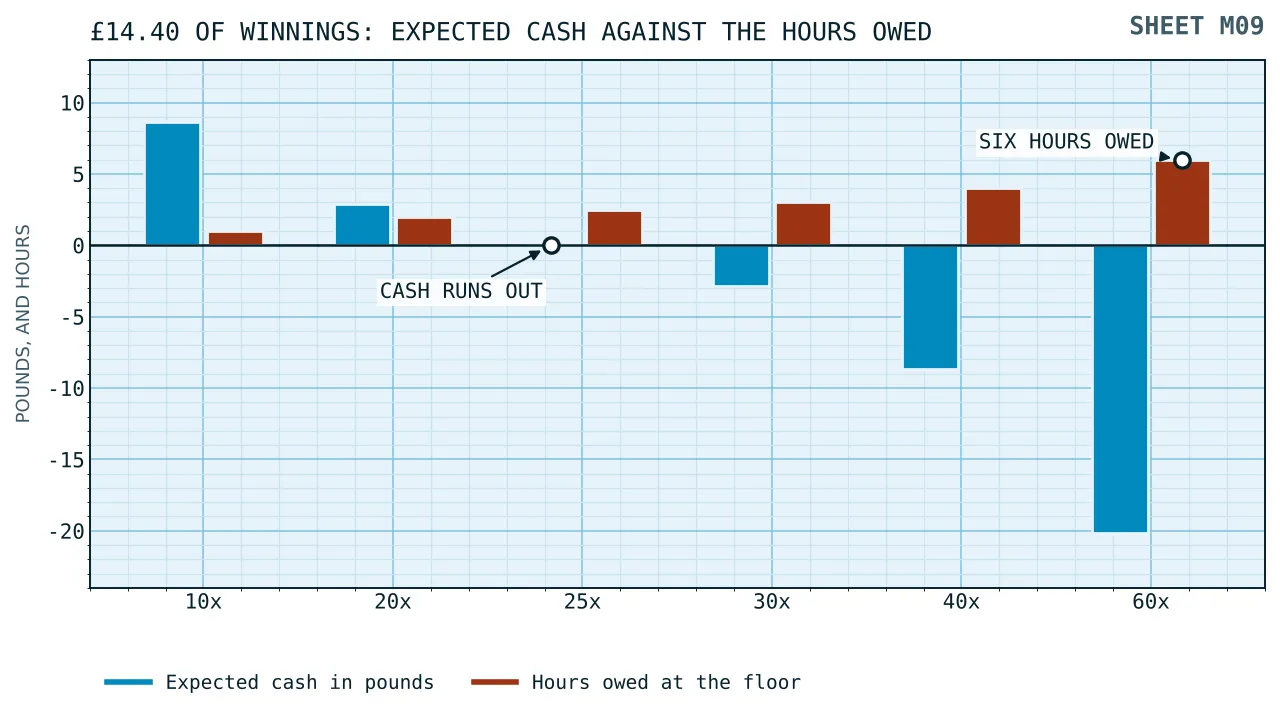
| W | Turnover to clear | House take | Expected cash | Hours at the floor |
|---|---|---|---|---|
| 10 times | £144.00 | £5.76 | £8.64 | 1.00 |
| 20 times | £288.00 | £11.52 | £2.88 | 2.00 |
| 25 times | £360.00 | £14.40 | £0.00 | 2.50 |
| 30 times | £432.00 | £17.28 | -£2.88 | 3.00 |
| 40 times | £576.00 | £23.04 | -£8.64 | 4.00 |
| 60 times | £864.00 | £34.56 | -£20.16 | 6.00 |
Nought arrives at twenty-five times and will not move, four pence levied twenty-five times over being a hundred pence. Put the expected cash at nought in the expression and the credit cancels itself, leaving a figure assembled out of the return and nothing else. A count of a hundred and fifty and a count of one reach that crossing in the same place.
Two observations the schedule invites.
The money and the hours pull in opposite directions. From the first row to the last the expected cash falls by £28.80 while the time owed rises by five hours. Every row below the third is a reader paying in hours for a total that has already reached nothing.
The ten times row is the only one where the arithmetic hands anything back, and that is the row a British licence now requires. Eight pounds sixty-four of expected cash against an hour at the reels is a different proposition from four hours against nothing, and the two are separated by a single figure in a document most readers never open.
4
Four hours, and the rules that hold them there
Four hours is not an estimate of how long somebody might take. It is the shortest a licensed site is permitted to let the obligation run, and the figure is built from one technical standard and a stake.
At 10p a cycle, £576.00 of turnover comes to 5,760 cycles. The pace is fixed from outside the terms, because 2.5 seconds must elapse from the start of a slot game before the next one may be commenced. Multiply and the obligation occupies 14,400 seconds, which is four hours to the second. The hundred and fifty cycles that were given away take six minutes and fifteen seconds of that.
Raising the stake shortens the clock and leaves the cost alone, and the law sets the limit of the shortening. The ceiling on a stake comes from a statutory instrument of 25 February 2025, which fastens a per-game-cycle limit onto every remote casino licence, those granted before it included: two pounds for anybody not yet twenty-five, and five pounds above that age. Calendar dates come from the regulator’s guidance rather than the instrument: 21 May 2025 for the two pound limit and 9 April 2025 for the five pound one. The guidance also confines both to online slots, which leaves blackjack and roulette outside. For six weeks a flat five pound ceiling applied to everybody, and that transitional spell is why the younger limit started later.
So at five pounds a cycle the same £576.00 is fewer than 116 cycles and under five minutes. At two pounds it is 288 cycles and twelve minutes. The expected cost stays at £23.04 in all three cases, because turnover is a quantity of money and the stake only decides how many pieces it arrives in.
5,760 cycles at 10p, 288 at the £2 ceiling, £23.04 either way
Two further rules stop the four hours being compressed by software rather than by stake. Automatic play is unavailable on a British licence. RTS 8A wants a fresh commitment to every game cycle, allowing one exception for peer-to-peer poker blinds that post themselves, which makes four hours into 5,760 decisions. And RTS 14E denies a customer any means of bringing a result forward, with quick spin, slam stop and turbo named in its guidance as features that cannot be offered, across remote games of every tempo.
In this bracket no Great Britain licence stands behind the cashier, and the loss can be itemised rather than merely asserted. Taking the pacing rules alone: the Curaçao responsible gaming policy sets no floor under the interval between cycles, no ceiling on a stake, and nothing against automatic play, so the four hours above are a figure that applies on one side of the licence and not the other.
5
A hundred and fifty handed over ten at a time
Counts of this size often arrive in daily pieces rather than in one lump, and the pieces leave the money untouched while changing everything about the logistics.
Split a hundred and fifty into fifteen daily tranches of ten. Each tranche is a credit of £0.96, carrying £38.40 of turnover at forty times, an expected cost of £1.54 and a shortfall of £0.58. Fifteen of those add back to £14.40 of credit and £576.00 of turnover. Not a penny has moved.
The number of deadlines has moved, from one to fifteen. Each tranche carries its own window, an unused tranche is ordinarily forfeited rather than carried into the next day, and the sixteen minutes a tranche demands at 10p a cycle have to be found on fifteen separate days. A single window of twenty-four hours would have held the whole four hours over again with room to spare. Fifteen windows of twenty-four hours each cannot be pooled.
British rules reach the shape of such an offer in two places. Any incentive must carry terms that are transparent, clear and fair, kept where a reader can lay hands on them, and that duty sits in Social Responsibility Code 5.1.1. The same provision bars a licensee from reducing what an incentive pays where the qualifying activity is completed in under the full offer period. That limb is the one written for a schedule of instalments, since a player who finishes early should not lose part of what was awarded.
A drip also runs into the product rule. From 19 January 2026 an incentive may not span two of the gambling products the provision lists: lottery, bingo, casino and betting. A hundred and fifty cycles alongside a deposit match stays inside casino, because slots are a casino product and a match on a casino deposit is too. A hundred and fifty cycles alongside bingo tickets spans two products and is caught. That reading comes straight off the rule’s own list of four.
Bonuses get two lines in the Curaçao policy and no third: transparent communication with clear terms, and no aggressive promotion of excessive play. Nothing in it touches an incentive whose value is altered partway, nothing puts a ceiling on a multiple, and no accessibility standard is attached to the terms at all. A fifteen-day drip is therefore a structure that British rules constrain in two specific ways and the offshore rulebook does not constrain at all.
The sheet that prices a drip as its subject rather than as a variation is free daily spins, where the window rather than the count is the thing doing the work.
6
Contribution, and what it does to the clock
Every figure so far has assumed a staked pound counts as a pound towards the requirement. Where a cabinet counts for less, the requirement itself is unchanged and the turnover needed to discharge it multiplies, which on a count this size pushes the hours into a different bracket altogether.
Suppose a cabinet counting thirty pence of each pound staked. Forty times £14.40 is still £576.00 of contribution owed. Earning it calls for £1,920.00 of turnover, whose expected cost is £76.80, so the shortfall against a credit of £14.40 moves from £8.64 to £62.40.
E = £14.40 × (1 – (40 × 0.04) / 0.30)
E = £14.40 × (1 – 5.3333)
E = -£62.40
The hours go the same way. £1,920.00 at 10p is 19,200 cycles, and the floor between them turns that into 48,000 seconds: thirteen hours and twenty minutes, which no window of a single day can hold.
Now return W to ten, the figure a British licence allows, and keep contribution where it is. Contribution owed falls to £144.00, turnover to £480.00, cost to £19.20, and the expected cash to -£4.80. A requirement at the regulated ceiling still prices below nought once a third is all that counts, which is the point of this part: the ceiling was drawn around the multiple, and nothing has been drawn around the weighting.
The thirty per cent has to be labelled for what it is. The rate comes from a consultation response, in which a respondent described thirty pence of every wagered pound going towards a requirement, and weighting was recorded and then left unregulated. Nobody publishes the rates currently applied, so the figures in this part are this site’s own sums laid over a rate that came from elsewhere. Weighting is taken as the subject on slots free spins.
£1,920.00 of turnover for £576.00 of contribution, at thirty pence to the pound
7
What a licence adds beneath the arithmetic
None of the arithmetic above depends on who holds the licence. The protections under it do, and on a count this size the ones worth naming are the ceiling on the multiple and the machinery around stopping.
The ceiling on the multiple
The ceiling a British licence imposes on W is ten, and it has stood since 19 January 2026. The provision’s own description of a wagering requirement is wagers totalling a stated value, reached before any funds can be drawn out, and its reach covers all licences bar gambling software and gaming machine technical, which is every remote casino licence issued in Britain. On £14.40 of credit it means £144.00 of turnover, £5.76 of cost, and £8.64 of expected cash. Sixty times, which the regulator cited as being in use before the ceiling arrived, would be £864.00 of turnover and a shortfall of £20.16.
The ceiling is written about bonus funds, and that wording is the whole of its reach. It is unpublished whether a free cycle constitutes bonus funds on its own account, and unpublished in both directions. The sound statement is the narrow one: winnings from a cycle that land as bonus funds carry a requirement of no more than ten times.
Stopping, and who makes it easy
An obligation running to four hours, or to thirteen, is an obligation somebody may want to walk away from in the middle. Here the two regimes are closer than a reader might expect, and in one place the offshore rulebook is stricter.
A British licensee has to offer financial limits that a customer can set from the point of registration onwards, has to prompt for one during registration or at the first deposit, and has to present setting a limit as the default, which means a customer who declines must take an action to decline and confirm it before going on to gamble. The durations on offer must take in a month, a week and twenty-four hours. A reduction is implemented immediately. An increase cannot take effect until a day has elapsed and the customer has returned to confirm that they still want it. Where two periods overlap the tightest limit governs, and the regulator’s worked example sets a daily limit of ten pounds against a weekly one of a hundred, with the result that the system must allow seventy pounds in a week and ten in a day.
The Curaçao policy requires cooling-off periods of three months, one month, seven days or twenty-four hours, reachable on a single button without an email and without the operator’s approval, with immediate effect, and a player may choose which product vertical it covers. It forbids an operator from discouraging a player who asks for one, and the forbidden methods are named: querying the decision, offering reassurance to postpone it, and holding out bonuses or promotions as an incentive to carry on playing. That last one is a bonus rule, and the British rulebook has no sentence quite like it.
On deposit limits Curaçao is the stricter of the two on one point. A reduction there is immediate, as it is here, but an increase waits seven days rather than twenty-four hours. Its periods are daily, weekly or monthly.
Self-exclusion runs the other way. Every British online gambling licensee belongs to Gamstop Online because the licence makes it a condition, and the scheme is plain about the limit: a registered person cannot be kept away from gambling offered by organisations outside the scheme. The choices at registration are six months, one year, five years, or a five-year term that renews itself, and a registration stays in force until its minimum period has expired. Curaçao requires exclusion at one operator and across that operator’s domains, with a year as the shortest term and three, five and ten years and a lifetime also on offer, and an exclusion there cannot be revoked by the player before it expires. Nothing on this sheet helps anybody past a block they have set, and the help numbers are at the foot.
The scale of the scheme is published. A release of 16 July 2026 recorded 614,738 people on the Gamstop Online register, sign-ups 16 per cent higher across the year’s first six months, and a monthly record of 12,236 reached in May 2026.
8
The working, per ten cycles
No term in the expression depends on the count, so the whole sheet reduces to a rate that can be multiplied up.
| Quantity | Per 10 cycles |
|---|---|
| On the front | £1.00 |
| Average winnings | £0.96 |
| Turnover to clear | £38.40 |
| House take on it | £1.54 |
| Shortfall | £0.58 |
| Minutes at the floor | 16 |
Multiply that column by the count divided by ten. Fifteen times it gives the hundred and fifty worked above. Twenty times it gives two hundred. Half of it gives five. The rate is the finding and the pounds are the illustration.
Three things the rate does not tell anybody.
It is a long-run average rather than a forecast of an afternoon. The £8.64 left by ten times on this credit marks the middle of a broad spread, whose most frequent single outcome is nothing at all. The expression is honest about repetition and silent about one sitting.
It prices the requirement and nothing else in the document. A ceiling on the credit’s winnings, a discretion the operator has kept back, or a threshold a claim must clear before anyone hears it: all of those are outside the brackets, and any one of them can bring the total to nothing while W stands still.
And it uses whichever figures it is given. Take the window, any limit on winnings, the contribution rate and W off the terms in front of you, run them through part 2, and what comes out belongs to you instead of to this sheet. Other counts are priced the same way: 100 free spins no deposit runs two-thirds of this one, 200 free spins runs four-thirds of it, and the same count on a named game is priced at 150 free spins on Book of Dead, which carries that game’s own published return. Every sheet in the section sits in the index at The multiple.
Questions
- What are 150 free spins with no deposit worth?
- Fifteen pounds as advertised and £14.40 of average winnings at 10p a cycle on a 96 per cent cabinet. A forty times requirement then demands £576.00 of turnover, costing an expected £23.04. The cost runs £8.64 beyond the credit, which is therefore exhausted, and the total at the foot is £0.00.
- At what requirement does a count of 150 come to nothing?
- Twenty-five times, where the cabinet returns 96 per cent. Four pence levied twenty-five times over comes to a hundred pence, which is the whole of a pound of credit. Below twenty-five something survives: £8.64 at ten times, £2.88 at twenty. Above it the requirement costs more than it was attached to.
- How long does a 150 spin play-through take?
- Four hours to the second at 10p a cycle, on a site holding a British licence. The £576.00 of turnover is 5,760 cycles, and 2.5 seconds must pass from the start of one slot game before the next may begin. The hundred and fifty free cycles themselves run for six minutes and fifteen seconds.
- Would a larger stake clear the requirement faster?
- Faster, yes, and no cheaper. Turnover to clear is an amount of money, so a bigger stake delivers the same £576.00 in fewer cycles at the same £23.04 of expected cost. Under five minutes of play at the five pound slot ceiling, about twelve at two pounds, and the total at the foot does not move.
- What changes if the 150 arrive ten a day?
- The money stays put and the deadlines multiply by fifteen. A tranche of ten is a credit of 96p with £38.40 of turnover and a 58p shortfall, and fifteen of them add back to the same totals. The difference is fifteen windows instead of one, sixteen minutes of play owed on each of fifteen days, and an unused tranche usually gone rather than carried.
- Can free spins be bundled with bingo tickets in one offer?
- Not under a British licence since 19 January 2026. An incentive may not span two of the products the provision names: betting, casino, bingo and lottery. Spins beside a casino deposit match stay inside one product, because slots are a casino game. Put bingo tickets beside the spins and the offer spans two products, which the rule catches.
- On this count, what is a 30 per cent contribution rate worth?
- It takes the shortfall from £8.64 to £62.40. Contribution owed is still £576.00, but thirty pence in the pound means £1,920.00 of turnover to earn it, at a cost of £76.80. Four hours becomes thirteen hours and twenty minutes. Even the regulated ten times prices at minus £4.80 at that rate.
- Is it easier to stop at an offshore casino or a British one?
- On cooling-off the offshore rulebook is specific. Curaçao requires periods of three months, a month, seven days or a day, reachable on one button with neither an email nor the operator’s consent, and it forbids an operator from dangling bonuses or promotions to talk a player out of using them. On deposit limits it waits seven days before an increase where Britain waits twenty-four hours.
- Does Gamstop cover a site without a British licence?
- No, and the scheme says so itself. Membership follows from holding a British licence, and the scheme publishes the limit itself: it cannot block gambling offered by organisations that are not participants. Figures for 16 July 2026 put the register at 614,738 people, a rise of 16 per cent across the year’s first six months.
- Which protections does an offshore count not come with?
- A ceiling of ten times on the requirement, the rule against one incentive spanning two products, the slot stake ceilings of two pounds and five pounds, the bars on automatic play and on turbo, and the 2.5 seconds that have to pass between slot cycles. The Curaçao policy consulted for this site contains none of them, and gives bonuses two sentences in total.