
Sheet R14 Revision 1 Checked 15 October 2026
Apple pay casino
Twenty-five pounds sent from a phone arrives as £25.00, with nothing taken on the way and no line on the banking page. On this rail the debit is not a fee of any kind. What it is instead is whatever stands behind the token, and where that is borrowed money the deposit costs £2.28 over a quarter while still arriving whole.
£0.00 charged to arrive, £2.28 charged behind the token
What stands behind a token, priced
Every destination on this spike is bought advertising. The site takes a fee if a reader goes on to register, and no figure printed below moves because of it.
The Spin Sheet
Till receipt No 01
Betportal
Lowest multiple here
For every €1 of spin credit at face per €1
Credit
Debit
No Great Britain licence
Licensed in Anjouan, Comoros, run by BetPortal Gaming Ltd, with Excite Ultra Media Ltd, reference ALSI-202601040-FI2.
Terms read 15 October 2026
Open the offer at Betportal, opens in a new tabThe Spin Sheet
Till receipt No 02
WinBeast
Five staged matches
For every €1 of spin credit at face per €1
Credit
Debit
No Great Britain licence
Licensed in Curaçao, operator not named on the site.
Terms read 15 October 2026
Open the offer at WinBeast, opens in a new tabThe Spin Sheet
Till receipt No 03
EliteSpin
Longest spin window
For every £1 of spin credit at face per £1
Credit
Debit
No Great Britain licence
Licensed in Costa Rica, run by PrimeTier Limited.
Terms read 15 October 2026
Open the offer at EliteSpin, opens in a new tabThe Spin Sheet
Till receipt No 04
Crown Jewelz
Multiple unpublished
No total struck
Credit
Debit
No Great Britain licence
Licensed in Curaçao, number not verified, operator not named on the site.
Terms read 15 October 2026
Open the offer at Crown Jewelz, opens in a new tabThe figure at the foot of a receipt is this site's own arithmetic and nothing an operator has published: the credit, less the share a spin gives back at 96 per cent return to player, less what playing the wagering through costs at the same return. It describes the offer, not one reader's afternoon. Where the conditions price above the credit the receipt prints nothing rather than a negative sum, and where a figure the sum needs is unpublished it prints the condition in the operator's words instead.
Three words stand in the amount column where no figure can. Noted is a published condition that takes value away without leaving the sum a figure to take. Unpriced is a condition whose figure nobody has published, or a credit that is not a sum until a deposit of your own sets it. Own money is money of yours, which is never part of a total.
Not one of the operators printed above holds a Great Britain licence, so the duties that licence carries do not reach them. Every online gambling company licensed in Great Britain has to be part of Gamstop Online, and a reader who has shut themselves out through the scheme is therefore not shut out here. The ceiling of ten times the bonus funds on a wagering requirement, in force since 19 January 2026, is a condition of that licence and binds the companies that hold one. Where a dispute goes instead is a matter for the authority named on the receipt, and the Gambling Commission describes what a reader faces without a British licence as a lack of recourse if things go wrong. Nobody under 18 may hold an account at any of them.
Every term printed on a receipt is the operator's own, and each receipt carries the day it was read. The oldest of those readings is 15 October 2026. What binds a reader is the operator's own full terms, and not a line printed here.
1
A deposit that arrives whole
Nothing is charged by the wallet, nothing is converted, and the figure the cashier shows is the figure that left the account. That makes this the cleanest entrance in the whole section, and it is why the page spends its time on two conditions rather than on three charges.
The first condition is eligibility, which decides whether the deposit counts towards an offer at all. The second is the instrument under the token, which decides what the deposit costs after it has arrived. So the arithmetic of arriving is unusually simple here and the arithmetic of what is underneath is not.
A debit card under a token behaves like a debit card: the money is the account holder’s and the cost of using it is nothing. Borrowed money behaves like borrowed money, and the cost arrives later, on a statement, with no connection to the cashier that benefited from it.
Two figures are modelled for that case and both are this sheet’s own: a handling charge of 3 per cent when the money is drawn, and 2 per cent a month on the balance afterwards. No regulator publishes either, and a lender revises its own whenever it likes, so replace them with the figures on your own agreement.
Three things have to be true before a token deposit is worth making, and only the first is visible on the cashier’s pages:
- The cashier accepts the wallet.
- The deposit qualifies for the offer attached to it.
- The instrument behind the token costs nothing to use.
2
What the token is standing on
A phone is not a payment method, which is the first thing to settle before any of this is useful. What the phone does is present a token, and the token draws on a card or an account held somewhere else.
A cashier is paid by that card. The bonus terms are written about that card. An exclusion list, where there is one, names that card. So the question a reader has is not whether the cashier takes the wallet but what the wallet is standing on, and the answer to the second question is in a banking app rather than on a casino page.
There is a second gate here as well, and it is worth naming because it is easy to miss on a device that opens with a fingerprint. A card issuer may decline a gambling payment on its own account, and a device wallet does not override an issuer. Two parties therefore have to agree before £25.00 moves, and a refusal by either looks identical on the screen.
Where a refusal was asked for, by the account holder or through a blocking tool, it is doing precisely what it was installed to do. This sheet has nothing to offer anybody looking to get round one, and where to find free help is printed below.
3
Twenty-five pounds at four multiples
Arrival is settled. What remains is the condition, and the expression that strikes it is the house one.
E = B × (1 – (W × (1 – RTP)) / g)
£25.00 is B here, matched in full and arriving whole. RTP is 0.96, g is one with slots at full weight, and W is whatever the terms say.
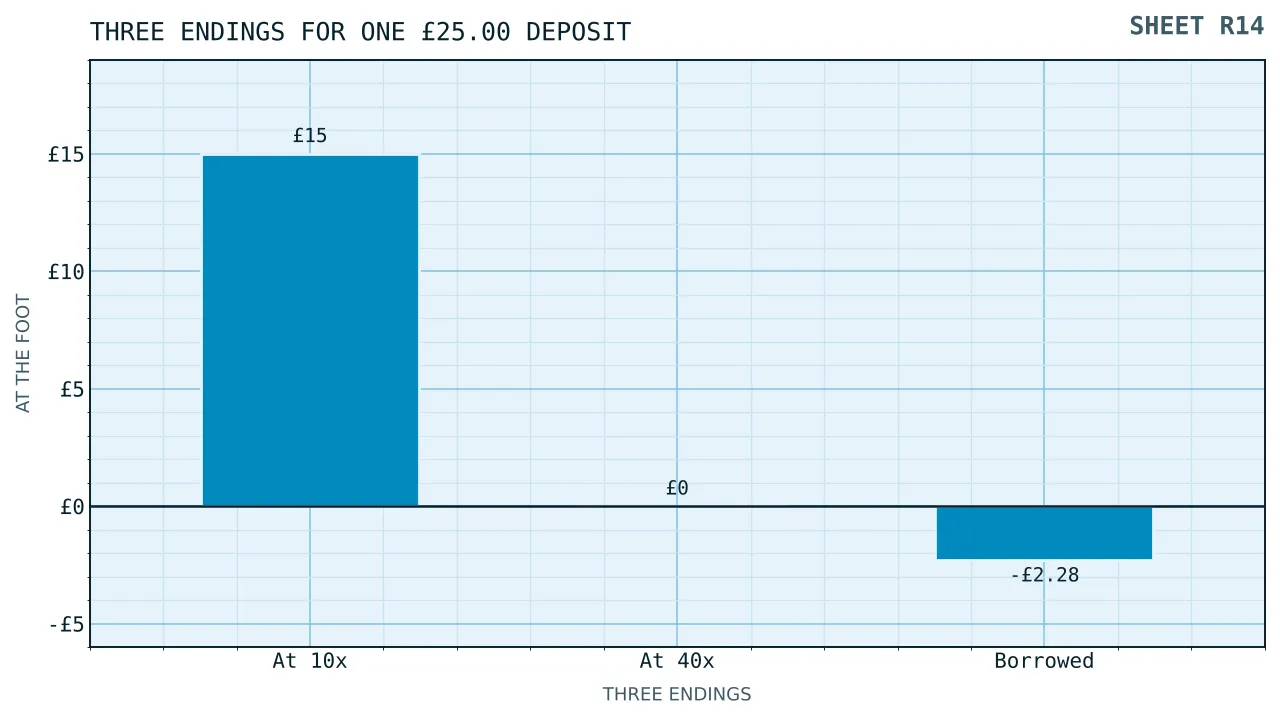
At the British ceiling of ten: ten fours are forty pence in the pound of edge, the bracket holds 0.60, and £15.00 is six-tenths of £25.00. Turnover of £250.00 is owed, and the expected cost of getting through it is £10.00.
At forty, the turnover owed is £1,000.00, the expected cost £40.00, and £15.00 of overrun sits behind a nought. Nought arrives at twenty-five times on any credit, because the multiple that cancels a bonus is one over the house edge.
| Multiple | Staking asked | At the foot | Expected cost |
|---|---|---|---|
| Ten times | £250.00 | £15.00 | £10.00 |
| Twenty times | £500.00 | £5.00 | £20.00 |
| Twenty-five times | £625.00 | £0.00 | £25.00 |
| Forty times | £1,000.00 | £0.00 | £40.00 |
The free entrance has bought a condition worth up to £15.00 and no more. That is the ceiling on this rail’s usefulness, and it is set by the multiple rather than by the phone.
4
Borrowed money cannot buy gambling in Britain
Borrowed money cannot buy gambling at a British licensee. The prohibition has stood since 14 April 2020 and it covers a card used at one remove, through a money service business, so putting an intermediary in the chain does not reopen the route.
The licences it binds run from betting intermediaries, pool betting and general betting on the non-remote side through to every remote licence, with the ancillary remote lottery and betting ones caught as well. What it leaves out is the technical end of the industry, the machine, software and host licences, none of which takes a deposit from a player.
Away from that register the limb is simply absent, so the token may stand on anything the issuer will allow. Which is where the £2.28 comes from, and the £2.28 is the one cost on this page that no casino document will ever print.
On £25.00 the handling charge is £0.75 and the first month’s interest is £0.50. Carry the balance a quarter and the interest compounds to £1.53, so the whole cost of the deposit is £2.28, which is 9.12 per cent of a sum that arrived with nothing deducted.
£2.28 on a quarter’s borrowing, 9.12 per cent of £25.00
Set it against what the offer is expected to be worth and the proportions become the point. At ten times, £25.00 of credit is expected to leave £15.00, so a quarter of borrowing has taken 15.2 per cent of the expectation before the first spin. At forty times the expectation is nought, so the borrowing is the whole of the result: minus £2.28 and nothing on the other side of the line.
5
The threshold that watches the deposit
A British cashier watches the size of a deposit as well as the instrument behind it, and the watching has a figure attached to it.
A monthly net-deposit threshold triggers the lighter financial checks. The opening figure, in force from 30 August 2024, was five hundred pounds a month. Since 28 February 2025 the threshold has read a hundred and fifty.
Which is close enough to this page’s deposit to be worth working. Four deposits of £25.00 inside a month is £100.00 and sits under that threshold; six of them is £150.00 and reaches it. A reader who tops up from a phone because it takes two seconds should know that the second of those patterns is a different regulatory animal from the first, and that the figure counted is the net deposit rather than the turnover.
The heavier assessments are a separate exercise and remain a pilot, kept out of any live environment, with the regulator stating that no consumer is affected while it runs. Neither the light-touch checks nor the pilot touches a credit rating, which the regulator says in terms.
None of this machinery exists on the offshore side. A threshold is a licence condition, and the island rulebook read for this build sets no deposit threshold of any kind, so six deposits and sixty are the same event there.
6
The spins attached, priced at 10p
Spins attached to a deposit of this size are priced the same way as everything else on this site. A round of twenty-five spins at 10p carries £2.50 of face value, and 96 pence back in the pound makes the average winnings £2.40.
Forty times on £2.40 asks for £96.00 of turnover and costs £3.84 in expectation, so the spins are expected to leave nothing at all. Ten times on the same £2.40 asks £24.00 of turnover, costs £0.96, and is expected to leave £1.44.
No primary source fixes what a spin is worth, so the 10p is this site’s working figure and not a rule. Nor is it published whether the winnings of a free spin are bonus funds for the purposes of the ten-times ceiling. The sourced statement is narrower than that and still useful: where those winnings are credited as bonus funds, the requirement fastened to them is capped at ten times at a British cashier.
What a licensed operator does owe is enough information to judge a chance of winning before the commitment is made. Four things are named as satisfying that: how prizes get allocated and winners determined, the probability of a winning event, the house margin, or the return percentage. An or sits between them, which is why a licensee can meet the standard without ever printing a return percentage.
Which matters on a page that works at 96 per cent. The 96 is this site’s assumption, held steady so that eighty-five sheets agree with one another, and a reader who finds a published figure for the game in front of them should put that figure into the same line instead. At 94 per cent the edge is six pence, the multiple that cancels a credit falls from twenty-five to about seventeen, and £2.40 at forty times is further under water than it was before.
7
What the licence was holding up
Out here the offer carries no Great Britain licence, and each loss can be itemised rather than gestured at.
The ten-times ceiling goes, which on this credit is the gap between £250.00 and £1,000.00 of turnover. The bar on taking payment from borrowed money goes, which on a quarter’s borrowing is the £2.28 this page has priced. The deposit threshold that triggers a financial check goes, so the hundred and fifty pounds a month is nobody’s business out there. Identity before the first spin goes, and with it the rule that documents may not be demanded at a payout where they could have been asked for earlier.
A British licensee settles identity before any play, and the rule reaches a bonus round and a no-stake demonstration game as surely as a staked one. The island rulebook read for this build withholds both staking and depositing until an operator has satisfied itself on age, and parks documentary identity at its own money-laundering milestones. A deposit made from a phone in four seconds is a poor match for a check that may not arrive until a payout is requested.
Membership of the national blocking scheme goes too, since a British licence is the only thing that compels it, and the scheme itself says it cannot reach a company that is not a member. No sentence here assists anyone in getting round a block; the help line sits at the foot of the sheet.
One duty does travel. The duty on remote gaming follows the player’s ordinary home rather than the operator’s paperwork, takes its charge from the operator’s profit, and has read 40 per cent since April 2026. Revenue crosses the water and protection does not, which is the offshore position stated as plainly as this sheet can state it.
8
Four readings, two of them in a bank app
Four readings settle this rail, and two of them are in a banking app rather than on the cashier’s pages.
| Reading | This deposit |
|---|---|
| Sterling that left the account | £25.00 |
| Figure the cashier credited | £25.00 |
| Cost of the instrument behind the token | £2.28 a quarter |
| Multiple in the bonus terms | 40x |
Subtract the first reading from the second and the cost of arriving appears, which on this rail is nothing at all. Multiply the second by the fourth and you have the turnover owed. A twenty-fifth of that figure is what producing it is expected to cost. The third reading is the one nobody takes, and on a quarter of borrowing at the rates modelled here it is worth £2.28.
Every expectation on this sheet is an average across many attempts, and one attempt at a bonus usually ends at nothing. A handling charge and a month of interest are not averages. They are dated entries on a statement, and they arrive whether the spins went well or badly.
Neighbouring sheets, same family of question: google pay casino for the other device wallet and the exit that cannot come back the same way, credit card casino for the instrument this page prices from the outside, and visa casino for the debit card under the token. The section is indexed at The rail, sheet by sheet.
Questions
- Does a phone wallet deposit arrive in full?
- Ordinarily it does. Twenty-five pounds sent from a phone is credited as £25.00, with no conversion, no carriage and no line on the banking page, which makes it the cleanest entrance in this section. The cost sits behind the token instead of inside it, and the two things worth establishing are whether the deposit qualifies for the offer and what instrument the token is drawing on.
- What does this rail actually cost, then?
- Whatever stands behind the token. A debit card costs nothing to use, so the rail is free. Borrowed money costs what the agreement says: on the figures modelled here, a handling charge of 3 per cent is £0.75 on £25.00, a month at 2 per cent is £0.50, and a quarter compounds to £1.53, making £2.28 in all, or 9.12 per cent of a deposit that arrived with nothing deducted.
- Can borrowed money fund a casino deposit in Britain?
- Not at a cashier licensed in Britain. Borrowed money has been barred from buying gambling since 14 April 2020, and the bar reaches a card used at one remove through a money service business, so an intermediary in the chain changes nothing. The licences caught run from betting intermediaries, pool betting and general betting on the non-remote side through to every remote licence. Away from that register the bar is simply absent.
- What is a £25.00 match worth at forty times?
- Nothing. Forty lots of £25.00 is £1,000.00 of turnover, which at four pence in the pound costs £40.00 in expectation, and £40.00 against £25.00 of credit leaves nought with £15.00 of overrun behind it. A British cashier may ask ten times and no more, a limit dated 19 January 2026, and ten times asks £250.00 of turnover at a cost of £10.00 and leaves £15.00 on the expectation.
- What do twenty-five free spins add to it?
- At 10p a spin, £2.50 of face value and £2.40 once the 96 per cent return has been applied. Forty times on that £2.40 wants £96.00 of turnover and costs £3.84, so the round is expected to leave nothing; ten times wants £24.00, costs £0.96, and leaves £1.44. No primary source fixes what a spin is worth, so the 10p is this site’s working figure rather than a rule.
- Will topping up from a phone trigger a financial check?
- Only above a threshold, and only at a British cashier. The lighter financial checks begin above a monthly net-deposit figure that opened at five hundred pounds a month on 30 August 2024 and has read a hundred and fifty since 28 February 2025. Four deposits of £25.00 in a month is £100.00 and stays under it; six is £150.00 and reaches it. The heavier assessments remain a pilot, kept out of any live environment, and the regulator’s own position is that a credit rating is untouched by either exercise.
- Why was my wallet payment refused?
- Two parties have to agree before the money moves, and this page cannot tell you which of them refused. A card issuer may decline a gambling payment on its own account, and a device wallet does not overrule an issuer. Where the block was asked for deliberately, by the account holder or through a blocking tool, it is working as intended and nothing here is written to help get past it.
- Must a licensed game show me its return to player?
- Not necessarily that figure. What is owed is enough information to judge a chance of winning before the commitment is made, and four things are named as satisfying it: how prizes get allocated and winners determined, the probability of a winning event, the house margin, or the return percentage. An or joins them, so a licensee can comply without printing a percentage. This site works at 96 per cent as a standing assumption, and a published figure for the game in front of you should replace it.
- What am I without at an offshore cashier taking this wallet?
- At the loose end of this market the offer carries no Great Britain licence, and the losses are itemisable. The ten-times ceiling goes, which on this credit is the gap between £250.00 and £1,000.00 of turnover. The bar on paying with borrowed money goes, worth £2.28 on a quarter at the rates modelled here. The deposit threshold that triggers a financial check goes. Identity before the first spin goes. And so does membership of the national blocking scheme, which only a British licence compels.