
Sheet F01 Revision 1 Checked 15 October 2026
1 pound deposit casino
One pound buys ten cycles at 10p apiece and 96p of average winnings. Set a flat 50p handling charge beside it and half the deposit is gone before a reel turns. Match the pound in full and forty times leaves nothing of the credit, while the British ceiling of ten would have left 60p.
10 cycles bought, 96p expected back, 50p a charge can take first
What the smallest sum on the sheet is worth
Every destination on this spike is bought advertising. The site takes a fee if a reader goes on to register, and no figure printed below moves because of it.
The Spin Sheet
Till receipt No 01
Betportal
Lowest multiple here
For every €1 of spin credit at face per €1
Credit
Debit
No Great Britain licence
Licensed in Anjouan, Comoros, run by BetPortal Gaming Ltd, with Excite Ultra Media Ltd, reference ALSI-202601040-FI2.
Terms read 15 October 2026
Open the offer at Betportal, opens in a new tabThe Spin Sheet
Till receipt No 02
WinBeast
Five staged matches
For every €1 of spin credit at face per €1
Credit
Debit
No Great Britain licence
Licensed in Curaçao, operator not named on the site.
Terms read 15 October 2026
Open the offer at WinBeast, opens in a new tabThe Spin Sheet
Till receipt No 03
EliteSpin
Longest spin window
For every £1 of spin credit at face per £1
Credit
Debit
No Great Britain licence
Licensed in Costa Rica, run by PrimeTier Limited.
Terms read 15 October 2026
Open the offer at EliteSpin, opens in a new tabThe Spin Sheet
Till receipt No 04
Crown Jewelz
Multiple unpublished
No total struck
Credit
Debit
No Great Britain licence
Licensed in Curaçao, number not verified, operator not named on the site.
Terms read 15 October 2026
Open the offer at Crown Jewelz, opens in a new tabThe figure at the foot of a receipt is this site's own arithmetic and nothing an operator has published: the credit, less the share a spin gives back at 96 per cent return to player, less what playing the wagering through costs at the same return. It describes the offer, not one reader's afternoon. Where the conditions price above the credit the receipt prints nothing rather than a negative sum, and where a figure the sum needs is unpublished it prints the condition in the operator's words instead.
Three words stand in the amount column where no figure can. Noted is a published condition that takes value away without leaving the sum a figure to take. Unpriced is a condition whose figure nobody has published, or a credit that is not a sum until a deposit of your own sets it. Own money is money of yours, which is never part of a total.
Not one of the operators printed above holds a Great Britain licence, so the duties that licence carries do not reach them. Every online gambling company licensed in Great Britain has to be part of Gamstop Online, and a reader who has shut themselves out through the scheme is therefore not shut out here. The ceiling of ten times the bonus funds on a wagering requirement, in force since 19 January 2026, is a condition of that licence and binds the companies that hold one. Where a dispute goes instead is a matter for the authority named on the receipt, and the Gambling Commission describes what a reader faces without a British licence as a lack of recourse if things go wrong. Nobody under 18 may hold an account at any of them.
Every term printed on a receipt is the operator's own, and each receipt carries the day it was read. The oldest of those readings is 15 October 2026. What binds a reader is the operator's own full terms, and not a line printed here.
1
Ten cycles, and what they hand back
Divide a pound by the price of a cycle and the answer is the whole of what the deposit buys. At the 10p this site works at throughout, one pound is ten cycles of a slot and not an eleventh.
A game returning 96 per cent hands back 9.6p for every 10p that crosses it, so ten cycles average 96p of winnings and the toll on the pound is 4p. That toll is the only honest cost in the arrangement, and at this size it is the smallest number on the sheet. Everything that follows is larger.
Which is the finding this section exists for. A pound is not a small version of a tenner. It is the deposit at which every cost that was quoted as a flat sum stops being a rounding error and starts being the arithmetic.
Held fixed on this sheet:
- A cycle priced at 10p, so a pound buys ten of them.
- Slots returning 96 per cent, which makes the expected toll 4p on the pound.
- Forty times for the multiple, a requirement of that weight being usual in terms drawn up outside British supervision, and ten set next to it because a licensee may go no higher.
- Slots counting at their whole value towards a requirement, so g stands at one.
2
A charge does not shrink with the deposit
Here is the arithmetic that gives this section of the site its name. A percentage cost falls as the sum falls. A fixed cost does not, so its weight climbs as the deposit drops, and at the floor it arrives before the division rather than after it.
Work it with a flat 50p. On a £25.00 payment that is two per cent and nobody would notice. On £10.00 it is five per cent. On £5.00 it is a tenth. On the pound this sheet is about, it is half the money, and half the money is five cycles rather than ten.
No source behind this site records what any cashier takes for handling a payment, and a figure of that kind would not stay current if it did, so the charge here is modelled at three sizes rather than quoted. All three do the same thing. They come off the top, they do not scale, and the count of cycles falls with them.
| Paid in | Share the 50p takes | Cycles without it | Cycles after it | Cycles lost |
|---|---|---|---|---|
| £1.00 | 50.0% | 10 | 5 | 5 |
| £3.00 | 16.7% | 30 | 25 | 5 |
| £5.00 | 10.0% | 50 | 45 | 5 |
| £10.00 | 5.0% | 100 | 95 | 5 |
| £25.00 | 2.0% | 250 | 245 | 5 |
What holds steady in that schedule is not the percentage but the cycles. Five of them go missing at every size, which is the whole behaviour of a fixed sum: the shortfall in cycles stays put while the shortfall in proportion moves. Five of ten is a different event from five of two hundred and fifty, and only one of them changes what the evening consists of.
A flat 50p is 50.0% of a pound and 2.0% of £25.00
Push the charge a little further and the sum stops working altogether. A handling figure of £1.50 is larger than the deposit it is attached to, so a pound sent against it buys nothing whatever, and the shortfall has to be met from a second payment before any play begins. That is the shape of cost this section is built to catch, and it cannot happen at any deposit worth the name.
3
The stake that will not go lower
A charge is one way for a fixed sum to eat a pound. The other is the smallest stake a game will accept, which does its damage by dividing rather than subtracting.
Ten cycles is what the pound buys at 10p. Where a game will not run below 20p, the same pound is five cycles. At 25p it is four, at 50p it is two, and at a pound a cycle the entire deposit is one pull of a single lever.
| Smallest stake a game takes | Cycles in £1.00 |
|---|---|
| 10p | 10 |
| 20p | 5 |
| 25p | 4 |
| 50p | 2 |
| £1.00 | 1 |
Nothing in the British rulebook sets a floor under a stake. What it sets is a ceiling, and the ceiling is statutory: an instrument made on 25 February 2025 writes a limit into every remote casino licence, including the ones issued before it, so that no individual may stake more than £5.00 on a single game cycle, or more than £2.00 where that individual is under twenty-five. Those apply to online slots and to nothing else, roulette and blackjack among the games left out. Calendar dates for the two ceilings, the ninth of April 2025 for the larger and the twenty-first of May for the smaller, come from the regulator’s guidance; the instrument itself prints a six-week formula and no date at all.
So a reader depositing a pound is nowhere near the regulated ceiling and has no regulated protection against the opposite problem. Where the smallest stake on offer is 50p, two cycles is the whole of the evening, and no rule anywhere says otherwise. The same gap runs through the value of a free cycle: no primary source fixes what one is worth in pence, who fixes it, or what has to be disclosed about it. It is a commercial decision, and at the floor it decides everything.
4
Sixty pence, and then nothing
Attach a full match to the pound and a second quantity appears, worth exactly as much as the condition over it allows.
The line this site runs everything through reads as follows.
E = B × (1 – (W × (1 – RTP)) / g)
Every letter on it already has a value here. B is £1.00 of matched credit, RTP is 0.96, g is one, and W is whatever the terms ask. Forty fours are a hundred and sixty, which drops the bracket to negative 0.60, and six tenths of a pound with that sign in front of it is a shortfall of 60p and not a balance.
Said as turnover instead: forty lots of a pound is £40.00 through the games, four per cent of which is £1.60 of expected cost. The credit was a pound. It runs out two thirds of the way through the condition and the last 60p of cost falls on whatever else is in the account.
Now the British maximum. The ceiling has read ten since the nineteenth of January 2026: bonus funds may not be put through the games more times than that at a licensee, under the third limb of the code provision on incentives. Ten times a pound is £10.00 of turnover, costing 40p, which leaves 60p expected. Sixty pence is therefore the whole worth of that ceiling on a matched pound, and weighing sixty pence against the trouble of claiming is the decision actually on offer.
For scale, the regulator’s own account of what it was correcting names a multiple of up to sixty times in use before the cap. Sixty times a pound is £60.00 of turnover and £2.40 of expected cost, so the overrun on a pound of credit is £1.40, which is to say more than the deposit and the credit together.
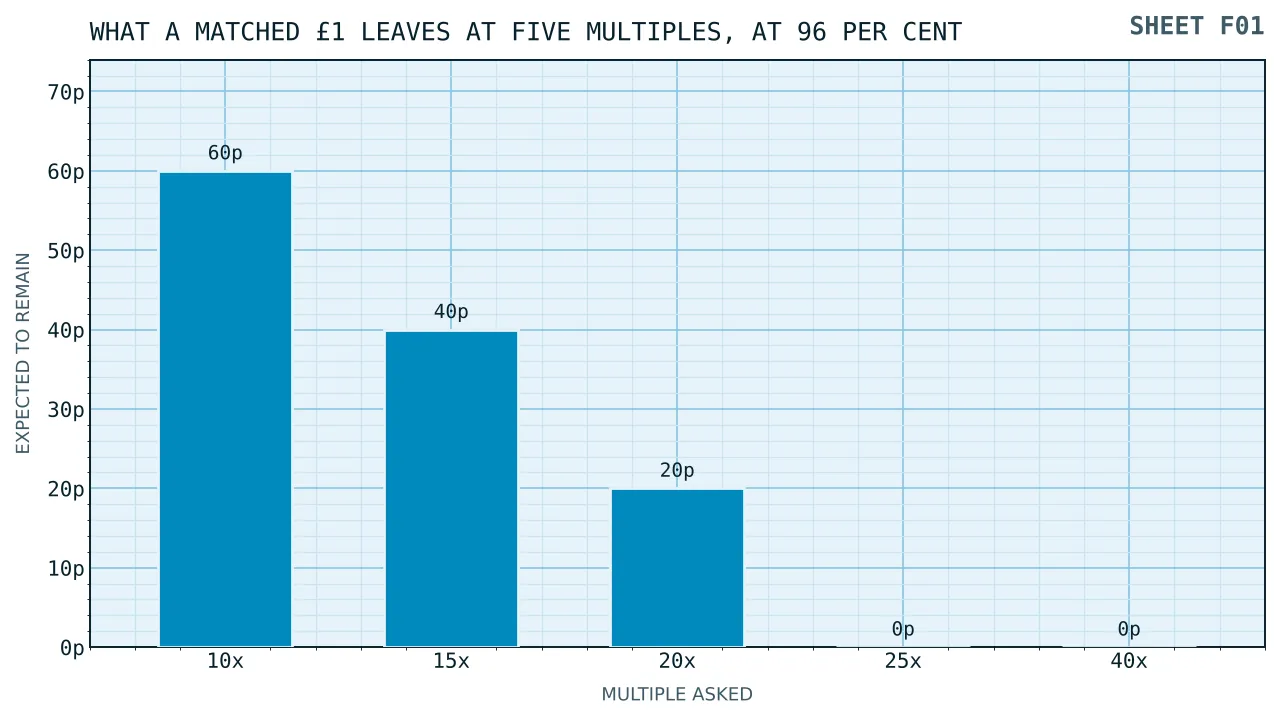
| Multiple asked | Expected to remain |
|---|---|
| 10x, the British ceiling | 60p |
| 15x | 40p |
| 20x | 20p |
| 25x | £0.00 |
| 40x | £0.00 |
Twenty-five times is where the credit is exactly consumed at this return, and the arithmetic does not care what the credit was. A pound, a fiver and fifty pounds all reach nought at the same multiple. What changes with size is how much the deficit beyond it is worth, and on a pound it is small enough to be invisible, which is precisely why the condition gets accepted.
5
Twenty-five seconds at the shortest
Ten cycles have a minimum duration under a British licence, and it is short enough to be worth writing down.
Between the start of one slot cycle and the point at which the next may begin, two and a half seconds have to pass. Ten of them therefore occupy 25 seconds at the very least, and a pound is spent inside half a minute. The standard that sets the interval carries no commencement date for the slots figure, so this sheet quotes the requirement and attaches no date to it. A date is published for the other interval, the five seconds governing casino games other than slots while leaving out poker played between customers, and the date is 17 January 2025.
Three further design rules hold the pace where it is. Commitment is owed cycle by cycle, which is what the autoplay ban amounts to, and the single published exception to it covers the posting of blinds at poker. Anything that brings the result forward is out, the guidance naming turbo, quick spin and slam stop in those words. And a return at or below the stake may not be celebrated, so a 10p cycle paying 10p back gets the figure displayed and no fanfare over it.
Why a pound makes that last rule easy to see: at ten cycles, a reader can count the results. Most of them will be nothing, several will be less than the 10p that bought them, and a licensed game is not permitted to dress the second kind up as the first kind of event. None of the three rules appears in the offshore policy consulted for this build, where the same ten cycles can be automated and finished in whatever time the software needs.
6
What must happen before a pound is taken
A one pound payment triggers the same obligations as a thousand pound one, which is the most useful thing a reader at this end of the market can know.
Identity first, and that includes a free cycle
Under the condition on customer identity, a licensee has to obtain and verify enough to establish who the customer is before that customer may gamble at all. Three items are named as a minimum and not as a limit: date of birth, then address, then name. An announcement whose rules took effect on 7 May 2019 settled how far that reaches. A stake met by the house, a bonus and a free bet alike, is covered exactly as a stake met by the customer is, and so too are the versions of a licensee’s games that carry no prize whatever, which the regulator calls not technically gambling for precisely that reason. Up to that point an age check could be finished within seventy-two hours of play starting.
The trapdoor at the other end
The same condition will not let a cashier hold a withdrawal hostage to a question it could reasonably have asked earlier. It does not stop a licensee seeking what another legal duty obliges it to seek at that moment, which is the one carve-out. Before any money goes in, the customer also has to be told which documents might be wanted, when and how to supply them.
A limit typed in, not chosen off a list
A financial limit is what the live standard makes the form propose, turning it down is a deliberate act, and the turning down has to be confirmed back before any money is deposited or staked. A free text box takes the figure, which is exactly the detail that matters at a pound: a menu whose smallest option is ten is useless to somebody paying in one. Among the durations on offer there has to be one of a month, one of a week and one of twenty-four hours. A reduction binds at once; movement the other way means a wait of a day at minimum and then a further positive step to confirm it.
Where two periods overlap, the tighter governs, and the regulator publishes the working. Ten pounds a day beside a hundred a week yields ten a day and seventy a week, because seven tens are seventy and the looser figure never gets reached. At a pound a payment that daily ceiling is ten payments, and the weekly one is seventy.
Payment, and the threshold a long way off
A credit card cannot fund any of it, and has not since 14 April 2020, the condition being written to catch the same card sent by way of a money service business too. Light-touch financial vulnerability checks begin above £150.00 of net deposits in a month, a threshold that came down from £500.00 on 28 February 2025. At a pound a time, that is a hundred and fifty payments.
7
The same pound with nothing behind it
Offers at the bottom of this market frequently come from cashiers holding no Great Britain licence, and part 6 then describes something that is not happening.
Taking the subtractions in order of what they cost a pound: the ten-times ceiling goes, so 60p of expected value on a matched pound becomes £0.00 at forty times. The stake ceiling goes, though at this deposit it was never binding. The two-and-a-half-second interval goes, and with it the ban on automation and the ban on bringing a result forward, so ten cycles need no particular time at all. Gone too is the bar on making a fuss of a return no larger than the stake that bought it. Identity before any play goes. The Curaçao rulebook behind this section puts a date-of-birth confirmation at registration in its place and defers full document checking to later money-laundering milestones. The credit-card condition goes. Membership of the scheme that handles self-exclusion nationally goes as well, that scheme’s reach being drawn by the British licence and by nothing besides.
Two sentences stand in place of the incentive rules. Bonuses and promotions are to be put across transparently and with clear terms; promotion must stop short of being aggressive enough to drive excessive play. No ceiling on a multiple appears anywhere in that policy, nothing bars one incentive from holding several product types, and no list says which conditions are to count as significant.
The British regulator has put its own description of the consequence on the record. An industry warning notice of 20 January 2025 records that unlicensed websites may carry inadequate social responsibility and anti-money-laundering controls, that they leave customers exposed to fraud, to data privacy problems and to unfair practices, and that they often target vulnerable customers including people who have excluded themselves through the national scheme. In a post of 21 October 2025 its director of enforcement and intelligence added the three absences and the consequence: age verification, safer gambling tools and secure payment systems are often missing, and consumers face unfair gaming practices, financial loss and a lack of recourse when something goes wrong.
One trap is worth naming because a pound is often spent on the strength of it. A familiar game is not evidence of a licence. The same notice records games supplied by licensed operators turning up on unlicensed websites, and the enforcement that followed is published: on 23 July 2026 a Malta-incorporated supplier agreed to pay £4.75m after the regulator found its games on six unlicensed sites reachable from Great Britain, with large volumes of visits between December 2023 and November 2024.
The check the regulator asks a player to make takes less time than ten cycles. Look for a stated licensed status, click through to the public register, and see that the activities and the website domain names recorded there match the site in front of you. The register page publishes no guidance on how to read it and carries no date, so anyone relying on it should note the day they looked.
8
Five readings on a one pound payment
Four of the five sit in the terms rather than on the banking page, and whether any of them is worth reading is settled by the opening line.
| What to establish | On a pound |
|---|---|
| Any flat charge on the way in | 50p takes half |
| The smallest stake a game accepts | 10p gives 10 cycles |
| The credit, if any, attached | £1.00 matched |
| The multiple written over it | 40x, or 10x licensed |
| What survives the condition | £0.00, or 60p at 10x |
Lines one and two are the whole of this section’s subject, and they are the two nobody reads, because on a larger payment neither of them changes the answer. Lines three to five are the arithmetic the rest of this site is for.
And the caution that belongs under every figure here. Sixty pence is a mean across many repetitions and not a sum anybody is handed. Ten cycles of a slot carrying large rare prizes will most often return less than the 96p the average promises, and quite often nothing. The pound, by contrast, is exact: it left the account the moment it was asked for.
Three sheets sit next to this one in the same section. Thirty cycles and the gap between a cashier’s floor and an offer’s floor are priced under £3 minimum deposit casino uk, which is where a deposit large enough to be accepted turns out to be too small to qualify. Fifty cycles and the deposit at which a flat charge stops dominating are under £5 deposit casino. A hundred cycles with the whole British apparatus removed are under non gamstop casinos uk 10 deposit, priced duty by duty. Every sheet in the section is indexed at The floor, and the arithmetic itself is set out at How a receipt is struck.
Questions
- What does a £1 deposit actually buy?
- Ten cycles of a slot at 10p each, and 96p of average winnings where the game returns 96 per cent. The expected toll on the pound is 4p, which is the smallest cost in the whole arrangement. Any flat charge, any stake floor above 10p and any play-through condition is larger than that 4p, and at this size each of them is larger by a wide margin.
- Why does a 50p charge matter so much on one pound?
- Because a fixed sum does not fall when the deposit falls. Fifty pence is two per cent of £25.00, five per cent of £10.00, a tenth of £5.00 and half of £1.00. The cycles lost are the same five at every size, so the loss in cycles is constant while the loss in proportion is not, and five cycles out of ten changes the evening in a way five out of two hundred and fifty does not.
- Can a charge be bigger than the deposit?
- Arithmetically yes, and that is the shape of cost this part of the site exists to catch. A handling figure of £1.50 set against a one pound payment leaves nothing at all to play with and needs a second payment to cover the shortfall before any cycle runs. No deposit above the floor can produce that outcome, which is what makes the floor its own subject.
- What is a matched pound worth after forty times?
- Nothing, with a 60p deficit behind it. Forty lots of a pound is £40.00 of turnover, four per cent of which is £1.60 of expected cost against £1.00 of credit, so the credit is consumed about two thirds of the way through and the rest falls on the balance. At ten times, which has been a licensee’s British limit since the nineteenth of January 2026, turnover of £10.00 costs 40p and leaves 60p expected. Twenty-five times is where the credit is exactly used up, whatever its size.
- Is there any rule about the smallest stake a slot will take?
- No. The British rules fix a ceiling and leave the floor alone. A single slot cycle may not take more than £5.00, or more than £2.00 from anyone under twenty-five, a condition written into every remote casino licence by an instrument made on 25 February 2025. Guidance puts the larger ceiling in force from 9 April 2025 and the smaller one from 21 May. Those are slots limits and do not reach roulette or blackjack. Nothing published says how low a stake may go, and nothing published fixes what a free cycle is worth either.
- How long do ten cycles take?
- At least twenty-five seconds at a British licensee, because two and a half seconds have to elapse between one slot cycle starting and the next being allowed to. Automation cannot shorten it, because a separate decision is owed on every cycle, and nor can turbo, quick spin or slam stop, all three named in the guidance as not permitted. The standard carries no commencement date for the slots interval, so none is given here.
- Will a licensed cashier let me set a limit as low as a pound?
- The sum is keyed in by the customer rather than chosen from a short menu, which is the detail that makes a very small ceiling possible. A limit is what the form proposes, declining it is a deliberate step, the declining has to be confirmed back before anything is deposited or staked, and the durations run to a month, to seven days and to twenty-four hours. Where two periods overlap the tighter wins: ten pounds a day beside a hundred a week permits ten a day and seventy a week.
- What does a one pound offer lose with no British licence behind it?
- The ten-times ceiling, which is worth 60p of expectation on a matched pound. The stake ceiling. The two-and-a-half-second interval, the bar on automation, the bar on hurrying a result along, and the prohibition on dressing up a return that fails to exceed its own stake. Identity verification before any play, including bonus and free-to-play. The credit card ban. The financial limit prompt and its default. And a place in the scheme handling self-exclusion nationally, whose reach the British licence draws and nothing else does.
- Does a familiar game mean the site is licensed?
- It means nothing at all on its own. A warning notice of 20 January 2025 records licensed suppliers’ games turning up where no licence is held, and the published consequence came on 23 July 2026, when a Malta-incorporated supplier agreed to pay £4.75m over its games being reachable from Great Britain on six unlicensed sites, which drew large volumes of visits between December 2023 and November 2024. The check that does work is the public register: look for a stated licensed status, click through, and see that the activities and domain names match.