
Sheet F02 Revision 1 Checked 15 October 2026
£5 deposit casino
A fiver is fifty cycles at 10p and a twenty pence toll on the whole balance. Any flat charge of 50p is worth two and a half complete passes of that balance. Match the fiver and a British licensee can leave £3.00 expected, while forty times leaves nothing with £3.00 of overrun behind it.
50 cycles, a 20p toll, and £3.00 at the ceiling of ten
What a five pound floor is worth once costed
Every destination on this spike is bought advertising. The site takes a fee if a reader goes on to register, and no figure printed below moves because of it.
The Spin Sheet
Till receipt No 01
Betportal
Lowest multiple here
For every €1 of spin credit at face per €1
Credit
Debit
No Great Britain licence
Licensed in Anjouan, Comoros, run by BetPortal Gaming Ltd, with Excite Ultra Media Ltd, reference ALSI-202601040-FI2.
Terms read 15 October 2026
Open the offer at Betportal, opens in a new tabThe Spin Sheet
Till receipt No 02
WinBeast
Five staged matches
For every €1 of spin credit at face per €1
Credit
Debit
No Great Britain licence
Licensed in Curaçao, operator not named on the site.
Terms read 15 October 2026
Open the offer at WinBeast, opens in a new tabThe Spin Sheet
Till receipt No 03
EliteSpin
Longest spin window
For every £1 of spin credit at face per £1
Credit
Debit
No Great Britain licence
Licensed in Costa Rica, run by PrimeTier Limited.
Terms read 15 October 2026
Open the offer at EliteSpin, opens in a new tabThe Spin Sheet
Till receipt No 04
Crown Jewelz
Multiple unpublished
No total struck
Credit
Debit
No Great Britain licence
Licensed in Curaçao, number not verified, operator not named on the site.
Terms read 15 October 2026
Open the offer at Crown Jewelz, opens in a new tabThe figure at the foot of a receipt is this site's own arithmetic and nothing an operator has published: the credit, less the share a spin gives back at 96 per cent return to player, less what playing the wagering through costs at the same return. It describes the offer, not one reader's afternoon. Where the conditions price above the credit the receipt prints nothing rather than a negative sum, and where a figure the sum needs is unpublished it prints the condition in the operator's words instead.
Three words stand in the amount column where no figure can. Noted is a published condition that takes value away without leaving the sum a figure to take. Unpriced is a condition whose figure nobody has published, or a credit that is not a sum until a deposit of your own sets it. Own money is money of yours, which is never part of a total.
Not one of the operators printed above holds a Great Britain licence, so the duties that licence carries do not reach them. Every online gambling company licensed in Great Britain has to be part of Gamstop Online, and a reader who has shut themselves out through the scheme is therefore not shut out here. The ceiling of ten times the bonus funds on a wagering requirement, in force since 19 January 2026, is a condition of that licence and binds the companies that hold one. Where a dispute goes instead is a matter for the authority named on the receipt, and the Gambling Commission describes what a reader faces without a British licence as a lack of recourse if things go wrong. Nobody under 18 may hold an account at any of them.
Every term printed on a receipt is the operator's own, and each receipt carries the day it was read. The oldest of those readings is 15 October 2026. What binds a reader is the operator's own full terms, and not a line printed here.
1
Fifty cycles and a twenty pence toll
Five pounds is the commonest floor in this market and the first one where the arithmetic of play outweighs the arithmetic of charges. Both halves of that sentence need a figure behind them, so here are the two figures.
Run a fiver through a slot at 10p a cycle and it buys fifty of them. Nine point six pence of each of them comes back at a 96 per cent return, so one complete pass of the balance averages £4.80 and costs 20p. That twenty pence is the honest price of playing the deposit once, and it is the yardstick everything else here is held against.
Keep the two apart as you read. The toll is small, slow and unavoidable. A charge is immediate, fixed and avoidable, and a play-through condition is larger than either by an order of magnitude. Confusing the three is how a fiver gets spent without anybody deciding to spend it.
The assumptions this sheet holds still, with the reason for each:
- A cycle at 10p, so the deposit is fifty cycles and not some other number.
- Slots at 96 per cent, which makes one pass of the balance cost 20p.
- Forty times for a play-through, because that is the sort of figure terms carry where no British register stands behind them, and ten because that is the legal maximum for a licensee.
- Full weight on slots towards any condition, which is g at one.
2
What a flat charge costs in staking
A charge on the way in is usually quoted as a share of the deposit, and quoting it that way flatters it. Ten per cent sounds like a tenth of something. Convert the same sum into staking and it stops sounding like a tenth of anything.
Here is the conversion. A 96 per cent game takes 4p out of every pound that crosses it, so a charge divided by four pence gives the staking that charge is equivalent to. Fifty pence comes out at £12.50 of turnover, which is a hundred and twenty-five cycles, which is two and a half complete passes of a five pound balance. Paid at the till, before a reel has turned.
| Flat charge | Equivalent staking | Cycles at 10p | Passes of £5.00 | Share of £5.00 |
|---|---|---|---|---|
| 10p | £2.50 | 25 | 0.5 | 2.0% |
| 20p | £5.00 | 50 | 1.0 | 4.0% |
| 50p | £12.50 | 125 | 2.5 | 10.0% |
| £1.00 | £25.00 | 250 | 5.0 | 20.0% |
Carry the twenty pence line away from that schedule. A charge of that size is the whole toll of playing the deposit once over, so a reader who pays it has handed the house its entire take on the fiver and has yet to watch one reel move. Nobody reading a percentage would have known that.
A 50p charge equals the edge on £12.50 of staking, or 125 cycles
No charge figure for any named cashier sits in the material this site is built from, and none could be kept honest if it did, because a schedule of charges is the property of the business that publishes it and moves when that business pleases. The sums in that schedule are modelled rather than quoted. What is not modelled is the conversion, which holds for any charge at all: divide by the edge and you have the turnover it is worth.
3
Five pounds is also one lawful spin
The same figure does two opposite jobs in British online gambling, and a reader who meets both in one evening may reasonably be confused.
As a deposit, five pounds is the smallest sum many cashiers will take. As a stake, five pounds is the largest sum anybody aged twenty-five or over may put on a single slot cycle. That ceiling is statutory. Regulations made on 25 February 2025 attach to every remote casino operating licence, the ones already issued among them, a limit on what a single person may put on one game cycle: £5.00 from the age of twenty-five upwards, and £2.00 below it. A six-week transitional period ran a flat five for everybody, so the younger figure began six weeks after the older one. In the regulator’s guidance those two moments are 9 April 2025 and 21 May 2025.
What the limit covers is narrower than most readers assume. It attaches to an online slots game, defined as a casino game played online that is reel-based, meaning one where moving or changing images decide whether a prize or some other advantage is won. Roulette and blackjack are outside it, and the regulator’s guidance says so in terms.
So the arithmetic of a fiver swings on a decision nobody announces. At the adult ceiling the entire deposit is one cycle. At the ceiling for an eighteen to twenty-four-year-old it is two cycles with a pound left over. At the 10p this sheet works at it is fifty. Nothing published sets a lower bound, so the figure between one and fifty is the player’s to choose and the choice is worth more than any bonus on the page.
| Stake chosen per cycle | Cycles in £5.00 |
|---|---|
| 10p, this sheet’s working figure | 50 |
| £2.00, the ceiling under twenty-five | 2 and £1.00 over |
| £5.00, the ceiling at twenty-five and above | 1 |
4
Three pounds, and only at the ceiling
Put a full match on the fiver and a second balance appears, worth whatever the condition over it permits and no more.
E = B × (1 – (W × (1 – RTP)) / g)
Only one letter on it is still unsettled at this point. B stands at £5.00 of matched credit, RTP at 0.96, g at one because slots count whole, and W is the only thing the terms get to decide.
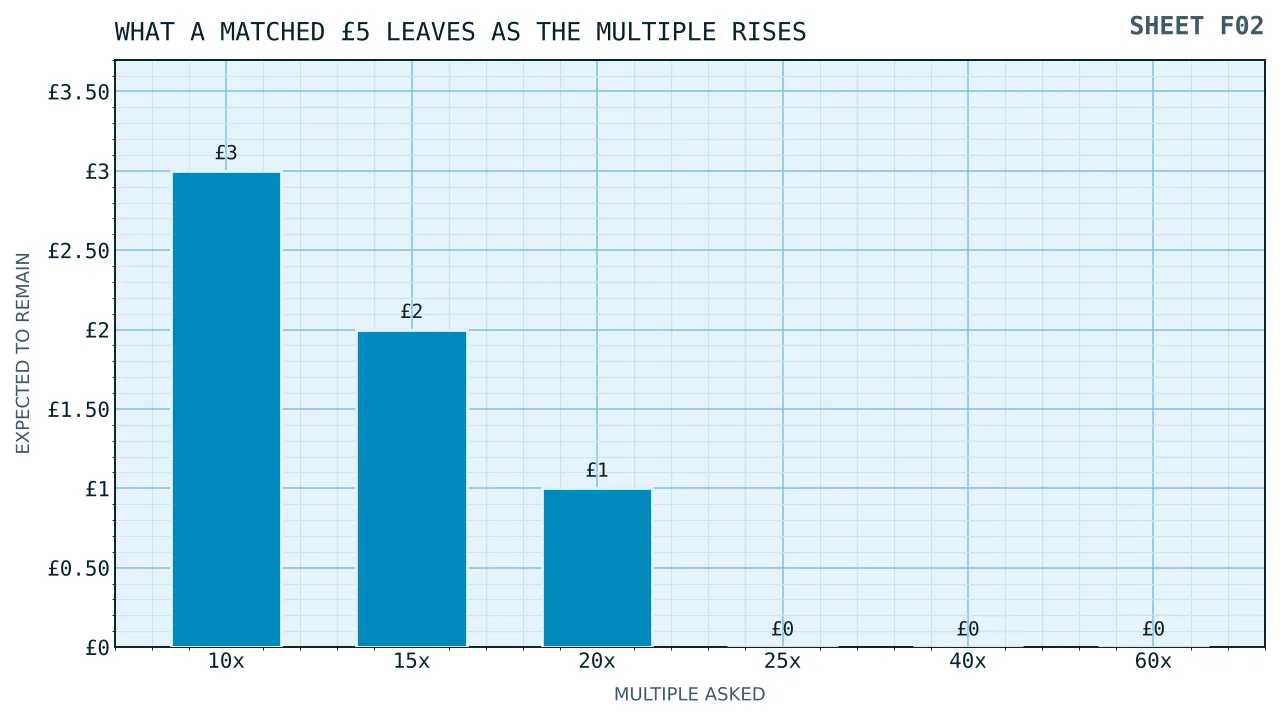
Take W at the British maximum first, since that is the kindest reading available. Ten times a fiver wants £50.00 staked; the edge on that comes to £2.00; what is expected to survive is £3.00. Three pounds is therefore the ceiling on what a matched fiver is worth at a licensed cashier, and it arrived with the regulated maximum. From the nineteenth of January 2026 the code provision governing incentives, at its third limb, stopped a licensee requiring more than ten passes of bonus money through the games.
Now the figure this site models away from that register. At forty times the staking owed is £200.00, and the edge on it comes to £8.00. The credit was five pounds. It is consumed five eighths of the way along and the remaining £3.00 comes out of whatever else is in the account, so the expected value of the offer is nought and the expected damage is three pounds.
For the upper end, the regulator has put a figure of its own on what the ceiling was built to stop, recording that some licensees were applying play-through of up to sixty times. Sixty times a fiver is £300.00 through the games and £12.00 of expected cost, leaving an overrun of £7.00, which is more than the credit and the deposit together.
| Multiple | Turnover owed | Expected cost | Expected to remain |
|---|---|---|---|
| 10x, the legal maximum | £50.00 | £2.00 | £3.00 |
| 15x | £75.00 | £3.00 | £2.00 |
| 20x | £100.00 | £4.00 | £1.00 |
| 25x | £125.00 | £5.00 | £0.00 |
| 40x | £200.00 | £8.00 | £0.00 |
| 60x | £300.00 | £12.00 | £0.00 |
One row of that schedule does not behave like the others. At twenty-five times the credit is used up to the penny, and that happens at twenty-five whatever the credit was, because the multiple is a property of the condition and not of the sum. A fiver, fifty pounds and five hundred all reach nought together. Size decides only how much the shortfall beyond it is worth.
5
Two minutes and five seconds
Fifty cycles has a floor under its duration at a British licensee, and the floor is low enough to be startling when it is written down in seconds.
Two and a half seconds must elapse between a slot cycle starting and the next one being allowed to start. Fifty of them therefore run no faster than 125 seconds, which is two minutes and five seconds for a complete pass of the deposit. The standard that sets that interval publishes no commencement date for it, so this sheet states the requirement and leaves the date alone. Where a casino game is not a slot, poker between customers excepted, the interval is five seconds, and for that one a date is published: 17 January 2025.
Four further rules hold the pace down, and each of them does something a reader at this deposit can observe.
- Every cycle takes a fresh commitment from the customer, which is the autoplay prohibition, its one published exception being blinds posted at poker.
- Nothing may bring the result forward. Turbo, quick spin and slam stop are named in the guidance as features that are not allowed.
- Playing several games at once cannot be offered as a feature, split screens and multi-screen arrangements included, and since 17 January 2025 operator-led functionality for running products simultaneously has been barred outright, the published example being a roulette table beside a blackjack one.
- A product may not work on a customer to chase a loss, to put up the stake, or to carry on after saying they want to stop, and money sitting inside a product is not to be replenished except by the customer’s own choice on each occasion.
The same date brought in something a five pound player can use directly. From 17 January 2025 a licensee has had to display, as it happens, how long a customer has been gambling and what they have spent net. On a fiver that display is the difference between knowing the deposit is half gone and finding out afterwards.
6
Getting a fiver back out again
At the floor, the exit matters more than the entrance, because a small balance is the one most easily stranded by a round number.
What a licensee may not do to a deposit balance
No term may be imposed, used, enforced or leant on by a licensed cashier where its object or its effect is a maximum on the sum a consumer draws from their own deposit balance. A clause the regulator itself prints as failing that test caps a day’s withdrawals at fifty pounds and a week’s at five hundred. A player’s entitlement runs to the whole of that balance, winnings and all, at whatever moment they choose; no restriction may sit on the maximum; and reasonableness is required of any limit placed on how large the withdrawals are or how many of them there may be. The page carrying that rule publishes no date of its own, so none is attached to it here.
Where a five pound balance sits in that sentence
The published prohibition is written about maximums. A floor under a withdrawal is a limit on size, so it falls inside the reasonableness wording, and no published example addresses one. This sheet states that chain and stops there, which is the honest position: what can be said with a source is that a maximum is barred outright and that any limit on size or number must be reasonable.
The arithmetic, though, is not in doubt. A balance of £5.00 with £4.80 expected back after one pass cannot reach a round figure above it without a win, and a floor set above what the deposit can produce is a refusal written as a number rather than as a sentence. The British regulator has described exactly that behaviour away from its register, naming sites that block payouts or set withdrawal limits so high as to be unattainable.
Two things that are not the same object
A limit over the winnings a bonus may produce can sit beside an unrestricted right over the deposit balance in the same terms on the same day, with no contradiction, because the two fasten to different pots. The prohibition covers the deposit balance. Nothing published bars a limit on the winnings a bonus throws off, and no standard figure for such a limit appears in any primary source, which is why this sheet prints none.
And one trapdoor the condition closes
Asking for money back may not set off a demand for information the cashier had a reasonable chance to ask for sooner. The one carve-out covers whatever some other legal duty requires at exactly that moment. Nor may a licensee offer to undo a withdrawal once it has been asked for. The guidance adds two things: money already requested is not to be available for depositing again, and the route out is to carry as little friction as the operator can arrange.
7
What belongs beside a small headline
British advertising rules have something proportionate to say about offers at this size, and the word proportionate is the regulator’s rather than this sheet’s.
Proportion is required between an inducement or a reward and what a player has actually spent, counted in money and in hours. Promotions must not climb at a faster rate as a player spends more, and must not push regular gambling of substantial sums at a fixed frequency. A promotion must not encourage participation that is repetitive or frequent, nor encourage anybody to spend beyond what they can afford to lose.
The advertising regulator’s own illustration of something that can pass is worth quoting with its condition still attached, because the condition is what makes it useful. One reward, taking the form of a free bet, after fifty pounds of wagering, could be acceptable; the proviso attached is that a reward of that sort is not unusual at that level for the sort of gambling concerned. Convert the fifty pounds into this sheet’s units and the proportion becomes visible: £50.00 of wagering is five hundred cycles at 10p, or ten complete passes of a five pound deposit.
Which terms must sit where a reader cannot miss them is published too. For a casino promotion the significant ones are likely to include any minimum stakes, how to take part, and any play-through condition. The base duty is that marketing must not mislead. Significant terms belong within the advertisement, placed near the headline figure on whichever page a reader arrives at or registers through. An advertisement that gives them too little prominence is a misleading one. The code provision on incentives adds a requirement of its own: an offer’s terms are to be clear, transparent and fair, and within easy reach of anybody the offer is made to.
One word is regulated rather than merely discouraged. An offer is not to be called free if qualifying for it means putting money of the customer’s own on a game, which is why that word and a five pound qualifying deposit do not belong together.
8
A fiver with no register behind it
Offers at the five pound floor are frequently made by cashiers holding no Great Britain licence, and the whole of parts 3 to 7 then describes a regime that is not in force.
Priced on this deposit, the subtractions run as follows. The ten-times ceiling goes, and with it the £3.00 that was the most a matched fiver could be worth; at forty times the same credit expects nothing and carries a £3.00 shortfall. The stake ceiling goes, so the whole deposit may ride on one cycle of any size the software offers. The interval of two and a half seconds goes, and with it the bans on automation, on hurrying a result along and on running several games together, so fifty cycles may take whatever time the software needs. The prohibition on putting a maximum over a deposit balance goes. Identity before any play goes. The credit-card condition goes. And the place in the national scheme for self-exclusion goes, that scheme reaching exactly as far as the British licence reaches and not one site further.
What replaces the incentive rules, in the Caribbean policy opened for this build, is two sentences: bonuses and promotions are to be communicated transparently with clear terms, and promotion must not be aggressive to the point of encouraging excessive play. No multiple is capped. No mixing of product types inside one incentive is forbidden. No list of significant conditions exists, and the proportionality wording in part 7 has no counterpart.
Exactness pays here, because loose claims about the law run in both directions. Providing facilities for gambling without an operating licence is a criminal offence under the Act of 2005, and the penalty on conviction runs to imprisonment for a term not exceeding fifty-one weeks, a fine not exceeding level five on the standard scale, or both, the fifty-one weeks reading as six months in Scotland. That offence is written throughout about the person providing the facilities. The licensing requirement follows the player rather than the equipment: since 1 November 2014 it has been immaterial where the facilities are provided from, and the test for a remote operator with no equipment in Great Britain is whether it knows or should know the facilities are being used, or are likely to be used, here.
None of that makes an unlicensed cashier a safe place to leave five pounds, and the regulator has said why in its own words. An unlicensed website may be running inadequate controls over money laundering and over social responsibility alike, and may leave a customer exposed to unfair practices, to trouble over data privacy, and to fraud. Secure payment systems, tools for safer gambling and checks on age are often simply not there. The consequences named are unfair gaming practices, financial loss, and no recourse when something goes wrong.
The check that settles it costs nothing and takes less time than one pass of a fiver. Find the licensed status the site states, follow it through to the public register, and satisfy yourself that what is recorded there, the permitted activities and the domain names both, answers to the site in front of you. No date and no reading instructions are published alongside that register, so the day of the check is worth noting down by anybody who leans on it.
9
Four readings on a five pound payment
Four numbers settle a five pound deposit, and only the first of them is published anywhere a reader will trip over it.
| The reading | On a fiver |
|---|---|
| Any charge, converted into staking | 50p is £12.50 |
| The stake you intend per cycle | 10p gives 50 cycles |
| The multiple written over any credit | 10x legal, 40x modelled |
| What the credit expects to leave | £3.00, or £0.00 |
The second reading is the one nobody writes down and the one that moves the answer furthest. A fiver is fifty cycles or one cycle depending on a decision taken in silence, and no rule anywhere constrains it. The third and fourth are what the rest of this site exists to compute.
Then the caution that belongs under every expected figure here. Three pounds is an average over many repetitions, not a sum anybody is handed. Where the prizes are large and rare, fifty cycles land under that £4.80 average far more often than over it, and now and then they land on nothing. The fiver itself is exact, and it left the account the moment the cashier asked.
Three neighbours, and the method behind them. At a tenth of this size a flat charge takes over the arithmetic completely, which is what 1 pound deposit casino works out. A till that accepts less than an offer insists on, and the price of the difference between those two figures, sits at £3 minimum deposit casino uk. Strip every British duty off this same deposit and what remains is costed at non gamstop casinos with £5 deposit, duty by duty. The working behind every total here is laid out at How a receipt is struck. Everything else in this part of the tree is listed at The floor.
Questions
- What does five pounds buy at a casino?
- Fifty cycles of a slot at 10p each. At a 96 per cent return each one gives 9.6p back, which puts a complete pass of the balance at £4.80 on average and 20p in cost. That twenty pence is the honest price of playing the deposit once over, and every other cost on a five pound offer should be measured against it rather than against the fiver.
- How much does a flat charge really cost on a fiver?
- Divide the charge by the house edge and the answer arrives in staking. At 96 per cent the games take 4p of each pound crossing them, so 50p is the edge on £12.50 of turnover, which is a hundred and twenty-five cycles, which is two and a half complete passes of a five pound balance. Twenty pence is the edge on a single pass. A reader who pays twenty pence at the till has given the house its whole take on the deposit before a reel turns.
- Is five pounds a small deposit or a big stake?
- Both, and that is the oddity of this rung. Five pounds is the smallest sum many cashiers accept, and it is also the largest sum anybody aged twenty-five or over may stake on a single slot cycle under an instrument made on 25 February 2025 and in force from 9 April 2025. The figure for anyone under twenty-five is two pounds, in force from 21 May 2025 after a six-week transition at a flat five. So the whole deposit can be one lawful cycle, or two with a pound over, or fifty at 10p.
- What is a matched fiver worth once the play-through is priced?
- Three pounds at the British maximum and nothing at all above twenty-five times. Ten times a fiver is £50.00 of turnover costing £2.00, leaving £3.00 expected, and ten times has been the legal limit for a licensee since the nineteenth of January 2026. At forty times the staking owed is £200.00 and the edge on it £8.00, which uses the credit up five eighths of the way along and takes £3.00 out of the balance behind it. Sixty times, the figure the regulator records some licensees using before the cap, costs £12.00 and overruns by £7.00.
- How long does one pass of a five pound deposit take?
- At least two minutes and five seconds at a British licensee. No second slot cycle may start inside two and a half seconds of the first, which puts fifty of them at 125 seconds or more. Automation cannot compress it, a fresh commitment being owed on every cycle, and the guidance names slam stop, quick spin and turbo as features a licensee may not offer. No commencement date for the slots figure appears on the standard itself, and none is supplied here.
- Can a licensed casino cap what I withdraw?
- Not out of the deposit balance. No term may be imposed, used, enforced or leant on if what it is for, or what it does, is to cap the sum a consumer draws from that balance. The clause the regulator prints as a failure allows a withdrawal of fifty pounds within a day and five hundred within a week, and nothing beyond that. That balance, winnings and all, may be drawn at whatever moment the player chooses, and reasonableness is required of any limit on how large the withdrawals are or how many of them there may be. The page carrying that rule states no date of its own.
- What about a minimum withdrawal bigger than my balance?
- The published prohibition is written about maximums, and a floor under a withdrawal is a limit on size, so it sits inside the reasonableness wording. No published example addresses one, and this sheet goes no further than that chain. The arithmetic is plainer: a £5.00 balance expecting £4.80 back after a pass cannot reach a round figure above itself without a win, and the British regulator has described sites away from its register setting withdrawal limits so high as to be unattainable, and blocking payouts outright.
- Does a win cap on a bonus break the withdrawal rule?
- No, because the two attach to different pots and can both be true at once. The prohibition covers the deposit balance. A limit over the winnings a bonus may produce is a different object; nothing published bars one; and no standard figure for such a limit appears in any primary source, which is why none is printed here.
- What must appear beside a five pound offer?
- Significant terms, inside the advertisement and close to the headline figure on the landing and sign-up pages. For a casino promotion those are likely to include any minimum stakes, how to take part and any play-through condition. An advertisement giving them too little prominence is a misleading one. Inducements are also to be proportionate to the money and time a player spends, and an offer should not be called free where the customer must stake their own money to qualify.
- What does a fiver lose at a cashier with no British licence?
- The ten-times ceiling, and with it the £3.00 that was the most a matched fiver could be worth. The stake ceiling, so the whole deposit can ride on one cycle of any size. The two-and-a-half-second interval and the bans on automation, on hurrying a result and on running games simultaneously. The prohibition on putting a maximum over a deposit balance. Identity verification before any play. The credit-card condition. And a place in the national scheme for self-exclusion, which reaches exactly as far as the British licence does. What stands in their place, in the Caribbean policy read for this build, is two sentences asking for clear terms and no aggressive promotion.