
Sheet N05 Revision 1 Checked 15 October 2026
Free £10 no deposit
£10.00 of credit, no play-through, and £9.60 left after the single pass through a game that credit of this kind still makes. Everything after that depends on one event the arithmetic has no symbol for: whether the account is verified and the money paid. A one in twenty-five chance of it never arriving costs 38.4p, which is roughly what the whole house edge on the pass costs.
38.4p, the cost of a one in twenty-five failure on £9.60
What the conditions leave
Every destination on this spike is bought advertising. The site takes a fee if a reader goes on to register, and no figure printed below moves because of it.
The Spin Sheet
Till receipt No 01
Betportal
Lowest multiple here
For every €1 of spin credit at face per €1
Credit
Debit
No Great Britain licence
Licensed in Anjouan, Comoros, run by BetPortal Gaming Ltd, with Excite Ultra Media Ltd, reference ALSI-202601040-FI2.
Terms read 15 October 2026
Open the offer at Betportal, opens in a new tabThe Spin Sheet
Till receipt No 02
WinBeast
Five staged matches
For every €1 of spin credit at face per €1
Credit
Debit
No Great Britain licence
Licensed in Curaçao, operator not named on the site.
Terms read 15 October 2026
Open the offer at WinBeast, opens in a new tabThe Spin Sheet
Till receipt No 03
EliteSpin
Longest spin window
For every £1 of spin credit at face per £1
Credit
Debit
No Great Britain licence
Licensed in Costa Rica, run by PrimeTier Limited.
Terms read 15 October 2026
Open the offer at EliteSpin, opens in a new tabThe Spin Sheet
Till receipt No 04
Crown Jewelz
Multiple unpublished
No total struck
Credit
Debit
No Great Britain licence
Licensed in Curaçao, number not verified, operator not named on the site.
Terms read 15 October 2026
Open the offer at Crown Jewelz, opens in a new tabThe figure at the foot of a receipt is this site's own arithmetic and nothing an operator has published: the credit, less the share a spin gives back at 96 per cent return to player, less what playing the wagering through costs at the same return. It describes the offer, not one reader's afternoon. Where the conditions price above the credit the receipt prints nothing rather than a negative sum, and where a figure the sum needs is unpublished it prints the condition in the operator's words instead.
Three words stand in the amount column where no figure can. Noted is a published condition that takes value away without leaving the sum a figure to take. Unpriced is a condition whose figure nobody has published, or a credit that is not a sum until a deposit of your own sets it. Own money is money of yours, which is never part of a total.
Not one of the operators printed above holds a Great Britain licence, so the duties that licence carries do not reach them. Every online gambling company licensed in Great Britain has to be part of Gamstop Online, and a reader who has shut themselves out through the scheme is therefore not shut out here. The ceiling of ten times the bonus funds on a wagering requirement, in force since 19 January 2026, is a condition of that licence and binds the companies that hold one. Where a dispute goes instead is a matter for the authority named on the receipt, and the Gambling Commission describes what a reader faces without a British licence as a lack of recourse if things go wrong. Nobody under 18 may hold an account at any of them.
Every term printed on a receipt is the operator's own, and each receipt carries the day it was read. The oldest of those readings is 15 October 2026. What binds a reader is the operator's own full terms, and not a line printed here.
1
Ten pounds that is not money yet
A credit of £10.00 given away without a deposit has three stages to get through before anybody spends it. It has to arrive, it has to reach a game, and it has to leave as a payment. Most writing about offers of this size covers the first and assumes the other two.
Stage two is quickly priced. Credit of this shape generally has to be staked once before the cashier treats it as withdrawable, and one trip through a game paying back 96 per cent takes four pence from every pound, or 40p here. That leaves £9.60. Sheet N04 works that pass through in detail under the key £20 free no deposit casino.
Stage three is the subject of this sheet, and it has no arithmetic of its own because no primary source publishes any. What it has instead is a timetable, a set of duties, and a question about which side of the account the check sits on.
Fixed here:
- Credit of £10.00, nothing deposited.
- A 96 per cent game, so four pence in the pound for the one pass.
- No play-through beyond that pass, which is the point of the key. The forty times this site uses on the wagered sheets does not apply and is not used.
- Full weighting, since nothing is being cleared.
- Failure rates of 5, 10, 25 and 50 per cent used in part 5 purely as illustrations. Nobody publishes a real one, and this sheet does not invent one.
2
The line, and the term it has no symbol for
Sheet N05 reaches its total through the line this site is built on:
E = B × (1 – (W × (1 – RTP)) / g)
£10.00 enters as B. The count of turnovers the credit owes is W; the share a game gives back is RTP; the weighting is g; what survives at the end is E. With W at one, which is the single pass:
E = £10.00 × (1 – (1 × 0.04) / 1)
E = £9.60
Now look at what the line assumes. Every symbol in it describes play. None of them describes the account. The expression cannot express a credit that is correct in every particular and simply never paid, because payment is not one of its terms.
Patch it by hand. Call the chance of the money actually arriving p, and the honest price of the credit is £9.60 multiplied by p. That is not a refinement. On small credits it is the dominant term, and part 5 shows how quickly it overtakes everything the formula does measure.
3
Three jobs one check is doing
An identity check is often read as an obstacle between a player and their money. It is doing three separate jobs, and the British regulator names all three: confirming how old somebody is, confirming who they are, and finding out whether they have already excluded themselves.
The third is the one that matters most on a site about offshore offers, and it is worth being blunt. A cashier that performs no check cannot discover a self-exclusion, because the register it would have to consult is reached through the check. Nothing on this sheet explains how to get round a check, a block or a self-exclusion, and nothing on it should be read as encouragement to look.
Three items are obtained and checked before anybody is allowed to gamble: an address, a date of birth and a name. Which papers prove them is left open. Household bills, driving licences and passports are the examples given, and the Commission states in terms that it does not prescribe what a business should ask to see.
Two details that sharpen the timing. It is not confined to play paid for with a customer’s own money: play bought with a bonus or a free bet is caught, and so are versions of games offered free to play. And it replaced an older position under which operators had seventy-two hours to complete an age check. The announcement setting it out is dated 7 February 2019 and says the rules begin on 7 May without naming the year; 7 May 2019 is the only reading its own date allows.
The Commission’s consumer guide on age and identity is older than most of the rules around it, published 23 September 2020 and last updated 13 April 2022. The current wording sits in the licence condition itself, which is what this sheet works from.
4
Before the first cycle, or at the window
Timing is the whole difference, and on a £10.00 credit it is the difference between a condition and a trap.
Under a British licence the check happens first. Identity is settled before any gambling, which means before the credit is used, which means a player who reaches the end of the pass has already cleared the obstacle. The same licence condition closes the other door: a demand for further information may not be hung on a withdrawal request where asking sooner was a reasonable option. Where another legal duty genuinely requires something at that point, it may still be asked, and the Commission’s consumer wording puts anti-money-laundering material in the same place, to be requested promptly rather than saved up for the moment somebody wants paying.
Outside that licence the sequence can invert. The Curaçao policy of 21 February 2025 bars a deposit and bars a wager until the operator is content that the player is over eighteen. At registration that contentment may rest on a confirmed date of birth, with open-source checking, a tick box and a payment-method confirmation offered alongside it. Full identity work, meaning a government-issued document of the passport, national card or driving licence sort, waits on whatever milestones that regime has set for due diligence and for money laundering, arriving sooner only where the operator doubts the age.
Read that against a £10.00 withdrawal. A milestone framework is, by construction, a set of thresholds. A small payment may sit below them, in which case nothing is asked and the money moves; or the request may be what triggers the milestone, in which case the document arrives at the window rather than at the door. The British rule removes that uncertainty by putting the check at the start. No equivalent appears in the offshore rulebook read for this site.
£10.00 of credit resting on one document nobody has asked for yet
5
£9.60 priced against the chance of being paid
Multiply £9.60 by the chance of the payment arriving and the scale of the term becomes obvious.
| Payment arrives | Credit is worth | Cost of the doubt | Against the 40p pass |
|---|---|---|---|
| Always | £9.60 | £0.00 | 0.0 times |
| 24 times in 25 | £9.22 | £0.38 | 1.0 times |
| 19 times in 20 | £9.12 | £0.48 | 1.2 times |
| 9 times in 10 | £8.64 | £0.96 | 2.4 times |
| 3 times in 4 | £7.20 | £2.40 | 6.0 times |
| Half the time | £4.80 | £4.80 | 12.0 times |
The second row is the one to carry away. A failure rate of one in twenty-five costs 38.4p, and the entire house edge on the compulsory pass costs 40p. The two are the same size. Every clause in a set of terms about documents, deadlines for supplying them and the consequences of not doing so is therefore at least as expensive as the arithmetic that gets checked.
Lower down the table it stops being close. A one in ten failure costs 96p, nearly two and a half times the pass. At one in four the credit has lost £2.40, which is six passes through the game.
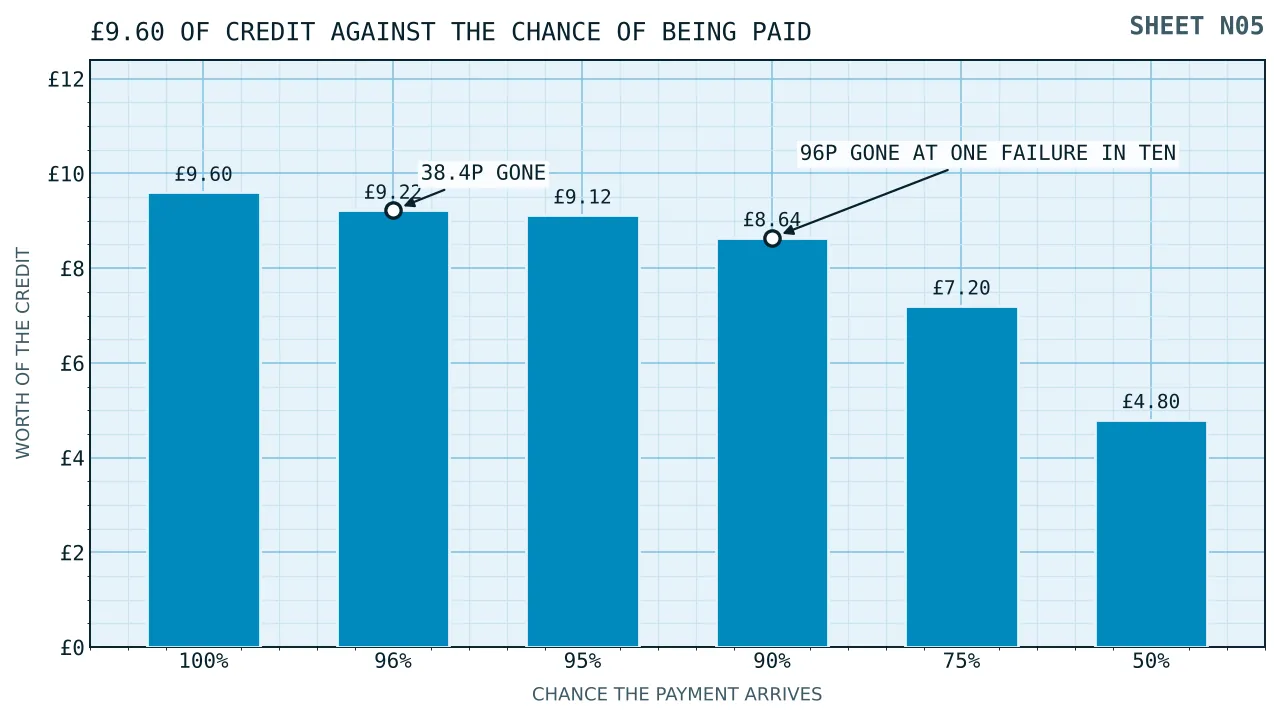
None of those rates is a published figure and none is offered as one. No primary source gives a failure rate, a payout refusal rate or a verification outcome for any operator, licensed or otherwise. The table is a scale, built so a reader can put their own estimate against the only number on the page that the formula produces.
6
The clock if it goes wrong
Where a payment does not arrive, the British timetable is published, and setting £10.00 against it is instructive.
| What is owed, and when | Figure |
|---|---|
| Acknowledgement, round-the-clock operator | 24 hours |
| Acknowledgement otherwise | 3 working days |
| Whole process, escalation included | 8 weeks |
| Window to raise it at all | 6 months |
| £10.00 across the full eight weeks | 17.9p a day |
Eight weeks is fifty-six days, and £10.00 spread across them is 17.9p a day. That figure is the quiet argument of this sheet. The process exists, it is enforceable against a British licensee, and on a credit this size the effort of using it will usually exceed what it recovers.
The clock can also stop. Seven days of silence from a customer who has been asked something reasonable may make it reasonable to halt the eight weeks until they answer, and the count then picks up from where it paused instead of starting afresh. A player who leaves a message unanswered for a fortnight has extended their own timetable by a fortnight.
Six months is the other end of it. Counting from the incident, that is the least a customer gets in which to raise one, and no term shutting complaints out inside the window is available to a licensee. Complaining sooner may be encouraged. The window itself cannot be trimmed.
7
Where a complaint ends, and what nobody will do
Where an offer comes from an operator holding no Great Britain licence, the timetable in part 6 does not reach it, and neither does anything else below. Detail beats a headline here.
The regulator is not the place
On its own account, the British regulator is no ombudsman. It says it lacks the powers to settle gambling complaints or to get a consumer’s money back, that disputes about transactions such as withdrawal problems or technical faults in a game are outside what it can resolve, and that having no access to customer accounts it cannot see what happened. Its instruction to a player is to take the complaint to the gambling business first.
Where it goes after that
A British licensee’s final answer has to explain the decision, say that the operator’s own process is finished, and set out how to take the matter to an approved alternative dispute resolution body. Only approved entities may be used, and eight stand on the published list. For remote gambling across all sectors the list names IBAS, eCOGRA, CEDR, Blexr Limited and ADR Group. Pegasus ADR Service is listed for adult gaming centres, non-remote bingo, family entertainment centres and pubs and members clubs, so it is not a route for a remote casino dispute at all.
What exists offshore, and what it may cost to use
There is a complaints route, and a page claiming otherwise would be wrong. Six months is the window a player gets in Curaçao, at no cost; acknowledgement in writing is owed inside a week; four weeks is the operator’s time to answer, with a single further stretch of four more where written notice is given. Complaints about responsible gaming go to the front of the queue. On individual disputes the regulator there stands back in much the same terms the British one uses.
The difference sits in who writes the rules of the escalation, and on a £10.00 credit it bites hard. Alternative dispute resolution in Curaçao is mandatory and free to the player, with the operator paying, but the operator may set the parameters, and the policy says so outright. Three are named: a floor on the value of a claim before it can be escalated at all, whether the result is binding on the player, and whether the process has to come before any court proceedings. All relevant circumstances are to be weighed in judging whether measures of that sort are justified, and claims of low value are named as a case where a worry about misuse may be understood. A £10.00 credit is precisely the size a minimum-value threshold is built to exclude.
Two further limits bind the player there. A process once completed cannot be started again with a different body, and somebody who abandons one part-way should not expect to raise the same dispute later.
8
Reading the verification clause
Four questions, and the first two decide it.
| The question | On this credit |
|---|---|
| When is identity settled | before play, or at payout |
| What is the credit worth if it is not | £0.00 |
| How long may the operator take | 8 weeks |
| What is that worth per day | 17.9p |
The second line is brutal and it is also correct. A credit that cannot be paid out is not a reduced credit. It is nothing, and nothing multiplied by any return whatsoever stays nothing.
Two cautions on the answer.
The probabilities in part 5 belong to the reader, not to this sheet. Put your own figure in the first column and read off the second. The arithmetic is honest even when the input is a guess, so long as the guess is labelled as one.
And a credit that clears verification easily was not thereby a gift. Its cost went somewhere, and this section is where the other somewheres get measured: a clock over the cycles on sheet N02, headed 70 free spins no deposit no wager; a ceiling on what the cashier hands over, on sheet N03, headed £30 free no deposit; and a withdrawal floor standing above the credit itself on sheet N08, headed free £5 no deposit casino. All of them are indexed at Nothing asked back.
Questions
- What is a free £10 no deposit credit worth?
- £9.60 once the single pass through a game is priced, and £9.60 multiplied by the chance of the payment arriving once the account is priced too. Credit of this shape is normally staked once before the cashier treats it as withdrawable, and on a game returning 96 per cent that pass takes four pence from every pound, or 40p here.
- Why does verification matter more than the arithmetic?
- Because of the sizes involved. A one in twenty-five chance that the payment never arrives costs 38.4p against £9.60, and the entire house edge on the compulsory pass costs 40p. Those are the same figure. A one in ten failure costs 96p, which is nearly two and a half times the pass, and the formula this site uses has no symbol for any of it.
- When is identity checked at a British licensed site?
- Before any gambling at all. Date of birth, address and name are obtained and verified first, and the duty covers play bought with a bonus or a free bet along with versions of games offered free to play. The same condition stops a demand for information being hung on a withdrawal request where asking sooner was a reasonable option.
- What documents will be asked for?
- That is not fixed. Household bills, driving licences and passports are the examples given, and the regulator states in terms that it does not prescribe what a business should ask to see. The duty falls on the information, being date of birth, address and name, and not on any particular piece of paper.
- How long can an operator take over a disputed £10?
- Eight weeks for the whole process, escalation included, at a British licensee. Acknowledgement is owed within three working days, or inside 24 hours where gambling is offered around the clock. Eight weeks is fifty-six days, so £10.00 held across all of it is worth 17.9p a day, and the clock can pause if a reasonable information request goes unanswered for seven days.
- Can the regulator get my money back?
- No, and it says so plainly. It describes itself as not an ombudsman, states that it lacks the powers to settle gambling complaints or recover a consumer’s money, says disputes over withdrawals or technical faults in a game are outside what it can resolve, and notes that it has no access to customer accounts. It tells players to complain to the gambling business first.
- Is there any complaints route at an offshore site?
- There is, and claiming otherwise would be wrong. Six months is the window a player gets in Curaçao at no cost, acknowledgement in writing is owed inside a week, and the operator answers within four weeks with one further stretch of four more where written notice is given. Dispute resolution is compulsory and free to the player, the operator carrying the cost.
- So what is the catch on a small offshore claim?
- Who writes the terms of the escalation. Curaçao’s policy says outright that the operator may set the parameters, among them a floor on the value of a claim before anything can be escalated, and whether the result binds the player. Claims of low value are named as a case where a worry about misuse may be understood, and £10.00 is exactly the size such a floor is built to exclude.