
Sheet D05 Revision 1 Checked 15 October 2026
Deposit 5 get 200 free spins
An award of two hundred 10p spins averages £19.20 of winnings. Forty turnovers of that sends £768.00 across the reels, costing £30.72, which runs £6.52 beyond what a fiver and the award between them hold. Per pound handed over: £153.60 of turnover.
£153.60 of turnover owed for each £1 handed over
What a fiver buys
Every destination on this spike is bought advertising. The site takes a fee if a reader goes on to register, and no figure printed below moves because of it.
The Spin Sheet
Till receipt No 01
Betportal
Lowest multiple here
For every €1 of spin credit at face per €1
Credit
Debit
No Great Britain licence
Licensed in Anjouan, Comoros, run by BetPortal Gaming Ltd, with Excite Ultra Media Ltd, reference ALSI-202601040-FI2.
Terms read 15 October 2026
Open the offer at Betportal, opens in a new tabThe Spin Sheet
Till receipt No 02
WinBeast
Five staged matches
For every €1 of spin credit at face per €1
Credit
Debit
No Great Britain licence
Licensed in Curaçao, operator not named on the site.
Terms read 15 October 2026
Open the offer at WinBeast, opens in a new tabThe Spin Sheet
Till receipt No 03
EliteSpin
Longest spin window
For every £1 of spin credit at face per £1
Credit
Debit
No Great Britain licence
Licensed in Costa Rica, run by PrimeTier Limited.
Terms read 15 October 2026
Open the offer at EliteSpin, opens in a new tabThe Spin Sheet
Till receipt No 04
Crown Jewelz
Multiple unpublished
No total struck
Credit
Debit
No Great Britain licence
Licensed in Curaçao, number not verified, operator not named on the site.
Terms read 15 October 2026
Open the offer at Crown Jewelz, opens in a new tabThe figure at the foot of a receipt is this site's own arithmetic and nothing an operator has published: the credit, less the share a spin gives back at 96 per cent return to player, less what playing the wagering through costs at the same return. It describes the offer, not one reader's afternoon. Where the conditions price above the credit the receipt prints nothing rather than a negative sum, and where a figure the sum needs is unpublished it prints the condition in the operator's words instead.
Three words stand in the amount column where no figure can. Noted is a published condition that takes value away without leaving the sum a figure to take. Unpriced is a condition whose figure nobody has published, or a credit that is not a sum until a deposit of your own sets it. Own money is money of yours, which is never part of a total.
Not one of the operators printed above holds a Great Britain licence, so the duties that licence carries do not reach them. Every online gambling company licensed in Great Britain has to be part of Gamstop Online, and a reader who has shut themselves out through the scheme is therefore not shut out here. The ceiling of ten times the bonus funds on a wagering requirement, in force since 19 January 2026, is a condition of that licence and binds the companies that hold one. Where a dispute goes instead is a matter for the authority named on the receipt, and the Gambling Commission describes what a reader faces without a British licence as a lack of recourse if things go wrong. Nobody under 18 may hold an account at any of them.
Every term printed on a receipt is the operator's own, and each receipt carries the day it was read. The oldest of those readings is 15 October 2026. What binds a reader is the operator's own full terms, and not a line printed here.
1
A fiver and two hundred spins
Small sums attract the most lopsided offers in this market, and the reason is arithmetic rather than generosity. A spin award is a fixed quantity. The sum a reader is asked for is a variable. Shrink the variable and the ratio between them grows without anybody writing a larger number on the advertisement.
Two hundred spins is the award. At the 10p this sheet works at, their face is £20.00. Face is what gets staked and not what gets paid, so a game handing back 96 per cent turns that face into £19.20 of average winnings. The missing £0.80 never belonged to anybody but the house.
Nothing published anywhere in Great Britain fixes the cash value of a spin. Who decides it, what has to be said about it, whether a floor or a ceiling exists: the regulator’s material addresses none of the three. So 10p is a working price declared as one, and a reader with a different price can rebuild every line of this page in a minute.
Then there is the fiver, which is the whole reason this page sits in a section about matched money. It is the reader’s money. It was the reader’s money before the award was advertised and it is on the debit side of every total here. It is not a winning, it never becomes one, and the only thing it does in the arithmetic is absorb a shortfall when the condition reaches past the credit.
What is held still, so the figures can be audited:
- Five pounds paid in, two hundred spins awarded, each spin priced at 10p.
- A return to player of 96 per cent, with the edge at four pence in the pound.
- Full weight on every stake.
- Forty turnovers demanded, which is the sort of figure asked on the offshore side. A British licensee may ask ten.
- The requirement rests on the spin winnings, not on the fiver as well.
2
The steepest ratio in this section
Reduce the offer to one pound paid in and the comparison with its neighbours makes itself.
A fiver buys £19.20 of credit, so a pound buys £3.84 of it. Turned over forty times, that pound of payment owes £153.60 across the reels. For every single pound the reader hands over, a hundred and fifty-three pounds and sixty pence has to be put at risk before anything may leave the account.
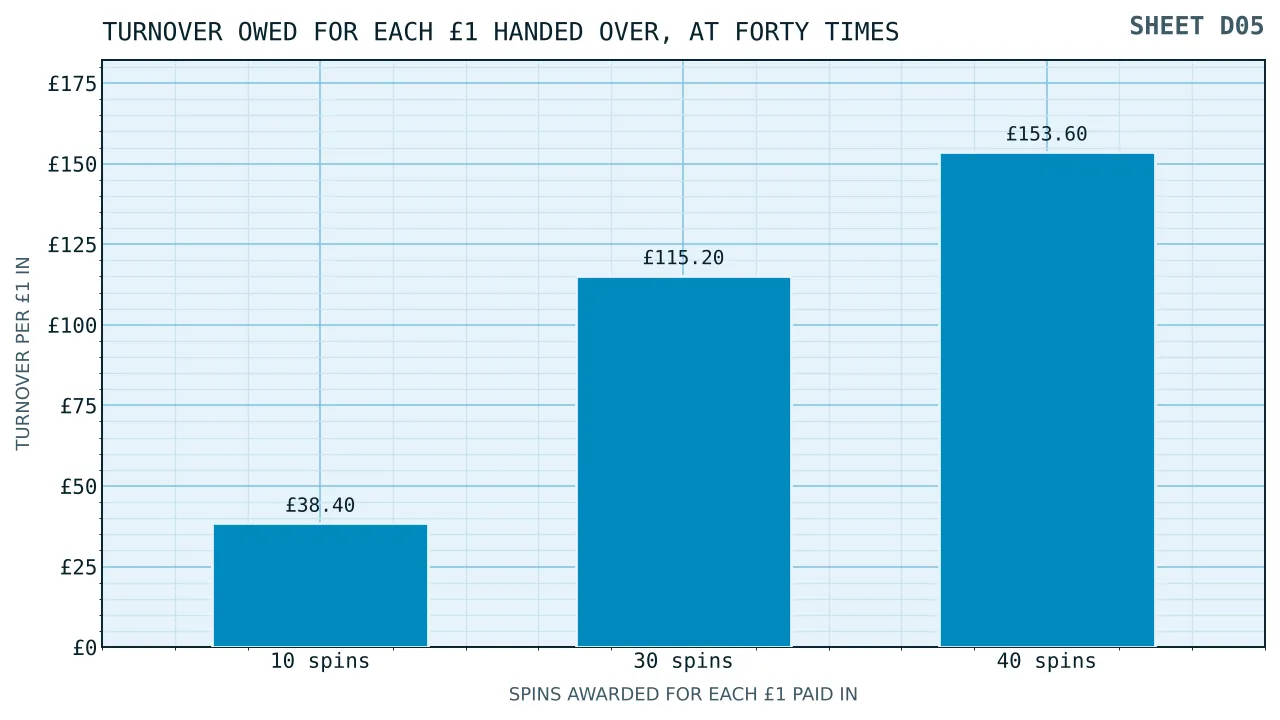
Set that against a tenner and a hundred spins, where a pound buys £0.96 of credit and owes £38.40. Same spins, same price per spin, same multiple, and four times the obligation per pound. Nothing in either advertisement makes that visible, because the two numbers that create it are printed in different places and in different units.
As a percentage the award is 400 per cent at face and 384 per cent once the return is applied. That is the heaviest headline in this section, and it got there without a percentage being printed at all.
£3.84 of credit per £1 in, which is 384 per cent
3
The expression, and £6.52 past a fiver
One expression carries every figure on this site, and here it is taking an award of this shape.
E = B × (1 – (W × (1 – RTP)) / g)
Substituting takes a moment. B is the credit, which for two hundred spins is £19.20 of average winnings and not the £20.00 of face. W is forty. RTP is 0.96. g is one. Last comes E, the part of the credit still standing once the turnover has been done.
E = £19.20 × (1 – (40 × 0.04) / 1)
E = £19.20 × (1 – 1.60)
E = -£11.52
In pounds: £19.20 turned over forty times demands £768.00 of play, and four pence in each of those pounds is £30.72 of expected cost. Eleven pounds and fifty-two pence more than the credit it hangs on.
Now bring in the fiver. The account holds £24.20 in all, being the £5.00 paid in and the £19.20 the spins are expected to return. A cost of £30.72 is £6.52 beyond it. The account empties and the condition is still six pounds and fifty-two pence short of being met.
Read that last figure carefully, because it is the sharpest thing on the page. The shortfall is larger than the sum the offer asked for. A reader could hand over the fiver twice and still not cover what a two hundred spin award costs at forty times.
£30.72 of expected cost against £24.20 held
4
£11.52, the sum two hundred spins want
Fix the award and let the payment move, and the whole offer resolves to one threshold.
Each 10p spin averages 9.6 pence and owes £3.84 of turnover at forty times, which costs 15.36 pence. So a spin is 5.76 pence short of funding itself, and two hundred of them are short by £11.52. That is the payment an award of this size needs standing behind it before any of a reader’s own money is expected to come back.
The offer asks for £5.00. The award wants £11.52. The gap between those two figures, £6.52, is the same shortfall the long arithmetic produced in part 3, arrived at from the other end.
| Paid in | Held in all | Turnover owed | Edge takes | Foot reads |
|---|---|---|---|---|
| £5.00 | £24.20 | £768.00 | £30.72 | £0.00 |
| £10.00 | £29.20 | £768.00 | £30.72 | £0.00 |
| £11.52 | £30.72 | £768.00 | £30.72 | £0.00 |
| £15.00 | £34.20 | £768.00 | £30.72 | £3.48 |
| £20.00 | £39.20 | £768.00 | £30.72 | £8.48 |
Three of the five columns never move. The award is fixed, so the credit, the turnover and the cost are fixed with it, and the only thing a reader controls is how much of their own money stands behind the obligation.
Which produces a result nobody advertises: on an award of this shape, paying in more is the only way to keep anything. That is not a recommendation to pay in more. It is a description of a structure in which the smallest payment the cashier will take is also the one the arithmetic treats worst, and the honest conclusion is that the structure is the problem rather than the size of anybody’s fiver.
At the British ceiling the threshold collapses. Ten turnovers of £19.20 is £192.00 of play and £7.68 of cost, so the credit contributes £11.52 rather than consuming it and a fiver closes at £16.52. The same award, the same price per spin, and a difference of sixteen pounds fifty-two on one term.
5
Three offers compared per pound
Per-pound figures are the only way to compare offers whose two numbers are printed in different units. The schedule takes three shapes from this section and reduces each to what one pound of a reader’s money buys and owes.
| The offer | Credit per £1 | Turnover per £1 | Cost per £1 | Foot reads |
|---|---|---|---|---|
| £10 and 100 spins | £0.96 | £38.40 | £1.54 | £4.24 |
| £10 and 300 spins | £2.88 | £115.20 | £4.61 | £0.00 |
| £5 and 200 spins | £3.84 | £153.60 | £6.14 | £1.14 |
The last cell in that bottom row is a trap and is printed to be explained rather than read off. One pound of a fiver carries £6.14 of expected cost against £4.84 of money, so the per-pound foot is negative by £1.30, and the £1.14 is what five of those pounds come to once the floor at nothing is applied to the account as a whole rather than pound by pound. Losses do not scale down neatly, because an account cannot go below empty.
The ordering is the point. Credit per pound rises down the column and the foot falls, which is the general result of this whole section stated on three worked examples: at any multiple above twenty-five, a more generous ratio is a worse offer.
Twenty-five times is where all three cross, the house edge inverted being the only thing that sets it and the ratio cancelling clean out of the working. Underneath twenty-five the ordering turns over and the heaviest award is the best of them.
6
Small sums and the checks they attract
Two hundred spins is also five hours and twenty minutes of obligation, and a reader paying in five pounds is unlikely to have been told so.
£768.00 of turnover at 10p a cycle is 7,680 cycles. Under RTS 14D a further slot cycle waits 2.5 seconds, so 19,200 seconds is the floor beneath them. Five hours and twenty minutes, in cycles that must each be committed to separately because software may not be left running them.
A fiver also sits well below the point where British affordability work begins, which is worth stating precisely rather than vaguely. A British online customer meets light-touch financial vulnerability checks once net deposits cross a monthly figure. From 30 August 2024 that figure was £500; from 28 February 2025 it has been £150. The separate enhanced assessments have not been rolled out live and remain a pilot, with the regulator stating that a consumer’s credit rating is untouched by either exercise.
Set that threshold against this offer. Thirty fivers in a month is £150, which on an award of this shape would be £576.00 of credit and £23,040.00 of turnover at forty times. Small payments do not make small obligations; they make frequent ones.
None of it can be funded by borrowing on a British site. From 14 April 2020 licence condition 6.1.2 has refused payment for gambling by credit card, and refused it just as firmly where a money service business carries the card payment through. Payment instruments go unmentioned altogether in the Curaçao policy read for this sheet.
7
What a licence puts under a fiver
Jurisdiction leaves the arithmetic alone, a 96 per cent game behaving identically in every time zone. It decides what stands underneath instead, and an award advertised this way holds no Great Britain licence whatever. An itemised cost beats a label.
Ten turnovers, not forty
A British requirement may demand no more than ten turnovers of bonus funds. Social Responsibility Code 5.1.1 made it so from 19 January 2026. Price that on this award: £192.00 of turnover where out here it is £768.00, expected cost of £7.68 where out here it is £30.72, and a foot reading £16.52 where out here it reads nothing.
Nobody has published whether a spin on its own answers to the description bonus funds, and guessing is not available. The narrow safe statement runs the other way round: where spin winnings reach an account as bonus funds, the requirement on them stops at ten.
Exclusion, and the shape of it on each side
A British licence puts an operator into Gamstop Online automatically. Figures published on 16 July 2026 put 614,738 people on that register, a six-month rise of 16 per cent, with 12,236 in May alone making it the record month. Of everybody on it, more than one in two had taken the longest period available.
Before choosing a period it helps to know how the two regimes differ on them. Four options appear at British registration: six months, twelve months, five years, and five years that renew unless stopped. Curaçao makes its operators offer twelve months as the floor, then three years, five, ten, and exclusion for life. Neither regime lets a player end an exclusion early.
The difference that matters is reach rather than length. One British registration covers every licensed operator at once. Exclusion in Curaçao attaches to a single licensee across its own domains, and that rulebook deals with the rest of the market by saying the player ought to be encouraged to go and exclude themselves at other sites as well. No line here assists anybody around either arrangement. The numbers to ring are at the foot.
Cooling off, which is quicker offshore
Four cooling-off lengths are required in Curaçao: a day, a week, a month, three months. One click reaches them, with no email to send and no approval to wait for, they bite immediately, and they can be chosen for one product vertical at a time. The operator is barred from talking a player out of it, by questioning the decision, by offering reassurance, or by dangling a bonus to keep them playing. That last prohibition is the one worth noticing on a page about bonuses, and it is written into the offshore rulebook rather than the British one.
8
Running the sum on any small offer
There is a one-line version of this page, and it fits on the back of a receipt from somewhere else.
| The step | Here |
|---|---|
| Spins in the award | 200 |
| Each wants 5.76p behind it | £11.52 |
| The cashier asks for | £5.00 |
| The difference | -£6.52 |
Multiply the count of spins by 5.76 pence and compare the product with the payment demanded. A positive difference means something of the reader’s own is expected to survive; a negative one means it is not. That constant assumes a 10p spin, forty turnovers and a 96 per cent return, and shifts only when one of those does.
Thirty turnovers put the figure at 2.88 pence a spin. Twenty-five put it at nothing. Ten turnovers reverse the sign altogether, each spin then handing 5.76 pence to the reader rather than taking it, which is the reason the British ceiling stands this entire page on its head.
Two warnings, as always.
An expected foot is a long-run average, not a prediction about one attempt. The usual single result, on an award this heavy, is a balance emptied while most of the turnover is still outstanding. Nothing in the expression describes that spread.
And a cashier owns the terms. Six things need lifting from whatever document has actually gone up: how many spins, priced at what, over how many turnovers, at what weighting, against which base, inside what window.
Among neighbouring shapes, deposit 10 get 100 free spins carries the lightest ratio anywhere in this section, deposit 10 get 300 free spins runs a heavier one against twice the payment, and 400% deposit bonus states very nearly the same ratio as a percentage. Everything else sits under Matched money.
Questions
- What are 200 free spins worth on a £5 deposit?
- Nothing survives, on the figures used here. The face of two hundred 10p spins is £20.00, which a 96 per cent return turns into £19.20 of average winnings. Forty turnovers of £19.20 sends £768.00 across the reels and costs £30.72. Counting the fiver, the account holds £24.20, so it empties with £6.52 of condition unmet.
- Why is a £5 deposit the worst of these offers rather than the best?
- Because the award is fixed and the payment is not. Two hundred spins credit £19.20 whether a reader pays in five pounds or twenty, so the smaller the payment the larger the ratio between the obligation and the money standing behind it. A fiver here carries £153.60 of turnover per pound paid in, against £38.40 per pound on a tenner with a hundred spins.
- What deposit do 200 free spins actually need behind them?
- £11.52 at forty times. Each 10p spin averages 9.6 pence, owes £3.84 of turnover and costs 15.36 pence, so it is 5.76 pence short of funding itself. Two hundred of those shortfalls is £11.52. The offer asks for £5.00, and the £6.52 between the two figures is exactly the shortfall the long arithmetic produces.
- What percentage match is 200 spins on a fiver?
- Four hundred per cent at face and 384 per cent once priced. Two hundred spins at 10p is £20.00 of face against £5.00 paid in. Using the £19.20 of average winnings instead gives 384 per cent, which is the honest figure. That makes this the heaviest ratio in the section, and it got there without any percentage being printed on the offer.
- Is the £5 I pay in treated as a winning?
- No. The fiver was the reader’s beforehand and stays on the debit side of each total printed here. The only credit is the £19.20 of average spin winnings. That is why the foot gets struck against a balance of £24.20 and not against nought, and the fiver’s single job in the arithmetic is soaking up a shortfall once the condition has outrun the credit.
- How long does the play-through on 200 spins take?
- The floor is five hours and twenty minutes, with another eight and a third minutes for the award itself. The turnover of £768.00 at 10p a cycle is 7,680 cycles, each waiting 2.5 seconds under RTS 14D before another may start, which is 19,200 seconds. Software may not run them, so each cycle is a separate decision.
- Would paying in more make the offer worth taking?
- It would make it less bad, which is not the same thing. The credit, the turnover and the expected cost are all fixed by the award, so the only variable is how much of a reader’s own money stands behind them. Paying in £15.00 leaves £3.48 expected and £20.00 leaves £8.48, while the fiver on the front leaves nothing. The structure is what makes the smallest payment the worst treated.
- What would 200 spins leave under a British licence?
- £16.52 on a fiver, where out here the answer is nothing. Ten turnovers of bonus funds is the British limit on a wagering requirement, set by Social Responsibility Code 5.1.1 and live from 19 January 2026, and applying it cuts turnover from £768.00 to £192.00 and expected cost from £30.72 to £7.68. Since nobody has published whether a spin on its own is bonus funds, only the narrower statement holds: a requirement attaching to spin winnings that have been credited as bonus funds goes no further than ten.
- How does self-exclusion differ between the two sides?
- In reach rather than in length. One registration with Gamstop Online covers every operator licensed in Great Britain at once, and 614,738 people were registered when figures were published on 16 July 2026. Exclusion in Curaçao attaches to one licensee across its own domains, its shortest period running twelve months against the six offered at British registration, and that rulebook handles everywhere else by saying the player ought to be encouraged to exclude themselves at other sites too.