
Sheet D06 Revision 1 Checked 15 October 2026
200% deposit bonus
Twenty pounds of credit arrives on a ten pound payment, and forty turnovers of it bill £800.00 across the reels. At 96 per cent that staking costs £32.00 against the £30.00 then held, so the foot settles at nothing with £2.00 of the requirement still outstanding.
20p of each pound paid in vanishes at forty times
What a doubled credit leaves
Every destination on this spike is bought advertising. The site takes a fee if a reader goes on to register, and no figure printed below moves because of it.
The Spin Sheet
Till receipt No 01
Betportal
Lowest multiple here
For every €1 of spin credit at face per €1
Credit
Debit
No Great Britain licence
Licensed in Anjouan, Comoros, run by BetPortal Gaming Ltd, with Excite Ultra Media Ltd, reference ALSI-202601040-FI2.
Terms read 15 October 2026
Open the offer at Betportal, opens in a new tabThe Spin Sheet
Till receipt No 02
WinBeast
Five staged matches
For every €1 of spin credit at face per €1
Credit
Debit
No Great Britain licence
Licensed in Curaçao, operator not named on the site.
Terms read 15 October 2026
Open the offer at WinBeast, opens in a new tabThe Spin Sheet
Till receipt No 03
EliteSpin
Longest spin window
For every £1 of spin credit at face per £1
Credit
Debit
No Great Britain licence
Licensed in Costa Rica, run by PrimeTier Limited.
Terms read 15 October 2026
Open the offer at EliteSpin, opens in a new tabThe Spin Sheet
Till receipt No 04
Crown Jewelz
Multiple unpublished
No total struck
Credit
Debit
No Great Britain licence
Licensed in Curaçao, number not verified, operator not named on the site.
Terms read 15 October 2026
Open the offer at Crown Jewelz, opens in a new tabThe figure at the foot of a receipt is this site's own arithmetic and nothing an operator has published: the credit, less the share a spin gives back at 96 per cent return to player, less what playing the wagering through costs at the same return. It describes the offer, not one reader's afternoon. Where the conditions price above the credit the receipt prints nothing rather than a negative sum, and where a figure the sum needs is unpublished it prints the condition in the operator's words instead.
Three words stand in the amount column where no figure can. Noted is a published condition that takes value away without leaving the sum a figure to take. Unpriced is a condition whose figure nobody has published, or a credit that is not a sum until a deposit of your own sets it. Own money is money of yours, which is never part of a total.
Not one of the operators printed above holds a Great Britain licence, so the duties that licence carries do not reach them. Every online gambling company licensed in Great Britain has to be part of Gamstop Online, and a reader who has shut themselves out through the scheme is therefore not shut out here. The ceiling of ten times the bonus funds on a wagering requirement, in force since 19 January 2026, is a condition of that licence and binds the companies that hold one. Where a dispute goes instead is a matter for the authority named on the receipt, and the Gambling Commission describes what a reader faces without a British licence as a lack of recourse if things go wrong. Nobody under 18 may hold an account at any of them.
Every term printed on a receipt is the operator's own, and each receipt carries the day it was read. The oldest of those readings is 15 October 2026. What binds a reader is the operator's own full terms, and not a line printed here.
1
Thirty pounds, and whose thirty pounds
Hand a cashier ten pounds under a two hundred per cent headline and the balance reads £30.00. Ten of those pounds were yours this morning. The other £20.00 is a conditional entry, redeemable when a turnover has been completed and worth nothing at all until then.
Those two sums stay in separate columns from the first line of this sheet to the last. Your tenner changed address without changing owner, and it stands as a debit of yours in all the totals that follow. The credit beside it is a promise with a price tag, and reading the two as one lump of thirty pounds is the commonest misreading available on a matched offer.
A doubled credit earns a sheet of its own because of where it falls on the percentage ladder. Pay a pound, get two pounds of bonus: that is the first rung at which the customary play-through turns the answer into a nought and then keeps going. Rungs lower down the ladder leave something. This one does not, and the working is short enough to follow in a single sitting.
Five quantities are held still here, and any of them can move in a real set of terms:
- Ten pounds paid in, credited at two hundred per cent.
- A reel game whose theoretical return is 96 per cent, so the edge is four pence in the pound.
- Full contribution, so a pound staked discharges a pound of the requirement.
- Forty turnovers demanded, which is the magnitude this bracket of the market tends to set, against a British ceiling of ten.
- The requirement reckoned on the credit by itself. Part 6 prices the wording that reaches further.
2
Twenty pence missing from each pound
Shrink the offer to a single pound and four lines dispose of it.
A pound paid in buys two pounds of bonus. Forty turnovers of two pounds send £80.00 across the reels. Eighty pounds of staking at a four pence expectation per pound bills £3.20. The balance available to pay that bill was £3.00.
Twenty pence short, and the twenty pence is the reader’s, because the credit has already been spent covering its own condition.
Multiply out and the proportion holds: £2.00 on a tenner, £10.00 on fifty pounds, £40.00 on two hundred. Nothing in the ratio shifts when the payment does, which is what makes twenty pence a unit rather than a result.
Two things follow, and neither sits comfortably beside the advertisement.
One is the direction of travel. Somebody who ignores the offer still has their pound at the end of the morning. Somebody who takes it and works the condition off is expected to hold nothing, with twenty pence of staking still owed. The front of the advertisement says two hundred per cent and the money is expected to move the opposite way.
The other is the slope. Each additional pound of bonus bought per pound paid in adds sixty pence of overrun, since clearing a pound of bonus is expected to consume £1.60 of play and to return £1.00. A single pound of bonus for each pound paid in leaves forty pence. Two pounds leave nothing and owe twenty pence. Three pounds owe eighty pence. The whole family of percentage headlines lies along that one slope.
£80.00 of staking for each £1 handed to a cashier
3
The expression, on £20.00 of credit
Reasoning by the pound is quick, and the long form deserves one outing, so the doubled tenner now goes through this site’s single expression without shortcuts.
E = B × (1 – (W × (1 – RTP)) / g)
Nothing to the right of the equals sign is unknown before a reel has turned. B stands for the bonus at face, £20.00 here. W counts the turnovers demanded, forty of them. RTP is the fraction a reel game hands back, 0.96, which leaves four pence per pound as the house’s expectation. The weighting g is one, a slot counting in full. E is the worth of the credit once its condition has been discharged.
E = £20.00 × (1 – (40 × 0.04) / 1)
E = £20.00 × (1 – 1.60)
E = -£12.00
Restated in money: forty turnovers of £20.00 amount to £800.00 of staking, the edge expects four pence of each pound of it, and the bill is £32.00. The credit the bill hangs on is £20.00, so the condition overshoots its own gift by £12.00.
Where an offer asks for no payment, an overshoot of that sort simply stops. There is nothing of the reader’s in the account for it to reach, and the total rests at nought. A matched offer is different in exactly one respect: the overshoot has somewhere to go. The balance is £30.00, the bill is £32.00, and the last £2.00 is drawn out of the ten pounds that was never part of the gift in the first place.
The clock is the same figure in other units. £800.00 at 10p a cycle is 8,000 pulls. Inside the British standards a reel game must put 2.5 seconds between successive cycles, which pins the lot to 20,000 seconds: five hours, thirty-three minutes and twenty seconds, which is a floor and not a projection. RTS 8A will not let software take those decisions on a player’s behalf, so 8,000 is also a count of separate commitments to carry on.
£32.00 of expected cost against £30.00 in the account
4
166.67 per cent, where the ladder crosses
Hold the forty turnovers and the 96 per cent steady, let the percentage float, and the whole ladder resolves into one crossing point.
Write p for the pounds of bonus bought per pound paid in. The balance available is one pound of the reader’s plus p pounds of credit. The bill is £1.60 for every one of those p pounds. Set the two equal and p comes out at one and two thirds, which is a headline of 166.67 per cent.
That is the figure a reader comparing percentages actually needs. Under that figure something survives. Over it the offer is a transfer away from whoever takes it, and two hundred per cent clears the line by a third of a pound of bonus per pound paid in.
| Headline | Bonus per £1 | Staking owed | Expected cost | Foot per £1 |
|---|---|---|---|---|
| 100% | £1.00 | £40.00 | £1.60 | £0.40 |
| 150% | £1.50 | £60.00 | £2.40 | £0.10 |
| 166.67% | £1.67 | £66.67 | £2.67 | £0.00 |
| 200% | £2.00 | £80.00 | £3.20 | -£0.20 |
| 250% | £2.50 | £100.00 | £4.00 | -£0.50 |
| 300% | £3.00 | £120.00 | £4.80 | -£0.80 |
| 400% | £4.00 | £160.00 | £6.40 | -£1.40 |
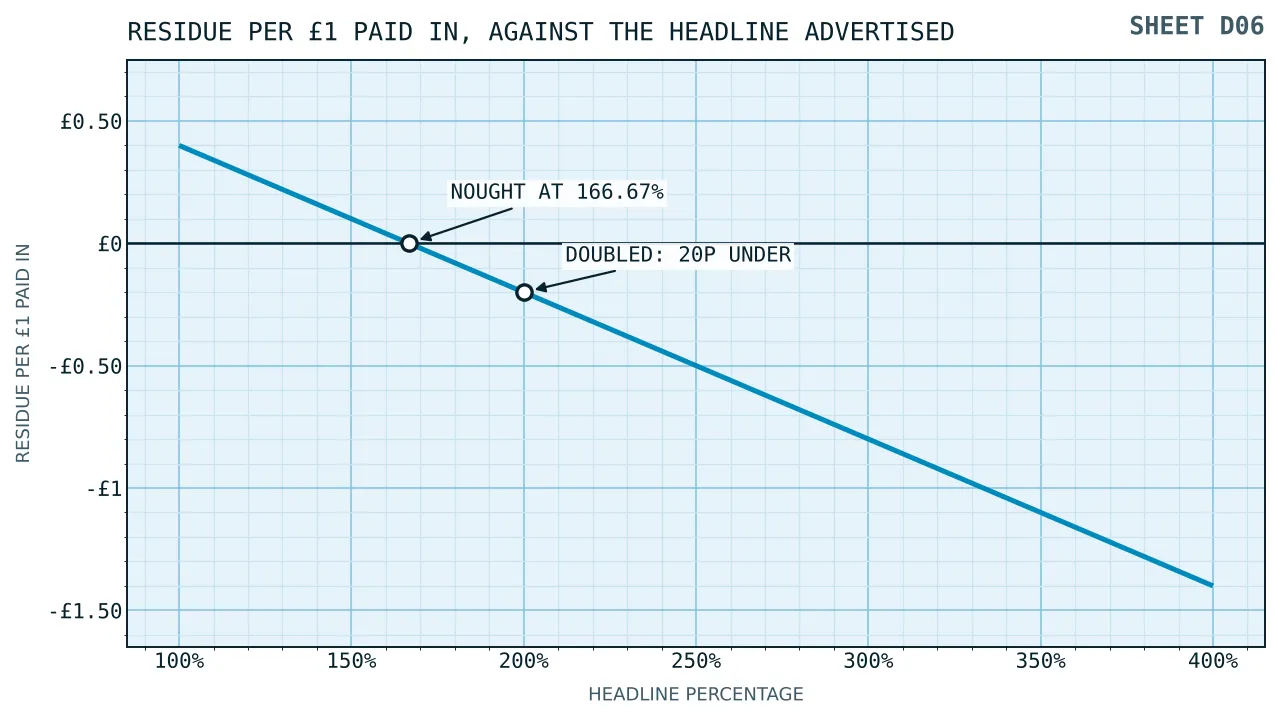
Take the foot of each row in turn and the figures trace a straight descent: sixty pence off for every extra pound of bonus bought per pound paid in. A reader who learns that one slope has learnt the whole ladder, and the percentage on the front becomes a measure of obligation rather than a measure of generosity.
Worth saying plainly, because the advertisement will not. A bigger number on the front is a worse instrument at any fixed multiple, and the only thing that makes a large percentage tolerable is a small W beside it.
5
Thirty-seven and a half turnovers
The other way to find the edge of this offer is to pin the percentage at two hundred and let the multiple move instead.
A doubled tenner holds £30.00 and sheds eighty pence per turnover, since four pence of £20.00 is eighty pence. Thirty pounds divided by eighty pence is thirty-seven and a half. So 37.5 is the multiple at which this headline is worth precisely the payment that bought it, and the forty asked out here stands two and a half turnovers beyond that.
Two and a half turnovers is the entire difference between an offer worth something and an offer worth nothing, which is why a page quoting the percentage and omitting the multiple has reported nothing of use.
| Turnovers demanded | Foot on £10 paid in |
|---|---|
| 10x | £22.00 |
| 20x | £14.00 |
| 25x | £10.00 |
| 30x | £6.00 |
| 37.5x | £0.00 |
| 40x | -£2.00 |
| 50x | -£10.00 |
Three rows there repay a second look.
At twenty-five turnovers the foot is £10.00, which is the payment handed back and not a penny more. Twenty-five fours are a hundred, so at that multiple the bonus has bought its own condition exactly, and it does so at any percentage whatever. Move to a game returning 95 per cent and it becomes twenty; on a 97 per cent game, 33.3. It tracks the house edge inverted and nothing else.
At ten turnovers, the most a British licensee may now demand, a doubled tenner closes at £22.00. That is twelve pounds of profit on a ten pound payment, expected, and it is the clearest measure on this sheet of what one capped term is worth.
At fifty turnovers the reader is £10.00 down, having handed over ten pounds and worked £1,000.00 of staking to keep none of it.
6
The base a multiple bites on
One short phrase buried in a set of bonus rules outweighs the hundred percentage points this sheet is named after, and it is skimmed by almost everybody.
Reckon the forty turnovers on the bonus by itself and a doubled tenner owes £800.00. Reckon them on the payment and the bonus together and the base is £30.00, the staking is £1,200.00, the expected cost is £48.00, and the foot is nothing with £18.00 of the requirement unworked. Nine times the shortfall computed in part 3, out of one conjunction.
| What the requirement says | Balance at the foot |
|---|---|
| Forty turnovers of £20.00 of bonus | -£2.00 |
| Forty turnovers of bonus and payment | -£18.00 |
| Ten turnovers of £20.00 of bonus | £22.00 |
A balance cannot fall below nothing, so read the two negative figures as the amount of staking still owing when the account empties. The gap between the first row and the second is £16.00, which is what the word joining your money to theirs costs on a ten pound payment.
Where a requirement of that breadth stands against the British ceiling has not been put in writing anywhere. Bonus funds are what the ten-times limit speaks of, and no worked case has been published for a condition reaching money the player brought with them. This sheet reports the published wording and declines to extend it.
The practical reading is dull and useful. Find the base before you find the multiple, because a modest multiple on a wide base beats a modest percentage every time, and the two figures are rarely printed the same distance from the headline.
7
What a licence would be worth here
A reel game does not care which flag flies over the room it sits in, and 96 per cent pays the same proportion wherever it is hosted. The jurisdiction settles something else entirely, which is the list of duties running underneath the arithmetic, and a headline doubling the credit this way has no Great Britain licence standing under it. Each missing duty is priced below on the same ten pounds.
Ten turnovers rather than forty
From 19 January 2026 the wagering a British licensee may fasten to bonus funds stops at ten times. Ten turnovers of £20.00 is £200.00 of staking and £8.00 of expected cost, and the foot would read £22.00 instead of nothing. One capped term is worth £22.00 on a ten pound payment, and that is more than the payment and the shortfall put together.
A percentage cannot buy its way past the ceiling
What the ceiling does not touch is the number on the front. A larger percentage under a British licence buys a larger bonus and a proportionally larger obligation, and the exchange rate between them never moves. Four hundred per cent of a tenner is £40.00 of bonus and at most £400.00 of play-through; three hundred gives £30.00 and £300.00; two hundred gives £20.00 and £200.00; a hundred gives £10.00 and £100.00. Ten pounds of turnover per pound of bonus at every rung. The regulated ceiling is the ten; the rest of that paragraph is this sheet’s own multiplication.
Who you are, settled before the bonus is touched
A British licensee will not let a customer gamble until it has obtained and verified who they are, and date of birth, address and name are the minimum that condition 17.1.1 names. Bonus-funded play is caught by the same requirement, and so is a free bet, and so are the games a licensee hosts in demonstration form. Nor may a withdrawal request be the moment the questions begin, where the operator could reasonably have asked sooner. On a matched offer that matters twice over, because the questions arrive before the bonus is credited rather than after a reader has worked £800.00 of staking through it.
What the rulebook out here leaves out
The responsible gaming policy Curaçao published on 21 February 2025, version 1.0, is the offshore rulebook this sheet reads against the British one. Bonuses get two sentences in it: terms are to be put plainly, and aggressive promotion is not to be used to drive excessive play. No multiple is capped. No stake is capped. No interval between cycles is imposed, nothing bars a reel from running itself, and nothing objects to a game celebrating a return that failed to beat the stake that bought it. The £22.00 computed earlier is the cheapest of those absences to count, because it is the only one with a number attached.
One register, or one operator at a time
A British licence drags an operator into Gamstop Online whether it cares for the idea or not, and the scheme is candid about where its reach ends, since it cannot bar a registered person from gambling services supplied by organisations that never joined. Out here exclusion is bought operator by operator. A Curaçao self-exclusion covers one licensee and the domains that licensee runs, and the policy’s answer for everywhere else is to encourage the player to exclude at each of them in turn. The support numbers printed under this sheet are the right first call, and no line on this page will help anybody back through a door they shut on themselves.
8
Pricing a doubled credit yourself
Six lines settle a percentage headline of any size. The third and the sixth are the two that get skipped.
| The line | Here |
|---|---|
| Sum you will actually hand over | £10.00 |
| Bonus the percentage buys | £20.00 |
| Base the requirement attaches to | £20.00 |
| Staking at W over g | £800.00 |
| House edge of that staking | £32.00 |
| Against a balance of £30.00 | -£2.00 |
Weighing two headlines against each other takes one multiplication. Percentage into multiple gives staking per pound paid in: two hundred at forty turnovers comes to £80.00, and so does one hundred at eighty. Two documents with the same product are the same instrument wearing different advertising, and the percentage is the half a reader remembers.
Two cautions before anyone banks a figure of this sort.
A foot computed this way is an average over the long run, never a forecast of one attempt. Nothing is what a doubled credit is worth across a great many repetitions. The commonest result of a single go at it is an empty balance a long way short of the staking demanded, and part 3’s expression says nothing about that spread, by construction.
And a term beats a figure. Five things come off whatever document a cashier has actually published rather than off this one: the multiple, the weighting, the base the requirement attaches to, any lid fixed on the bonus’s winnings, and the number of days the window runs.
Sibling sheets worth reading beside this one: 100% deposit bonus is the rung beneath, and the last on the ladder that leaves anything; 400% deposit bonus stands furthest past the crossing; deposit 10 get 100 free spins pays the same ten pounds out in cycles rather than cash; and slots sign up bonus prices a reel welcome against the rules written for reels. The index at Matched money holds the rest, and How a receipt is struck carries the method in full.
A doubled headline has now been priced, and the price is twenty pence in every pound.
Questions
- What is a 200% deposit bonus worth on £10?
- Nothing, expected, with £2.00 of staking still owing when the balance empties. Two hundred per cent of ten pounds is £20.00 of bonus, so the account holds £30.00. Forty turnovers of the bonus come to £800.00 of staking, and at 96 per cent the house expectation on that is four pence in the pound, or £32.00. Thirty pounds will not cover a bill of thirty-two.
- Why does a larger percentage leave a reader worse off?
- Because the bonus and its obligation arrive together, and past a certain point the obligation is the heavier of the two. At forty turnovers each pound of bonus runs up £1.60 of expected play while giving back a pound, so sixty pence of overrun is fastened to it. At a pound of bonus to a pound of payment, forty pence survives. Two pounds leave nothing and owe twenty pence. Four pounds owe £1.40.
- At what percentage does a match stop leaving anything?
- At 166.67 per cent, on forty turnovers and a 96 per cent game. Write p for the pounds of bonus bought per pound paid in: the balance is 1 plus p, the expected bill is 1.6 times p, and the two are equal when p is one and two thirds. Anything advertised above that figure is expected to cost a reader money, and two hundred per cent is a third of a pound of bonus past it.
- How many turnovers can a doubled credit survive?
- Thirty-seven and a half. A doubled tenner holds £30.00 and sheds eighty pence per turnover, because four pence of £20.00 is eighty pence, and thirty pounds divided by eighty pence is 37.5. The forty asked at this end of the market stands two and a half turnovers beyond that, and those two and a half turnovers are the whole difference between an offer worth something and an offer worth nothing.
- How much staking does a 200% match owe per pound paid in?
- £80.00. A pound buys two pounds of bonus and forty turnovers of two pounds is eighty pounds across the reels. Percentage into multiple gives that figure directly, which is also why two hundred per cent at forty turnovers and one hundred per cent at eighty turnovers are the same instrument under two different advertisements.
- What would the same headline leave under a British licence?
- £22.00 on the same ten pounds, against nothing out here. Wagering fastened to bonus funds by a British licensee has stopped at ten times since 19 January 2026, so the staking would be £200.00 rather than £800.00 and the expected cost £8.00 rather than £32.00. Set that against the £30.00 held and the foot is £22.00, which is twelve pounds of expected profit on a ten pound payment.
- What happens if the turnover is reckoned on the deposit too?
- It makes it nine times worse. Reckoned on the bonus alone, forty turnovers of £20.00 is £800.00 of staking costing £32.00, and £2.00 is owing when the balance empties. Reckoned on the payment and the bonus together the base is £30.00, the staking £1,200.00 and the cost £48.00, which leaves £18.00 owing. Whether the British ten-times ceiling reaches a condition drawn that widely is unpublished, and this sheet declines to guess in either direction.
- How long would £800.00 of staking take at 10p a cycle?
- Twenty thousand seconds at the very quickest, which is five hours, thirty-three minutes and twenty seconds. Eight thousand cycles is what the staking divides into at 10p, and a British reel game may not start the next inside 2.5 seconds of the last. RTS 8A will not let software run them unattended, so the 8,000 are also 8,000 separate decisions to carry on.
- What protection does a 200% offer without a Great Britain licence drop?
- A specific list, and £22.00 of it has a price on this page. Wagering would be capped at ten times bonus funds. Betting, casino, bingo and lottery credit could not be mixed inside one incentive. Date of birth, address and name would be verified ahead of any play whatever, including play paid for by a bonus. Reel stakes would be capped at £5 a cycle, or £2 under twenty-five years of age, with 2.5 seconds between cycles and no software running them. A deposit balance could not be capped on the way out. Gamstop Online would cover the operator. The Curaçao policy read for this sheet carries none of that.