
Sheet D07 Revision 1 Checked 15 October 2026
Deposit 10 get 100 free spins
Multiply the hundred cycles by 10p and the face is £10.00; take 96 per cent of that and the average return is £9.60. Forty turnovers bill £384.00 of staking at £15.36 of expected cost, and £4.24 of the ten pounds is expected back.
5.76p of overrun attaches to each cycle awarded
What a hundred cycles leave
Every destination on this spike is bought advertising. The site takes a fee if a reader goes on to register, and no figure printed below moves because of it.
The Spin Sheet
Till receipt No 01
Betportal
Lowest multiple here
For every €1 of spin credit at face per €1
Credit
Debit
No Great Britain licence
Licensed in Anjouan, Comoros, run by BetPortal Gaming Ltd, with Excite Ultra Media Ltd, reference ALSI-202601040-FI2.
Terms read 15 October 2026
Open the offer at Betportal, opens in a new tabThe Spin Sheet
Till receipt No 02
WinBeast
Five staged matches
For every €1 of spin credit at face per €1
Credit
Debit
No Great Britain licence
Licensed in Curaçao, operator not named on the site.
Terms read 15 October 2026
Open the offer at WinBeast, opens in a new tabThe Spin Sheet
Till receipt No 03
EliteSpin
Longest spin window
For every £1 of spin credit at face per £1
Credit
Debit
No Great Britain licence
Licensed in Costa Rica, run by PrimeTier Limited.
Terms read 15 October 2026
Open the offer at EliteSpin, opens in a new tabThe Spin Sheet
Till receipt No 04
Crown Jewelz
Multiple unpublished
No total struck
Credit
Debit
No Great Britain licence
Licensed in Curaçao, number not verified, operator not named on the site.
Terms read 15 October 2026
Open the offer at Crown Jewelz, opens in a new tabThe figure at the foot of a receipt is this site's own arithmetic and nothing an operator has published: the credit, less the share a spin gives back at 96 per cent return to player, less what playing the wagering through costs at the same return. It describes the offer, not one reader's afternoon. Where the conditions price above the credit the receipt prints nothing rather than a negative sum, and where a figure the sum needs is unpublished it prints the condition in the operator's words instead.
Three words stand in the amount column where no figure can. Noted is a published condition that takes value away without leaving the sum a figure to take. Unpriced is a condition whose figure nobody has published, or a credit that is not a sum until a deposit of your own sets it. Own money is money of yours, which is never part of a total.
Not one of the operators printed above holds a Great Britain licence, so the duties that licence carries do not reach them. Every online gambling company licensed in Great Britain has to be part of Gamstop Online, and a reader who has shut themselves out through the scheme is therefore not shut out here. The ceiling of ten times the bonus funds on a wagering requirement, in force since 19 January 2026, is a condition of that licence and binds the companies that hold one. Where a dispute goes instead is a matter for the authority named on the receipt, and the Gambling Commission describes what a reader faces without a British licence as a lack of recourse if things go wrong. Nobody under 18 may hold an account at any of them.
Every term printed on a receipt is the operator's own, and each receipt carries the day it was read. The oldest of those readings is 15 October 2026. What binds a reader is the operator's own full terms, and not a line printed here.
1
What a hundred cycles are worth
An award of cycles is not an award of money, and this sheet is about the distance between those two things. A cashier that hands over a hundred of them has handed over a hundred opportunities to stake 10p, not ten pounds.
Price the award in two steps. The face is the count times the stake, so a hundred at 10p is £10.00 of face. The average return is the face times the proportion a reel game gives back, so £10.00 at 96 per cent averages £9.60. Forty pence of the face is consumed before any condition is reached at all, by the ordinary edge of the game the cycles are spent on.
So the credit this sheet goes on to price is £9.60, and not the round ten pounds a reader would get from reading the headline twice. The difference looks small. Multiplied by forty it is £16.00 of staking, which is a larger sum than the award is worth.
Beside the award sits the ten pounds the reader paid in to qualify. That tenner is not a winning, has never been a winning, and does not become one when the cashier credits the cycles. It is money that changed accounts, and every total on this sheet carries it as a debit of the reader’s rather than a credit of anybody else’s.
Four working figures, and none of them is fixed by any rule:
- A cycle priced at 10p. No British rule sets the cash value of a free spin, so 10p is a figure chosen for this site and carried across every sheet on it.
- A theoretical return of 96 per cent, with the stake contributing in full towards the requirement.
- Forty turnovers, which is the magnitude asked in this bracket of the market. A British licensee may go no higher than ten.
- The requirement set against the winnings from the cycles and not against the ten pounds. Part 6 says what happens to that assumption.
2
One cycle, accounted end to end
Divide the award by a hundred and a single cycle carries the entire argument.
| The line | Per cycle |
|---|---|
| Face, at the stake this site works to | 10.00p |
| Average return at 96 per cent | 9.60p |
| Staking owed at forty turnovers | £3.84 |
| Expected cost of that staking | 15.36p |
| Left of the cycle | -5.76p |
Read the last line slowly. Each cycle awarded brings in 9.6p of average winnings and brings with it 15.36p of expected cost, so it closes 5.76p underwater. The award is a liability priced in single pence, repeated a hundred times.
A hundred of them therefore run £5.76 underwater between them, and the only thing in the account capable of absorbing that is the ten pounds the reader paid in to qualify. Ten pounds less £5.76 is £4.24, and one subtraction has now done the work of the whole sheet.
The per-cycle figure is the useful one to carry about, because it is indifferent to the count. Two hundred cycles would run £11.52 underwater. Three hundred would run £17.28 underwater. A larger award bolted to the same ten pound payment makes the arithmetic worse and the advertisement better, which is a combination worth recognising on sight.
£3.84 of staking owed for each cycle awarded
3
£9.60 through the one expression
Per-cycle reasoning is quick, and the award deserves one pass through the long form, so the whole hundred goes into the site’s standing expression together.
E = B × (1 – (W × (1 – RTP)) / g)
Symbol by symbol, in the order each one bites. B is the credit the condition attaches to, £9.60 of average winnings from the cycles. W is the count of turnovers demanded, forty. RTP is the proportion the reels return, 0.96, which makes the house’s expectation four pence in the pound. The weighting g is one. E is what is left of the credit when the condition has been satisfied.
£9.60 × 40 = £384.00 of staking
£384.00 × 0.04 = £15.36 of expected cost
E = £9.60 – £15.36 = -£5.76
In pounds and pence: forty turnovers of £9.60 make £384.00 of staking, and the house expectation of four pence per pound bills £15.36. Set that beside the £9.60 it is fastened to and the condition outruns its own credit by £5.76, which is the figure part 2 arrived at the other way round.
Where no payment is asked, a negative E has nowhere to land and the answer rests at nought. An offer with a qualifying payment behind it is different, because the staking draws on whatever is in the balance and the balance holds the reader’s tenner. So the close is £19.60 held less £15.36 spent, which is £4.24: 42.4 pence in the pound of what was paid in.
The clock is the same obligation in seconds. At 10p a cycle, £384.00 of staking is 3,840 cycles, and the British standard holds a reel game to one cycle every 2.5 seconds, which floors the lot at 9,600 seconds. Two hours and forty minutes, exactly, and that is before a single cycle runs slower than the standard allows. The hundred awarded cycles themselves take 250 seconds of it. Everything after the first four minutes and ten seconds is staked out of the account rather than given.
£15.36 of expected cost against £19.60 in the account
4
£5.76, and the payment that covers it
Something peculiar happens when the payment moves and the award does not, and it is the most practical result on this sheet.
The staking owed never changes. A hundred cycles arrive whatever the payment is, five pounds or five hundred, the winnings they average are £9.60 either way, and forty turnovers of £9.60 is £384.00 of staking in both cases. The bill is £15.36, flat, and it is met out of a balance that grows pound for pound with the payment.
So the whole offer turns on one threshold: the payment has to cover £5.76, which is the amount by which the bill exceeds the credit it was attached to. Pay in less and the balance empties with the condition unfinished. Pay in more and the excess is what survives.
| Paid in | Balance | Staking owed | Expected cost | At the foot |
|---|---|---|---|---|
| £5.00 | £14.60 | £384.00 | £15.36 | £0.00 |
| £5.76 | £15.36 | £384.00 | £15.36 | £0.00 |
| £10.00 | £19.60 | £384.00 | £15.36 | £4.24 |
| £20.00 | £29.60 | £384.00 | £15.36 | £14.24 |
| £50.00 | £59.60 | £384.00 | £15.36 | £44.24 |
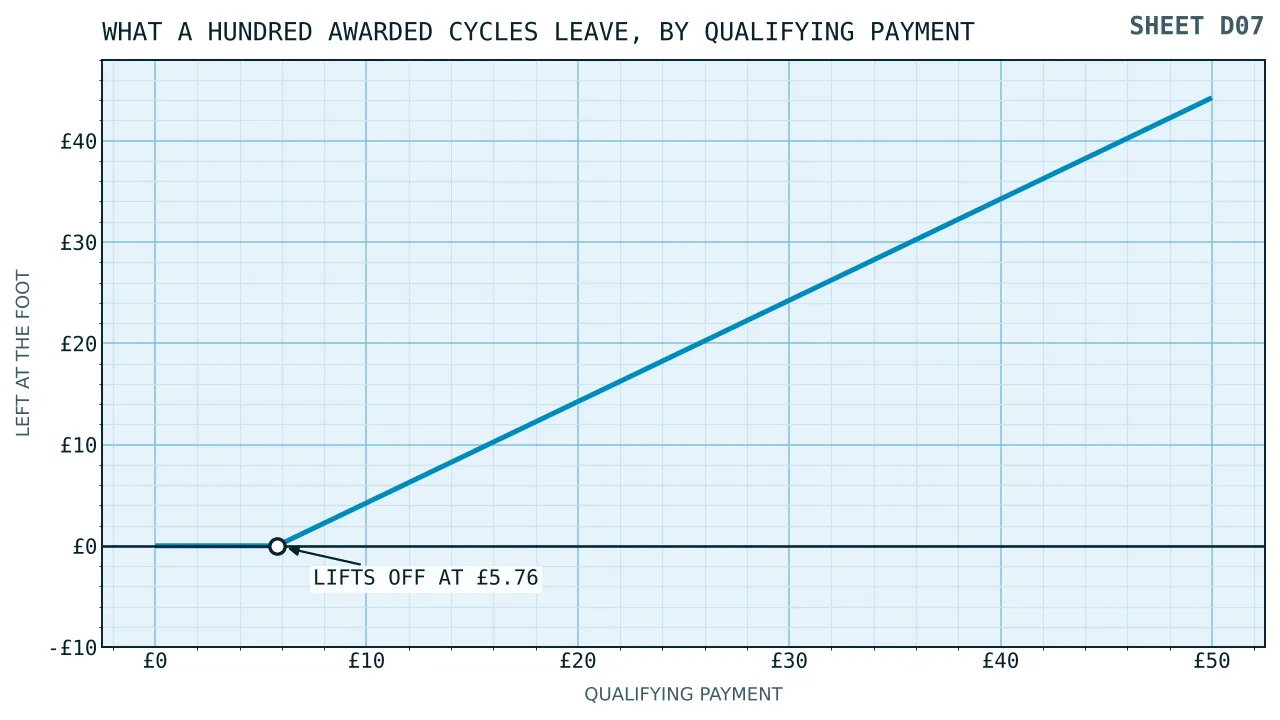
Two readings of that drawing deserve stating, because they pull in opposite directions.
A ten pound payment clears the threshold by £4.24, which is the number this sheet is named for. A five pound payment does not clear it at all and closes at nothing with 76p of the condition still unworked. Ten pounds is on the right side of the line, which makes this particular pairing of payment and award one of the few in its family that survives contact with a forty times requirement.
Surviving is not the same as gaining. Four pounds and twenty-four pence back out of ten pounds paid in is a loss of £5.76 against never having taken the offer at all, and the reader has committed two hours and forty minutes of individual decisions to arrive at it.
5
Twenty-four pence better than cash
Set the award against the cash alternative and a small surprise falls out. A tenner matched once over in bonus money leaves £4.00 at forty turnovers. A tenner paid in for a hundred cycles leaves £4.24. The cycles win, by twenty-four pence.
The reason is the order in which the two haircuts fall. Cash credit of £10.00 goes into the requirement at its full face, so the base is ten pounds and the staking is £400.00. The cycles take their 4 per cent first, which drops the base to £9.60 and the staking to £384.00. Sixteen pounds less of staking is 64p less of expected cost, against 40p less in the balance, and the difference between those two numbers is the twenty-four pence.
Nobody should choose an offer on twenty-four pence. The point of the comparison is the mechanism: a requirement is cheaper when it bites on a base that has already been discounted, and a spin award is a cash credit that has been discounted before the multiple arrives. It is also why a cashier can advertise a hundred cycles as being worth ten pounds while handing over something that prices at £9.60.
One further asymmetry runs the other way, and part 6 is where it is priced. A cash credit of £10.00 is money in an account. A hundred cycles is an entitlement to stake, and an entitlement can expire with cycles unused, be paid out in instalments across several days, or be restricted to one named game. None of those three things can happen to ten pounds of cash credit, and none of them appears anywhere in the expression.
6
What the award declines to tell you
Three figures govern an award of cycles, and only one of them is reliably printed beside the headline. The count usually is. The stake behind each cycle and the condition attached to the winnings are the two that decide the answer.
Nobody publishes what a cycle is worth
Searching the British regulator’s own material for a rule on the cash value of a free spin returns nothing: no minimum, no maximum, no disclosure duty aimed at the figure itself. The pence behind a cycle is a commercial choice made by whoever is giving it away. Two things are nonetheless owed to a reader before they commit. Under RTS 3C the information needed to judge the chances of winning must be easy to get hold of beforehand, which may be served by a return percentage, by the house margin, or by the probabilities of the winning events. And under Social Responsibility Code 5.1.1 the terms of an incentive must be clear, fair, transparent and easy for the person being offered it to find.
The consequence for this sheet is arithmetical. Halve the stake behind each cycle and the award’s own figures halve with it: £4.80 of average winnings, £192.00 of staking and £7.68 of expected cost, which leaves £7.12 at the foot of a ten pound payment. A hundred cycles at 5p is another offer entirely under an identical headline.
Whether the ceiling reaches a cycle at all
Here is a gap that has to be left open. The British limit of ten times speaks of bonus funds. Whether a free spin is itself bonus funds for that purpose has not been published, and this sheet will not fill the hole in either direction. What can be said is the chain: where a player’s winnings from a cycle are credited as bonus funds, the requirement set on those funds cannot pass ten times. Beyond that the wording runs out, and a page that announces the cap covers free spins as such has gone further than the published material permits.
The clauses an advertisement is obliged to show
Four kinds of clause sit on the advertising regulator’s own catalogue of what counts as significant in a gambling promotion. The window inside which an offer must be claimed and used is one. A bar on particular bet types, or a floor under the odds, is another. The money or the turnover demanded is the third. The gate on who qualifies at all, whether by age, by location or by not already holding an account, is the fourth. Every one of them is a printed line on an award of cycles, and CAP Code rule 8.17 asks for significant conditions to be put clearly and prominently where leaving them out would mislead. The British regulator supplies the consequence: where significant conditions are not prominent enough, the advertisement is a misleading one.
Two rulings put dates on that. A voucher worth five pounds in free bets breached the Code on 27 August 2025, because it did not work on 14 March, the day of the Cheltenham Gold Cup, and said nothing about that. On 17 July 2024 a ten pound free bet depended on a reply by text before a set time. That deadline went unstated in the advertisement, and the regulator treated it as a condition significant enough that omitting it was likely to mislead. Neither case concerned cycles on a reel game. Both concerned a deadline a reader could not see.
A lid on the winnings, which the withdrawal rule does not touch
Nothing in the primary sources fixes a standard ceiling on what bonus money may win, so no figure for one is quoted anywhere here. What does need separating is a pair of rules that sound alike. A British licensee may not put any maximum at all on what a player withdraws from a deposit balance. Fifty pounds a day with five hundred a week is the specimen of forbidden wording the regulator prints. That protection reaches the ten pounds a reader paid in. It does not reach a cap on what £9.60 of spin winnings may turn into, because that is a different instrument altogether. Both can be true at once on the same account, and knowing which is which is the difference between reading a term and guessing at it.
7
£11.52 of licence on one award
None of the arithmetic above depends on where the room is kept. A reel game returning 96 per cent behaves the same under any flag. What the jurisdiction settles is the list of duties underneath it, and a spin award bought with a ten pound payment has no Great Britain licence to stand on. The missing duties are costed below on the same award.
Ten turnovers in place of forty
Social Responsibility Code 5.1.1 has capped a British wagering requirement at ten times the bonus funds, in force from 19 January 2026. Ten turnovers of £9.60 is £96.00 of staking and £3.84 of expected cost, which lifts the foot from £4.24 to £15.76. One ceiling, £11.52, on a hundred cycles and a tenner. The regulator’s stated reason for acting was a market in which requirements ran as high as sixty times, so the forty worked here sits between the old practice and the new ceiling.
Checks that come before the cycles do
A British licensee may not allow anybody to gamble before it has established and checked who they are, with date of birth, address and name named as the minimum. The duty does not stop at a player’s own money: it reaches play funded from a bonus, play on a free bet, and the demonstration builds of the games as well. Nor may a withdrawal request be the first moment the questions arrive, where they could reasonably have been asked earlier. The practical effect on an award of cycles is that the identity work happens before the award is credited rather than after two hours and forty minutes of staking.
Pace, and who decides each cycle
Two British rules put a floor under the time an award of this size takes. RTS 14D holds a reel game to a minimum of 2.5 seconds from the start of one cycle to the point where the next may begin. RTS 8A requires the customer to commit to each cycle individually, which is the autoplay ban, and the guidance carves out nothing beyond automatic blinds in peer-to-peer poker. Together they turn 3,840 cycles into 3,840 separate decisions spread over at least 9,600 seconds. Neither rule appears in the Curaçao policy this sheet reads against the British one, where an award may be cleared as fast as the software runs.
What is absent from the offshore rulebook
The Curaçao rulebook this sheet reads is a responsible gaming policy at version 1.0, issued 21 February 2025. Bonuses get two sentences in it: promote them transparently with clear terms, and do not drive excessive play with aggressive promotion. Nothing caps a multiple. Nothing caps a stake. Nothing imposes an interval between cycles, nothing forbids software from taking the cycles for the player, and nothing objects to a game making a fuss of a return that came in at or under the stake. On one point it is the stricter regime: a request to lower a deposit limit takes effect at once there, as it does in Great Britain, while a request to raise one sits out seven days against twenty-four hours here.
Exclusion from one place, or from one operator
A Great Britain licence puts an operator inside Gamstop Online as a condition, and the scheme says plainly where that leaves a registered person: it cannot keep them away from gambling services run by organisations that are not in it. Out here the unit of exclusion is the operator. A Curaçao self-exclusion runs across one licensee and the domains it holds, lasts a year at the shortest and cannot be lifted before it expires. For anywhere else, the policy’s answer is encouragement rather than coverage. Nothing on this sheet will help anybody around a block they put in place, and the support numbers stand at the foot of the page.
8
Pricing an award of cycles yourself
Six lines price any award of this shape, and the second line is the one that does the damage.
| The line | Here |
|---|---|
| Count times the stake behind a cycle | £10.00 |
| Apply the game’s return to the face | £9.60 |
| Staking at W over g | £384.00 |
| House edge of that staking | £15.36 |
| Balance it is charged against | £19.60 |
| At the foot | £4.24 |
The shortcut for anybody weighing two awards side by side is the per-cycle overrun. At forty turnovers and 96 per cent, a cycle costs 5.76 times its own stake in expected loss beyond what it brings in, so a 10p cycle runs 5.76p underwater and a 20p cycle runs 11.52p underwater. Multiply by the count and compare the answer with the qualifying payment. If the payment is the smaller figure, the offer prices at nothing before anything else in the terms has been read.
Two warnings sit on that £4.24.
It is an average across a great many attempts and not a prediction of one. A single run at a hundred cycles and £384.00 of staking most commonly ends with an empty balance and the condition unfinished, and the expression was never built to describe that spread.
And the terms outrank the figures. Five things have to come off whatever document the cashier has actually published: the multiple, the stake behind each cycle, whatever base the requirement bites on, any lid on what the winnings may become, and how long the window stays open.
Nearby sheets run the same arithmetic over different shapes of award. Deposit 5 get 200 free spins doubles the count and halves the payment, which is the pairing the threshold in part 4 rules out. 100% deposit bonus is the cash version of the same tenner, priced at four pounds flat. Casino welcome bonus bolts the two instruments together and prices the pair at once. Everything in Matched money is built on the method at How a receipt is struck, which spells it out line by line.
A hundred cycles have now been costed one cycle at a time, and the bill is 5.76p apiece.
Questions
- What is deposit 10 get 100 free spins actually worth?
- £4.24 of the ten pounds, expected. A hundred cycles staked at 10p have a face of £10.00, and a reel game returning 96 per cent averages £9.60 back. Forty turnovers of £9.60 puts £384.00 across the reels, of which the edge expects £15.36. The balance holding that bill is £19.60, so £4.24 survives it.
- Why is the credit £9.60 rather than £10.00?
- Because the face of an award is what it lets a player stake, not what it pays them. A hundred cycles at 10p is £10.00 of staking handed over, and the ordinary edge of the game takes four pence in the pound of it before any bonus condition is reached. Forty pence goes that way, which leaves £9.60 of average winnings for the requirement to bite on.
- How much does one free spin cost in the end?
- 5.76p, at forty turnovers and 96 per cent. A single 10p cycle averages 9.6p of winnings and drags £3.84 of staking behind it, which is expected to cost 15.36p. Take the one from the other and each cycle closes 5.76p underwater. A hundred of them come to £5.76, and the qualifying payment is the only thing in the account able to absorb it.
- What is the smallest deposit that makes this offer worth taking?
- £5.76, on this award and this multiple. The staking owed never moves with the payment, because a hundred cycles arrive whatever is paid in and forty turnovers of £9.60 is £384.00 either way. The bill is a flat £15.36 against a balance of the payment plus £9.60, so the two are equal at £5.76 and anything smaller empties the account with the condition unfinished.
- Are 100 free spins better than £10 of bonus money?
- By twenty-four pence on these figures, which is a mechanism rather than a recommendation. Cash credit of £10.00 enters the requirement at face, so the staking is £400.00 and the foot reads £4.00. The cycles are discounted to £9.60 before the multiple arrives, so the staking is £384.00 and the foot reads £4.24. A requirement costs less when it bites on a base that has already been cut.
- How long does £384.00 of staking take at 10p?
- Nine thousand six hundred seconds at the fastest, which is two hours and forty minutes. The staking of £384.00 divides into 3,840 cycles at 10p, and the British standard allows a reel game one cycle every 2.5 seconds. RTS 8A requires a commitment to each cycle individually, so those 3,840 are 3,840 separate decisions rather than one instruction.
- Does the ten-times cap cover free spins?
- That has not been published, and this sheet will not guess at it. The British limit speaks of bonus funds, and no source states whether a free spin is itself bonus funds for that purpose. The narrow thing that can be said: once a cycle’s winnings have been credited to a player as bonus funds, ten turnovers is as far as any requirement on them may go.
- What would a hundred cycles leave under a British licence?
- £15.76 instead of £4.24, on the same ten pound payment. The British ceiling of ten times on bonus funds took effect on 19 January 2026, which turns £384.00 of staking into £96.00 and £15.36 of expected cost into £3.84. The ceiling alone is worth £11.52 here, and the figure the regulator gave for what it was fixing was sixty times.
- What does a reader give up on an award with no Great Britain licence?
- A list that can be named duty by duty, and this is what a British licence would impose on the same award. The multiple could not pass ten. The identity work would be finished, to a standard naming date of birth, address and name, before the first cycle ran. Each cycle would carry a statutory ceiling of £5 on a reel game, or £2 for anybody under twenty-five, and 2.5 seconds would separate it from the one after. Software could not take the cycles. A near-miss could not be substituted for an ordinary loss, turbo and slam stop would be unavailable, and a return no better than the stake would get no fanfare. A withdrawal once asked for could not be handed back, and nothing could cap what comes out of the deposit balance. The operator would sit inside Gamstop Online. Curaçao’s rulebook, read for this sheet, contains none of that.