
Sheet D08 Revision 1 Checked 15 October 2026
400% deposit bonus
Forty pounds of bonus arrives on a payment of ten, and forty turnovers of it demand £1,600.00 of staking. The edge on that comes to £64.00 against £50.00 in the account, so the balance empties with £14.00 of the condition still to work off.
£1.40 gone from each pound paid in at forty times
What a quadrupled credit leaves
Every destination on this spike is bought advertising. The site takes a fee if a reader goes on to register, and no figure printed below moves because of it.
The Spin Sheet
Till receipt No 01
Betportal
Lowest multiple here
For every €1 of spin credit at face per €1
Credit
Debit
No Great Britain licence
Licensed in Anjouan, Comoros, run by BetPortal Gaming Ltd, with Excite Ultra Media Ltd, reference ALSI-202601040-FI2.
Terms read 15 October 2026
Open the offer at Betportal, opens in a new tabThe Spin Sheet
Till receipt No 02
WinBeast
Five staged matches
For every €1 of spin credit at face per €1
Credit
Debit
No Great Britain licence
Licensed in Curaçao, operator not named on the site.
Terms read 15 October 2026
Open the offer at WinBeast, opens in a new tabThe Spin Sheet
Till receipt No 03
EliteSpin
Longest spin window
For every £1 of spin credit at face per £1
Credit
Debit
No Great Britain licence
Licensed in Costa Rica, run by PrimeTier Limited.
Terms read 15 October 2026
Open the offer at EliteSpin, opens in a new tabThe Spin Sheet
Till receipt No 04
Crown Jewelz
Multiple unpublished
No total struck
Credit
Debit
No Great Britain licence
Licensed in Curaçao, number not verified, operator not named on the site.
Terms read 15 October 2026
Open the offer at Crown Jewelz, opens in a new tabThe figure at the foot of a receipt is this site's own arithmetic and nothing an operator has published: the credit, less the share a spin gives back at 96 per cent return to player, less what playing the wagering through costs at the same return. It describes the offer, not one reader's afternoon. Where the conditions price above the credit the receipt prints nothing rather than a negative sum, and where a figure the sum needs is unpublished it prints the condition in the operator's words instead.
Three words stand in the amount column where no figure can. Noted is a published condition that takes value away without leaving the sum a figure to take. Unpriced is a condition whose figure nobody has published, or a credit that is not a sum until a deposit of your own sets it. Own money is money of yours, which is never part of a total.
Not one of the operators printed above holds a Great Britain licence, so the duties that licence carries do not reach them. Every online gambling company licensed in Great Britain has to be part of Gamstop Online, and a reader who has shut themselves out through the scheme is therefore not shut out here. The ceiling of ten times the bonus funds on a wagering requirement, in force since 19 January 2026, is a condition of that licence and binds the companies that hold one. Where a dispute goes instead is a matter for the authority named on the receipt, and the Gambling Commission describes what a reader faces without a British licence as a lack of recourse if things go wrong. Nobody under 18 may hold an account at any of them.
Every term printed on a receipt is the operator's own, and each receipt carries the day it was read. The oldest of those readings is 15 October 2026. What binds a reader is the operator's own full terms, and not a line printed here.
1
Fifty pounds, ten of them yours
Nothing in this corner of the market shouts louder than a quadrupled bonus, and nothing prices worse. Pay in ten pounds, watch £40.00 appear beside it, and the account shows £50.00. Forty of those fifty pounds belong to whoever put the offer up, and in expectation the condition attached to them takes them back before a reader sees any of it.
Two sums, two columns, and they do not get added together anywhere on this sheet. The tenner is money that moved between accounts and stayed in one name throughout. The £40.00 is a conditional entry whose value depends entirely on a turnover figure printed somewhere else in the terms, and which can be worth nothing at all.
Scale is the thing to hold on to. A quadrupled bonus is four times the credit of a matched one, so it brings four times the obligation, and the obligation does not stop politely when it has used up the bonus. Once it has consumed the £40.00 it carries on into the ten pounds the reader brought, which is how a headline advertising four hundred per cent ends up costing its taker the whole payment.
What is being held fixed, and what would change the answer:
- A payment of ten pounds, credited at four hundred per cent.
- Reels returning 96 per cent of what is staked through them over the long run.
- Stakes contributing in full, so a pound of play clears a pound of requirement.
- Forty turnovers, the figure commonly printed in this bracket. A British licensee stops at ten.
- The condition reckoned on the bonus and not on the payment. Nothing on this sheet assumes the wider version, which would be worse again.
2
A pound in, £1.40 out
One pound is enough to carry the whole page, and the working runs to four lines.
A pound paid in buys four pounds of bonus, which puts £5.00 in the account. Forty turnovers of four pounds send £160.00 across the reels. At four pence of expectation per pound staked, that bills £6.40. Five pounds held against a bill of six pounds forty leaves the account empty and £1.40 of staking unperformed.
So the unit of this offer is a loss of £1.40 for every pound handed over, and the pound itself is part of that loss. Pay in ten and the gap is £14.00. Pay in a hundred and it is £140.00. There is no payment size at which a quadrupled bonus at forty turnovers comes out level, because the shortfall rises in step with the payment rather than against a fixed cost.
That last sentence is the difference between this sheet and a fixed award of spins. An award of a hundred cycles costs the same whatever the payment, so a large enough payment eventually covers it. A percentage bonus scales, so a large payment buys a proportionally larger hole. Four hundred per cent is the worst rung of the percentage ladder at every payment size on it.
Where the slope comes from is worth one line of its own. Each pound of bonus is expected to eat £1.60 of play while handing back £1.00, so sixty pence of overrun rides on it. Four pounds of bonus therefore carry £2.40 of overrun, against one pound of the reader’s to meet it. One pound less two pounds forty is minus £1.40, which is the same figure arrived at from the other end.
£160.00 of staking owed per £1 paid in
3
£1,600.00 across the reels
The per-pound route is quick. The long form is worth running once on the full tenner, because the intermediate figures are the ones a reader will want to recognise again.
E = B × (1 – (W × (1 – RTP)) / g)
Unpacked: E is the residue. B is the bonus at face, which is £40.00. W is the turnovers demanded, forty. RTP is the share the reels return over the long run, 0.96, so the complement is the four pence in the pound the house expects. g is the weighting, taken at one because slots contribute in full.
E = £40.00 × (1 – (40 × 0.04) / 1)
E = £40.00 × (1 – 1.60)
E = -£24.00
Now in money. Forty turnovers of £40.00 is £1,600.00 of staking. Four pence in each of those sixteen hundred pounds is £64.00 of expected cost. The bonus the cost is fastened to is £40.00, so the condition runs £24.00 past the thing it was attached to.
Twenty-four pounds must be found, and the balance holds nothing else except the reader’s own money. Ten pounds of it exists, the shortfall is £24.00, and the account therefore closes at nothing with £14.00 of the requirement still unmet. A reader who never claimed the offer would be ten pounds better off, and a reader who claims it is expected to lose the lot with the bonus never having become withdrawable.
The hours belong to the same figure. At 10p a cycle the obligation comes to 16,000 pulls. Under RTS 14D a cycle on a reel game may not follow its predecessor inside two and a half seconds, so 40,000 seconds is the floor under it: eleven hours, six minutes and forty seconds. RTS 8A makes each of those cycles an individual commitment, because software is not permitted to take them, so the figure is simultaneously a quantity of time and a count of decisions.
£64.00 of expected cost against £50.00 held
4
31.25 turnovers, and not one more
Every percentage headline has a multiple at which it stops being worth anything, and for this one the figure is unusually low.
A quadrupled pound holds £5.00 and sheds sixteen pence per turnover, because four pence of £4.00 is sixteen pence. Five pounds divided by sixteen pence is 31.25. Past that multiple whoever takes the offer is funding it, and the forty asked out here is nearly nine turnovers beyond the limit.
| Turnovers | Staking per £1 | Expected cost | Foot per £1 | On £10 paid in |
|---|---|---|---|---|
| 10x | £40.00 | £1.60 | £3.40 | £34.00 |
| 20x | £80.00 | £3.20 | £1.80 | £18.00 |
| 25x | £100.00 | £4.00 | £1.00 | £10.00 |
| 31.25x | £125.00 | £5.00 | £0.00 | £0.00 |
| 40x | £160.00 | £6.40 | -£1.40 | -£14.00 |
| 50x | £200.00 | £8.00 | -£3.00 | -£30.00 |
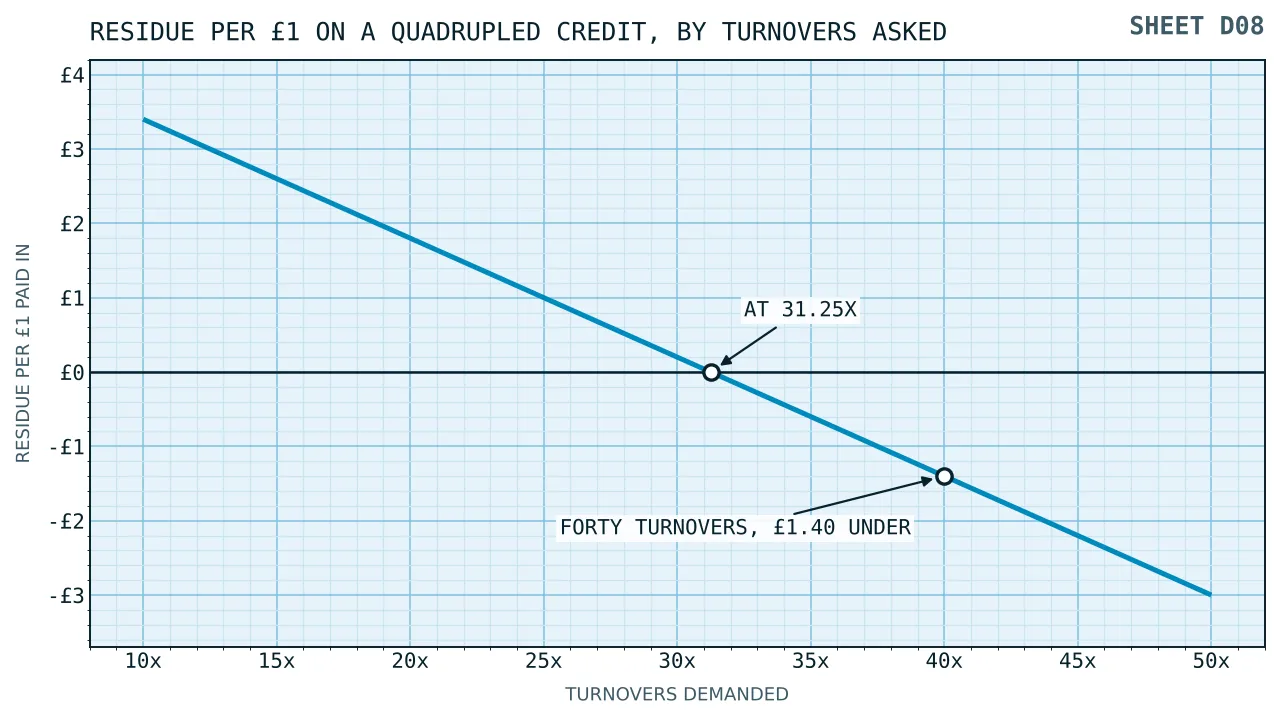
Three rows there carry more than their figures.
Twenty-five turnovers hands the payment back and adds nothing, and the reason is unconnected with four hundred per cent. Four pence taken twenty-five times is a pound, so at that multiple a pound of bonus has paid for its own condition precisely. The figure is the house edge inverted and holds at any percentage: a 95 per cent game gives twenty, a 97 per cent game 33.3.
Ten turnovers, the ceiling a British licensee now works under, turns the same tenner into £34.00. That is twenty-four pounds of expected gain on ten pounds paid in, and it is the entire argument for reading W before the percentage.
Fifty turnovers takes three pounds from every pound paid in. A reader paying in ten pounds under those terms is expected to lose the ten with the condition unmet, having staked £2,000.00 getting there.
5
£160.00 of staking for every pound
One multiplication compares any two percentage offers, and it is the only arithmetic a reader needs at the point of choosing. Take the percentage into the multiple and the product is staking per pound paid in.
Four hundred at forty turnovers gives £160.00 for every pound. So does one hundred at a hundred and sixty turnovers, and so does two hundred at eighty. Three offers, one obligation, and the difference between them is entirely a matter of which half of the sum is printed in a larger typeface.
Within Great Britain the same multiplication has a ceiling bolted to one of its factors, and the result is tidier than a reader might expect. The limit falls on W rather than on the percentage, so a bigger headline buys a bigger bonus and a proportionally bigger obligation, the ratio between them pinned at ten to one. On a tenner that reads as £40.00 of bonus against at most £400.00 of play-through at four hundred per cent; £30.00 against £300.00 at three hundred; £20.00 against £200.00 at two hundred; and £10.00 against £100.00 at a hundred. The ten is the regulated figure. The rest of that list is this sheet multiplying.
Which is the useful thing to know about a large percentage under a licence: it is not generous and it is not dangerous either. It is proportional. A reader doubling the headline doubles both sides of the bargain and ends in the same place per pound, which is why the percentage alone has never been a reason to prefer one set of terms to another.
Out here, where no ceiling sits on the multiple, the same percentage is free to be paired with a figure of any size at all. That is the whole of the difference, and it is worth £48.00 on this tenner: the gap between the £16.00 of expected cost at ten turnovers and the £64.00 at forty.
6
Clauses that empty it without W
E prices a turnover and is blind to prose. Three kinds of clause commonly fastened to a large percentage bonus sit outside the expression altogether, and any of them can take the total to nothing while the multiple looks perfectly ordinary.
What a bonus is allowed to win
No published rule sets a standard maximum win on bonus money, and this sheet invents none. Two protections do stand nearby and they are routinely confused. The first stops a British licensee capping, at any level at all, the money a player draws down from a deposit balance. The regulator prints an example of the forbidden kind: a daily ceiling of fifty pounds sitting under a weekly one of five hundred. That covers the ten pounds paid in to qualify. The second does not exist. A ceiling on what £40.00 of bonus may turn into is a different instrument, and the deposit-balance protection does not touch it. The two can hold on one account at one time, which is why they have to be read apart rather than together.
A discretion kept in reserve
Put a number on what a discretionary clause is worth to a regulator. Taichi Tech Limited, the company behind the Fafabet trading name, paid out £170,000 on 3 July 2025 for one line in the bonus rules governing its new casino promotions: a discretion reserved to shut accounts or strip winnings out. That penalty is 4,250 times the £40.00 of bonus priced on this sheet. The condition found to have been breached was the fair and open one, wording of that kind was described as short on transparency and apt to produce unfair outcomes for consumers, and the penalty arrived with a requirement to commission an independent third-party audit covering safer gambling and anti-money-laundering controls. What did not happen is that the term was struck out. Money changed hands and the clause stands, so a reader meeting one offshore is meeting something a British regulator has fined an operator for using, not something that has been declared void.
Terms that moved after you agreed to them
Four tests sit in licence condition 7.1.1, and one statute runs through the first two of them. Unfairness is measured by the 2015 Consumer Rights Act and so is transparency; a licensee must keep to its own terms and must not bury them; a material change needs telling to customers ahead of the moment it bites; and unfair commercial practices are out throughout, on the meaning carried by the 2024 statute on digital markets, competition and consumers. A reader working through £1,600.00 of staking over eleven hours has an obvious interest in the third test, because it is the one that stops a figure moving while the work is being done.
7
£34.00, duty by duty
A reel game behaves the same under every jurisdiction, and none of the arithmetic above would move if the room changed hands tomorrow. What moves is the set of duties beneath it. A quadrupled bonus sold on these terms has no Great Britain licence attached, which changes none of the figures and all of the obligations, and the loss is better counted item by item than summed up in an adjective.
Ten turnovers, which is worth £34.00
A British licensee has had no room, since 19 January 2026, to ask for more than ten turnovers of the bonus funds, the limit sitting in the third prohibition of Social Responsibility Code 5.1.1. Ten turnovers of £40.00 is £400.00 of staking and £16.00 of expected cost, so the foot would read £34.00 rather than nothing. One term, forty-eight pounds of swing, on a ten pound payment.
One product to an incentive
A companion rule took effect on the same date and gets much less attention. A British incentive may not reach across more than one product type, and the four types the rule names are lottery, bingo, casino and betting. Three exceptions sit on it, and each one upsets an assumption. Two items of a single type are permitted, the regulator’s illustration being a raffle with a scratchcard. A betting offer and a casino offer may share an email provided the customer opted in to marketing for each. And a credit the holder may put on any product they choose, ten pounds good across betting and casino alike, is outside the ban entirely. A quadrupled casino bonus carrying reel spins sits inside a single type, slots being a casino product. Put bingo tickets on the same incentive and it straddles two.
Money that is not borrowed
Licence condition 6.1.2 keeps borrowed money out of gambling on a British site. A credit card is not a payment method a licensee may take for gambling, and sending the same card payment through a money service business changes nothing. The position has held since 14 April 2020. On a percentage offer this matters more than it does elsewhere, because the bonus is a multiple of the payment: a ten pound payment on a credit card buys £40.00 of bonus, £1,600.00 of obligation and eleven hours of work, all funded by somebody else’s money. That route stays open under the Curaçao policy this sheet reads.
Somebody to complain to, and who writes the rules of it
Both regimes publish a complaints route, and saying otherwise would simply be false. A British operator owes an acknowledgement inside three working days, cut to twenty-four hours where it runs gambling round the clock, has to close the whole process within eight weeks including internal escalation, and must take complaints for six months at least from the incident. Curaçao sets the same six months and the same eight weeks, reached as four weeks with one further four available on written notice. What parts the two regimes is authorship of the appeal’s own terms. In Great Britain the entity has to be one the Commission approved, and eight of them are named on the published list. In Curaçao the process costs the player nothing and the operator carries the bill, yet the policy openly allows the operator to fix the parameters: whether an appeal must precede court action, whether its outcome binds the player, and whether a claim must reach a minimum value to qualify. Both regulators decline to decide individual disputes, and the British one puts it in four words: we are not an ombudsman.
Exclusion, and where it reaches
A British licence brings Gamstop Online with it, not as an option, which is why the scheme is complete on one side of this market and missing from the other. Its own terms mark the edge: it cannot stop a registered person reaching gambling services supplied by organisations outside it. Curaçao requires exclusion too, but one licensee at a time across that licensee’s domains, with one year the shortest period available and no revocation before it runs out. Nothing anywhere on this sheet will help anybody round a block of their own making, and the numbers to ring are printed under the questions.
8
Pricing the loudest headline there is
Six lines, and the last two are where a large percentage gives itself away.
| The line | Here |
|---|---|
| The payment you actually make | £10.00 |
| Bonus credited by the percentage | £40.00 |
| Staking at W over g | £1,600.00 |
| Edge of that staking | £64.00 |
| Balance charged | £50.00 |
| At the foot, £14.00 unworked | £0.00 |
The shortest test for a percentage offer is a division rather than a multiplication. Divide the balance by the expected cost of one turnover of the bonus and the answer is the multiple the offer can survive. Here the balance is £50.00, one turnover of £40.00 costs £1.60, and the answer is 31.25. Compare that with the multiple actually printed. If the printed figure is the larger, the offer prices at nothing and nothing in the rest of the document can rescue it.
Two things to keep in mind about any figure on this page.
Each of them is an average taken over a great many attempts, and not a statement about one. Across a long run a quadrupled tenner is worth nothing at forty turnovers; on a single attempt the usual outcome is an empty balance several hundred pounds of staking short of the finish, and the expression has nothing to say about that distribution.
And the document beats the arithmetic. Five quantities have to be read off whatever the cashier has put up rather than assumed from this sheet: the turnovers demanded, the contribution each game makes, the base the condition is reckoned on, whatever ceiling is set over the bonus’s winnings, and how many days the window lasts.
For the rungs below this one, 300% deposit bonus costs eighty pence in the pound and 200% deposit bonus costs twenty, while 100% deposit bonus is the only rung that returns anything at forty turnovers. An award fixed in advance behaves differently, and deposit 10 get 100 free spins is where that is worked. The section index at Matched money lists them, and How a receipt is struck holds the method.
Four hundred per cent has now been costed, and it costs a pound forty in the pound.
Questions
- What is a 400% deposit bonus worth on £10?
- Nothing, with £14.00 of staking unperformed when the balance empties. Four hundred per cent of ten pounds credits £40.00, so the account shows £50.00. Forty turnovers of the bonus demand £1,600.00 across the reels, which the edge prices at £64.00. Fifty pounds will not meet a bill of sixty-four.
- Why is the biggest percentage the worst offer?
- Because the bonus and its obligation grow together and the obligation grows faster. At forty turnovers a pound of bonus swallows £1.60 of play in expectation and returns a pound, leaving sixty pence of overrun. Four pounds of bonus bring £2.40 of overrun against one pound of the reader’s own, which is £1.40 underwater before any other clause has been looked at.
- At what multiple does a quadrupled bonus stop leaving anything?
- 31.25 turnovers. A quadrupled pound holds £5.00 and sheds sixteen pence per turnover, since four pence of £4.00 is sixteen pence, and five divided by 0.16 is 31.25. The forty asked in this part of the market is nearly nine turnovers past that, which is why the answer is a nought rather than a small number.
- How much staking does 400% owe for each pound paid in?
- £160.00. A pound buys four pounds of bonus and forty turnovers of four pounds is a hundred and sixty pounds across the reels. The percentage taken into the multiple gives that figure straight off, which is also why four hundred per cent at forty turnovers, two hundred at eighty and one hundred at a hundred and sixty are one obligation under three advertisements.
- Is a bigger deposit a way out of it?
- No, because a percentage bonus scales with the payment and so does the hole it digs. Ten pounds in loses £14.00, a hundred pounds in loses £140.00, and the ratio never shifts. That is the structural difference from a fixed award of spins, whose cost stays the same whatever is paid in, so that a large enough payment eventually covers it.
- What would 400% leave under a British licence?
- £34.00 on the same ten pounds. Asking for more than ten turnovers of the bonus funds has been shut to a British licensee since 19 January 2026, under the third prohibition in Social Responsibility Code 5.1.1. Ten turnovers of £40.00 is £400.00 of staking and £16.00 of expected cost, against £50.00 in the account. One term is worth £48.00 of swing here.
- How long would £1,600.00 of staking take at 10p?
- Forty thousand seconds at the absolute quickest, which is eleven hours, six minutes and forty seconds. The staking divides into sixteen thousand cycles at 10p, and under RTS 14D none may follow its predecessor inside two and a half seconds. RTS 8A will not let software take the cycles, so sixteen thousand separate decisions are what the obligation actually consists of.
- Can a casino take the bonus back after I have cleared it?
- A clause of that shape exists and has cost an operator money. A fine of £170,000 went to Taichi Tech Limited, the company behind the Fafabet trading name, on 3 July 2025, over a single line in its new-casino bonus rules that kept a discretion to close an account or forfeit the winnings in it. The condition breached was the fair and open one, and an independent audit came with the penalty. The term was not struck out, though, so a reader meeting one elsewhere is meeting something a regulator has fined an operator for using rather than something void.
- Which protections are absent from an offer with no Great Britain licence?
- Count them as duties a British licensee carries. Wagering may not exceed ten turnovers of the bonus funds. One incentive may not reach across betting, casino, bingo and lottery at once. A credit card may not fund the payment, nor the same payment sent through a money service business. Identity is settled against a minimum of address, date of birth and name before anybody plays, bonus-funded play included. Reel stakes stop at £5 a cycle, dropping to £2 below the age of twenty-five, and cycles cannot be run by software or taken faster than one every two and a half seconds. Nothing may cap what leaves a deposit balance, and a requested withdrawal may not be handed back. A complaint escalates to an entity the regulator has approved. Membership of Gamstop Online comes with the licence. The Curaçao rulebook read for this sheet has none of it.