
Sheet M12 Revision 1 Checked 15 October 2026
1000 free spins no deposit
Four noughts on the front come to £100.00 at face and £96.00 of average winnings. Forty times turns that into £3,840.00 of required staking, an expected cost of £153.60, and twenty-six hours and forty minutes of pressing a button.
£96.00 of credit, £3,840.00 to stake, 26 hours 40 minutes of it
What the conditions leave
Every destination on this spike is bought advertising. The site takes a fee if a reader goes on to register, and no figure printed below moves because of it.
The Spin Sheet
Till receipt No 01
Betportal
Lowest multiple here
For every €1 of spin credit at face per €1
Credit
Debit
No Great Britain licence
Licensed in Anjouan, Comoros, run by BetPortal Gaming Ltd, with Excite Ultra Media Ltd, reference ALSI-202601040-FI2.
Terms read 15 October 2026
Open the offer at Betportal, opens in a new tabThe Spin Sheet
Till receipt No 02
WinBeast
Five staged matches
For every €1 of spin credit at face per €1
Credit
Debit
No Great Britain licence
Licensed in Curaçao, operator not named on the site.
Terms read 15 October 2026
Open the offer at WinBeast, opens in a new tabThe Spin Sheet
Till receipt No 03
EliteSpin
Longest spin window
For every £1 of spin credit at face per £1
Credit
Debit
No Great Britain licence
Licensed in Costa Rica, run by PrimeTier Limited.
Terms read 15 October 2026
Open the offer at EliteSpin, opens in a new tabThe Spin Sheet
Till receipt No 04
Crown Jewelz
Multiple unpublished
No total struck
Credit
Debit
No Great Britain licence
Licensed in Curaçao, number not verified, operator not named on the site.
Terms read 15 October 2026
Open the offer at Crown Jewelz, opens in a new tabThe figure at the foot of a receipt is this site's own arithmetic and nothing an operator has published: the credit, less the share a spin gives back at 96 per cent return to player, less what playing the wagering through costs at the same return. It describes the offer, not one reader's afternoon. Where the conditions price above the credit the receipt prints nothing rather than a negative sum, and where a figure the sum needs is unpublished it prints the condition in the operator's words instead.
Three words stand in the amount column where no figure can. Noted is a published condition that takes value away without leaving the sum a figure to take. Unpriced is a condition whose figure nobody has published, or a credit that is not a sum until a deposit of your own sets it. Own money is money of yours, which is never part of a total.
Not one of the operators printed above holds a Great Britain licence, so the duties that licence carries do not reach them. Every online gambling company licensed in Great Britain has to be part of Gamstop Online, and a reader who has shut themselves out through the scheme is therefore not shut out here. The ceiling of ten times the bonus funds on a wagering requirement, in force since 19 January 2026, is a condition of that licence and binds the companies that hold one. Where a dispute goes instead is a matter for the authority named on the receipt, and the Gambling Commission describes what a reader faces without a British licence as a lack of recourse if things go wrong. Nobody under 18 may hold an account at any of them.
Every term printed on a receipt is the operator's own, and each receipt carries the day it was read. The oldest of those readings is 15 October 2026. What binds a reader is the operator's own full terms, and not a line printed here.
1
A thousand cycles, and ninety-six pounds behind them
The largest count in this part of the tree is also the simplest to price, because nothing in the arithmetic alters when a headline gets bigger. What alters is how long the answer takes to arrive, and on a count this size the clock does more work than the money.
A thousand cycles priced at 10p are £100.00 of face value. Nobody collects a hundred pounds. Those cycles have to be spent before they are money. At a theoretical return of 96 per cent the thousand of them average £96.00, with four pounds of the face value already forfeited to the edge.
Those ninety-six pounds are B. Every line further down is worked off that figure and not off the three noughts in the headline.
The 10p is this sheet’s working price for a cycle and carries no authority beyond that. No rule anywhere sets a spin’s cash value. It is a commercial choice, which is why this sheet labels its 10p an assumption and scales everything off it. Lift the price and both the credit and the obligation lift by the identical factor, worked out a penny at a time by 20 free spins on Big Bass Bonanza, where twenty cycles are costed at five different prices.
Forty times is the requirement carried through this page. Multiples of that order are what this part of the market fastens to a large count. Ten times the bonus funds is where a British licence stops, a limb of Social Responsibility Code 5.1.1 that began to bite on 19 January 2026. The regulator’s own figure for what it was correcting is sixty times, which it recorded as being in use by some licensees before the ceiling arrived.
Five inputs, and each of them can be swapped for the figure on your own document:
- A thousand cycles at 10p, so £100.00 advertised against £96.00 averaged.
- Theoretical return of 96 per cent, leaving the house four pence in every pound.
- W set at forty, moved up and down in part 3.
- Every staked pound counting in full, until part 6 stops it doing so.
- Nothing paid in, so the credit is the outer edge of the exposure.
2
Ninety-six pounds through the expression
One expression produces every total on this page, and it is short enough to carry about.
E = B × (1 – (W × (1 – RTP)) / g)
The letters divide between the parties. An operator chooses B and W; the games settle RTP and g; E is what the arithmetic leaves in pounds. B is the credit in hand, W counts the turnovers demanded of it, RTP is the share a machine gives back and g is the slice of a stake allowed to count.
Split in two, the sum goes like so. Staking owed is forty lots of £96.00, which comes to £3,840.00. Driving that much across a machine that retains four pence in the pound has an expected price of £153.60.
£96.00 of credit set against £153.60 of expected cost gives E = -£57.60.
The bracket agrees. Forty turnovers at four pence is 1.60, subtract that from one for -0.60, and six-tenths of £96.00 is the same £57.60.
Fifty-seven pounds sixty is owed to nobody. With nothing paid in there is no balance to take below nought, so the credit simply runs out somewhere inside the £3,840.00 and the sitting closes at £0.00. The minus measures how far the condition outgrew the thing it was pinned to, which on a thousand cycles is by three-fifths.
Put commercially, the gift is worth ninety-six pounds and the string attached to it has an expected price of a hundred and fifty-three pounds sixty. A headline of a thousand is not a large gift with a small condition. It is a large gift with a condition larger again.
3
Five multiples against one credit
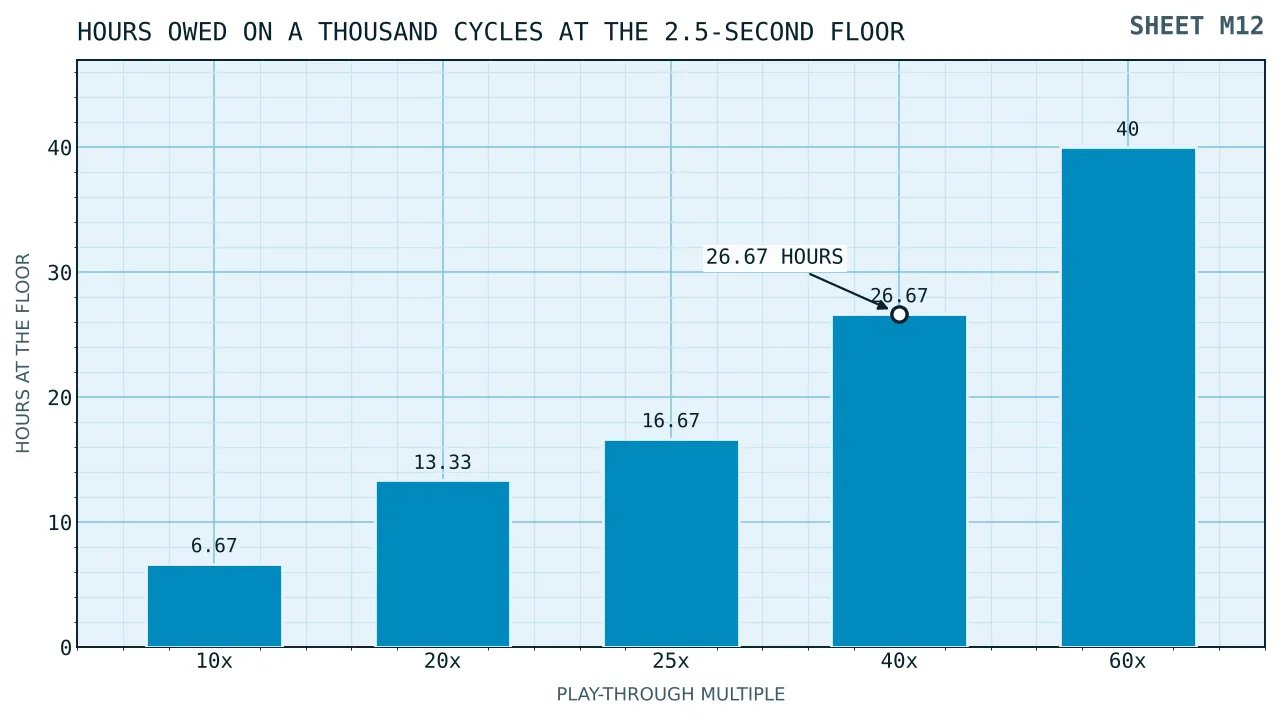
W is the term that travels furthest from one document to the next, so here is one credit of £96.00 under five of them, with the floor on the clock alongside the money.
| W | Staking owed | Expected cost | E | Hours at the floor |
|---|---|---|---|---|
| 10 times | £960.00 | £38.40 | £57.60 | 6.67 |
| 20 times | £1,920.00 | £76.80 | £19.20 | 13.33 |
| 25 times | £2,400.00 | £96.00 | £0.00 | 16.67 |
| 40 times | £3,840.00 | £153.60 | -£57.60 | 26.67 |
| 60 times | £5,760.00 | £230.40 | -£134.40 | 40.00 |
Set E to nought and B leaves the working, so what decides the crossing is one over four pence and not the thousand on the front. The answer is twenty-five, and it stays twenty-five whether the credit is ninety-six pence or ninety-six thousand pounds. A big count buys no better position against that figure. It buys the same position, drawn larger.
Which is why the hours column is the one worth staring at. Ten times is most of a working day. Sixty times is a working week. The difference between those two rows is a single number typed into a set of bonus terms, and everything else about the offer is identical.
4
Twenty-six hours forty, and the one lever on it
Required staking of £3,840.00 at 10p a go is 38,400 cycles. Pacing comes from RTS 14D, a floor of 2.5 seconds measured from the beginning of one slot game to the beginning of any next, which puts 96,000 seconds under the obligation. Twenty-six hours and forty minutes, and a floor rather than an estimate.
The thousand advertised cycles occupy forty-one minutes and forty seconds of that. A reader who treats the headline as the commitment has underestimated it by a factor of thirty-eight.
Nothing may be set running unattended: RTS 8A wants every game cycle committed to by the customer, the one exception being automatically posted blinds in peer-to-peer poker. The bar on hurrying a result is RTS 14E, whose guidance strikes out quick spin, slam stop and turbo, with carve-outs for feature games carrying no extra stake and for reveal-all controls. A return no larger than the stake gets no fanfare under RTS 14F, which leaves the system to display the amount awarded and sound a short note as it is credited.
So the count of cycles cannot be hurried. What can be changed is how much each one carries, and that is the single lever a player holds over twenty-six hours.
Stake at a pound and £3,840.00 becomes 3,840 cycles, or two hours and forty minutes. Stake at the statutory maximum and it becomes 768 cycles, which is thirty-two minutes once the pacing rule has taken its toll. A slot cycle on a British licence cannot be staked above five pounds, or above two pounds where the player is under 25, under regulations made on 25 February 2025. At the lower of those two ceilings the obligation is 1,920 cycles and an hour and twenty minutes.
Those ceilings reached slots and nothing else. The regulator says in terms that they do not touch roulette or blackjack, and gives 9 April 2025 and 21 May 2025 as the dates they began. The instrument is SI 2025 No. 215, and its definition is narrow: a reel-based casino game, played online, whose arrangement of images settles whether a prize falls due.
Two warnings sit on that lever. Raising the stake raises the variance and leaves the expected cost exactly where it was: £153.60 is four pence in the pound whether the pound arrives in ten pieces or in two. And a set of bonus terms may impose a ceiling of its own well below five pounds. No published rule fixes any maximum bet for the period a bonus is live, which makes it a figure to look up in the terms rather than infer from the statute.
38,400 cycles at 10p, or 768 at the £5 ceiling, for the same £3,840.00
5
One credit, twenty deadlines
A four-figure count seldom arrives whole. It is paid out in pieces, and the pieces leave the total alone while changing everything about how it has to be met.
Take the common shape, fifty cycles a day for twenty days.
| Quantity | One day | Twenty days |
|---|---|---|
| Cycles | 50 | 1,000 |
| Average winnings | £4.80 | £96.00 |
| Staking owed at 40x | £192.00 | £3,840.00 |
| Expected cost | £7.68 | £153.60 |
| Minutes at the floor | 80 | 1,600 |
The money reconciles to the penny. What does not reconcile is the logistics. One condition with one window has become twenty conditions with twenty windows, each asking for eighty minutes of uninterrupted button pressing, and a tranche left unused is generally gone rather than banked for later.
British rules reach that structure at two points. Social Responsibility Code 5.1.1 wants an incentive’s terms fair, transparent and clear, and easily accessible to anyone the incentive reaches. Its third prohibition is aimed squarely at instalments: a licensee may not cut an incentive’s value because the qualifying activity was finished inside less than the offer period. Early completion must not be penalised.
The advertising code comes at the same problem from the other end. Under rule 8.17 a significant condition is one a reader has to be shown clearly and prominently, and deadlines count: the window for claiming an instalment and the window for playing it out. Twenty tranches mean twenty of each. A decision of 17 July 2024 prices the omission. A free bet of ten pounds turned on answering a text message by a stated hour; the advertisement carried no deadline; the regulator took the deadline to be significant and its absence likely to mislead.
Code 5.1.1 reaches every licence except the gaming machine technical and software categories, and its page carries no effective date. The dated limb is the ceiling, which came into force on 19 January 2026.
6
Thirty pence in the pound, across a long batch
Everything up to here has counted a staked pound at a pound. Where a game counts for less, the requirement does not shrink; the staking needed to earn it swells, and across thirty-eight thousand cycles the swelling is severe.
Put contribution at three pounds in every ten. Forty times £96.00 is still £3,840.00 of contribution to be earned. Covering that now calls for £12,800.00 of staking, priced at £512.00, which pushes the overshoot from £57.60 to £416.00.
The clock follows the staking. That £12,800.00 is 128,000 cycles at 10p. Multiply by two and a half seconds and the obligation is 320,000 seconds: eighty-eight hours and fifty-three minutes, over as many sittings as the window allows.
Now wind W back to ten, the furthest a British licence reaches, and leave the rate where it is. Contribution owed falls to £960.00, staking lands on £3,200.00, the expected price on £128.00, and E on -£32.00. Weighting survived the ceiling untouched, which is why a requirement inside the regulated limit can still price at nothing once a rate is applied to it.
Thirty per cent is an illustration and not a measurement of anything. It reaches this page from a consultation respondent who described thirty pence of each staked pound counting towards a requirement, a submission the regulator logged before deciding to leave weighting alone. No schedule of current contribution rates is published anywhere, so the figures above are arithmetic run against a rate somebody else quoted. The term gets the whole of a page to itself at slots free spins, where the threshold it has to clear is worked out properly.
£12,800.00 of staking buys £3,840.00 of contribution where a pound counts as thirty pence
7
What the pacing and the ceiling are worth off the register
Every protection priced into the figures above belongs to one jurisdiction. A cashier outside the British register holds no Great Britain licence, so the pacing and the ceiling above are not its problem, and what a British player gives up is best read one duty at a time.
The Curaçao rulebook read for this site is version 1.0, dated 21 February 2025. It sets down no wagering ceiling, no limit on a stake, nothing about the gap between cycles, and no prohibition on turbo or on automated play. Celebrating a return that no more than matches the stake is unmentioned there as well. The mandatory list runs to age verification, information accessibility, self-assessment, behaviour tracking, cooling-off and self-exclusion, deposit limits, staff and affiliate training, and general marketing principles. The twenty-six hours above is therefore a British figure. Elsewhere the identical £3,840.00 may be pushed through as quickly as a platform allows, on as many games at once as it chooses to open.
Bonuses occupy two lines of that rulebook, about transparent terms and about not promoting so aggressively as to encourage excessive gambling. Nothing in it answers to the ten-times ceiling, to a list of significant conditions, or to the kind of published adjudication quoted in part 5.
Self-exclusion offshore is a matter for one operator at a time. The Curaçao policy bars a player from that operator’s domains and then suggests they exclude themselves from other sites too. Britain routes it through the licence instead. A British online licence obliges the operator to join Gamstop Online, and since April 2020 that has meant running the whole customer list against the register at least once in every twenty-four hours. The scheme states its own boundary in terms, that it cannot help prevent anyone reaching services run by organisations outside it, and that boundary is the whole practical difference a licence makes to a self-excluded reader.
One further thing the regulator has put on record, because it bears directly on a headline of a thousand. A notice the regulator published to the industry on 20 January 2025 records weak controls over money laundering and social responsibility on such websites, customers exposed to fraud, data privacy problems and unfair practices, and a habit of targeting people who have self-excluded. It also records casino games from licensed suppliers appearing on sites with no licence, so recognising the reels proves nothing about who is running them. Evolution Malta Holding Limited settled at £4.75m on 23 July 2026, after the Commission found its games running on six unlicensed websites reachable by British consumers.
8
Running the ratio on the count you were handed
None of the working above depends on the count being a thousand. Written per pound of credit, forty times demands forty pounds of staking, costs one pound sixty, and leaves minus sixty pence; ten times demands ten pounds, costs forty pence, and leaves sixty pence; twenty-five times demands twenty-five pounds, costs a pound, and leaves nothing at all. Multiply the three lines by however many pounds of credit are in front of you.
In cycles the ratio is tidier still. Multiply the advertised count by W and by the return, and you have the cycles owed: a thousand at forty times gives 38,400, and a hundred at forty times gives 3,840. Multiply those by two and a half seconds for the floor under the clock.
Three things the total does not settle.
It is a mean and not a forecast. The £57.60 that ten times would leave describes the middle of a very wide spread, and the single most frequent result of a long batch of cycles is still nothing. The arithmetic is honest about a thousand repetitions and silent about a single evening.
It supposes two things that may not hold: that the credit survives to the end of the staking, and that the winnings survive to a withdrawal. A cap on a bonus’s winnings, or a discretion the operator has written in for itself, lies outside the expression and can flatten the answer without W moving at all. An operator was fined £170,000 for precisely that shape of term on 3 July 2025, the Commission finding a discretion to shut accounts or withhold winnings without clear justification to breach the fair and open condition.
And it takes the terms at their word. Look up W, look up the rate, look up the window, note any cap, and run the four of them through part 2. Other counts get the same treatment: 200 free spins runs a fifth of this one, 100 free spins no deposit a tenth, and 150 free spins no deposit sits between them. The multiple lists the section by size.
Questions
- What is a thousand free spins with no deposit actually worth?
- A thousand cycles at 10p are advertised at £100.00 and average £96.00 where the game returns 96 per cent. Forty times then wants £3,840.00 of staking, at an expected price of £153.60. The price exceeds the credit by £57.60, so the credit cannot meet it: it runs out partway and the closing line is £0.00.
- How many hours does the play-through actually run to?
- Twenty-six hours and forty minutes is the floor, on a British licence. Required staking of £3,840.00 means 38,400 cycles at 10p, and RTS 14D stands 2.5 seconds between the beginning of a slot game and the earliest beginning of another, giving 96,000 seconds in all. The thousand advertised cycles are forty-one minutes and forty seconds of it.
- Is a count of a thousand better value than a count of a hundred?
- Not per pound. Every term in the calculation moves in step with the credit, so ten times the cycles produce ten times the winnings and ten times the shortfall. The headline and the obligation grow together. What a large count really changes is the hours, which rise from two and two-thirds to twenty-six and two-thirds on the same multiple.
- At what multiple does the credit come to nothing?
- The crossing sits at twenty-five times, on a game returning 96 per cent, and the count has no bearing on it. Put the expected cash at nought and B drops out of the equation, leaving the multiple as the reciprocal of the four pence edge. Ninety-six pence and ninety-six pounds cross out together.
- Can a bigger stake per spin shorten the obligation?
- It shortens the clock and leaves the money alone. The same £3,840.00 is 38,400 cycles at 10p, 3,840 at a pound and 768 at five pounds, which is thirty-two minutes rather than twenty-six hours. A British licence caps a slots cycle at five pounds, and at two pounds for anyone under 25. The expected cost stays at £153.60 throughout, because four pence in the pound does not care how the pound is divided.
- What changes when the spins arrive fifty a day?
- The totals do not move and the deadlines multiply by twenty. One daily tranche is £4.80 of winnings carrying £192.00 of required staking, an expected price of £7.68 and eighty minutes at the floor. Twenty of those add back to £96.00 and £3,840.00 exactly. Twenty windows now have to be met instead of one, and a tranche nobody uses is normally forfeited rather than carried.
- What does contribution at 30 per cent do to a count this large?
- It turns a £57.60 shortfall into a £416.00 one. Contribution owed stays at £3,840.00. Earning it at thirty pence in the pound wants £12,800.00 of staking, priced at £512.00, and eighty-eight hours fifty-three minutes of reels. Even ten times, the furthest a British licence reaches, lands on minus £32.00 at that rate.
- Which of these protections survive at an offshore cashier?
- None of them, because each one hangs off a British licence. The Curaçao responsible gaming policy carries no wagering ceiling, no stake limit, nothing on the gap between cycles and no prohibition on automation or turbo, and its entire treatment of bonuses is two lines about transparent terms and aggressive promotion. Self-exclusion there binds one operator and its own domains rather than a national register.