
Sheet O09 Revision 1 Checked 15 October 2026
Non gamstop curacao casino sites
A 200 per cent headline on £25.00 credits £50.00, which is worth £30.00 under a ceiling of ten and nought at forty times. Thirty pounds is the price of one sentence the island’s rulebook does not contain, and the rest of that rulebook is better than its reputation and worse than a licence.
£30.00 on a £50.00 credit, the cost of one missing sentence
What an island licence leaves at the foot
Every destination on this spike is bought advertising. The site takes a fee if a reader goes on to register, and no figure printed below moves because of it.
The Spin Sheet
Till receipt No 01
Betportal
Lowest multiple here
For every €1 of spin credit at face per €1
Credit
Debit
No Great Britain licence
Licensed in Anjouan, Comoros, run by BetPortal Gaming Ltd, with Excite Ultra Media Ltd, reference ALSI-202601040-FI2.
Terms read 15 October 2026
Open the offer at Betportal, opens in a new tabThe Spin Sheet
Till receipt No 02
WinBeast
Five staged matches
For every €1 of spin credit at face per €1
Credit
Debit
No Great Britain licence
Licensed in Curaçao, operator not named on the site.
Terms read 15 October 2026
Open the offer at WinBeast, opens in a new tabThe Spin Sheet
Till receipt No 03
EliteSpin
Longest spin window
For every £1 of spin credit at face per £1
Credit
Debit
No Great Britain licence
Licensed in Costa Rica, run by PrimeTier Limited.
Terms read 15 October 2026
Open the offer at EliteSpin, opens in a new tabThe Spin Sheet
Till receipt No 04
Crown Jewelz
Multiple unpublished
No total struck
Credit
Debit
No Great Britain licence
Licensed in Curaçao, number not verified, operator not named on the site.
Terms read 15 October 2026
Open the offer at Crown Jewelz, opens in a new tabThe figure at the foot of a receipt is this site's own arithmetic and nothing an operator has published: the credit, less the share a spin gives back at 96 per cent return to player, less what playing the wagering through costs at the same return. It describes the offer, not one reader's afternoon. Where the conditions price above the credit the receipt prints nothing rather than a negative sum, and where a figure the sum needs is unpublished it prints the condition in the operator's words instead.
Three words stand in the amount column where no figure can. Noted is a published condition that takes value away without leaving the sum a figure to take. Unpriced is a condition whose figure nobody has published, or a credit that is not a sum until a deposit of your own sets it. Own money is money of yours, which is never part of a total.
Not one of the operators printed above holds a Great Britain licence, so the duties that licence carries do not reach them. Every online gambling company licensed in Great Britain has to be part of Gamstop Online, and a reader who has shut themselves out through the scheme is therefore not shut out here. The ceiling of ten times the bonus funds on a wagering requirement, in force since 19 January 2026, is a condition of that licence and binds the companies that hold one. Where a dispute goes instead is a matter for the authority named on the receipt, and the Gambling Commission describes what a reader faces without a British licence as a lack of recourse if things go wrong. Nobody under 18 may hold an account at any of them.
Every term printed on a receipt is the operator's own, and each receipt carries the day it was read. The oldest of those readings is 15 October 2026. What binds a reader is the operator's own full terms, and not a line printed here.
1
Fifty pounds of credit, and one absent sentence
Calling a cashier on this licence unregulated is lazy and, as it happens, wrong. A rulebook exists, it runs to several documents, and large parts of it would be unremarkable under a British licence. The honest method is to open it, set out what is in it, and then name what is not, because the thing that is not in it costs a reader a figure that can be written down.
The working deposit here is £25.00, carrying a 200 per cent headline, so £50.00 of credit. Trading with no Great Britain licence is what the cashiers behind this key have in common, and the dearest single consequence of that is one missing sentence about a multiple. Part 3 prices it at £30.00. Parts 5 and 8 are where the island does better than its reputation, and parts 6, 7 and 9 are where it does worse than a licence.
Held fixed on this sheet, and why:
- Ten pence a cycle, so £25.00 buys two hundred and fifty of them.
- Ninety-six per cent as the return, this site’s figure wherever no particular game is named.
- A 200 per cent headline, giving £50.00 of credit on the deposit, with the ladder from one hundred to four hundred beside it.
- Forty times for the play-through, a figure terms reach freely where no British register bites, and ten times set against it, that being the British maximum.
- Slots counting whole towards a requirement, so g is one, apart from part 4, whose entire subject is weighting.
2
A foundation of 1999, an ordinance of 2024
Begin with the institution, because a reader who knows nothing else should know that it is real.
The body calls itself a foundation, incorporated on 19 April 1999 to regulate gaming in and out of the island as a whole, and arising directly out of what the task force on financial action in the Caribbean said in a second mutual evaluation it published during 1998. Its ordinance on games of chance has been in effect since 24 December 2024, a pivotal reform of online gaming there by the regulator’s own description, with the reform itself begun in November 2023. One discrepancy is worth flagging: the regulator’s own about page carries a 2025 date for that same ordinance, so this sheet uses 24 December 2024, which two of the three published statements support.
Licensing and supervising online gaming is one of its functions, alongside land-based casinos, numbers lottery licences, notifications for bingo and charitable goods lotteries, and supervision of anti-money-laundering compliance across the whole industry. When the site was read for this build it stated that its own online gaming portal was offline.
Eight headings make the responsible gaming requirements mandatory there: deposit limits; cooling off and self-exclusion placed in the player’s own hands; behaviour tracking; self-assessment by the player; information kept accessible; age verification; general principles covering marketing and advertising; and training, which reaches an operator’s employees and also its affiliates, its marketing partners and the influencers it uses on social media.
Eight headings, and not one of them is a number a player could use. That is the observation the rest of this sheet is built on.
3
Thirty pounds, and fourteen hours of button
The sentence the island does not carry caps a play-through at ten times the bonus funds. Britain has carried it since the nineteenth of January 2026. What follows is what its absence is worth on this deposit, and the difference is a licence.
E = B × (1 – (W × (1 – RTP)) / g)
Credit goes in as B, at £50.00 on a 200 per cent headline. RTP stands at 0.96 and g at one until part 4, leaving the multiple as the figure the terms themselves settle.
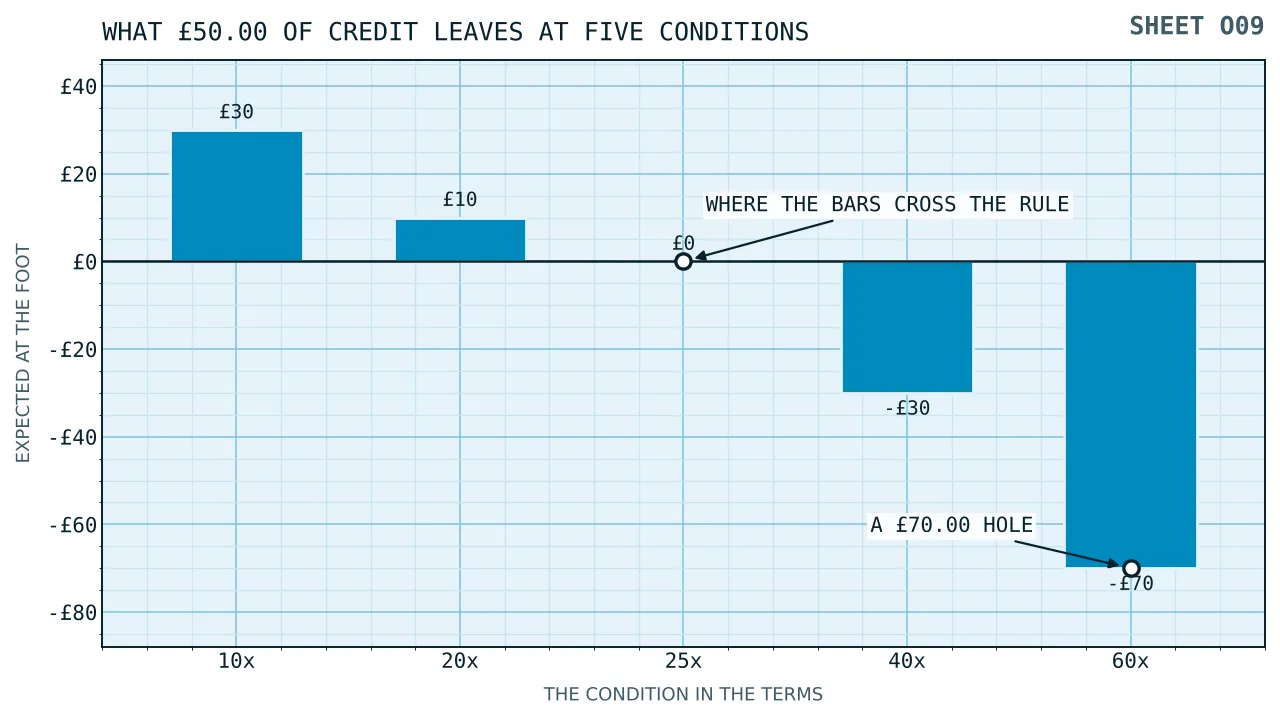
Ten times asks £500.00 through the games. The toll on that staking is £20.00, so £30.00 is expected to survive. Forty times asks £2,000.00, costing £80.00 against fifty pounds of credit, so the credit runs out a quarter of the way down the requirement and £30.00 of cost is expected to fall on the deposit standing behind it.
| The condition | Staking owed | Cycles of 10p behind it | Expected cost | Standing at the foot |
|---|---|---|---|---|
| Ten times, the British ceiling | £500.00 | 5,000 | £20.00 | £30.00 |
| Twenty times | £1,000.00 | 10,000 | £40.00 | £10.00 |
| Twenty-five times | £1,250.00 | 12,500 | £50.00 | £0.00 |
| Forty times, modelled here | £2,000.00 | 20,000 | £80.00 | £0.00 |
| Sixty times | £3,000.00 | 30,000 | £120.00 | £0.00 |
The cycles column turns a condition into a quantity of evening, and this is where the absent design rules show up in the same arithmetic. Twenty thousand cycles at a British minimum gap of 2.5 seconds take fifty thousand seconds, which is thirteen hours fifty-three minutes and twenty seconds of button pressing with nothing expected at the far end of it. No floor under that pace exists on the island, so the thirteen hours is a protection rather than an obstacle, and it is one of the things the licence was buying.
20,000 cycles at 2.5 seconds is 13 hours 53 minutes 20 seconds
Sixty times was not invented for effect. When the British regulator explained why a ceiling was wanted, it recorded some licensees applying play-through up to sixty times, and that figure is the only market multiple in this build’s material that comes from a regulator rather than from a model. At sixty times a fifty pound credit carries a £70.00 overrun, which is the credit, the deposit, and twenty pounds besides.
4
Weighting, which outlives every ceiling
A ceiling on a multiple is not a ceiling on turnover, and the gap between those two things is game weighting. It survived the British reform untouched, which makes it the one mechanism that behaves identically on either side of the register.
A contribution rate below a hundred per cent means a pound staked counts as less than a pound against a requirement. The figure quoted on the British regulator’s own consultation page, offered there by respondents rather than by the regulator, is thirty pence of contribution for each pound wagered. Work with that rate and what follows is this site’s own arithmetic rather than anybody’s finding.
At ten times, £50.00 of credit needs £500.00 of contribution behind it. Thirty pence in the pound means reaching that £500.00 takes about £1,666.67 of staking, costing £66.67 at four pence in every pound. That is £66.67. Fifty pounds of credit against sixty-six pounds sixty-seven of cost is a negative line under a ceiling that was being obeyed to the letter.
Which is the most useful thing on the sheet for a reader comparing two sets of terms. A multiple is one of two numbers, and the second is usually printed somewhere further down in smaller type. No primary source publishes a current contribution table, so this sheet prints none and uses the one rate it can cite.
Ten times at 30p in the pound needs £1,666.67 staked
5
Three points where the island asks more
A sheet that only listed absences would be arguing rather than measuring. Three things here are either tighter than their British counterpart or have none.
- A rise to a deposit limit waits seven days there. A cut takes effect at once. Britain requires a wait of twenty-four hours at minimum before a rise binds, so on that single point six further days are demanded here. Daily, weekly and monthly are the periods available there. The British list has to run to a month, to a week and to a day.
- Cooling off cannot be talked out of. There are four lengths, each of which must be reachable through a single-click button, no email and no approval from the operator wanted, each biting immediately and each selectable by product: twenty-four hours, one week, one month and three months. And talking a player out of it is forbidden: no bonus or promotion handed over to keep the play going, no reassurance offered to delay the decision, and no questioning of the decision itself.
- Affiliates are reached by name. Making sure affiliates keep to responsible gaming standards is the operator’s own duty here, and the policy backs it with penalties for failure, with audits, and with contracts that bind. Affiliates go unmentioned in the British regulator’s advertising material, which addresses third parties only by asking for reasonable steps about where advertising is placed, copyright-infringing websites being the case named.
A licensee’s footer there is specified item by item: the digital seal, the licence number, a link to the responsible gaming policy, the registered address and name of the licence holder, a statement that the regulator supervises it, and links out to addiction support, local as well as international. GamCare, Gamblers Anonymous and GambleAware are the international examples it gives, with GamCare spelled there without its internal capital. So the island’s rulebook sends a British player to British support bodies, and that is worth knowing before anybody describes it as indifferent.
6
The rulebook is silent on
Now the absences, which is the half that costs money. Each item below binds a British licence holder, and none of them shows up anywhere in the island policy consulted here. The frame is deliberate: silence is what a page about a rulebook can honestly report.
| The rulebook says nothing about | What that silence is worth here |
|---|---|
| Any ceiling over a play-through | £30.00 of expectation on £50.00, and £1,500.00 of staking that need not be owed |
| Keeping one incentive to one kind of gambling product | Fifty pounds of casino credit may share its terms with bingo tickets |
| A ceiling over the stake in one slot cycle | Britain’s figures are £5.00, and £2.00 below twenty-five, making the deposit five lawful cycles or twelve |
| A floor under the gap between game cycles | Britain says 2.5 seconds for a slot and five for other casino games, poker between players aside |
| Automatic play, turbo buttons and slam stops | Twenty thousand cycles may be instructed once rather than chosen twenty thousand times |
| Celebrating a return that fails to beat its stake | A 10p cycle returning 10p may arrive with noise and colour behind it |
| Substituting a near miss for a loss | A losing outcome may be swapped for a more exciting losing outcome |
| Playing several games at one time, or changing rules mid-game | Both are barred outright under a British licence |
| A term that rations what may leave a deposit balance | No published right of exit attaches to the deposit or to its winnings |
| Offering a player the chance to cancel a withdrawal | A payout once asked for may be turned back into a stake |
| Identity settled before any play at all | Britain wants a name, an address and a birth date first, bonus rounds included |
| Credit cards as a way of funding an account | Britain has barred them since 14 April 2020, money service routes included |
| A limit prompted for at registration, and offered as the default | Limits exist there, but nothing requires anybody to be asked |
| A check once net deposits pass a monthly figure | Britain’s light-touch threshold has stood at £150.00 since 28 February 2025 |
| Membership of a national self-exclusion scheme | There is no such scheme to belong to, which is part 7 |
Two sentences are the whole of what the island asks about bonuses. Transparent communication, with clear terms attached, is the first. Aggression in promotion is not to reach the point of encouraging excessive gambling. Neither sentence limits a multiple, neither confines an incentive to one product type, and neither resembles the significant-conditions list the British advertising regulator publishes for a promotion.
7
A register that spans one operator
This is the difference the key in the title is actually about, and it is architectural rather than a matter of strictness.
Self-exclusion there is defined as a player barring themselves voluntarily from all or some online gaming activity with one specified operator. Exclusion from every domain that operator runs follows next. For the whole remainder of the market the policy goes no further than encouragement: the player should be urged to exclude at other gambling sites too, one site at a time. There is no register spanning operators, and that one absence accounts entirely for a British registration stopping at the island’s edge.
One year is the long-term minimum the ordinance makes an operator offer, with lifetime exclusion and terms of ten, five and three years available beyond it. Once it is confirmed, a player cannot revoke it before the term runs out, so the shortest option there is double the shortest option here and the longest runs for a lifetime.
| Feature | Great Britain | The island policy |
|---|---|---|
| What one registration covers | Every licensed online account at once | A single operator, across all of its domains |
| The rest of the market | Inside the same registration | Encouragement to exclude, site by site |
| Shortest term available | Six months | One year |
| Longest term available | Five years, renewable | A lifetime |
| Finishing it early | Not before the minimum has elapsed | Not before the term expires |
| What sets the boundary | The British licence, and nothing else | The operator a player happened to register with |
Early release is available under neither arrangement, and the longer minimum is the island’s. What the island has not got is one register, which is a statement about coverage and not an instruction to anybody. The British regulator adds the part that matters. Sites without a licence frequently single out vulnerable customers, its notice of 20 January 2025 records, and having excluded oneself through the scheme is one of the marks it names.
Where a registration is what brought a reader here, three published things cost nothing, and not one of them is a way round anything. GamCare keeps the helpline that carries the name National Gambling Helpline, and dialling 0808 8020 133 costs nothing and reaches it at every hour on every day in the year, with a live chat window and WhatsApp reaching it too, for the caller or for somebody they are worried about. Gamban is blocking software: one licence, every major platform, and a count of blocked gambling sites and applications in the tens of thousands. The free British route is GamCare’s rather than the software company’s, published under the name TalkBanStop, which ties the helpline and the blocker to the national scheme. Its page is a news item of April 2021, dated the twelfth, and no length is given there for the free access, so none is given here. This site’s own treatment is Staying in control.
8
A complaint route, and who writes its last stage
Any page saying that no complaints route exists on this licence is simply wrong. The real difference is narrower, later in the process, and more interesting.
The clocks, which very nearly agree
A complaint costs the player nothing and may be lodged at any point inside six months of the incident, or of the settlement of the bet it concerns. Written confirmation of receipt is owed within one week, an assessment and a response inside four weeks, and one extension of four further weeks is permitted on written notice, which brings the whole to eight weeks. Responsible gaming complaints jump the queue. Resolution inside five business days is what best efforts are to aim at, receipt gets confirmed within two days, delay is capped at a fortnight, and a further fortnight is available where the player answers slowly.
Set that beside Britain and the figures line up almost exactly. Six months at minimum from the incident is the British window too, and no term may close it sooner. Eight weeks from arrival is the British maximum for the whole process, internal escalation counted inside it. Acknowledgement is owed as soon as is reasonably possible, and three working days is the outer limit; one day is the limit where the gambling on offer runs round the clock. A British clock may be halted where a reasonable information request has gone seven days without an answer, and it restarts at the point it stopped.
The last stage, which does not agree at all
Approval of the dispute bodies is the British regulator’s, and an approved one is the only sort a licensee may use. Eight bodies carry approval, and five of them are listed for remote across every sector: IBAS, eCOGRA, Blexr, the ADR Group and the centre for effective dispute resolution. Two more appear in the table against all sectors, ProMediate and the Tattersalls Committee, and of those the Tattersalls Committee lists betting alone in its own entry. The eighth, the Pegasus service, is listed against premises businesses only, so remote casino is not among the sectors it covers, and one further provider is recorded on the page as having been removed.
Dispute resolution there is compulsory, and it costs the player nothing because the operator bears all of it. The policy openly envisages the operator setting those parameters itself, and three get named. Whether a minimum claim value has to be met before escalation is one. Whether the outcome binds the player is the second. Whether the process has to be finished before a court may be approached is the third.
The first of those three is where this deposit meets a wall, and the sum is immediate. £50.00 of credit is the largest figure that could be in dispute on this sheet, and £30.00 was expected of it under a ceiling of ten, nought under forty times. Set a claim-value floor anywhere above those figures and the dispute falls outside the process before it has begun. Justification for such a restriction is assessed, the regulator says, with every relevant circumstance taken into account. Two cases get named. A worry about misuse it may understand where claims are of low value. Where a self-excluded person has been admitted, it expects the matter taken seriously whatever the sum involved. The second of those two cases is the one worth remembering off this page.
Two further limits bind a player once a process has started. Neither side may restart a finished process in front of a different provider, and a player who walks away from one already begun should not expect to raise the dispute again later. Only the registered player may complain, because the ordinance bars the selling, donating, renting, leasing, pawning or pledging of any claim against a licence holder.
Where both regulators stop
Individual disputes are declined on both sides, and in language that is nearly the same. The British regulator says it is not an ombudsman. Resolving a gambling complaint, or helping a consumer recover money, is beyond the powers it states it holds. A technical fault in a game, or a problem over a withdrawal, is not a thing it can resolve. And customer accounts are closed to it, so what happened inside one is not visible to it. Complaining to the business first is what it tells a player to do. On the island, transactions on an operator’s website are not something the regulator will decide or resolve a player’s complaint about. Reviewing or overturning what the operator or the dispute provider decided lies outside its remit too, the one exception being a decision deemed inadequately handled, and what it learns feeds its own supervision and enforcement instead.
9
What cannot be said about this licence
This section exists because it is where most writing on the subject goes wrong, and because a page that invents a figure is worse than a page that admits a gap.
- Which licence any particular offshore brand holds is not stated by any primary source, and nor is the number of sites holding any given offshore licence. What a licence requires is what gets described here, and the holders never get counted.
- No distribution of play-through multiples, of withdrawal ceilings or of spin values across this market is published anywhere citable, so the contrast on this page is a structural one. A ceiling of ten exists in Britain, and the island policy carries no ceiling whatever. Forty times, modelled right through, is an assumption stated as one, and no measurement of anybody’s terms.
- Operators report complaint numbers to the regulator on 15 January and on 15 June, the first reports falling due in January 2026. None of those reports could be found published in aggregate, so no complaint volume for the island appears on this sheet.
- One near neighbour in this market issues from a commercial domain and not a government one, cites no Act, ordinance or regulation by name, and its own page about player complaints came back as an error when it was fetched for this build. Its time limits, its remedies and whether any decision of its binds an operator are therefore not described here, and part 8 is not extended to it.
- Cite a Costa Rican registration and this build could locate no rulebook, no register and no complaints route belonging to any regulator there, and that, rather than anything about what Costa Rican law requires, is what this sheet says.
What can be said, and is a real difference rather than an adjective, is that a British licence has published money behind its enforcement. The regulator’s own enforcement list carries £5m from land-based casino operators on 7 October 2026, £4.75m from a games supplier on 23 July 2026, £2m on 17 December 2025 and £10m on 22 October 2025, with licence suspensions published beside them. No equivalent list of sums taken from island licensees could be found for this build, which is an absence of information rather than a finding about conduct, and it is reported here as the former.
10
Four readings before twenty-five pounds goes
Four questions settle a deposit made at a cashier on this licence, and only the first has anything to do with the games.
| What to settle first | This deposit |
|---|---|
| What 10p cycles the deposit buys | 250 of them, £24.00 back |
| What £50.00 of credit survives | £0.00 at forty, £30.00 at ten |
| The contribution rate behind the multiple | 30p in the pound triples the staking |
| Whether an escalation is possible | A claim floor could shut out £50.00 |
Rows three and four are the two nobody computes, and both can be computed before a penny moves. Take the credit, multiply by the multiple, then divide by the contribution rate: the staking actually owed is what comes out. Search the dispute clause for any minimum claim value, then set it beside the largest sum which could conceivably be in dispute, fifty pounds on this page.
And the usual caution about a mean. Thirty pounds is a mean across a great many identical attempts and not a sum that gets handed over. Two hundred and fifty cycles of a slot with rare large prizes come in under £24.00 far more often than over it. The twenty-five pounds is the only exact quantity in the arrangement, and the cashier had it as soon as it was asked for.
Related sheets follow. The same licence question put about a site rather than a jurisdiction is at non uk casinos, and the identity timing this rulebook sets is priced at no verification casinos. The absent design rules are converted into seconds and stake ceilings at slots not on gamstop, and the wallet that carries a deposit to a cashier on this licence is priced at paypal off the register. Off the register indexes this section, and the working behind each figure sits at How a receipt is struck.
Questions
- Is a cashier on this licence actually regulated?
- Yes, and calling it unregulated is wrong. The body calls itself a foundation, incorporated on 19 April 1999 to regulate gaming in and out of the island as a whole, and arising directly out of what the task force on financial action in the Caribbean said in a second mutual evaluation it published during 1998. Its ordinance on games of chance has been in effect since 24 December 2024. It publishes a rulebook. Setting down what the rulebook holds, then naming the things missing from it, is the work worth doing.
- What is the absent wagering ceiling worth on a deposit of twenty-five pounds?
- Thirty pounds, where a 200 per cent headline gives £50.00 of credit. Ten times, the British ceiling since the nineteenth of January 2026, asks £500.00 through the games; the toll on that staking is £20.00, so £30.00 is expected to survive. Forty times asks £2,000.00 and costs £80.00 against fifty pounds of credit, so the credit runs out a quarter of the way down the requirement and £30.00 of cost is expected to fall on the deposit behind it.
- Why does a wagering multiple understate the turnover owed?
- Because game weighting sits behind it and survived the British reform untouched. A contribution rate below a hundred per cent means a pound staked counts as less than a pound against a requirement. At the thirty pence in the pound quoted on the British regulator’s consultation page, £50.00 of credit at ten times needs £500.00 of contribution, which takes about £1,666.67 of staking and costs £66.67. Fifty pounds of credit against that cost is a negative line under a ceiling being obeyed to the letter. No primary source publishes a current contribution table, so none is printed here.
- Is this rulebook ever stricter than the British one?
- At three points it is. A rise to a deposit limit waits seven days there against a British minimum of twenty-four hours, with a cut immediate under both. Four cooling-off lengths have to be reachable through a single-click button with no email and no approval, those being twenty-four hours, one week, one month and three months, and talking a player out of one is forbidden: no bonus handed over to keep play going, no reassurance to delay the decision, no questioning of it. And making sure affiliates keep to those standards is the operator’s own duty there, backed by penalties for failure, by audits and by contracts that bind, where affiliates go unmentioned in the British regulator’s advertising material.
- What is the rulebook silent about?
- Fifteen things a British licence imposes. Any ceiling over a play-through, which is worth £30.00 here. Keeping one incentive to one product type. A ceiling over the stake in one slot cycle. A floor under the gap between cycles. Automatic play, turbo buttons and slam stops. Celebrating a return that fails to beat its stake. Substituting a near miss for a loss. Several games at once, and changes to rules mid-game. A term rationing what leaves a deposit balance. Cancelling a withdrawal. Identity settled before any play. Credit cards as a funding route. A limit prompted for at registration. A check once net deposits pass a monthly figure. And membership of a national self-exclusion scheme, because there is none to belong to.
- How does self-exclusion work on this licence?
- Operator by operator. It is defined as a player barring themselves voluntarily from all or some online gaming activity with one specified operator, and exclusion from every domain that operator runs follows next. For the whole remainder of the market the policy goes no further than encouragement: the player should be urged to exclude at other gambling sites too, one site at a time. There is no register spanning operators, and that one absence accounts entirely for a British registration stopping at the island’s edge.
- Are the exclusion periods shorter there?
- Longer, at both ends. One year is the long-term minimum the ordinance makes an operator offer, with lifetime exclusion and terms of ten, five and three years available beyond it. Once confirmed, a player cannot revoke it before the term runs out. Double the six months a British registration can run for is therefore the shortest option there, and a lifetime is the longest, against five years as the longest single British period. Neither arrangement lets anybody out early.
- Can a player complain about money at a cashier on this licence?
- A route exists, and its clocks very nearly match the British ones. A complaint costs the player nothing and may be lodged at any point inside six months of the incident, or of the settlement of the bet it concerns. Written confirmation of receipt is owed within one week, an assessment and a response inside four weeks, and one extension of four further weeks is permitted on written notice, which brings the whole to eight weeks. Responsible gaming complaints jump the queue, with resolution inside five business days as the target. Dispute resolution at the end is compulsory and free, the operator paying for it.
- So where do the two complaint regimes really part company?
- At the last stage, over who writes its rules. Approval of the dispute bodies is the British regulator’s, and an approved one is the only sort a licensee may use. Eight carry approval, and their coverage is uneven: five of them are listed for remote across every sector, while one of the eight is not listed against remote casino at all. Out there the policy openly envisages the operator setting those parameters itself, and names three. Whether a minimum claim value has to be met before escalation. Whether the outcome binds the player. Whether the process has to be finished before a court may be approached. On a small deposit the first of those three bites hardest, since £50.00 is the largest sum that could be in dispute here.
- How many sites hold this licence?
- No primary source states it, so this sheet does not. Which licence any particular offshore brand holds is not published either, and nor is any distribution of play-through multiples, withdrawal ceilings or spin values across the market. That is why the contrast drawn here is structural rather than statistical: a ceiling of ten exists in Britain and no ceiling appears in the island policy at all. Forty times, modelled right through, is an assumption stated as one and no measurement of anybody’s terms.
- What does the rulebook say about bonuses?
- Two sentences, and that is the whole of it. Transparent communication, with clear terms attached, is the first. Aggression in promotion is not to reach the point of encouraging excessive gambling. Neither sentence limits a multiple, neither confines an incentive to one product type, and neither resembles the significant-conditions list the British advertising regulator publishes for a promotion. Thirty pounds on this deposit is what the first of those omissions costs.
- Does the rulebook point a British player anywhere for help?
- It does, which is worth knowing before anybody calls it indifferent. A licensee’s footer there is specified item by item: the digital seal, the licence number, a link to the responsible gaming policy, the registered address and name of the licence holder, a statement that the regulator supervises it, and links out to addiction support, local as well as international. GamCare, Gamblers Anonymous and GambleAware are the international examples it gives. The free British route belongs to GamCare: a helpline carrying the name National Gambling Helpline, reached by dialling 0808 8020 133, Gamban as blocking software, and the pair of them tied to the national scheme under the name TalkBanStop.