
Sheet F04 Revision 1 Checked 15 October 2026
Non gamstop casinos uk 10 deposit
A hundred cycles at 10p is what a tenner buys, with £9.60 of average winnings over one pass. Matched in full under a British licence it would leave £6.00 expected; at the forty times this part of the market writes it leaves nothing and runs £6.00 past the credit. Six pounds on a tenner is the arithmetic of the absent ceiling, and it is the smallest of the things that go missing.
£6.00 on a matched tenner is what the absent ceiling costs
What a ten pound floor leaves away from the register
Every destination on this spike is bought advertising. The site takes a fee if a reader goes on to register, and no figure printed below moves because of it.
The Spin Sheet
Till receipt No 01
Betportal
Lowest multiple here
For every €1 of spin credit at face per €1
Credit
Debit
No Great Britain licence
Licensed in Anjouan, Comoros, run by BetPortal Gaming Ltd, with Excite Ultra Media Ltd, reference ALSI-202601040-FI2.
Terms read 15 October 2026
Open the offer at Betportal, opens in a new tabThe Spin Sheet
Till receipt No 02
WinBeast
Five staged matches
For every €1 of spin credit at face per €1
Credit
Debit
No Great Britain licence
Licensed in Curaçao, operator not named on the site.
Terms read 15 October 2026
Open the offer at WinBeast, opens in a new tabThe Spin Sheet
Till receipt No 03
EliteSpin
Longest spin window
For every £1 of spin credit at face per £1
Credit
Debit
No Great Britain licence
Licensed in Costa Rica, run by PrimeTier Limited.
Terms read 15 October 2026
Open the offer at EliteSpin, opens in a new tabThe Spin Sheet
Till receipt No 04
Crown Jewelz
Multiple unpublished
No total struck
Credit
Debit
No Great Britain licence
Licensed in Curaçao, number not verified, operator not named on the site.
Terms read 15 October 2026
Open the offer at Crown Jewelz, opens in a new tabThe figure at the foot of a receipt is this site's own arithmetic and nothing an operator has published: the credit, less the share a spin gives back at 96 per cent return to player, less what playing the wagering through costs at the same return. It describes the offer, not one reader's afternoon. Where the conditions price above the credit the receipt prints nothing rather than a negative sum, and where a figure the sum needs is unpublished it prints the condition in the operator's words instead.
Three words stand in the amount column where no figure can. Noted is a published condition that takes value away without leaving the sum a figure to take. Unpriced is a condition whose figure nobody has published, or a credit that is not a sum until a deposit of your own sets it. Own money is money of yours, which is never part of a total.
Not one of the operators printed above holds a Great Britain licence, so the duties that licence carries do not reach them. Every online gambling company licensed in Great Britain has to be part of Gamstop Online, and a reader who has shut themselves out through the scheme is therefore not shut out here. The ceiling of ten times the bonus funds on a wagering requirement, in force since 19 January 2026, is a condition of that licence and binds the companies that hold one. Where a dispute goes instead is a matter for the authority named on the receipt, and the Gambling Commission describes what a reader faces without a British licence as a lack of recourse if things go wrong. Nobody under 18 may hold an account at any of them.
Every term printed on a receipt is the operator's own, and each receipt carries the day it was read. The oldest of those readings is 15 October 2026. What binds a reader is the operator's own full terms, and not a line printed here.
1
A hundred cycles, and forty pence of toll
A tenner is the one deposit in this section that is not small. It is a hundred cycles at 10p, it carries £9.60 of average winnings through one complete pass of a 96 per cent slot, and the house takes 40p for that pass. No flat charge and no stake floor is going to swallow a sum that size, which is why this sheet prices something else entirely.
What it prices is the licence. Every offer written against this key comes from a cashier holding no Great Britain licence, and a licence is not a badge. It is a bundle of specific duties, each with a figure or a date behind it, and every one of them is absent from the ten pound deposit this page is about. Part 6 names them one by one. Parts 2 and 3 cost the single most expensive absence first, so that a reader who stops reading has at least the number.
One of the absences is not a number at all. The national scheme for self-exclusion is bounded by the British licence itself, so a cashier that does not hold one sits outside the scheme by construction. That is the whole mechanism behind the phrase in this page’s title, it is set out in part 5, and this sheet does not tell anybody how to use it.
Held fixed here, and why:
- A cycle at 10p, so a tenner is a hundred of them.
- Slots at 96 per cent, putting one pass of the deposit at 40p.
- Forty times for a play-through, because terms drawn where no British register applies commonly reach that far, with ten times alongside as the counterfactual that a licence would have imposed.
- Slots counting whole towards a requirement, g at one.
- A full match on the deposit in part 2, and headline percentages from one hundred to four hundred in part 3.
2
Six pounds, which is what the ceiling was worth
Take the deposit matched in full, so the credit is £10.00, and run it twice: once under the condition a licence would have permitted, and once under the condition this part of the market writes.
E = B × (1 – (W × (1 – RTP)) / g)
Ten pounds is what B stands for here. RTP is nought point nine six, and g is one. W is the whole argument.
Under a licence W could not have exceeded ten. Ten times a tenner is £100.00 of staking, the edge on which is £4.00, and £6.00 is expected to come through. That limit has been in force since the nineteenth of January 2026 and it is written about bonus funds: a licensee may not require them to be turned over more than ten times for the money to become withdrawable.
Out here W is forty. Forty times a tenner wants £400.00 staked, and the edge on that is £16.00. The credit is ten pounds, so it is exhausted once a quarter of the condition has been satisfied, and the other £6.00 is expected to come out of the deposit standing behind it. The offer prices at nothing and carries a six pound shortfall.
Those two runs are the same offer under two legal regimes, so the difference between them is the price of the licence on this one line. £6.00 of expectation, plus £300.00 of staking a reader does not have to do, plus £12.00 of edge they do not have to pay. On a ten pound deposit.
| Condition | Staking owed | Edge on it | Expected to remain | Shortfall |
|---|---|---|---|---|
| 10x, the licensed maximum | £100.00 | £4.00 | £6.00 | none |
| 25x | £250.00 | £10.00 | £0.00 | none |
| 40x, modelled here | £400.00 | £16.00 | £0.00 | £6.00 |
| 60x | £600.00 | £24.00 | £0.00 | £14.00 |
The sixty times row is not invented. When the regulator explained what the ceiling was for, it recorded play-through reaching sixty times at some licensees, and that is the one market multiple in the material behind this site which comes from the regulator itself. At sixty times a ten pound credit owes £600.00 of staking and overruns by £14.00, which is the credit and the deposit together with four pounds to spare.
3
A larger headline is a larger shortfall
The percentage on the front of an offer is the figure readers compare and the figure that matters least, and on a ten pound deposit at forty times it can be shown to matter in the wrong direction.
A ceiling, where one exists, bites on the multiple and not on the percentage. So raising the percentage does not reduce the turnover owed per pound of credit. It raises the credit, and the turnover rises with it in exact proportion. Where the multiple sits above twenty-five, every pound of credit is expected to cost more than it is worth, and a larger headline therefore enlarges a deficit rather than a prize.
| Headline | Credit | Staking owed | Expected to remain | Shortfall |
|---|---|---|---|---|
| 100 per cent | £10.00 | £400.00 | £0.00 | £6.00 |
| 200 per cent | £20.00 | £800.00 | £0.00 | £12.00 |
| 300 per cent | £30.00 | £1,200.00 | £0.00 | £18.00 |
| 400 per cent | £40.00 | £1,600.00 | £0.00 | £24.00 |
At forty times, a 400 per cent headline on £10.00 is a £24.00 shortfall
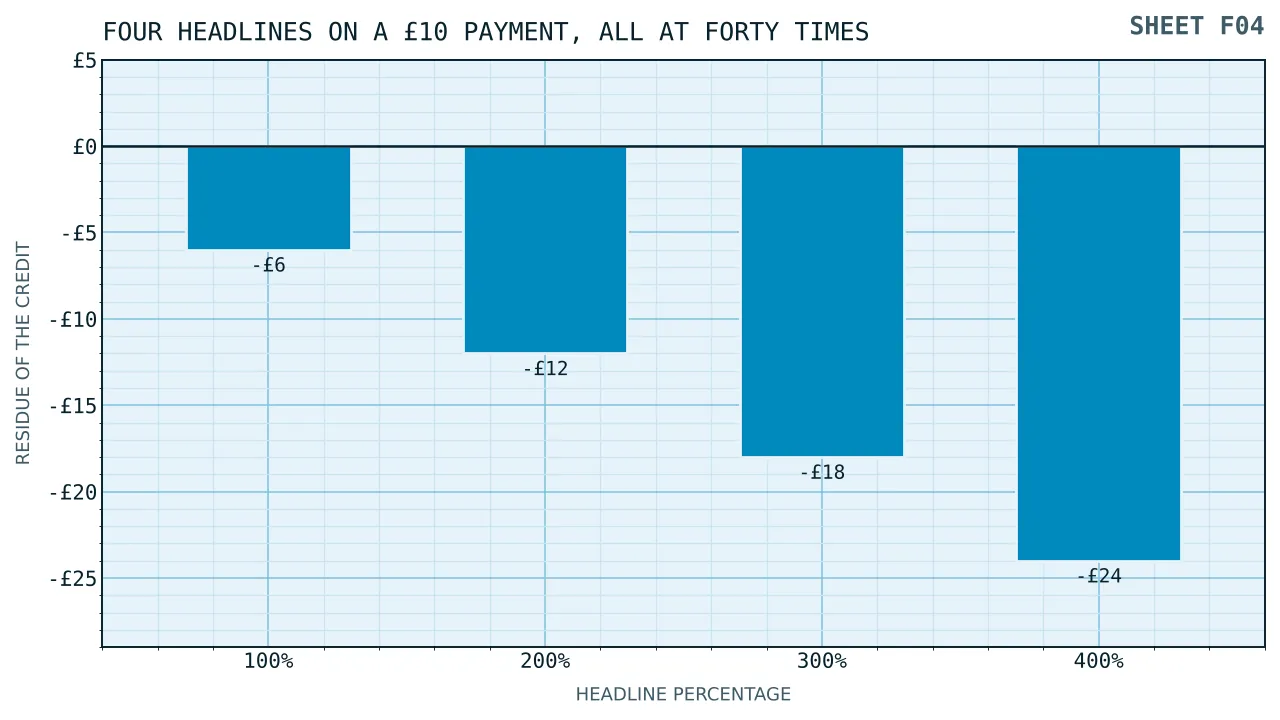
Which is the cleanest statement of what the ceiling does. Under a licence, each pound of credit keeps sixty pence at the maximum multiple, so four hundred per cent on a tenner would have been worth £24.00 expected. Off the register at forty times the identical headline is a twenty-four pound hole. The sign in front of the number is the licence.
4
What the scheme is, exactly
Readers type the scheme’s name in several spellings, most often as “casinos not on GamStop”. The scheme writes itself Gamstop, and its full name has been Gamstop Online since a refreshed identity was introduced in November 2025. What it does is one thing: it blocks a registered person’s access to accounts on gambling websites and apps, and it describes that service as free, quick and easy.
Behind it stands a company called The National Online Self Exclusion Scheme Limited, at 3 Greengate, Cardale Park, Harrogate, HG3 1GY, with registered number 10504973. The Remote Gambling Association set it up in June 2017 at the request of the department responsible for media, culture and sport and of the Gambling Commission. In March 2020 it became a condition of the licence for every operator taking business from British residents, on top of whatever schemes those operators ran themselves, and from April 2020 an operator has had to check its whole customer base against the register at intervals of no more than twenty-four hours.
A separate service, Gamstop Betting Shops, blocks access to betting shops. It was founded in 2016 as the Multi Operator Self Exclusion Scheme and joined the same group in July 2023. Online and premises exclusion are therefore two registrations, and signing up to one does not cover the other.
The periods, and how firmly they hold
Four periods are offered at registration: five years with automatic renewal, five years, one year, and six months. Switching that renewal off is only possible in the closing six months of a five-year registration. A registration cannot be ended early: the scheme’s own terms put it in capitals, that a self-exclusion will not be capable of deactivation until the minimum period has run out. Nor does it fall away by itself at the end. The scheme will not remove an exclusion automatically, and the options then are to extend by a further six months, one year or five years, or to deactivate deliberately; doing nothing at all continues the exclusion for up to seven years more.
Deactivation goes through the scheme’s contact centre, and a day of cooling off runs first at minimum, with the exclusion live throughout it. For seven years afterwards the scheme tells gambling operators that the person was previously self-excluded, and during those seven years operators are not obliged to keep them out. Those terms were last updated on 20 May 2026.
How many people are on it
The register held 614,738 consumers at figures published on 16 July 2026, registrations having risen by 16 per cent across the first six months of 2026, with May 2026 setting a monthly record at 12,236 sign-ups. More than one in two of those registrants took the maximum five years. Six months was the choice of a quarter of registrants across all ages, and of 38 per cent of the under-25s, a group whose registrations were up by 26 per cent on the year before and which accounts for close to one in three self-exclusions. Of the new registrations, more than seven in ten were men.
5
Why a licence sets the scheme’s reach
This is the hinge of the whole page, and it is one sentence of published rule. Membership of Gamstop Online is compulsory for an online gambling company that holds a Great Britain licence. The reach of the scheme is therefore drawn by the licence and by nothing the scheme itself can do.
The scheme states the consequence against itself, which is the most useful fact on this sheet. Its terms say it can assist only with excluding a person from gambling services that participating operators offer, and that where an organisation does not participate the scheme cannot help keep that person away from its services. That is a limit on the protection a registered person has, and it should be read as one. It is not an invitation, and nothing on this site will help anybody act on it.
What follows from that sentence is a ten pound deposit with no scheme over it, and the British regulator has described what else tends to be missing from such a place. Its industry warning notice of 20 January 2025 sets out what tends to be wrong with a site that holds no licence. The anti-money-laundering and the social responsibility controls may both be inadequate. Fraud, unfair practices and difficulty over data privacy are the exposures named. And such sites, the notice records, often go after vulnerable customers, among them people who have taken a self-exclusion through the scheme. The targeting is the point. A reader who arrived here because a registration is in the way is in the group the regulator says such sites go looking for.
Two sourced points keep the picture honest in both directions.
- Operating a gambling business with no Commission licence is to act illegally, and two consequences are named. The regulator may take action against the operator. And major payment systems organisations may withdraw its payment facilities, the published example being MasterCard. A payment route that disappears is a ten pound deposit that cannot be retrieved by the way it went in.
- The statutory offence is written about the person providing the facilities, not about the customer. To provide facilities for gambling with no operating licence is an offence under the 2005 Act. The sentence available is up to fifty-one weeks inside, or a fine at level five on the standard scale, or the two together, and in Scotland the fifty-one weeks reads as six months. None of which makes an unlicensed site a safe place to deposit, because what a reader surrenders there is the protection catalogued in part 6 and not their liberty.
The regulator is also candid about the limits of enforcement. It has written that, given the scale of revenue involved, it is unlikely ever to dismantle the ecosystem entirely. It also reports a 32 per cent fall in traffic across the hundred and sixty websites it had picked out for enforcement. It calls the illegal market increasingly sophisticated, digitally driven and global in scale, and puts no revenue figure on it.
6
The duties that come off a tenner
Here is the licence taken apart. Every item in the schedule that follows is imposed on a British licence holder. A cashier lacking the licence is bound by not one of them, and not one of them turns up in the Caribbean rulebook consulted for this build. Where the duty has a figure, the figure is worked on this page’s ten pound deposit.
| What a licence imposes | What it is worth on a tenner |
|---|---|
| Ten times as the ceiling on a play-through | £6.00 of expectation on a matched tenner, and £300.00 of staking not owed |
| One gambling product type per incentive | A tenner of casino credit cannot be tied to bingo tickets under shared terms |
| £5.00 and £2.00 stake ceilings on slots | A tenner is at least two lawful cycles, or five below the age of twenty-five |
| 2.5 seconds between slot cycles | A hundred cycles take 250 seconds at the very least, which is four minutes and ten |
| No automation, no turbo or slam stop | A hundred separate decisions rather than one |
| No celebrating a return at or below its stake | A 10p cycle returning 10p is displayed, not dressed up |
| No manufactured near miss | A losing event may not be swapped for a near-miss losing event |
| No maximum on withdrawals from a deposit balance | The tenner, and winnings on it, withdrawable at any time |
| No offer to cancel a withdrawal once requested | A requested payout cannot be turned back into a stake |
| Identity verified before any play at all | Address, name and date of birth, bonus and prize-free play included |
| No credit card as a funding method | The tenner cannot arrive on credit, nor via a money service business |
| A financial limit prompted and defaulted to | A ceiling typed in, a day, a week or a month, reductions immediate |
| Light-touch financial vulnerability checks | Fifteen payments of this size reach the £150.00 monthly threshold |
| Complaints answered inside eight weeks, then independent dispute resolution | A route out of a disagreement that the regulator has approved |
| Membership of the national self-exclusion scheme | One registration covering every licensed account |
What stands in place of the first item in that schedule, where a cashier names a Caribbean licence, is two sentences on bonuses: clear terms, transparently put across, and promotion kept short of the aggressive. No multiple is limited. No incentive is restricted to one product type. No stake and no game cycle is capped at all.
In fairness to that rulebook, it is not empty. It requires self-exclusion, cooling-off periods of twenty-four hours, seven days, one month or three months reachable by a single click and effective at once, and deposit limits where a reduction takes effect immediately while an increase waits seven days, which is longer than the British minimum of twenty-four hours. It also reaches affiliates directly, through binding contracts, compliance audits and penalties, which the British regulator’s own advertising pages do not.
Its self-exclusion, though, is the opposite of the scheme in part 4. It operates at the level of one operator: a player bars themselves from a specified operator, must then be excluded from all that operator’s domains, and the policy’s answer to every other gambling site is to encourage the player to exclude from those as well, one at a time. The periods run from a minimum of one year, with options at three, five and ten years and for life, and once confirmed cannot be revoked before the term ends. So the minimum is longer than the six months the British scheme offers and the coverage is narrower by the whole of the rest of the market.
7
Getting money out, and who pays the duty
Two questions a reader with ten pounds at an offshore cashier actually asks. What happens when I want it back, and does anybody tax it.
The exit
Under a British licence the deposit balance has a prohibition of its own behind it. A licensee must not rely on, enforce, use or impose any term that exists to cap what a consumer withdraws from that balance, or that has that effect. Money in that balance, winnings included, comes out when the player wants it, and a limit on how large or how frequent the withdrawals are has to be reasonable. None of that binds a cashier without the licence.
The regulator has described, in its own words, what it has seen instead: sites blocking payouts, and sites setting withdrawal limits so high that they cannot be reached. The second of those is worth converting into arithmetic, because on a tenner it is a sharp instrument. A balance of £10.00, expected to come back as £9.60 after one pass, cannot clear a withdrawal floor above itself without a win. A floor of £50.00 on a ten pound deposit is a refusal written as a number, and it needs the balance to quintuple before it stops being one. The same post records serious data protection concerns for players, with risks of identity theft and fraud, and the absence of recourse when something goes wrong.
The duty, which is not the player’s
British gaming duty follows where the player lives rather than where the licence sits, and this is a precise, sourced thing to know about an offshore cashier. An operator offering remote gambling, spread betting aside, to a person who usually lives in the United Kingdom owes one or more of these duties wherever it is based. Remote Gaming Duty falls on the gaming provider’s profits from remote gaming played by such a customer, reckoned as stakes received less winnings paid out. Its rate is 40 per cent for periods on or after the first of April 2026. It stood at 21 per cent from the first of April 2019, and at 15 per cent before that. An operator outside the United Kingdom and not in a group generally has to appoint a representative approved by the revenue, unless it is based in an exempt jurisdiction such as an EU member state, Norway or Gibraltar.
So a cashier with no licence that takes a British player’s tenner is inside the scope of British gaming duty all the same. That is more useful than a vague claim about legality, and it cuts both ways: sitting inside the scope of a duty is not holding a licence, and it brings none of part 6 along with it.
For the player the position is arrived at by absence and not by any charging provision, and it ought to be put that way round. The revenue’s published manual puts it that betting and gambling, as such, do not amount to trading, so winnings are not income from a trade. The case behind it was decided in 1925, where the taxpayer lived entirely off bets placed on horses at starting prices and the judge held there was no trade, in the words there is no tax on a habit. Having a system, studying form or living on the proceeds does not by itself make it one. No government page states in terms that gambling winnings are untaxed, nothing here addresses any individual’s circumstances, and none of this is tax advice.
8
If the scheme is what is in the way
A proportion of the people reading a page with this title are registered with the scheme and have found that it works. This section is for them, it is the most important part of the sheet, and it contains no route round anything.
The arithmetic first, because it is the honest argument. A hundred cycles of a matched tenner at forty times prices at £0.00 with a £6.00 shortfall behind it. At four hundred per cent the shortfall is £24.00. There is no version of this arithmetic where the offer is worth defeating a registration for, and the deposit sits at a cashier with no ceiling on a multiple, no obligation to pay a balance out, no approved route for a complaint and no regulator a British player can take one to.
What is published, and free, and does work:
- A free helpline. GamCare takes calls on 0808 8020 133 under the name National Gambling Helpline, at every hour of every day of the year, by telephone, by live chat and over WhatsApp, from anybody ringing about themselves, a friend or a family member. The international format is +44 8088 020 133. GamCare is a company limited by guarantee registered in England, number 03297914, a charity registered in England, number 1060005, and registered in Scotland as SC050547.
- Blocking software. Gamban blocks tens of thousands of gambling websites and apps across all major device platforms under one licence, and is available through the Apple App Store and Google Play. Its own site offers a seven-day free trial and publishes no free route for British users, so the free British route is the one GamCare publishes rather than the one the software company does.
- TalkBanStop, which pairs the three. GamCare is Talk, providing the helpline. Gamban is Ban, the blocking software, described there as covering up to fifteen devices and usable across a household. The national scheme is Stop. GamCare states that Gamban is free for anybody calling the helpline or using GamCare’s support and treatment services. That page is a news article dated 12 April 2021, silent on the length of the free access, so no duration is stated here.
Two things worth knowing about a registration that is already in place, both from the scheme’s own terms. A registration cannot be brought to an end before its minimum term has run. And where somebody does deactivate, the day of cooling off runs first and the exclusion stays live right through it. Those are features rather than obstacles, and a registration chosen at six months can be extended by six months, a year or five years at the end of the term.
The site’s own page on staying in control is at Staying in control.
9
Five readings on a ten pound payment
Five numbers settle a tenner at a cashier off the British register, and the last of them is not a number.
| What to settle | On ten pounds |
|---|---|
| Cycles the deposit buys at 10p | 100, £9.60 back |
| Multiple over any credit | 40x modelled, 10x if licensed |
| Expectation on a matched tenner | £0.00, against £6.00 |
| Shortfall at a 400 per cent headline | £24.00 |
| Duties in force over the deposit | None of the fifteen |
Only the first of those five is published where a reader will meet it. The second takes a search through the terms, the third and fourth take the arithmetic on this page, and the fifth takes a look at the public register. A licensed status should be stated on the site, a click from that statement should land in the register, and the entry found there should answer to the site the reader is looking at. No date accompanies the register and no guide to reading it, so the day of the check belongs in the reader’s own note.
And the caution. Six pounds and twenty-four pounds are averages over many repetitions, not sums anybody hands over. A hundred cycles of a slot with large rare prizes comes in below £9.60 far more often than above it. The tenner is the only exact figure here, and the cashier had it the moment it was asked for.
Related sheets. The same question at half the deposit, with the Caribbean rulebook set against the British one line by line, is at non gamstop casinos with £5 deposit. For the licensed arithmetic at this end of the market without the register question attached, £5 deposit casino converts a flat charge into staking and 1 pound deposit casino shows what a fixed cost does when the deposit is small enough. Two floors at one cashier, and the price of the gap, are at £3 minimum deposit casino uk. The sheets in this part of the tree are indexed at The floor, and away from the register altogether there is Off the register.
Questions
- What does a ten pound deposit buy at a cashier outside the scheme?
- A hundred cycles at 10p and £9.60 of average winnings over one pass of a 96 per cent slot, the house taking 40p for that pass. What it does not buy is any of the fifteen duties a British licence imposes, because not one of them binds a cashier without a Great Britain licence, and the most expensive single absence is the ceiling on a play-through, worth £6.00 on a matched tenner.
- How much does the missing wagering ceiling cost on a tenner?
- Six pounds of expectation, plus £300.00 of staking avoided and £12.00 of edge unpaid. Under a licence the multiple could not pass ten: £10.00 of credit would owe £100.00 of staking, costing £4.00, and £6.00 would be left standing. At the forty times this part of the market writes, the same credit owes £400.00 and the edge on that is £16.00, which exhausts the credit a quarter of the way through and takes £6.00 out of the deposit behind it.
- Is a bigger percentage match better off the register?
- It is worse, and the arithmetic says so plainly. A ceiling bites on the multiple rather than the percentage, so a larger headline raises the credit and raises the turnover owed in exact proportion. Above twenty-five times each pound of credit is expected to cost more than it is worth, so at forty times a hundred per cent on a tenner leaves a £6.00 shortfall, two hundred per cent leaves £12.00, three hundred leaves £18.00 and four hundred leaves £24.00. Under the licensed ceiling those same four headlines would have been worth £6.00, £12.00, £18.00 and £24.00 in expectation instead.
- What is Gamstop Online, and who runs it?
- A scheme that blocks a registered person’s access to accounts on gambling websites and apps, free of charge. The company carrying it, The National Online Self Exclusion Scheme Limited, sits at 3 Greengate, Cardale Park, Harrogate, HG3 1GY, under registered number 10504973. The Remote Gambling Association set it up in June 2017 at the request of the department for media, culture and sport and of the Gambling Commission; it became a licence condition in March 2020; and from April 2020 onwards an operator has had to run its whole customer base against the register at intervals of no more than twenty-four hours. A separate service covers betting shops, so one registration does not do both.
- Why does the scheme not cover sites without a British licence?
- Because its reach is drawn by the licence. Membership of Gamstop Online is compulsory wherever an online gambling company holds a Great Britain licence, and that single rule is what sets the boundary. The scheme states the consequence against itself: it can assist only with services that participating operators offer, and where an organisation does not participate it cannot help keep a person out. That is a limit on the protection a registered person has, and the regulator records that unlicensed sites often target people who have self-excluded through the scheme.
- How long does a registration last, and can it be lifted early?
- At registration there are four to choose from: five years with automatic renewal, five years, one year and six months, with the renewal switchable off only during the last six months of a five-year registration. It cannot be ended early: the scheme’s terms state in capitals that a self-exclusion cannot be deactivated until its minimum period has run out. It does not lapse by itself either, and doing nothing continues it for up to seven years more. A deliberate deactivation goes through the contact centre with at least twenty-four hours of cooling off, during which the exclusion stays live, and for seven years afterwards operators are told the person was previously self-excluded.
- How many people are registered?
- 614,738 consumers as at figures published on 16 July 2026, with registrations up 16 per cent across the first half of 2026 and a monthly record of 12,236 sign-ups in May 2026. More than one in two registrants took the maximum five years. Six months was chosen by a quarter of registrants across all ages, and by 38 per cent of the under-25s. Registrations from that younger group rose 26 per cent year on year, it accounts for close to one in three self-exclusions, and of the new sign-ups more than seven in ten were men.
- Is it illegal for me to play at a site without a British licence?
- The statutory offence is written about whoever provides the facilities, not about the customer. Doing so with no operating licence is an offence under the 2005 Act, carrying up to fifty-one weeks inside, or a fine at level five on the standard scale, or the two together, which in Scotland is read as six months rather than fifty-one weeks. What a reader gives up at such a cashier is the protection in part 6, not their liberty. The regulator also names a practical consequence: payment facilities may be withdrawn from such a business by major payment systems organisations, its own example being MasterCard.
- Can an offshore cashier refuse to pay a ten pound balance out?
- Nothing in the published British prohibition reaches it. A licensee must not rely on, enforce, use or impose a term that caps what a consumer withdraws from a deposit balance, by design or in effect, and money in that balance comes out when the player asks for it. The regulator has described what it has seen instead: payouts blocked outright, and withdrawal limits pitched so high that they cannot be got to. On a tenner that is sharp. A £10.00 balance expecting £9.60 back after a pass cannot clear a £50.00 floor without a win, so a floor of that size is a refusal written as a number.
- Does anybody pay tax on this?
- The operator does, and its liability follows the player’s home rather than its own licence. An operator offering remote gambling to someone who usually lives in the United Kingdom owes British gaming duty wherever it is based. On its profits, stakes received less winnings paid out, Remote Gaming Duty runs at 40 per cent for periods from the first of April 2026, against 21 per cent from the first of April 2019. So an unlicensed cashier is inside the scope of the duty and still outside every duty in part 6. For the player, the revenue’s published position is that betting and gambling are not of themselves a trade, which is why winnings are not income from a trade. Nothing here is tax advice.
- What should I do if a registration is the reason I am reading this?
- Use the three published things that work, none of which costs anything. GamCare’s helpline carries the name National Gambling Helpline. Calls reach it on 0808 8020 133, at any hour on any day of the year, by telephone, by live chat and over WhatsApp, from the caller or from a friend or a relative. Gamban blocks tens of thousands of gambling sites and apps across all major platforms under one licence. TalkBanStop pairs the two with the national scheme, and GamCare states that Gamban is free for anybody calling the helpline or using its support and treatment services. That page is a news article dated 12 April 2021 and states no duration, so none is claimed here.