
Sheet F05 Revision 1 Checked 15 October 2026
Non gamstop casinos with £5 deposit
Fifty cycles is what a fiver buys on either side of the British register, and that is the end of the similarities. A 150 per cent match out here is £7.50 of credit, worth £4.50 under a ceiling of ten and worth nothing at the forty times this corner of the market writes, with £4.50 of shortfall underneath. The same number, with the sign turned round.
£4.50 kept at ten times, £4.50 short at forty, on one £7.50 credit
A five pound floor priced away from the register
Every destination on this spike is bought advertising. The site takes a fee if a reader goes on to register, and no figure printed below moves because of it.
The Spin Sheet
Till receipt No 01
Betportal
Lowest multiple here
For every €1 of spin credit at face per €1
Credit
Debit
No Great Britain licence
Licensed in Anjouan, Comoros, run by BetPortal Gaming Ltd, with Excite Ultra Media Ltd, reference ALSI-202601040-FI2.
Terms read 15 October 2026
Open the offer at Betportal, opens in a new tabThe Spin Sheet
Till receipt No 02
WinBeast
Five staged matches
For every €1 of spin credit at face per €1
Credit
Debit
No Great Britain licence
Licensed in Curaçao, operator not named on the site.
Terms read 15 October 2026
Open the offer at WinBeast, opens in a new tabThe Spin Sheet
Till receipt No 03
EliteSpin
Longest spin window
For every £1 of spin credit at face per £1
Credit
Debit
No Great Britain licence
Licensed in Costa Rica, run by PrimeTier Limited.
Terms read 15 October 2026
Open the offer at EliteSpin, opens in a new tabThe Spin Sheet
Till receipt No 04
Crown Jewelz
Multiple unpublished
No total struck
Credit
Debit
No Great Britain licence
Licensed in Curaçao, number not verified, operator not named on the site.
Terms read 15 October 2026
Open the offer at Crown Jewelz, opens in a new tabThe figure at the foot of a receipt is this site's own arithmetic and nothing an operator has published: the credit, less the share a spin gives back at 96 per cent return to player, less what playing the wagering through costs at the same return. It describes the offer, not one reader's afternoon. Where the conditions price above the credit the receipt prints nothing rather than a negative sum, and where a figure the sum needs is unpublished it prints the condition in the operator's words instead.
Three words stand in the amount column where no figure can. Noted is a published condition that takes value away without leaving the sum a figure to take. Unpriced is a condition whose figure nobody has published, or a credit that is not a sum until a deposit of your own sets it. Own money is money of yours, which is never part of a total.
Not one of the operators printed above holds a Great Britain licence, so the duties that licence carries do not reach them. Every online gambling company licensed in Great Britain has to be part of Gamstop Online, and a reader who has shut themselves out through the scheme is therefore not shut out here. The ceiling of ten times the bonus funds on a wagering requirement, in force since 19 January 2026, is a condition of that licence and binds the companies that hold one. Where a dispute goes instead is a matter for the authority named on the receipt, and the Gambling Commission describes what a reader faces without a British licence as a lack of recourse if things go wrong. Nobody under 18 may hold an account at any of them.
Every term printed on a receipt is the operator's own, and each receipt carries the day it was read. The oldest of those readings is 15 October 2026. What binds a reader is the operator's own full terms, and not a line printed here.
1
Fifty cycles, and nothing standing behind them
Divide five pounds by a tenth of a pound and the count is fifty. That arithmetic is identical wherever the cashier is incorporated, and a slot returning 96 per cent averages £4.80 back out of those fifty whoever licensed it. The games are not the subject of this sheet.
The subject is what surrounds them. Behind every offer answering to this key stands a cashier with no Great Britain licence to its name, and what such a licence consists of is a list of duties, each with a date or a figure fastened to it. Part 3 puts the British list beside the Caribbean one that most often replaces it, item for item, including the two places where the replacement is stricter. Parts 4 to 6 take the three questions a reader with a fiver really has: whether a self-exclusion is reached, whether a complaint goes anywhere, and whether the money comes back.
Part 2 goes first because it carries the money. A fiver is small enough that the whole cost of the missing ceiling can be stated in one figure, and the figure is four pounds fifty.
Fixed throughout, with the reason attached:
- Ten pence a cycle, making the deposit fifty cycles and £4.80 of average winnings.
- Forty times as the working play-through, that being the sort of condition written where British supervision does not reach, against ten times as the counterfactual a licence would have forced.
- A 150 per cent headline in part 2, giving £7.50 of credit, with the ladder from one hundred to three hundred per cent beside it.
- Slots at full weight towards a requirement, so g is one.
2
Four pounds fifty, with the sign turned round
Headline percentages run higher away from the register than a licensed cashier tends to print, so this sheet takes 150 per cent rather than a flat match. On five pounds that is £7.50 of credit, and the expression settles the rest.
E = B × (1 – (W × (1 – RTP)) / g)
Seven pounds fifty goes in as B. The return is 0.96, the weighting is one, and W is the figure the terms are free to choose.
Run it at ten, the figure a British licensee could not have exceeded since the nineteenth of January 2026. Seventy-five pounds of staking is owed, the edge on that is £3.00, and £4.50 is expected to come through.
Run it at forty, the figure this corner of the market puts into terms. £300.00 of staking is owed, the edge comes to £12.00, and since the credit was seven pounds fifty it is used up at the three-quarter mark with £4.50 of expected cost left to fall on the deposit behind it.
Set those two beside each other and the result is unusually tidy. Four pounds fifty is what the ceiling would have preserved, and four pounds fifty is what its absence costs. One number, two signs, and the difference between them is a licence.
| Multiple | Staking owed | Edge on it | Expected to come through | Falling on the deposit |
|---|---|---|---|---|
| 10x, a licensee’s limit | £75.00 | £3.00 | £4.50 | none |
| 20x | £150.00 | £6.00 | £1.50 | none |
| 25x | £187.50 | £7.50 | £0.00 | none |
| 40x, modelled here | £300.00 | £12.00 | £0.00 | £4.50 |
| 60x | £450.00 | £18.00 | £0.00 | £10.50 |
Sixty times is not a figure this sheet invented. Explaining why the ceiling was needed, the British regulator recorded play-through running as far as sixty times at some licensees, and that remains the only market multiple in the sourced material behind this site that the regulator itself provides. On a fiver at 150 per cent it asks £450.00 through the games and overruns the credit by £10.50, which is twice the deposit and more.
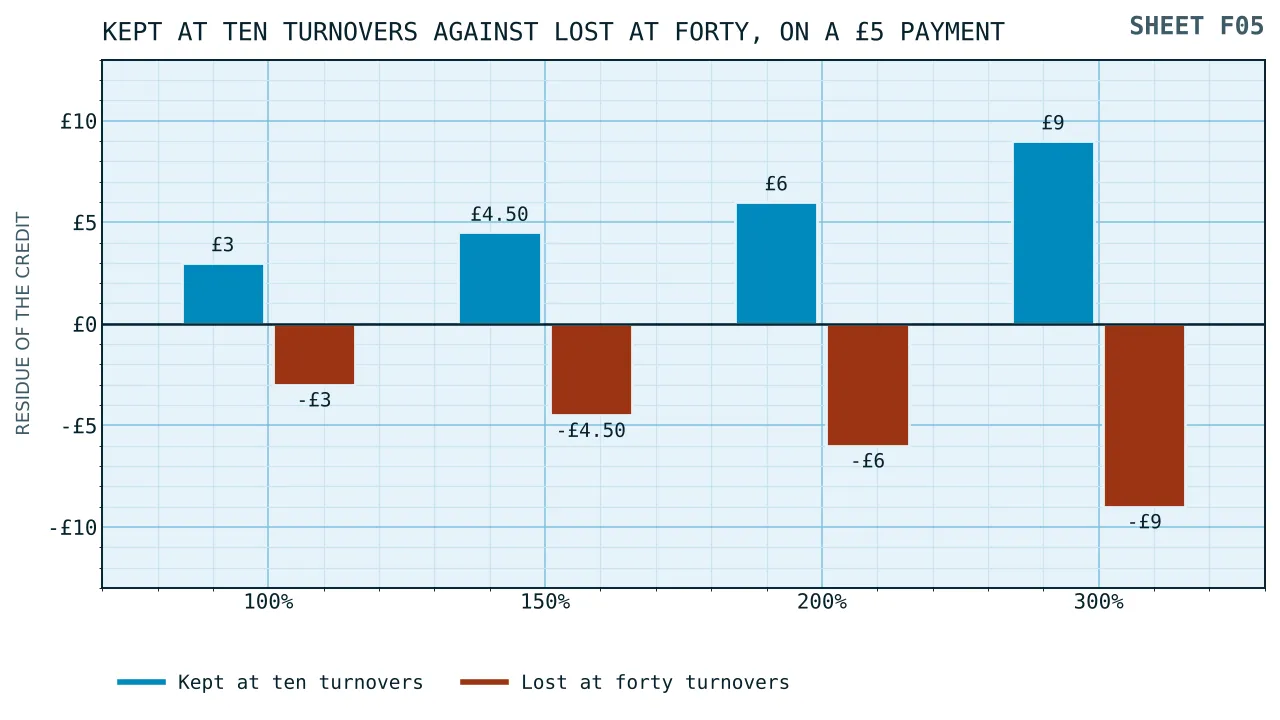
| Headline | Credit | Kept at 10x | Kept at 40x | Lost at 40x |
|---|---|---|---|---|
| 100 per cent | £5.00 | £3.00 | £0.00 | £3.00 |
| 150 per cent | £7.50 | £4.50 | £0.00 | £4.50 |
| 200 per cent | £10.00 | £6.00 | £0.00 | £6.00 |
| 300 per cent | £15.00 | £9.00 | £0.00 | £9.00 |
A ceiling, where one is in force, works on the multiple and leaves the percentage alone. Lifting the percentage therefore lifts the credit and lifts the staking owed in exact step, so the ratio between them never moves. Under twenty-five times a pound of credit is worth having, so a bigger headline is worth more. Above it, each pound of credit costs more than it is worth, and a bigger headline is simply a deeper hole.
At forty times, a 300 per cent headline on £5.00 costs £9.00
3
Two rulebooks, set line against line
Calling an offshore cashier unregulated is lazy and, for the commonest jurisdiction in this market, wrong. The Caribbean regulator does publish a rulebook. The honest method is to open it, read what is in it, and name what is not, which is slower than an adjective and the only way to show a reader what a fiver has lost.
A little about the body first. It describes itself as a foundation incorporated on the nineteenth of April 1999, created to regulate the whole gaming industry in and from the island, and arising directly out of the second mutual evaluation report of the Caribbean financial action task force in 1998. Its ordinance on games of chance came into effect on 24 December 2024, which the regulator calls a pivotal reform of online gaming there, with the reform beginning in November 2023. One caution: the regulator’s own about page also carries a 2025 date for the same ordinance, so this sheet uses the 2024 date, which two of its three statements support, and says that the discrepancy exists. When the site was opened for this build, it stated that its online gaming portal was offline.
What is in the rulebook, including where it is stricter
Three things in that policy run tighter than the British equivalent or have no British counterpart, and a page that left them out would be arguing rather than measuring.
- An increase to a deposit limit waits seven days. A reduction takes effect at once. The British minimum wait before an increase binds is twenty-four hours, so on this single point the island asks for six days more.
- Cooling off cannot be talked out of. Four lengths must be reachable by a single click, three months, one month, seven days and twenty-four hours, with no email and no approval wanted, each taking effect at once and selectable by product. And the operator must not discourage the player: not by questioning the decision, not by offering reassurances to delay it, and not by dangling bonuses or promotions to keep play going.
- Affiliates are reached directly. The operator is made responsible for affiliate compliance with responsible gaming standards, enforced through binding contracts, compliance audits and penalties for failure. Affiliates get no treatment at all on the British regulator’s advertising pages beyond a requirement to take reasonable steps over third parties and placement on copyright-infringing sites.
The policy also obliges a licensee’s website footer to carry the licence holder’s name and registered address, the licence number, a statement that the regulator oversees it, the regulator’s digital seal, a link to the responsible gaming policy, and links to gambling addiction support both local and international. Its own examples of the international ones are GamCare, Gamblers Anonymous and GambleAware, which is to say that the island’s rulebook points a British player at British support bodies.
What is not in it, priced on a fiver
Now the absences, each costed against this deposit. Not one of these appears anywhere in the policy read for this build.
| What a British licence imposes | Worth on this deposit |
|---|---|
| Credit cards barred as a way in | The fiver arrives on debit, on a wallet or by bank push, and never on credit |
| Who the customer is, settled before play | A name, a date of birth and an address, with bonus play and prize-free play inside the rule |
| Nothing automated and nothing hurried | Fifty separate decisions instead of one instruction |
| A floor under the pace of a slot | Fifty cycles cannot be got through inside 125 seconds |
| A small return may not be dressed up | Ten pence back on a 10p cycle is displayed and nothing more |
| Near misses may not be fabricated | One losing outcome may not be put in the place of another |
| A ceiling on a single slot cycle | £5.00, or £2.00 under twenty-five, so the deposit is one cycle or two |
| No ceiling permitted over a deposit balance | The fiver, and whatever is won on it, payable whenever the player asks |
| A single product type to an incentive | Casino credit on a fiver cannot share its terms with bingo tickets |
| Play-through capped at ten times | £4.50 on a £7.50 credit, and £225.00 of staking never owed |
On bonuses the whole of what the island asks is two sentences. Terms are to be put across transparently and clearly. Promotion is not to be aggressive enough to encourage excessive play. There is no ceiling on a multiple in it, no restriction on one incentive carrying several product types, and nothing resembling the British advertising regulator’s list of conditions that count as significant.
Where the island is plainly weaker is the timing of identity, and the gap is worth stating exactly. Its policy will not let a player deposit or wager unless the operator is satisfied they are eighteen or over. At registration that means a date of birth confirmed, and where it can be managed, a check against open sources, a box in which the player declares being over eighteen, and confirmation of the payment method. Full document checking, a government-issued passport, national identity card or driving licence at minimum, is tied to the later money-laundering and know-your-customer milestones, and is brought forward only where the operator has any doubt at all about age. A British licensee, by contrast, has to have verified name, address and date of birth before the customer gambles at all, with play funded by a bonus and play for no prize both inside the rule.
4
Self-exclusion, one operator at a time
This is the difference the key in this page’s title is actually about, and it is a difference of architecture rather than of strictness.
In Great Britain a licensed online gambling company has no choice about being inside Gamstop Online, because the rule makes it compulsory. One registration therefore covers every licensed account at once, and the boundary of the scheme is drawn by the licence rather than by anything the scheme decides. The scheme puts the limit on itself in terms: participating operators’ services are all it can help exclude a person from, and an organisation that stays outside the scheme is one it cannot keep that person out of. That is a limit on a registered person’s protection and nothing else, and this sheet offers no route round it.
The island does require self-exclusion, and the structure is the opposite way up. A player excludes themselves from a named operator; that operator must then bar them from every one of its own domains; and for the whole rest of the market the policy asks only that such a player be encouraged to exclude elsewhere too, site by site. There is no cross-operator register at all.
The periods run longer at both ends. Under the ordinance an operator must offer a long-term self-exclusion of one year, with further options at three years, five years, ten years and for life. Once confirmed it cannot be revoked by the player before the term ends. So the shortest exclusion available on the island is twice the shortest the British scheme offers, which is six months, and the longest single British period is five years where the island goes to a lifetime.
| Feature | Great Britain | The island policy |
|---|---|---|
| Scope of one registration | Every licensed online account | One operator and all of its domains |
| Other sites | Covered by the same registration | The player is encouraged to exclude from each |
| Shortest period | Six months | One year |
| Longest period | Five years, renewable | Lifetime |
| Ending it early | Not before the minimum has run | Not before the term ends |
So neither arrangement lets anybody out early, and the island’s minimum is the longer of the two. What the island does not have is a single register, and that absence is the whole of why a British registration does not reach a cashier licensed there. It is a statement about coverage, not an instruction.
If a registration is the reason this page was reached, the three things worth using are published and cost nothing. A free helpline is run by GamCare. The number is 0808 8020 133 and it is answered round the clock, every day in the year, by phone, by live chat and on WhatsApp, whether the caller rings about themselves or about somebody else. Gamban is blocking software. A single licence covers every major device platform, and what it blocks runs into tens of thousands of gambling apps and sites. TalkBanStop ties those two to the national scheme. GamCare publishes that Gamban costs nothing for anybody who rings that helpline, or who uses GamCare’s own support and treatment, and that publication is a news article from 12 April 2021 stating no length for the free access, so this sheet asserts none either. This site’s own page on the subject is Staying in control.
5
Complaining about five pounds
A page claiming there is no complaints route offshore would be wrong, and the real difference is narrower and more interesting than that. On the clocks the two regimes almost match. On who writes the rules of the final stage they part company completely.
The clocks, which agree
A British licensee should acknowledge a complaint as soon as it reasonably can, and within three working days at the outside; where gambling is offered at any hour, acknowledgement is owed inside a day. Eight weeks from the day the complaint arrived is the limit on the whole process, with any internal escalation counted inside it. The window for bringing one runs six months at minimum, counted from the incident, and no term may close it sooner. That clock can be halted when seven days go by with a reasonable request for information still unanswered by the customer, and it restarts from the point at which it stopped. In its final letter the operator must give its reasons, state that its own process has now reached an end, and set out the way to an independent dispute resolution body.
On the island the figures are six months to complain, free of charge, measured from the settlement of the bet or from the incident. Receipt must be confirmed in writing within one week. The operator assesses and responds inside four weeks, extendable once by four more with written notice to the player, so eight weeks in all. A responsible gaming complaint is prioritised, with best efforts at resolution inside five business days, receipt confirmed within two days, and delay capped at two weeks, extendable by two more where the player is slow to reply.
The final stage, which does not
In Great Britain the dispute resolution bodies are approved by the regulator, and a licensee is required to use one that has been. Eight stand on the published list: the centre for effective dispute resolution, eCOGRA, IBAS, ProMediate, ADR Group, Blexr, the Tattersalls Committee and the Pegasus service, with one provider recorded as having been removed. Coverage differs between them in a way that matters to a casino player. Five are listed for remote across all sectors. Two more appear against all sectors in the table, although one of those lists betting alone in its own entry, and the Pegasus service appears against adult gaming centres, bingo away from the internet, family entertainment centres, and public houses and members clubs, which is to say not against remote casino.
On the island, dispute resolution is compulsory and costs the player nothing, every cost falling on the operator. But the policy expressly contemplates the operator fixing the parameters, and names three of them: whether the process has to be exhausted before a player may go to court, whether a player is bound by its outcome, and whether a claim has to be worth some minimum before it may be escalated at all.
That third parameter is where a five pound deposit meets a wall, and the arithmetic is immediate. The largest sum in dispute on this page is £7.50 of credit, from which £4.50 was expected at a ceiling of ten and nothing at forty. A floor on claim value set anywhere above those figures puts the dispute outside the process before it starts. The regulator says it will take all relevant circumstances into account when judging whether such a restriction is justified, and it names two cases: low-value claims, where it may understand a concern about misuse, and the admission of a self-excluded person, which it expects to be taken seriously whatever the value. That second case is the one a reader of this page should hold on to.
Two further limits bind the player once a process has begun. A completed process cannot be started again with a different provider by either side. And where a player abandons one that has begun, the expectation is that they do not get to raise the dispute again later. Complaints may be brought only by the registered player, because the ordinance bars selling, donating, renting, leasing, pawning or pledging any claim against a licence holder.
What neither regulator will do
Both decline individual disputes, and in strikingly similar language. The British regulator’s own words are that it is not an ombudsman. The powers to resolve a gambling complaint, or to help a consumer recover money, are ones it says it does not have. A dispute about a withdrawal, or about a technical fault in a game, is not something it can resolve. And with no access to a customer’s account it cannot see what took place. It tells a player to complain to the business first. The island’s regulator likewise will not resolve or decide player complaints about transactions on an operator’s website, and will not review or overturn a decision by the operator or the dispute provider unless that decision was inadequately handled, though it does use the information to support its own supervision and enforcement. Operators there report complaint numbers twice a year, on the fifteenth of January and the fifteenth of June, with the first reports due in January 2026; no published aggregate of them could be found, so no complaint volume is quoted here.
6
What a five pound balance cannot reach
The last of the three questions, and the one a small balance answers worst.
Under a British licence a deposit balance has its own protection. A term of that sort may not be written by a licensee, nor applied, nor enforced, nor fallen back on, wherever it is there to put a ceiling over whatever a consumer draws out of that balance, or has that result. In the clause the regulator prints as a failing one, a day’s withdrawals are allowed up to fifty pounds and a week’s up to five hundred. A player may draw that balance, winnings included, whenever they choose; no restriction may stand on the maximum; and any limit on how large or how numerous the withdrawals are has to be reasonable. A licensee also may not offer to cancel a withdrawal once it has been requested, and the guidance asks for the route out to be as frictionless as the operator can make it. The page carrying that prohibition publishes no date, so none is attached to it here.
None of that binds a cashier away from the register, and the British regulator has put on record what it finds in place of it: payouts stopped, and withdrawal limits put so far up that a player cannot reach them. On a fiver the second is devastating and entirely quiet. A balance of £5.00, expected to return £4.80 after one pass, has to quadruple before it clears a withdrawal floor of £20.00. The floor is not a refusal in words. It is a refusal in arithmetic, and a reader can calculate it before depositing by dividing the floor by the balance. The same material notes grave concerns over data protection, with fraud and identity theft among the risks, and no recourse at all once something has gone wrong.
A £20.00 withdrawal floor needs a £5.00 balance to quadruple
The trap that catches careful readers
A game from a supplier a reader recognises proves nothing whatever about the site running it, and the enforcement behind that is published and recent. On 23 July 2026 a supplier incorporated in Malta settled at £4.75m, the British regulator having found its games on six websites without a licence that consumers here could reach, visited in large volumes from December 2023 through to November 2024. The findings: appropriate steps had not been taken to identify and assess the risks of money laundering and of terrorist financing; effective controls had not been maintained to stop its games reaching the British market by way of operators without a licence; and customer due diligence requirements had not been met. The regulator’s director of enforcement said the case exposed serious weaknesses in the supplier’s money laundering risk assessment, and that the failings were serious enough for licence suspension to be considered.
Which is the most practical thing on this sheet. The familiar logo on a reel is not evidence of anything, the regulator has said so in its own warning notice, and a reader checking a site by its games is checking the wrong object.
7
What can actually be checked
Three things are checkable from a reader’s own chair in under a minute, and one of them is the public register.
The British regulator publishes registers of licensed businesses, of personal licences and of premises, each searchable and downloadable, along with regulatory actions, public statements and freedom of information requests. What it tells a player to do with them is specific: confirm the business holds a Gambling Commission licence, look for a licensed status displayed on the website, click through to the register and see the licence, and check that the details recorded there, the activities and the website domain names among them, match. The register page itself carries no date and publishes nothing about how to interpret an entry, so a reader using it should note the day of the check and should not suppose the regulator has published an interpretation it has not.
The scale on the licensed side of that register is worth knowing, because it is the thing an offshore cashier is being compared against. For the year from April 2025 to March 2026 the British gambling market produced £17.5 billion of gross gambling yield, or £13.2 billion with reported lotteries taken out. The remote casino, betting and bingo sector made £8.3 billion of that, up 6.9 per cent. Inside that sector, online casino games produced £5.7 billion and slots alone £4.8 billion. Active accounts stood at 25.7 million at the close of the last reporting quarter, and on the thirty-first of March 2026 there were 2,154 licensed operators between them holding 3,097 licensed activities. Those figures were published on 17 September 2026.
What cannot be checked is worth saying too, because it is where most writing about this market goes wrong. No primary source states which licence any particular offshore brand holds, or how many sites hold a given offshore licence, so this sheet describes what a licence requires and never counts the holders. Nor does any primary source publish a distribution of play-through multiples, of withdrawal caps or of spin values across the offshore market, which is why the contrast on this page is structural: a ceiling of ten exists in Great Britain and no ceiling at all appears in the island policy. The forty times modelled throughout is this sheet’s working assumption, stated as one, and not a measurement of anybody’s terms.
One further jurisdiction turns up often enough to name. Where a cashier holds a licence from the gaming commission seated in the Mohawk Territory of Kahnawake in Quebec, that commission says its gaming law empowers it to make regulations, that it issues five kinds of licence under its regulations on interactive gaming, and that for interactive gaming it receives and reviews complaints, queries and investigations under the procedures those regulations set out. That is what its own site states, and this sheet goes no further than its own site does.
8
Four readings before a fiver goes
Four questions settle a five pound deposit made away from the British register, and only the first of them involves the games.
| The question | The answer here |
|---|---|
| What the deposit buys at 10p | 50 cycles, £4.80 back |
| What the credit survives at 40x | £0.00, against £4.50 |
| Whether a complaint can be escalated | A claim floor may exclude £7.50 |
| What a withdrawal floor demands | £20.00 needs a quadrupling |
The third and fourth are the ones nobody computes, and both can be computed in advance. Divide a published withdrawal floor by the balance you intend to deposit and you have the multiple your luck has to supply. Read the dispute clause for a minimum claim value and compare it with the largest sum that could possibly be in dispute, which on this page is seven pounds fifty.
And the caution. Four pounds fifty is a mean taken over very many repetitions, not a sum that gets handed to anybody. Fifty cycles of a slot carrying rare large prizes will land below £4.80 much more often than above it, and will sometimes land on nothing at all. The fiver is the single exact quantity in the arrangement, and it was gone the instant the cashier asked.
Where to go from here. The same question one rung up, with the British licence taken apart duty by duty on a larger deposit, is at non gamstop casinos uk 10 deposit, which also sets out what the self-exclusion scheme is and how firmly its periods hold. For the licensed arithmetic on this identical deposit, with a flat charge converted into staking, £5 deposit casino is the companion sheet. At a fifth of this deposit a fixed cost decides everything, which is 1 pound deposit casino, and where a till accepts less than an offer demands the gap is priced at £3 minimum deposit casino uk. Everything in this corner is listed at The floor, the working behind every figure appears at How a receipt is struck, and the wider offshore question has a section of its own at Off the register.
Questions
- What does a fiver buy at a cashier away from the British register?
- Fifty cycles at 10p, with £4.80 of average winnings out of them where the slot returns 96 per cent. That part of the arithmetic is the same wherever the cashier is incorporated. What differs is everything around the games, because every offer answering to this key comes from a business that holds no Great Britain licence, and a licence amounts to a list of specific duties rather than a badge.
- What does the absent wagering ceiling cost on a five pound deposit?
- Four pounds fifty on a 150 per cent credit, which is the shape this corner of the market tends to print. A £7.50 credit at ten times, the furthest a British licensee could go after the nineteenth of January 2026, owes £75.00 of staking, costs £3.00 and leaves £4.50 expected. At forty times it owes £300.00, costs £12.00, and runs out at the three-quarter mark with £4.50 of cost falling on the deposit behind it. The same figure, with the sign turned round.
- Is a 300 per cent match better than 150 per cent out here?
- Not at forty times. A ceiling works on the multiple and leaves the percentage alone, so lifting the percentage lifts the credit and lifts the staking owed in exact step and the ratio never moves. Below twenty-five times a bigger headline is worth more: on a fiver, 100 per cent keeps £3.00, 150 per cent keeps £4.50, 200 per cent keeps £6.00 and 300 per cent keeps £9.00 at a ceiling of ten. Above twenty-five times every one of them becomes a loss of exactly the same size.
- Are offshore casinos actually unregulated?
- Not in the commonest jurisdiction here, and calling them so is wrong. That Caribbean regulator describes itself as a foundation incorporated on the nineteenth of April 1999, arising out of the second mutual evaluation report of the Caribbean financial action task force in 1998, and its ordinance on games of chance came into effect on 24 December 2024. It publishes a rulebook. The useful work is reading what that rulebook contains and naming what it leaves out, which this sheet does item by item.
- Is the offshore rulebook ever stricter than the British one?
- On three points, yes. Raising a deposit limit there takes seven days to bind, where the British minimum wait is a single day, and a reduction binds at once under both. Cooling-off lengths of three months, one month, seven days and twenty-four hours must be reachable by a single click with no email and no approval, and the operator must not question the decision, offer reassurances to delay it, or dangle bonuses to keep play going. And affiliates are reached directly there, by binding contract, by compliance audit and by penalty, where the British advertising pages say nothing of them.
- Where is the offshore rulebook clearly weaker?
- On the timing of identity, and on everything in the design of the games. A player there cannot deposit or wager unless the operator is satisfied they are eighteen or over, which at registration means a date of birth confirmed, plus, where it can be managed, a check against open sources, a declaration box and confirmation of the payment method. Full document checking is tied to the later money-laundering milestones. A British licensee must have verified name, address and date of birth before the customer gambles at all, with bonus play and prize-free play both inside the rule. Nowhere in the island policy is there a ceiling on a play-through, a cap on a stake, a minimum game cycle, a bar on automation, or a restriction on making a fuss of a small return.
- Why does a British self-exclusion not reach these sites?
- Because its boundary is drawn by the licence. A licensed online gambling company here has no choice about being inside Gamstop Online, so one registration covers every licensed account and nothing past them. The scheme puts the limit on itself in terms: participating operators’ services are all it can help exclude a person from, and an organisation that stays outside the scheme is one it cannot keep that person out of. That bounds what a registered person is protected from, and this site offers nobody a way round it.
- How does self-exclusion work at an offshore cashier instead?
- Operator by operator. A player excludes themselves from a named operator, that operator must then bar them from every one of its domains, and for the rest of the market the policy asks only that the player be encouraged to exclude elsewhere as well, site by site. There is no cross-operator register. The periods are longer at both ends: the shortest is a year, with further terms at three years, at five, at ten and for life, against six months as the briefest British option, and once confirmed an exclusion cannot be revoked before it expires.
- Can I complain about five pounds at an offshore cashier?
- There is a route, and on the clocks it nearly matches the British one. Six months to complain, free of charge. Receipt confirmed in writing inside a week. A response inside four weeks, extendable once by four more with written notice, so eight weeks in all, which is the British maximum too. Responsible gaming complaints are prioritised, with best efforts inside five business days. Dispute resolution at the end is mandatory and free, with the operator paying for it.
- So what is the real difference on complaints?
- Who writes the rules of the final stage. The dispute resolution bodies in Great Britain are approved by the regulator and a licensee must use one of those, eight standing on the published list, with coverage differing between them: five are listed for remote across all sectors, and one is not listed for remote casino at all. On the island the operator may fix the parameters, among them whether the process has to be exhausted before court, whether a player is bound by the outcome, and whether a claim has to reach some minimum value before it can be escalated at all. That last one bites hardest on a small deposit, because the largest sum in dispute on this page is £7.50.
- Can an offshore cashier stop a five pound balance coming out?
- Nothing in the British prohibition reaches it. Under a licence such a term may not be written, applied, enforced or relied on wherever it puts a ceiling over the sum a consumer may draw from a deposit balance; and in the published failing clause a withdrawal is capped at fifty pounds within any day and five hundred within any week. The regulator has recorded what it finds instead: payouts blocked, and withdrawal limits set high enough to be unattainable. A balance of £5.00, which expects £4.80 back from one pass, must quadruple before a £20.00 floor is cleared, so divide any published floor by the deposit you intend and you have the multiple your luck has to find.
- Does a game I recognise mean the site is licensed?
- It does not, and the enforcement behind that is recent. On 23 July 2026 a supplier incorporated in Malta settled at £4.75m, after the British regulator found its games on six websites without a licence that consumers here could reach, visited in large volumes from December 2023 through to November 2024. The findings were that appropriate steps had not been taken to identify and assess money laundering and terrorist financing risks, that effective controls had not been maintained to stop its games reaching the British market by way of operators without a licence, and that customer due diligence requirements had not been met. A familiar logo on a reel is evidence about the supplier and about nothing else.