
Sheet O10 Revision 1 Checked 15 October 2026
Non gamstop paysafe casinos
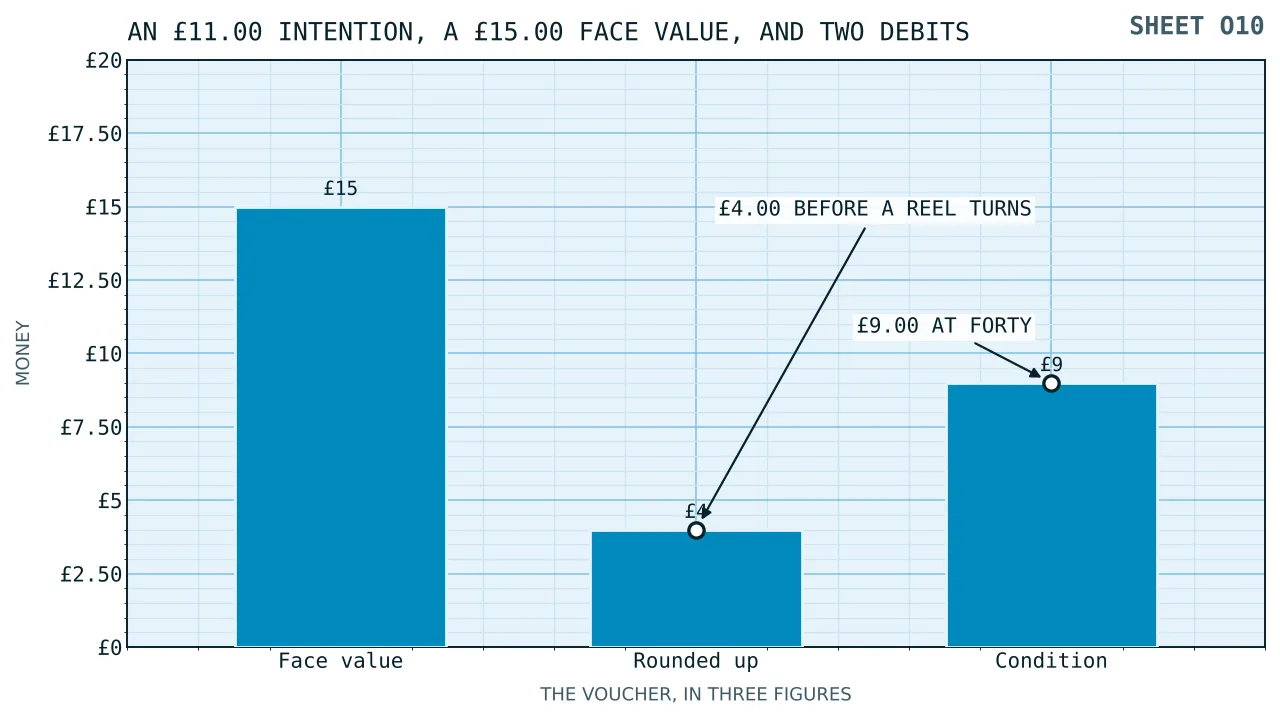
Wanting £11.00 and buying £15.00 puts £4.00 more at stake than was intended, 36.4 per cent before a reel turns. Match the fifteen in full and the credit is worth £9.00 where a ceiling of ten applies and nothing at forty times. Then the nine pounds has to leave by a rail the voucher cannot use.
£4.00 rounded up, £9.00 at best, and no way back down the voucher
What a prepaid face value leaves at the foot
Every destination on this spike is bought advertising. The site takes a fee if a reader goes on to register, and no figure printed below moves because of it.
The Spin Sheet
Till receipt No 01
Betportal
Lowest multiple here
For every €1 of spin credit at face per €1
Credit
Debit
No Great Britain licence
Licensed in Anjouan, Comoros, run by BetPortal Gaming Ltd, with Excite Ultra Media Ltd, reference ALSI-202601040-FI2.
Terms read 15 October 2026
Open the offer at Betportal, opens in a new tabThe Spin Sheet
Till receipt No 02
WinBeast
Five staged matches
For every €1 of spin credit at face per €1
Credit
Debit
No Great Britain licence
Licensed in Curaçao, operator not named on the site.
Terms read 15 October 2026
Open the offer at WinBeast, opens in a new tabThe Spin Sheet
Till receipt No 03
EliteSpin
Longest spin window
For every £1 of spin credit at face per £1
Credit
Debit
No Great Britain licence
Licensed in Costa Rica, run by PrimeTier Limited.
Terms read 15 October 2026
Open the offer at EliteSpin, opens in a new tabThe Spin Sheet
Till receipt No 04
Crown Jewelz
Multiple unpublished
No total struck
Credit
Debit
No Great Britain licence
Licensed in Curaçao, number not verified, operator not named on the site.
Terms read 15 October 2026
Open the offer at Crown Jewelz, opens in a new tabThe figure at the foot of a receipt is this site's own arithmetic and nothing an operator has published: the credit, less the share a spin gives back at 96 per cent return to player, less what playing the wagering through costs at the same return. It describes the offer, not one reader's afternoon. Where the conditions price above the credit the receipt prints nothing rather than a negative sum, and where a figure the sum needs is unpublished it prints the condition in the operator's words instead.
Three words stand in the amount column where no figure can. Noted is a published condition that takes value away without leaving the sum a figure to take. Unpriced is a condition whose figure nobody has published, or a credit that is not a sum until a deposit of your own sets it. Own money is money of yours, which is never part of a total.
Not one of the operators printed above holds a Great Britain licence, so the duties that licence carries do not reach them. Every online gambling company licensed in Great Britain has to be part of Gamstop Online, and a reader who has shut themselves out through the scheme is therefore not shut out here. The ceiling of ten times the bonus funds on a wagering requirement, in force since 19 January 2026, is a condition of that licence and binds the companies that hold one. Where a dispute goes instead is a matter for the authority named on the receipt, and the Gambling Commission describes what a reader faces without a British licence as a lack of recourse if things go wrong. Nobody under 18 may hold an account at any of them.
Every term printed on a receipt is the operator's own, and each receipt carries the day it was read. The oldest of those readings is 15 October 2026. What binds a reader is the operator's own full terms, and not a line printed here.
1
A face value, against a figure somebody wanted
Every other way of paying a cashier moves the figure a reader typed. A prepaid voucher moves the figure a shop had on the shelf. The sum is settled at a till, off a ladder of fixed values, and an intention that falls between two rungs has to climb to the one above it.
The climb is what this rail charges, and the behaviour is a flat fee’s. Its size is decided by where an intention happens to land, not by how large the payment is, so it does not shrink as the payment grows and it does not grow either. The ladder modelled here runs £10.00, £15.00, £25.00, £50.00 and £100.00. Those five values are an assumption of this sheet rather than a sourced fact, because a voucher ladder is published by no source this site may cite, and rungs are a commercial matter anybody may redraw without warning. Substitute the values printed wherever you buy, and all the sums below behave the same.
Take an intention of £11.00. The rung above it is £15.00, so £4.00 more than was wanted goes onto the voucher: 36.4 per cent of the original intention, decided before the cashier has seen any of it. This sheet then matches the whole face value in full, being the usual course where a balance has no way back to its source, and prices the credit from there.
What a prepaid rail does that no other rail in this section does:
- The face value arrives whole, with nothing deducted from it at the cashier.
- The charge is the money rounded up, which never reaches the table at all.
- Nothing can be paid back to a voucher, so the exit has to be some other rail.
- One code per payment, so a deposit built from three vouchers is three purchases and three codes, and a qualifying deposit is ordinarily one payment.
A cashier accepting a prepaid voucher against this key holds no Great Britain licence, and the voucher’s own issuer is not a substitute for one. The voucher’s rules govern the voucher. Parts 6, 7 and 8 set out what is missing at the other end of it.
2
Two doors that open one way only
Two things on this rail travel in one direction, and neither of them is obvious at the till.
The first is the money. A voucher is a sale of stored value, and nothing in that arrangement lets the issuer hand anything back to a player. So the deposit is made down a rail that has no return leg, and the balance it created is penned behind whichever other rail the cashier settles on. Part 5 works that pen in pounds.
The second is the question of who the player is. Buying a voucher settles nothing about that, and a reader who assumes the question has gone away has only moved it. The exit is where the identity question resurfaces, and nothing out here fixes the hour at which it gets asked. Under a British licence it could not be held back to that moment: a licensee is not permitted to make a withdrawal request the trigger for a demand it could reasonably have raised earlier, and money-laundering information is to be sought in good time rather than saved for a payout. That rule has no counterpart in anything this build managed to read.
Nothing on this sheet is advice about which way of paying a cashier will accept, and nothing here addresses a bar a reader has placed on their own payments. A bar of that kind belongs in the same class of protection as a national-scheme registration, and the numbers in part 6 are all this page has to offer about it.
3
Nine pounds on fifteen, nought at forty
Fifteen pounds of face value, matched in full, gives £15.00 of credit. What that credit is worth is settled by one number in the terms, and this is where the absent licence costs real money.
| The condition in the terms | Turnover it demands | Toll on that turnover | Expected at the foot | Running past the credit |
|---|---|---|---|---|
| Ten times, the British ceiling | £150.00 | £6.00 | £9.00 | nothing |
| Twenty times | £300.00 | £12.00 | £3.00 | nothing |
| Twenty-five times | £375.00 | £15.00 | £0.00 | nought |
| Forty times, this sheet’s figure | £600.00 | £24.00 | £0.00 | £9.00 |
Nine pounds is therefore what the ceiling would have preserved, and nine pounds is what its absence costs. The British limit has stood at ten times the bonus funds since the nineteenth of January 2026. Go to forty and the turnover demanded quadruples, the toll quadruples with it, and because the credit was only fifteen pounds it is used up well before the requirement is served.
£9.00 kept at ten times, £9.00 short at forty, on one £15.00 credit
Set the rounding beside that and the two charges are of comparable size on this rail, which is unusual. Four pounds was lost at the till and nine pounds at the condition. One of them is visible on a shelf and the other is printed in a document nobody reads before buying.
4
The line, and what rounding did to B
One expression carries every figure above, and on this rail the striking thing is not the expression but what has happened to its first letter before anybody reaches it. B was settled at a till, by a ladder, and not by the reader. What the ladder left over cannot come home, because no voucher takes a payment back.
E = B × (1 – (W × (1 – RTP)) / g)
Rounding has already fixed B at £15.00 by the time the expression is reached, the face value having been matched in full. Returns run at 0.96 here, the weighting at one, and the multiple is the only letter the terms choose.
Read it at forty. Four pence taken forty times over comes to 1.60, which puts the bracket at minus six-tenths, and six-tenths of fifteen pounds is £9.00 carrying a minus. Since no balance falls under nought, the minus is recording a credit exhausted while the requirement was still outstanding, with nine pounds of expected cost looking for somewhere else to fall.
Now run it on the money that was actually wanted. Had the rung matched the intention, B would have been £11.00, the ceiling case would have left £6.60, and the forty times case would have overrun by £6.60. So the four pounds rounded up is not merely four pounds. It enlarges the credit, enlarges the turnover demanded in exact proportion, and enlarges the overrun by £2.40. A bigger face value is a bigger obligation wherever the multiple sits above twenty-five.
£4.00 of rounding adds £2.40 to the overrun at forty times
5
A second rail, carrying a floor of its own
Nine pounds of expectation is the best case on this sheet, and the best case still has to find a way out of the building.
A cashier taking prepaid vouchers has to settle the other way by some different route: a debit card, a current account, or a wallet the player opens for the purpose. One payment has become two relationships that way. Nothing about the route in governs the route out, and the route out brings conditions nobody saw at the till: a smallest payment of its own, a clearing time of its own, a document request of its own.
Price the smallest payment, because on a sum this size it is decisive. Model a floor of £25.00 on the exit rail, stated as an assumption since no source behind this site publishes a minimum withdrawal. Nine pounds of expectation against a twenty-five pound floor stays where it is. It waits in the account to be staked away, or waits for another purchase at another till to lift it over the bar. Nine into twenty-five is a factor of two and seven-ninths, so the balance has to very nearly treble on luck alone before the floor stops functioning as a refusal.
| Stage of the errand | The figure here |
|---|---|
| What the reader meant to spend | £11.00 |
| What the ladder made them spend | £15.00 |
| Expected to survive forty times | £0.00 |
| Needed to clear the modelled exit floor | £25.00 |
Which is this rail’s finding, and wagering has no part in it. Divide the floor on the exit rail by whatever sum a reader expects to withdraw, and out comes the multiple luck has to supply before any of it reaches home. That sum can be done at the till, in front of the ladder, before a code exists.
6
Why a voucher reaches no register
A voucher reaches no register, because a register of this sort is fastened to licences and not to payments. Belonging to Gamstop Online is compulsory for a business licensed in Great Britain to offer gambling online, so the boundary is the licence’s and never the scheme’s. What a reader pays with has no standing in the question whatever.
Against its own interest the scheme states the limit: exclusion from services run by participating operators is all it can assist with, and an organisation outside it is one the scheme cannot keep anybody away from. That is the outer edge of a registered person’s protection, and this page offers nobody a way past it. The British regulator fills in the part that matters, in a warning notice of 20 January 2025: customers who are vulnerable are frequently the ones such sites pursue, and a self-exclusion already taken is among the marks the notice names.
The arithmetic is the argument, and it belongs here rather than in a footnote. An eleven pound intention becomes a fifteen pound payment, the matched credit is expected to leave £0.00 at forty times, and anything that does survive meets an exit floor it cannot reach. No arrangement of those figures makes this errand worth defeating a registration for.
Three things are published and free, and not one of them is a dodge. A helpline run by GamCare carries the name National Gambling Helpline. Dialling 0808 8020 133 is free, and the line is answered at every hour of the year, with live chat and WhatsApp reaching it too. Blocking software is the second: Gamban, one licence, every major device platform, and gambling sites and apps blocked in the tens of thousands. TalkBanStop is GamCare’s own name for the three in combination, and GamCare publishes that the software is free for a caller to the helpline or a user of its support and treatment services. Its page is a news item bearing the date 12 April 2021, which says nothing about how long the free access runs, so this page says nothing either. This site keeps its own account of all of it at Staying in control.
7
Nothing to point at
A British licence is useful to a player mainly as something to point at when a cashier does something. Written as the absence of anything to point at, the list runs like this, and not one of the fourteen turns up in the offshore rulebook this build consulted.
- Nothing to cite when a multiple reaches forty rather than ten.
- Nothing to invoke when one incentive carries casino credit and bingo tickets under shared terms.
- Nothing to appeal to when one slot cycle takes a stake over £5.00, the ceiling dropping to £2.00 for anybody not yet twenty-five.
- Nothing to invoke when a slot cycle follows its predecessor inside 2.5 seconds, or a cycle of some other casino game inside five.
- Nothing to object to when turbo, slam stop or an automatic cycle appears on the screen.
- Nothing to complain of when a return no larger than its own stake arrives with music behind it.
- Nothing to challenge when a losing outcome is swapped for a near-miss losing outcome.
- Nothing to insist on when several games run at once, or when the odds of one move while it is being played.
- Nothing to point at when a cashier rations what may leave a deposit balance.
- Nothing to fall back on when a withdrawal already requested is offered back as a stake.
- Nothing to rely on when identity is settled after the play rather than before it.
- Nothing to quote when a credit card funds the account, directly or through a money service business.
- Nothing to require when nobody is prompted to set a financial limit, or offered one as the default, and nothing to trigger a check when net deposits inside a month pass £150.00.
- Nothing to escalate to when eight weeks go by and no approved dispute body stands at the end of them, and nothing to register with, because the national self-exclusion scheme is drawn by the British licence.
The offshore rulebook is not blank, and claiming otherwise errs the other way. Deposit limits have to exist there over three periods, a day and a week and a month, with a cut biting at once and a rise held for seven days against Britain’s single day. Cooling off has to be a single click away and immediate, with no talking a player out of it permitted. Making sure affiliates keep to the standards is the operator’s own duty. On bonuses, two sentences are the whole of it: communicate the terms transparently and clearly, and keep promotion short of the point where excessive play is encouraged.
8
What the regulator reports finding instead
Every figure in part 5 assumes that the exit works. That assumption is the biggest unpriced item here, and the British regulator has published what it finds in place of it.
A prohibition of its own attaches to a deposit balance under a licence. Where a term exists to put a ceiling over the sum a consumer takes out of that balance, or works that way without saying so, it may not be imposed, used, enforced or leaned on. The regulator prints one specimen of the forbidden sort: a week held to five hundred pounds and a day to fifty. Winnings included, the balance comes out when the player asks. The maximum admits no restriction. And reasonableness is the test for any limit touching how large or how many the withdrawals are. Offering to cancel a withdrawal after the request has gone in is barred too, and the guidance wants as little friction on the way out as the operator can manage. That prohibition is published on a page carrying no date at all, so this sheet fastens none to it.
What the regulator reports in its place is two things: payouts stopped outright, and withdrawal thresholds put beyond a player’s reach altogether. On a voucher deposit the second of those is especially quiet, because a reader has already met one floor on the exit rail and will read a second as more of the same. Nine pounds cannot clear twenty-five, and nine pounds certainly cannot clear a figure chosen to be unreachable. Grave concern over the protection of player data is named in the same material, identity theft and fraud among the risks, with nothing to appeal to once matters have gone wrong.
One correction worth making before anybody checks a site by its reels. A reel from a supplier a reader knows proves nothing about the site it is turning on, and there is published enforcement behind that. On 23 July 2026 a Malta-incorporated games supplier settled at £4.75m. Six unlicensed websites open to consumers here had been found running its games, with visits in large volumes between December 2023 and November 2024.
9
Four readings before a code is keyed in
Four readings settle a prepaid deposit at a cashier outside the British register, and three of them can be taken standing at the till.
| What to settle before buying | On this errand |
|---|---|
| The gap between intention and rung | £4.00, or 36.4 per cent |
| The multiple tied to the credit | 40x here, 10x under a licence |
| What £15.00 of credit should leave | £0.00, against £9.00 |
| The least the exit rail will pay | £25.00 modelled |
Rows one and four are the two that belong to the rail rather than to the bonus, and they are the two nobody computes. The first is a subtraction done in front of a shelf. The fourth is a division done against a figure printed in the cashier’s banking terms, and the answer it gives is how far a balance must climb before any of it is reachable. Neither sum needs the bonus terms at all.
A mean needs its caution. Nine pounds is averaged across a great many identical attempts and is not a sum anybody collects, and one pass at a fifteen pound credit most often ends on nothing. The £4.00 rounded up at the till is not an average. It is exact, and it is gone before the first reel moves.
Neighbouring sheets. A charge to a mobile bill, which also cannot be reversed, is priced at pay by phone off the register, and a wallet, which can be paid back to but charges for the privilege, is at paypal off the register. The identity question this rail pushes to the exit is dealt with at no verification casinos, and the jurisdiction standing behind most of these cashiers is read end to end at Curaçao licensed sites. The section lives at Off the register, and the same voucher under a British licence is at paysafecard casino.
Questions
- What does a voucher’s face value actually cost?
- The gap between an intention and the rung above it. On the ladder modelled here, which runs £10.00, £15.00, £25.00, £50.00 and £100.00 as an assumption rather than a sourced fact, an intention of £11.00 has to buy £15.00. That puts £4.00 more at stake than was wanted, or 36.4 per cent of the original figure, and it is decided at the till before the cashier has seen any of it.
- Why does the rounding behave like a flat fee?
- Because its size is set by where an intention lands rather than by how large the payment is. It does not shrink as the payment grows and it does not grow either. An intention a pound above a rung is the expensive case and an intention sitting on a rung costs nothing at all, so the ladder rather than the cashier decides the rate a reader pays.
- What is a matched fifteen pound voucher expected to leave?
- Nine pounds where a ceiling of ten applies, and nought at forty times. The British limit has stood at ten times the bonus funds since the nineteenth of January 2026, and there the £15.00 of credit demands £150.00 of turnover, costs £6.00 at four pence in the pound, leaving £9.00 expected. At forty times the turnover demanded is £600.00, the toll on it £24.00, and the credit is used up well before the requirement is served, with £9.00 running past it.
- Does a larger face value help?
- Above twenty-five times it hurts, and the rounding is what makes that concrete. Had the rung matched an £11.00 intention, the credit would have been £11.00, the ceiling case would have left £6.60 and the forty times case would have overrun by £6.60. Buying £15.00 instead enlarges the credit, enlarges the turnover demanded in exact proportion, and enlarges the overrun by £2.40. A bigger face value is a bigger obligation.
- Can winnings come back to the voucher?
- No. A voucher is a sale of stored value and nothing in that arrangement lets the issuer hand anything back to a player, so the deposit travels down a rail with no return leg. A cashier taking prepaid vouchers has to settle the other way by some different route, a debit card or a current account or a wallet the player opens for the purpose, which turns one payment into two relationships.
- Why does the second rail matter so much on a small balance?
- Because it carries a smallest payment of its own. Model a floor of £25.00 on the exit rail, as an assumption, since no source behind this site publishes a minimum withdrawal. Nine pounds of expectation against a twenty-five pound floor stays where it is, waiting in the account to be staked away or waiting for another purchase at another till to lift it over the bar. Nine into twenty-five is a factor of two and seven-ninths, so the balance has very nearly to treble on luck alone.
- Does buying a voucher settle the identity question?
- It moves it, which is not the same thing. The exit is where the question resurfaces, and nothing out here fixes the hour at which it gets asked. Under a British licence it could not be held back to that moment, since a licensee is not permitted to make a withdrawal request the trigger for a demand it could reasonably have raised earlier, and money-laundering information is to be sought in good time rather than saved for a payout. That rule has no counterpart in anything this build managed to read.
- Why does the way of paying have no bearing on the national scheme?
- Because a register of this sort is fastened to licences and not to payments. Belonging to Gamstop Online is compulsory for a business licensed in Great Britain to offer gambling online, so the boundary is the licence’s and never the scheme’s. Against its own interest the scheme states the limit: exclusion from services run by participating operators is all it can assist with, and an organisation outside it is one the scheme cannot keep anybody away from. That is the outer edge of a registered person’s protection.
- What is there to point at if a cashier does something?
- Out here, nothing, and that is the honest answer. Nothing to cite when a multiple reaches forty rather than ten. Nothing to appeal to when one slot cycle takes a stake over £5.00. Nothing to invoke when a cycle follows its predecessor inside 2.5 seconds. Nothing to object to over turbo or an automatic cycle. Nothing to challenge when a loss is swapped for a near miss. Nothing to point at when a cashier rations what may leave a deposit balance. Nothing to rely on over the timing of an identity check. Nothing to escalate to after eight weeks. And nothing to register with, because the national scheme is drawn by the British licence.
- Can a cashier simply decline to pay the balance out?
- Nothing in the British prohibition reaches out here. Where a term exists under a licence to put a ceiling over the sum a consumer takes out of the deposit balance, or works that way without saying so, it may not be imposed, used, enforced or leaned on, and the regulator’s one specimen of the forbidden sort holds a week to five hundred pounds and a day to fifty. What the regulator reports in its place is two things: payouts stopped outright, and withdrawal thresholds put beyond a player’s reach altogether. Nine pounds cannot clear twenty-five, and certainly cannot clear a figure chosen to be unreachable.
- Is a familiar reel evidence of a licence?
- It is not, and published enforcement stands behind that. On 23 July 2026 a Malta-incorporated games supplier settled at £4.75m. Six unlicensed websites open to consumers here had been found running its games, with visits in large volumes between December 2023 and November 2024. A reel says something about its supplier and nothing about the site, so checking a site by its games examines the wrong object.