
Sheet M15 Revision 1 Checked 15 October 2026
150 free spins on Book of Dead, no deposit
One hundred and fifty cycles priced at 10p are £15.00 at face, £14.40 of average winnings, and £576.00 of staking owed at forty times. The expected price of that staking is £23.04, and four hours of reels.
£14.40 of winnings, £576.00 to stake, four hours to the minute
What the conditions leave
Every destination on this spike is bought advertising. The site takes a fee if a reader goes on to register, and no figure printed below moves because of it.
The Spin Sheet
Till receipt No 01
Betportal
Lowest multiple here
For every €1 of spin credit at face per €1
Credit
Debit
No Great Britain licence
Licensed in Anjouan, Comoros, run by BetPortal Gaming Ltd, with Excite Ultra Media Ltd, reference ALSI-202601040-FI2.
Terms read 15 October 2026
Open the offer at Betportal, opens in a new tabThe Spin Sheet
Till receipt No 02
WinBeast
Five staged matches
For every €1 of spin credit at face per €1
Credit
Debit
No Great Britain licence
Licensed in Curaçao, operator not named on the site.
Terms read 15 October 2026
Open the offer at WinBeast, opens in a new tabThe Spin Sheet
Till receipt No 03
EliteSpin
Longest spin window
For every £1 of spin credit at face per £1
Credit
Debit
No Great Britain licence
Licensed in Costa Rica, run by PrimeTier Limited.
Terms read 15 October 2026
Open the offer at EliteSpin, opens in a new tabThe Spin Sheet
Till receipt No 04
Crown Jewelz
Multiple unpublished
No total struck
Credit
Debit
No Great Britain licence
Licensed in Curaçao, number not verified, operator not named on the site.
Terms read 15 October 2026
Open the offer at Crown Jewelz, opens in a new tabThe figure at the foot of a receipt is this site's own arithmetic and nothing an operator has published: the credit, less the share a spin gives back at 96 per cent return to player, less what playing the wagering through costs at the same return. It describes the offer, not one reader's afternoon. Where the conditions price above the credit the receipt prints nothing rather than a negative sum, and where a figure the sum needs is unpublished it prints the condition in the operator's words instead.
Three words stand in the amount column where no figure can. Noted is a published condition that takes value away without leaving the sum a figure to take. Unpriced is a condition whose figure nobody has published, or a credit that is not a sum until a deposit of your own sets it. Own money is money of yours, which is never part of a total.
Not one of the operators printed above holds a Great Britain licence, so the duties that licence carries do not reach them. Every online gambling company licensed in Great Britain has to be part of Gamstop Online, and a reader who has shut themselves out through the scheme is therefore not shut out here. The ceiling of ten times the bonus funds on a wagering requirement, in force since 19 January 2026, is a condition of that licence and binds the companies that hold one. Where a dispute goes instead is a matter for the authority named on the receipt, and the Gambling Commission describes what a reader faces without a British licence as a lack of recourse if things go wrong. Nobody under 18 may hold an account at any of them.
Every term printed on a receipt is the operator's own, and each receipt carries the day it was read. The oldest of those readings is 15 October 2026. What binds a reader is the operator's own full terms, and not a line printed here.
1
A named game, and the number this sheet cannot print
A key that names a game asks for one number this sheet is not able to supply, which is the game’s own theoretical return. No primary source in this site’s evidence file publishes a return figure for the game named on the front, so none is printed here.
Nor does a British licence oblige anybody to publish one. RTS 3C offers four alternatives and the licensee may satisfy it with any of them. That turns the gap into the subject of the page rather than an awkwardness in it, because the return is the term the whole answer is most sensitive to.
One hundred and fifty cycles priced at 10p are £15.00 at face. Apply a 96 per cent return and £14.40 is the average winnings. Call that figure B, since part 4 runs it again at four other returns so a reader can see how much turns on the digit nobody has to print.
Ten pence a cycle is the second assumption, and it is an assumption for the same reason: no rule in Britain sets a spin’s cash value, identifies whoever does, or requires the figure to be published. Multiply the price and every pound figure here multiplies with it, while the cycle counts and the clock stay exactly where they are.
Forty times is the multiple carried through, that order of requirement being what this end of the market attaches to a count of this size. Ten times the bonus funds is the ceiling a British licence imposes, in force since 19 January 2026, and sixty times is the figure the regulator recorded as being in use among some licensees before it capped anything.
What is assumed, and what is sourced:
- Assumed: 10p a cycle, and a theoretical return of 96 per cent.
- Assumed: W at forty, moved in part 4 and in part 9.
- Assumed: a staked pound counting as a whole pound, right up to part 9.
- Sourced: the ten-times ceiling, the 2.5 second game cycle, the autoplay bar, the stake limits, and what RTS 3C actually requires.
- Not available at all: the named game’s published return, which is why part 4 exists.
2
Fourteen pounds forty, and the sum it goes through
Everything below comes off one ratio.
E = B × (1 – (W × (1 – RTP)) / g)
Return to player is the term this page cannot fill in, so B is computed at the house assumption and the sensitivity is shown instead. The other three behave themselves: B is the credit, W the turnovers demanded of it, g the fraction of a stake allowed to count, and E the pounds and pence at the end.
Forty times £14.40 is £576.00 of staking, whose expected price at four pence in the pound is £23.04, leaving E at minus £8.64.
The bracket gives it directly: 40 × 0.04 = 1.60, and one less that is -0.60.
Three-fifths of £14.40 is £8.64, so the closing line is £0.00 and the credit has run dry at some point inside the staking.
Nobody hands over the eight pounds sixty-four. With no deposit behind the cycles the balance has no road below nought, and the minus records how far the condition outran the thing it was attached to. Three-fifths, on these figures.
Here are the same winnings against five multiples, with the hours beside them, because on a count of this size the clock is the part a reader will feel.
| W | Staking | Hours | E |
|---|---|---|---|
| 10 times | £144.00 | 1.00 | £8.64 |
| 20 times | £288.00 | 2.00 | £2.88 |
| 25 times | £360.00 | 2.50 | £0.00 |
| 40 times | £576.00 | 4.00 | -£8.64 |
| 60 times | £864.00 | 6.00 | -£20.16 |
3
Four hours, and what paces them
Required staking of £576.00 at 10p a go is 5,760 cycles. Five thousand seven hundred and sixty cycles at two and a half seconds apiece is four hours to the minute. RTS 14D is what holds them apart, requiring 2.5 seconds to pass before the next slot game may be commenced.
The hundred and fifty advertised cycles take six minutes and fifteen seconds, so the obligation is thirty-eight times longer than the gift. That ratio is W multiplied by the return, which is why it recurs across the whole section whatever the count on the front happens to be.
Three rules hold the four hours in place, and each of them answers an obvious attempt to compress it. RTS 8A will not let a system run cycles on a player’s behalf; each one has to be committed to individually, with automatically posted poker blinds the single carve-out. Hurrying the outcome is barred by RTS 14E, whose guidance strikes quick spin, slam stop and turbo off the menu for remote games of any native speed, excusing only a feature round carrying no extra stake and a control that reveals everything at once. And RTS 14C shuts the parallel route, since no functionality may be offered that lets casino games run side by side, which its guidance extends to split screens and to multiple screens.
From 17 January 2025 a further change banned operator-led functionality for playing several products at the same time, with roulette and blackjack tables given as the regulator’s example. A companion duty arrived at the same time: net spend and time played have to be displayed in real time, which on a four-hour obligation is the only running total a player gets without doing the sum.
The stake is the one lever left, and statute bounds it. A slots game cycle is capped at five pounds, with two pounds the figure for a player under 25, by regulations made on 25 February 2025 and commenced on the regulator’s dates in April and May. Those ceilings reach online slots alone and leave roulette and blackjack outside. Staked at five pounds, the identical £576.00 becomes 116 presses instead of 5,760, under five minutes of work, with the expected price unmoved at £23.04.
5,760 cycles, 14,400 seconds, six minutes of them free
4
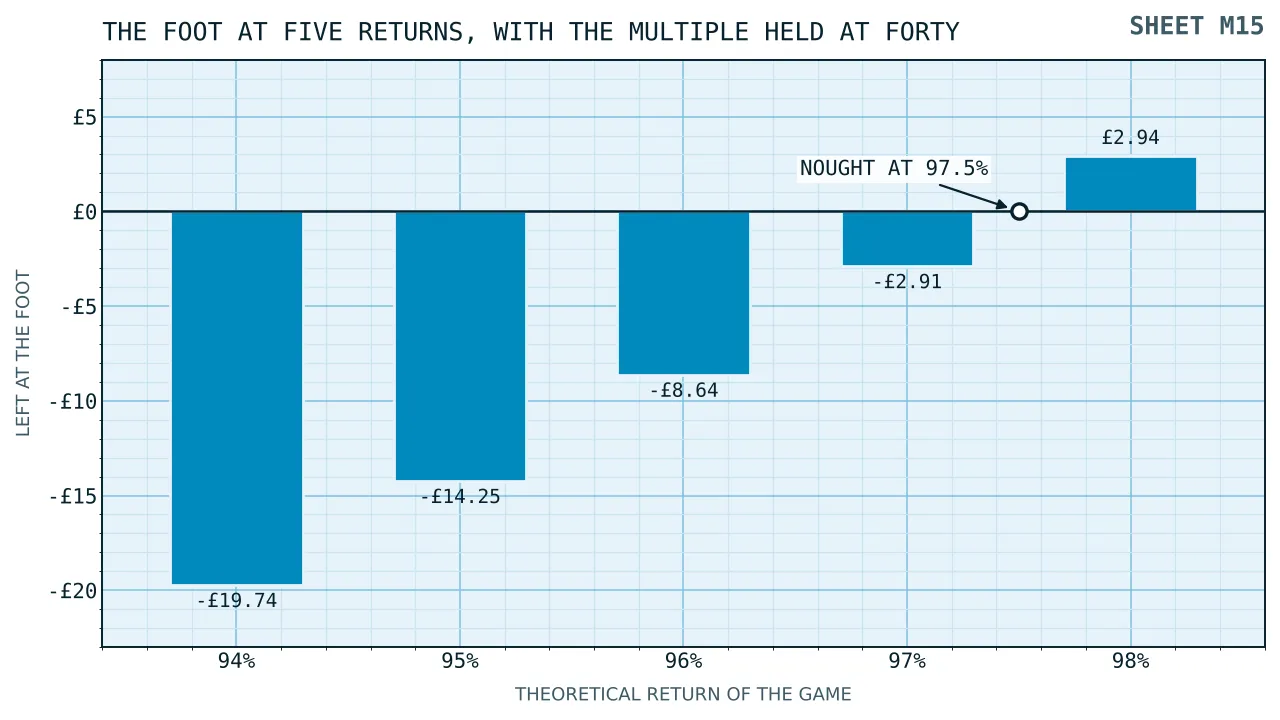
A point of return either way
This is the part that justifies the page. The multiple is printed in the bonus terms and the spin value can be inferred from the credit, but the return is a property of the game, and the whole answer swings on it.
| Return | B | Staking | Expected price | E | Break-even W |
|---|---|---|---|---|---|
| 94 per cent | £14.10 | £564.00 | £33.84 | -£19.74 | 16.7 |
| 95 per cent | £14.25 | £570.00 | £28.50 | -£14.25 | 20.0 |
| 96 per cent | £14.40 | £576.00 | £23.04 | -£8.64 | 25.0 |
| 97 per cent | £14.55 | £582.00 | £17.46 | -£2.91 | 33.3 |
| 98 per cent | £14.70 | £588.00 | £11.76 | £2.94 | 50.0 |
Two points of return either side of the house figure move the closing line from minus fourteen pounds twenty-five to minus two pounds ninety-one. Four points across the whole range turn a loss of nearly twenty pounds into a gain of £2.94. The advertised count never moves. The credit barely moves, from £14.10 to £14.70. What moves is the price of the condition, and it moves by a factor of three.
One over the edge is the break-even multiple, which runs from 16.7 at a 94 per cent return up to 50 at 98. Twenty-five, the figure this section is organised around, is the value at 96 per cent and nothing more fundamental than that. So two offers of a hundred and fifty cycles, identical on the front and identical in the wagering line, can sit on opposite sides of their own break-even depending on which build of which game the credit has to be spent on.
So the sheet uses 96 per cent, states that it is an assumption, and then shows exactly how much the answer moves when the real figure differs. A reader who finds the game’s published figure should substitute it and reread the row.
5
What the rulebook does and does not owe a reader
RTS 3 is the standard that governs what a licensed game has to tell a player before they commit, and it is the standard most often overstated on sites like this one.
RTS 3C asks for the information a customer could reasonably need to judge their chances to be easy to find before they commit to gamble. Then comes the list, and the list is where the misreading starts.
They stand as alternatives rather than as a bundle. A licensee may satisfy the standard by publishing the probability of winning events; or the house edge, which on the figure this sheet uses is four pence in the pound; or the return to player percentage; or, with no figure at all, a plain account of a game’s workings and of how it settles on a winner. A licensee that prints the house edge has met the standard without printing a return percentage at all, which is the single most misread thing in the whole rulebook.
Whichever item is chosen has to be there to be found before anybody commits to gamble, and where the choice falls on the return percentage the guidance wants the average theoretical figure. For peer-to-peer games an account of the mechanics and of how a winner emerges suffices by itself; for bingo and some lottery games, an account of how prizes get allocated suffices.
The neighbouring requirements fill in the rest. RTS 3A asks for an explanation of the applicable rules to be easily available beforehand, accurate, sufficient to cover all of them, and written so that reasonable steps have been taken to make it understandable. RTS 3B asks for enough information as play proceeds for a customer to follow the state of the game, lotteries excepted. RTS 3D asks for the potential prizes and payouts, or the means of working them out, to be available before the commitment. The standard ends at 3D; there is no 3E.
Which leaves a reader of this page in a precise position. A licensed site owes them a single item from that list about their chances, and the item the arithmetic needs is only one candidate among them.
6
Why a published return can be relied on
A return percentage would be a decorative number if the game were free to behave otherwise. Four requirements stop it, and together they are what make the 96 per cent in part 2 a usable figure rather than a boast.
Acceptable randomness is required of game results, and a compensated game is out: the guidance reads that as a bar on interventions, manual or automatic, that shift the probabilities. Results have to distribute themselves according to the theoretical probabilities, and that is the sentence turning a published average into a claim about the long run. Random numbers go in the order they come, and discarding one to achieve adaptive behaviour is not allowed.
Designs likely to mislead a customer about how probable a result is are prohibited, and the standard names two of them. A losing outcome may not be dressed up to look like a near miss, and anything simulating a real device has to simulate that device’s real probabilities. On a count of 5,760 cycles that rule is doing more work than any other on this page, because the impression a long losing run leaves is the thing most capable of turning a four-hour obligation into a longer one.
A game in play may not have its rules rewritten, its payouts altered or its outcome probabilities shifted, and the guidance names wording it will not accept: a rule saying the rules may change at any time. A change belongs to a game taken offline or suspended, and the customer has to be told it happened. A bonus round properly described to the player is a legitimate change rather than a breach.
The result of a game and of the customer’s gamble must be displayed clearly and accurately, and for long enough to be read. Alongside it, RTS 14F withholds celebration where a return does not exceed the total staked, so 10p back on a 10p cycle gets no win-related sound or animation. Across five thousand seven hundred and sixty cycles that is a great many results presented honestly as the small returns they are.
7
One game named, and where the credit may not go
An offer that names a game has restricted the credit before a reader has read a word of the terms, and that restriction interacts with two British rules.
The first is about mixing products. From 19 January 2026 one incentive may hold a single gambling product type, chosen from betting, casino, bingo and lottery. A slot is a casino product, so a match handed over with free spins sits inside one product type. Pair a match with bingo tickets and two types have been mixed, which the rule catches.
Three exemptions cut against what a reader would expect. Two products of the same type together are fine, the regulator instancing a scratchcard and a raffle. One email may carry a betting offer and a casino offer side by side, so long as marketing consent covers both products. And a credit the customer may spend wherever they like falls outside the ban altogether, the example given being a tenner usable across betting and casino alike. The regulator states the aim narrowly: incentives whose terms are tied together and held in common.
The second rule is about the terms. Social Responsibility Code 5.1.1 bites whenever a licensee offers anybody money, goods, services or another advantage, and it wants the incentive’s terms set out clearly, transparently and fairly, and made easy to reach for anyone it is offered to. Where a named game is the only eligible game, that is a significant condition and belongs in the advertisement rather than in the document behind it.
The advertising regulator’s list of significant conditions in a gambling promotion covers eligibility by newness, age or location; deposit and wagering requirements; deadlines for claiming and for using; and minimum odds or bet types. A restriction to one named game sits squarely inside the first of those, and the regulator’s position is that an advertisement showing its conditions too faintly is misleading.
8
A familiar reel set is not a licence
Out here the platform holds no Great Britain licence, so nobody owes a reader a return figure, a paced cycle or a stake ceiling.
Recognising the reel set proves nothing about the licence, because the regulator has found games from licensed suppliers running on sites with no licence at all. Its industry notice records exactly that, and it is the most useful single fact on a page whose key names a game: the artwork, the symbols and the feature round can be the ones a player knows, with none of the rules in parts 5 and 6 standing behind them.
That is not hypothetical. The regulator found games belonging to one supplier on six unlicensed websites that British consumers could reach, and a settlement of £4.75m followed on 23 July 2026 from Evolution Malta Holding Limited. Visits in volume were recorded from December 2023 to November 2024. Three failings were found: money laundering and terrorist financing risk not properly identified or assessed, controls inadequate to stop the games reaching the British market through unlicensed operators, and customer due diligence requirements unmet. The regulator’s enforcement director described serious weaknesses, and said the failings had been serious enough to make licence suspension a consideration.
The Curaçao policy consulted for this sheet sets out nothing about what a game must disclose on the likelihood of winning. Its mandatory list does include information accessibility, but no equivalent of the alternatives in part 5 appears anywhere in it. What is plainly absent from it: the wagering ceiling, the stake limits, the minimum interval between cycles, the bars on turbo and automatic play, and any restriction on cheering a return that only matches a stake. Bonuses get two lines: transparency in the communication of terms, and promotion that falls short of encouraging excessive gambling.
So the honest summary of a named-game offer off the register is that the game may be exactly the game, and the number this page could not print is a number nobody out there has to produce either. A British licence would not guarantee the figure’s appearance, because RTS 3C takes four forms. It would guarantee that one of them appears, and that the result it describes has not been adjusted while the reels turned.
9
Running it on the game you were actually given
Four readings and a subtraction, in the order a document gives them up.
| The step | Here |
|---|---|
| Count, times spin value | 150 at £0.10 |
| Times the game’s return | £14.40 |
| Times W, over g | £576.00 |
| Times the edge | £23.04 |
| Subtract, floor at nought | £0.00 |
| Divide staking by spin value | 5,760 cycles |
Only the second line needs the game, and it is the line most likely to be missing. Where the figure cannot be found, run the row for 95 and the row for 97 from part 4 and treat the pair as the range the answer sits in. On this count that range is minus fourteen pounds twenty-five to minus two pounds ninety-one, which is wide enough to matter and narrow enough to act on: both ends are below nought.
Then the term that has counted a pound as a pound throughout. Set contribution at thirty pence and the contribution owed stays at £576.00, while earning it takes £1,920.00 of staking, priced at £76.80, which drops E to -£62.40 and stretches the clock to thirteen hours and twenty minutes. At ten times, the regulated ceiling, the same rate still gives -£4.80.
The rate illustrates and measures nothing. Thirty pence of every staked pound counting towards a requirement is what one consultation respondent described to the regulator; the regulator noted the submission and left weighting unregulated; and no table of the rates presently in use exists in public. Contribution is the whole subject of slots free spins, where the level it has to reach before anything survives is worked out properly.
Two things this answer refuses to do. It will not forecast an afternoon: the mean of a hundred and fifty cycles describes a long run of such rounds, and the commonest single result of one round is nothing. And it will not survive a term lying outside the expression, a maximum win on the bonus or a discretion kept back by the operator, either of which can close the sheet with W untouched.
Counts on either side get the same treatment and carry the same stated assumption: 150 free spins no deposit runs the identical count without a game attached, 200 free spins runs a third more, and 20 free spins on Big Bass Bonanza works a named round through five different spin values. The multiple holds the whole set, ordered by the figure advertised.
Questions
- What is a round of 150 free spins on a named slot worth?
- Priced at 10p a cycle the round advertises £15.00 and averages £14.40 where the return is 96 per cent. Forty times then wants £576.00 put through the reels, at an expected price of £23.04. The price exceeds the credit by £8.64, which the credit cannot cover, so the foot reads £0.00.
- Why does this sheet not print the game’s return to player figure?
- Because no primary source in its evidence file publishes one for that game, and a figure without a source does not go on a page here. The house assumption of 96 per cent is used instead, labelled as an assumption, with the sensitivity worked out at returns from 94 to 98 per cent.
- Does a licensed site have to publish a return to player percentage?
- No. RTS 3C lists four items and joins them with or: the return to player percentage; the probability of winning events; the house edge or margin; or an account of the way a game runs and the way winners get decided. Publishing any single item on that list satisfies the standard, so a site can comply without printing a percentage anywhere.
- How much does the game’s return actually change the answer?
- More than anything else on the document. At forty times, a round of a hundred and fifty cycles closes at minus £19.74 on a 94 per cent game and at plus £2.94 on a 98 per cent one. The credit itself only moves from £14.10 to £14.70. What moves is the price of the condition, which runs from £33.84 down to £11.76.
- At what multiple does a round like this come to nothing?
- It depends on the return, which is the point of this page. Break-even sits at the inverse of the edge, which makes it 25 at 96 per cent, 20 at 95 and 33.3 at 97. Twenty-five is the figure this section works to because 96 per cent is the figure the site assumes.
- How long does forty times take on a hundred and fifty spins?
- Four hours to the minute, at the quickest a British licence allows. Staking of £576.00 is 5,760 cycles at 10p, and RTS 14D requires 2.5 seconds to pass before another slot game may be commenced. The hundred and fifty advertised cycles account for six minutes and fifteen seconds of it.
- Can the credit be spent on a different game to clear the wagering faster?
- Where the terms name one eligible game, no. That restriction is a significant condition on the advertising regulator’s own list, so it belongs in the advertisement rather than buried in the document. Separately, a single incentive has since 19 January 2026 been barred from mixing the four product types, betting, casino, bingo and lottery, though slots and a casino match both count as casino and may be combined.
- Does a familiar slot mean the site is licensed in Britain?
- Not at all. The regulator has recorded games from licensed suppliers turning up on websites with no licence, and in July 2026 a supplier settled at £4.75m because its games had appeared on six such sites, reachable by British consumers. Recognising the artwork says nothing about who holds the licence.
- What is missing when the same game runs offshore?
- The published rules behind the number. The Curaçao policy consulted here specifies nothing about what a game must disclose on the chance of winning, and the wagering ceiling, the stake limits, the minimum interval between cycles, the bars on turbo and automatic play and the restriction on celebrating a small return are all absent from it.