
Sheet M16 Revision 1 Checked 15 October 2026
20 free spins on Big Bass Bonanza, no deposit
Twenty cycles priced at 10p come to £2.00 of face value, £1.92 of average winnings, and £76.80 owed at forty times. Price the cycle differently and every pound figure moves. The 768 presses owed do not.
768 presses owed, 32 minutes, at any price per cycle
What the conditions leave
Every destination on this spike is bought advertising. The site takes a fee if a reader goes on to register, and no figure printed below moves because of it.
The Spin Sheet
Till receipt No 01
Betportal
Lowest multiple here
For every €1 of spin credit at face per €1
Credit
Debit
No Great Britain licence
Licensed in Anjouan, Comoros, run by BetPortal Gaming Ltd, with Excite Ultra Media Ltd, reference ALSI-202601040-FI2.
Terms read 15 October 2026
Open the offer at Betportal, opens in a new tabThe Spin Sheet
Till receipt No 02
WinBeast
Five staged matches
For every €1 of spin credit at face per €1
Credit
Debit
No Great Britain licence
Licensed in Curaçao, operator not named on the site.
Terms read 15 October 2026
Open the offer at WinBeast, opens in a new tabThe Spin Sheet
Till receipt No 03
EliteSpin
Longest spin window
For every £1 of spin credit at face per £1
Credit
Debit
No Great Britain licence
Licensed in Costa Rica, run by PrimeTier Limited.
Terms read 15 October 2026
Open the offer at EliteSpin, opens in a new tabThe Spin Sheet
Till receipt No 04
Crown Jewelz
Multiple unpublished
No total struck
Credit
Debit
No Great Britain licence
Licensed in Curaçao, number not verified, operator not named on the site.
Terms read 15 October 2026
Open the offer at Crown Jewelz, opens in a new tabThe figure at the foot of a receipt is this site's own arithmetic and nothing an operator has published: the credit, less the share a spin gives back at 96 per cent return to player, less what playing the wagering through costs at the same return. It describes the offer, not one reader's afternoon. Where the conditions price above the credit the receipt prints nothing rather than a negative sum, and where a figure the sum needs is unpublished it prints the condition in the operator's words instead.
Three words stand in the amount column where no figure can. Noted is a published condition that takes value away without leaving the sum a figure to take. Unpriced is a condition whose figure nobody has published, or a credit that is not a sum until a deposit of your own sets it. Own money is money of yours, which is never part of a total.
Not one of the operators printed above holds a Great Britain licence, so the duties that licence carries do not reach them. Every online gambling company licensed in Great Britain has to be part of Gamstop Online, and a reader who has shut themselves out through the scheme is therefore not shut out here. The ceiling of ten times the bonus funds on a wagering requirement, in force since 19 January 2026, is a condition of that licence and binds the companies that hold one. Where a dispute goes instead is a matter for the authority named on the receipt, and the Gambling Commission describes what a reader faces without a British licence as a lack of recourse if things go wrong. Nobody under 18 may hold an account at any of them.
Every term printed on a receipt is the operator's own, and each receipt carries the day it was read. The oldest of those readings is 15 October 2026. What binds a reader is the operator's own full terms, and not a line printed here.
1
Twenty cycles, and the number nobody prints
Of the three numbers that settle a round of spins, two are printed and one is not. The count is on the front, the multiple is in the terms, and the pence a single cycle carries appear nowhere.
Nothing in the British rulebook sets the cash value of a spin, says whose decision it is, or obliges anybody to publish it. So this sheet prices the round at five different cycle values and lets a reader pick the row that matches the credit they were given. That is what the page is for, and it is why a round of twenty gets a page of its own rather than a line in a table.
At the house value of 10p, twenty cycles are £2.00 of face value and, on a 96 per cent return, £1.92 of average winnings. Part 3 runs the same count at a penny, at 5p, at 20p and at 50p.
The named game matters to the arithmetic in one way only, through the return it pays, and nothing in this site’s evidence carries a published figure for it. A page here does not borrow a return figure from a secondary source, so 96 per cent stands as the stated assumption and the sensitivity is left visible. Nor does a British licence compel a licensee to print a return percentage: the standard that governs game information offers four alternatives joined by the word or, and a published house edge satisfies it just as well.
Forty times is the requirement carried through, that order being what this corner of the market attaches. On a British licence the multiple stops at ten times the bonus funds, a limit live since 19 January 2026. Sixty times is the regulator’s own note of what some licensees were charging before it intervened.
What moves with the price of a cycle, and what does not:
- Moves: the face value, the credit, the staking owed, and the expected price of that staking.
- Does not move: the count of presses owed, which is 768 here, and the time they take.
- Does not move: the multiple at which the credit is exactly spent, which is twenty-five.
- Held still throughout: a 96 per cent return, full contribution until part 7, and nothing paid in behind any of it.
2
One pound ninety-two through the symbols
Everything that has to be done comes off the same five symbols.
E = B × (1 – (W × (1 – RTP)) / g)
Spin value appears nowhere in it, which is the first clue to how this page works. B is the credit the spins produce, W the turnovers demanded, RTP the share a machine returns, g how much of a stake counts towards the requirement, and E the money at the foot.
Forty lots of £1.92 come to £76.80 of required staking. The edge then takes four pence in each of those pounds, which is £3.07, and E lands at minus £1.15.
Via the bracket: 1.60 is forty turnovers priced at four pence, and subtracting it from one gives -0.60.
Three-fifths of £1.92 is £1.15, so the foot of the sheet reads £0.00, the credit having run out inside the staking.
Twenty presses were given. Seven hundred and sixty-eight are owed. That is the sheet in two lines, and the rest of the page is about which of those two numbers a different spin value would change.
Nobody is billed the one pound fifteen. Nothing was paid in, so no balance can travel below nought, and the minus simply measures the excess of the condition over the credit. Three-fifths, on these inputs, and three-fifths at every spin value in part 3.
3
Five prices for one cycle
Twenty cycles, forty times, a 96 per cent return, and the price of a cycle moved through five values that bracket what this part of the market hands out.
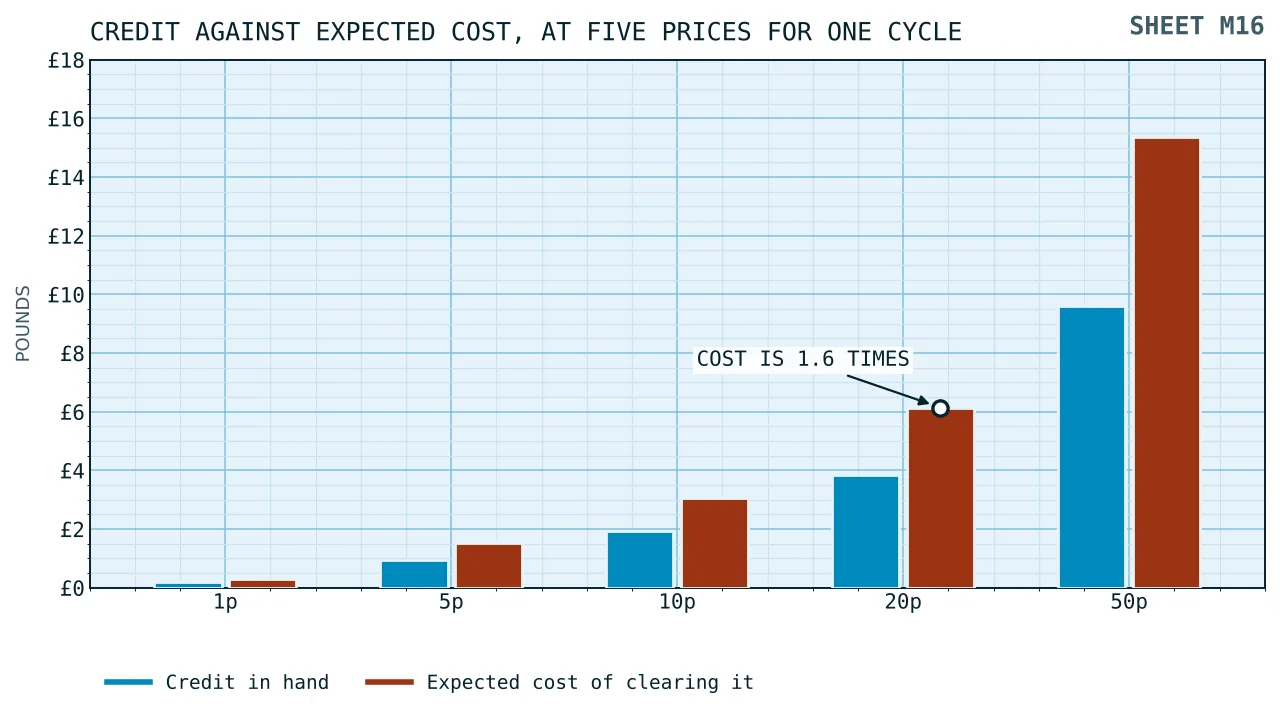
| Per cycle | Face | Credit | Presses owed | Staking owed | Expected price | E |
|---|---|---|---|---|---|---|
| 1p | £0.20 | £0.19 | 768 | £7.68 | £0.31 | -£0.12 |
| 5p | £1.00 | £0.96 | 768 | £38.40 | £1.54 | -£0.58 |
| 10p | £2.00 | £1.92 | 768 | £76.80 | £3.07 | -£1.15 |
| 20p | £4.00 | £3.84 | 768 | £153.60 | £6.14 | -£2.30 |
| 50p | £10.00 | £9.60 | 768 | £384.00 | £15.36 | -£5.76 |
Price a cycle at a penny and the credit is 19p against 31p of expected cost. Price it at fifty and the credit is £9.60 against £15.36. The ratio between the two columns never moves, because the price divides out of both of them.
Which is the finding a reader can carry away from this page. A generous spin value does not make a round of twenty a better offer. It makes it a bigger one, with the obligation enlarged in exactly the same proportion as the gift. Fifty times the price per cycle is fifty times the credit and fifty times the shortfall, and the foot of the sheet still reads £0.00.
A cycle priced at five pounds would put this round at £96.00 of credit, which is the same credit a thousand cycles at 10p produce. The arithmetic does not distinguish between the two, which is worth remembering next time a count in four figures looks like the generous end of the market. 1000 free spins no deposit prices that one out to the hour.
4
The clock that will not move
The count of cycles owed is the advertised count multiplied by the requirement and by the return, which on these inputs is 768 however a cycle is priced. Divide any staking figure in part 3 by its own cycle price and the answer is the same 768 every time.
Seven hundred and sixty-eight presses, spaced 2.5 seconds apart, run to thirty-two minutes, and that figure holds at a penny a cycle just as it does at fifty. The spacing is RTS 14D, which will not let a further slot cycle begin until two and a half seconds have elapsed from the start of the one before.
Twenty cycles take fifty seconds. The condition fastened to them takes thirty-two minutes. Thirty-two minutes of obligation against fifty seconds of gift gives thirty-eight to one, which is simply W multiplied by the return.
A credit priced in pence does not get a shorter obligation than one priced in pounds, because the obligation is counted in presses and the presses are counted from the credit. For a reader comparing two offers of twenty cycles that is the useful line: the money differs, the time does not.
Three rules keep the thirty-two minutes where they are. Automation is out under RTS 8A, every game cycle needing a commitment of its own; its one exception is the automatic posting of a poker blind. RTS 14E leaves a customer no control over how long a result takes, striking out slam stop, quick spin and turbo by name, whatever speed a game runs at natively. And RTS 14C forbids functionality that would set casino games running in parallel, split and multiple screens included, so four copies of one game is not a way to quarter the clock.
50 seconds given, 1,920 seconds owed, at every price
5
Where the ladder stops, at £5 and £2
The ladder in part 3 could in principle run upward for ever. In Great Britain it cannot, because a statutory instrument puts a ceiling on what a single slots cycle may carry.
The statutory ceiling on a slots cycle is five pounds, and two pounds for a player under 25, so the top of the ladder is fixed by regulation rather than by the market. Those regulations date from 25 February 2025, with the regulator publishing 9 April 2025 for the higher figure and 21 May 2025 for the lower. A six-week transitional period applied the five pound limit to everybody first, which is why the two dates sit six weeks apart.
The definition is worth knowing on a page about a named game, and it is tight: a casino game, reel-based, played online, where images that move or change, shown as reels or by some other means, settle whether a prize or other advantage is due. Roulette and blackjack are outside the limits altogether, which the regulator states in terms.
At fifty pence a cycle the round is still running at a tenth of the adult ceiling, so nothing in the ladder above is anywhere near the statutory limit. Where the ceiling starts to bite is on the staking rather than on the gift. The £76.80 owed at 10p could be met in 16 presses at a five pound stake, or 39 at two pounds, with the expected price still £3.07: an edge of four pence does not mind how a pound is broken up.
Two cautions on that. A larger stake widens the spread around the expected price sharply, so the arithmetic gets no safer, only faster. And a set of bonus terms will often cap the stake itself for as long as the credit lasts. No published rule fixes such a cap, so it is a line to locate in the terms rather than deduce from the statute.
6
The multiple, and only the multiple
Where this round stands against twenty-five is settled by the terms and by nothing else, since neither the count nor the price of a cycle can shift the crossing.
The crossing where a credit is exactly spent arrives at twenty-five where the return is 96 per cent, and neither the count on the front nor the price of a cycle has any purchase on it. Setting E to nought removes the credit from the working and leaves the reciprocal of the four pence the house keeps. Every page in this part of the tree arrives at the same figure by the same route.
So here is the requirement varied instead, with the presses counted rather than the pounds, because the presses are the column a different spin value would leave untouched.
| W | Presses owed | Minutes | E per £1 of credit |
|---|---|---|---|
| 10 times | 192 | 8 | £0.60 |
| 20 times | 384 | 16 | £0.20 |
| 25 times | 480 | 20 | £0.00 |
| 40 times | 768 | 32 | -£0.60 |
| 60 times | 1,152 | 48 | -£1.40 |
Read the last column as the per-pound answer and multiply by whatever credit the round produced. At 10p a cycle that credit is £1.92, so forty times leaves minus £1.15. At 50p it is £9.60, so the same multiple leaves minus £5.76. The column is the method; the credit is the scale.
The minutes column is identical at every spin value, which is the whole point of putting it beside the pounds. A reader offered twenty cycles at 20p and twenty cycles at 5p is being offered the same half hour of work for four times the money, and that is a comparison the front of an offer never makes.
7
Thirty pence in the pound on a small round
g has been sitting at one all the way down this page, and g is the term readers skip.
Let a staked pound count as thirty pence and the staking needed climbs to £256.00, priced at £10.24, which takes E down to minus £8.32 and the clock out to one hour and forty-seven minutes. The contribution owed has not changed: it is still £76.80. What changed is the volume of staking needed to earn it.
Even at ten times, as far as a British licence reaches, that rate leaves the round at minus 64p. The regulated ceiling speaks only of the multiple and is silent on the rate, so a requirement comfortably inside the limit still comes out at nothing with weighting against it.
That rate is an illustration and measures nothing about the market. Thirty pence in the pound is the figure one consultation respondent put to the regulator; the regulator recorded the submission and left weighting alone; and no public table of the rates currently in use exists. A whole page is given to the term at slots free spins, which works out how high it must be before anything survives.
Notice what weighting does to the clock. The presses owed stop being 768 and become 2,560 at 10p, which is where the spin-value independence of part 4 finally breaks: with g below one, the presses depend on the price per cycle again. At 50p the same contribution would be earned in 512 presses rather than 2,560, and that is the only place on this sheet where a larger spin value genuinely shortens the work.
£256.00 of staking to earn £76.80 of contribution at 30 per cent
8
A named game, off the register
Price a cycle however you like at a cashier with no Great Britain licence: no statute caps it and no standard paces it.
The two ceilings in part 5 are attached to a British remote casino licence and to nothing else. So is the 2.5 second interval, the bar on automatic play, the bar on turbo and the prohibition on running games side by side. Read the Curaçao rulebook end to end and the ceiling is absent, as are the stake limits, the paced cycle, the bar on automation and the rule about celebrating a return. Bonuses occupy two lines of it: terms communicated transparently, and promotion stopping short of encouraging excessive play.
Which matters most to the thirty-two minutes. Off the register, those 768 presses may go as fast as a platform allows, automated where it allows that, and split across however many games it opens at a time. The money in part 3 would be identical. The clock in part 4 would not exist.
A familiar reel set is no evidence of a licence, and this is the page where that bears repeating, because the key names a game. The regulator has recorded casino games from licensed suppliers appearing on websites with no licence at all, and in July 2026 one supplier settled at £4.75m over its games turning up on six such sites that British consumers could reach. Recognising the symbols says nothing about who is holding the money.
On identity the gap is in the timing rather than in the principle. Great Britain wants name, address and date of birth verified before anybody gambles at all, with bonus play and free-to-play versions inside the rule. Curaçao bars depositing and wagering until an operator is satisfied the player is over eighteen, but ties the government-issued document check to its own money laundering and know-your-customer milestones rather than to the first wager. Twenty free cycles are exactly the sort of play that falls into the space between those two positions.
9
Pricing the round you were actually offered
Five lines, the first of which is the one a document tends to hide.
| The step | At 10p |
|---|---|
| Find what a cycle is worth | £0.10 |
| Count, times price, times return | £1.92 |
| Times W, divided by g | £76.80 |
| Times the edge | £3.07 |
| Subtract, and floor at nought | £0.00 |
| Presses, and minutes | 768 and 32 |
Where the first line cannot be found, work backwards from the credit the cashier reports: divide it by the count and by the return, and the price per cycle falls out. Where the credit is not reported either, the row at 10p is the sheet’s assumption and the other rows in part 3 are the range.
Two things the answer leaves open. It is a mean, and on a round of twenty the mean is a statement about a great many such rounds rather than about this one, whose commonest single result is nothing. And it takes no account of a term sitting outside the expression, a bonus win cap or a discretion reserved by the operator; either can close the sheet with W, g and the price per cycle all untouched.
Rounds of twenty are common enough to be worth comparing properly. 20 free spins on registration no deposit runs the identical count through the duties a sign-up attracts, 25 free spins on registration no deposit puts five more cycles against the same two clocks, and a named game at seven and a half times the count gets priced on 150 free spins on Book of Dead. The multiple lists every sheet in the section against the figure on its front.
Questions
- What is a round of 20 free spins on a named slot worth?
- At 10p a cycle the round advertises £2.00 and averages £1.92 after a 96 per cent return. Forty times then wants £76.80 driven over the reels, at an expected cost of £3.07. That cost runs £1.15 beyond the credit, so the credit cannot meet it and the foot of the sheet reads £0.00.
- Does a higher spin value make the round a better offer?
- It makes it a bigger one, not a better one. Each pound figure moves with the price of a cycle, so 50p a cycle gives five times the credit of 10p and five times the shortfall. The proportion between credit and expected cost never changes, because the price divides out of both sides.
- How many spins does the wagering actually come to?
- Seven hundred and sixty-eight, at any spin value. The count owed is the advertised count multiplied by the requirement and by the return, which here is twenty times forty times 0.96. Divide any staking figure by its own cycle price and the same 768 comes out.
- How long does it take?
- Thirty-two minutes at the fastest allowed, and identical at a penny a cycle and at fifty. RTS 14D holds the next slot cycle back for 2.5 seconds from the moment the last one started, so 768 presses become 1,920 seconds. The twenty advertised cycles take fifty seconds.
- At what multiple does the round come to nothing?
- Twenty-five, where the return is 96 per cent. Set the expected cash to nought, watch the credit leave the equation, and the multiple left standing inverts a four pence edge. Neither the count on the front nor the price per cycle has any bearing on it.
- Is there a limit on what one spin can be worth?
- No rule sets a free spin’s value, but a British licence caps what may be staked on a slots cycle: five pounds, dropping to two for a player under 25, under regulations dated 25 February 2025 and commenced that April and May. Those limits reach online slots alone, so roulette and blackjack sit outside them.
- Can the wagering be cleared in a handful of large stakes?
- The £76.80 owed at 10p would take 16 presses at five pounds a go, or 39 at two pounds, and the expected price would still be £3.07, because the edge does not care how a pound is divided. What widens sharply is the spread around that price, and the bonus terms may well impose a maximum stake of their own.
- How much does a contribution rate of 30 per cent cost a round of twenty?
- It turns a £1.15 shortfall into £8.32. The contribution owed stays at £76.80, but earning it takes £256.00 of staking, priced at £10.24, and one hour and forty-seven minutes. Ten times, the limit of a British licence, still lands on minus 64p at that rate.
- Does a named game mean the site holds a British licence?
- Not in the least. The regulator has found games supplied by licensed firms running on sites that hold no licence, and a supplier paid £4.75m in July 2026 because its games had turned up on six of them, reachable by consumers here. Off the register no statute caps the spin value, no standard spaces the cycles, and automation runs free.