
Sheet D09 Revision 1 Checked 15 October 2026
Bingo sign up bonus
A tenner matched once over in bingo credit owes £400.00 of turnover at forty times, and that figure needs no return percentage to compute. Turning it into a cost does, and a bingo room is not obliged to publish one. Cleared on reels at 96 per cent it bills £16.00, leaving £4.00.
£400.00 owed, and no published return to price it with
What a bingo welcome leaves
Every destination on this spike is bought advertising. The site takes a fee if a reader goes on to register, and no figure printed below moves because of it.
The Spin Sheet
Till receipt No 01
Betportal
Lowest multiple here
For every €1 of spin credit at face per €1
Credit
Debit
No Great Britain licence
Licensed in Anjouan, Comoros, run by BetPortal Gaming Ltd, with Excite Ultra Media Ltd, reference ALSI-202601040-FI2.
Terms read 15 October 2026
Open the offer at Betportal, opens in a new tabThe Spin Sheet
Till receipt No 02
WinBeast
Five staged matches
For every €1 of spin credit at face per €1
Credit
Debit
No Great Britain licence
Licensed in Curaçao, operator not named on the site.
Terms read 15 October 2026
Open the offer at WinBeast, opens in a new tabThe Spin Sheet
Till receipt No 03
EliteSpin
Longest spin window
For every £1 of spin credit at face per £1
Credit
Debit
No Great Britain licence
Licensed in Costa Rica, run by PrimeTier Limited.
Terms read 15 October 2026
Open the offer at EliteSpin, opens in a new tabThe Spin Sheet
Till receipt No 04
Crown Jewelz
Multiple unpublished
No total struck
Credit
Debit
No Great Britain licence
Licensed in Curaçao, number not verified, operator not named on the site.
Terms read 15 October 2026
Open the offer at Crown Jewelz, opens in a new tabThe figure at the foot of a receipt is this site's own arithmetic and nothing an operator has published: the credit, less the share a spin gives back at 96 per cent return to player, less what playing the wagering through costs at the same return. It describes the offer, not one reader's afternoon. Where the conditions price above the credit the receipt prints nothing rather than a negative sum, and where a figure the sum needs is unpublished it prints the condition in the operator's words instead.
Three words stand in the amount column where no figure can. Noted is a published condition that takes value away without leaving the sum a figure to take. Unpriced is a condition whose figure nobody has published, or a credit that is not a sum until a deposit of your own sets it. Own money is money of yours, which is never part of a total.
Not one of the operators printed above holds a Great Britain licence, so the duties that licence carries do not reach them. Every online gambling company licensed in Great Britain has to be part of Gamstop Online, and a reader who has shut themselves out through the scheme is therefore not shut out here. The ceiling of ten times the bonus funds on a wagering requirement, in force since 19 January 2026, is a condition of that licence and binds the companies that hold one. Where a dispute goes instead is a matter for the authority named on the receipt, and the Gambling Commission describes what a reader faces without a British licence as a lack of recourse if things go wrong. Nobody under 18 may hold an account at any of them.
Every term printed on a receipt is the operator's own, and each receipt carries the day it was read. The oldest of those readings is 15 October 2026. What binds a reader is the operator's own full terms, and not a line printed here.
1
Ten pounds of room credit on a tenner
A bingo welcome is a percentage match wearing different clothes. Pay in ten pounds, receive ten pounds of credit good for tickets, and the account shows £20.00, ten pounds of which existed in your name before the offer did. The other ten is conditional on a turnover figure printed somewhere in the rules.
So far, identical to a cash match. What makes this sheet different from the rest of its section is what happens at the next step. Pricing a bonus means turning a quantity of turnover into a quantity of expected loss, and that conversion needs one number: the proportion the game hands back. On reels this site works to 96 per cent. In a bingo room there may be no published figure to work to at all, and part 3 sets out why that is not an oversight.
The honest shape of this page follows from that. The turnover owed can be computed exactly, since the multiple and the credit are all it needs. The cost of discharging it can be computed only under a stated assumption about where the staking happens. Both figures are given, and they are kept apart.
What is assumed, and which assumption is doing the work:
- Ten pounds paid in, matched once over in credit for the room.
- Forty turnovers of the credit, that being the magnitude printed in this corner of the market. A British licensee may ask ten.
- A return of 96 per cent wherever the staking is actually done, which is a reel figure and the one doing most of the work on this page.
- Full contribution, one pound staked clearing a pound of requirement. Part 5 prices what happens when it does not.
- The requirement measured against the credit alone, with the payment left out of the base.
2
£400.00, which the multiple settles alone
Start with the figure nobody can argue about. Forty turnovers of £10.00 of credit is £400.00 of staking to be put through, and that arithmetic uses the multiple and the credit and nothing further. No return percentage goes into it. No game weighting goes into it. Forty tens are four hundred.
Hold that figure against the thing a reader actually handed over. Ten pounds bought an obligation forty times its own size, and the obligation has to be discharged before the credit turns into money that can leave the account. Stated as a ratio: every pound paid in buys £40.00 of required staking. That ratio is the product of the percentage and the multiple, and on a matched offer at forty turnovers it holds whatever the payment.
Time is the same obligation in another unit, and it is worth doing in hundreds because bingo pricing varies so much more than reel pricing. At 10p a stake, every £100.00 of staking is 1,000 commitments, and on a British reel game those cannot be taken faster than one every 2.5 seconds, which is 2,500 seconds: forty-one minutes and forty seconds per hundred pounds. Four hundred pounds therefore floors at 10,000 seconds, which is two hours plus a further forty-six minutes and forty seconds.
A floor, mind, and not an expectation, and it assumes a stake of 10p throughout. It also assumes the staking happens on reels, which is the assumption part 7 unpicks, because the pace rules for a bingo game are not the pace rules for a slot.
£400.00 of contribution owed on £10.00 of room credit
3
The percentage a room need not print
Here is the fact that gives this sheet its shape, and it is routinely got wrong in both directions.
A British licensee owes a customer, before they commit to gamble, information good enough to let them judge their chances of winning. The standard then lists what that information must include, and the items are joined by the word or. A return to player percentage is one option. The house edge or margin is another. The probability of the winning events occurring is a third. And a description of the way the game runs, how winners are settled and how prizes get handed out is a fourth. Satisfying any one of them satisfies the requirement.
For bingo the guidance is blunter still: describing how the prizes get allocated will do on its own. So a British bingo room may discharge its whole disclosure duty without ever stating a percentage, and a room outside the British licence carries no such duty in the first place.
Which leaves a page like this one with a choice between inventing a figure and admitting the gap. The gap gets admitted. No percentage is asserted for a bingo game anywhere below. What is done instead is to price the obligation under a declared assumption, which is that the staking is cleared on a reel game returning 96 per cent, and to say in the same breath that a reader whose credit must be spent on tickets has no published number with which to check the answer.
Three things follow, and the third is the useful one:
- The £400.00 of staking is certain, because it comes out of the multiple.
- The expected cost of that staking is conditional, because it comes out of a percentage that may not exist in print.
- A term stating which games the credit may be spent on is therefore worth more to a reader than the multiple itself, since it decides whether the answer can be computed at all.
4
The expression, run on reels
With the assumption stated, the site’s standing expression goes to work on the matched tenner.
E = B × (1 – (W × (1 – RTP)) / g)
Fill it in. The credit at face is B, £10.00 of it. Forty is W, the turnovers demanded. RTP is the proportion returned, 0.96 on the reel assumption, which leaves four pence in the pound running against the player. g is one while the staking contributes in full. E is the residue once that condition is behind the player.
B × W = £400.00 of contribution
£400.00 × 0.04 = £16.00 of expected cost
E = £10.00 – £16.00 = -£6.00
Converted into money: the edge on £400.00 of staking is £16.00, set against £10.00 of credit, so the condition overshoots the gift by £6.00. The balance includes the reader’s tenner, which is where the overshoot lands, and the foot therefore reads £4.00 against £20.00 held.
Forty pence in every pound paid in, expected, on the reel assumption and at full contribution. It is one of the better answers in this section, and both of the qualifications attached to it are load-bearing: change where the staking happens or how much of it counts, and the four pounds goes.
Widen the base and it goes immediately. Where the forty turnovers are reckoned on payment and credit at once, the base becomes £20.00. The staking rises to £800.00 and the cost to £32.00, while the balance stays at £20.00. The account empties with £12.00 of the requirement unperformed. Whether the British ten-times ceiling catches a condition written that broadly has not been settled in public, the limit being expressed in terms of bonus funds, and nothing here will pretend otherwise.
£16.00 of cost charged to a £20.00 balance
5
Eighty per cent, where it turns
Contribution is the quiet term in a set of bonus rules and on a bingo offer it is the one most likely to decide the answer, because the credit is often usable in one place and the requirement cleared in another.
The mechanism is division. A requirement of £400.00 is written in units of contribution, not units of stake. Where a pound staked contributes a pound, the two coincide. Where a pound staked contributes less, the staking needed rises by the reciprocal, and the expected cost rises with it while the balance stays exactly where it was.
The regulator’s consultation records a respondent describing a rate of 30 per cent, at which each pound wagered counts thirty pence towards the requirement. That quoted rate is the only contribution figure this site will attribute to anything, and the ladder below is arithmetic built on rates of its own choosing rather than a schedule of what any game actually contributes. No such schedule is published, so none is reproduced here.
| A pound staked counts | Staking needed | Expected cost | Balance at the foot | Kept per £1 paid in |
|---|---|---|---|---|
| 100p | £400.00 | £16.00 | £4.00 | 40p |
| 80p | £500.00 | £20.00 | £0.00 | 0p |
| 70p | £571.43 | £22.86 | -£2.86 | -29p |
| 50p | £800.00 | £32.00 | -£12.00 | -120p |
| 30p | £1,333.33 | £53.33 | -£33.33 | -333p |
| 20p | £2,000.00 | £80.00 | -£60.00 | -600p |
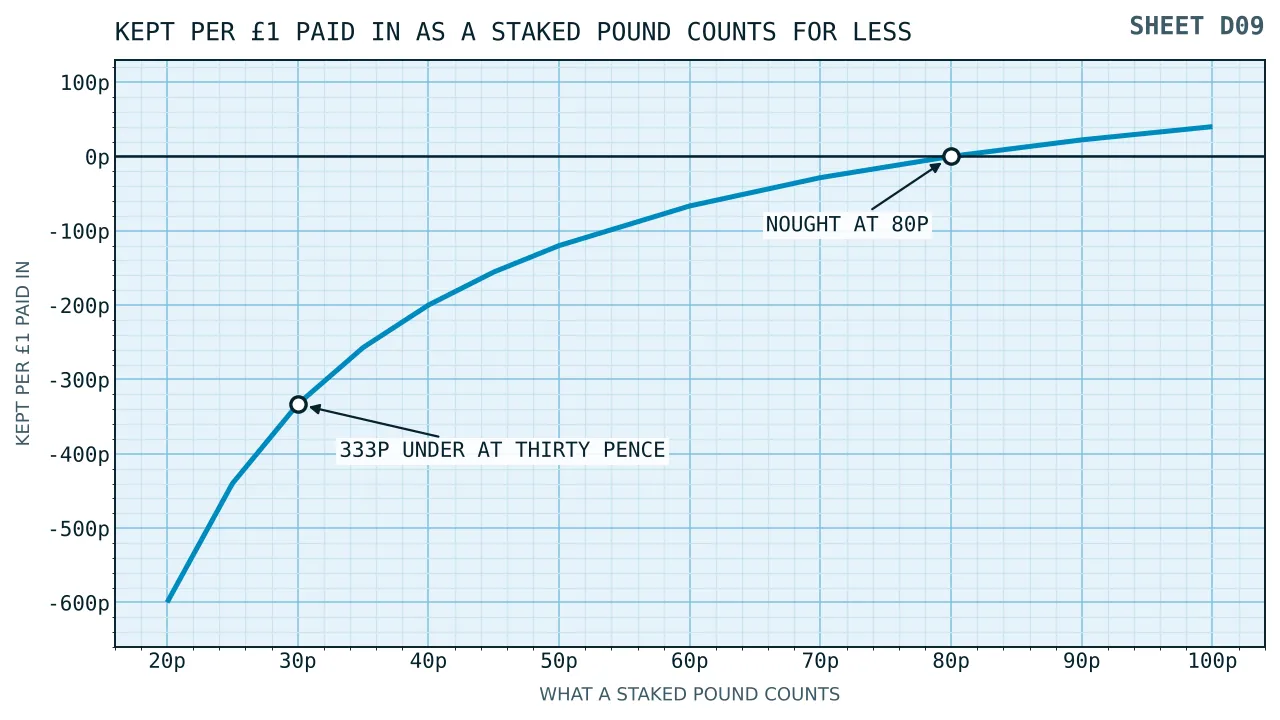
Eighty pence in the pound is the figure to remember from this sheet. Solve for the rate at which nothing survives and it comes out as the expected cost at full contribution divided by the balance, which here is sixteen pounds over twenty. Any rate above 80p leaves something. Any rate below it takes the payment, and at the quoted 30p the offer runs £3.33 underwater for every pound paid in.
Worth noticing what the regulated ceiling does to that. Ten turnovers of £10.00 is £100.00 of contribution and £4.00 of expected cost at full count, so the crossing rate falls to 20p in the pound. A capped multiple does not merely improve the answer; it makes the answer robust to a term the reader will probably never see printed.
£1,333.33 of staking to deliver £400.00 at 30p in the pound
6
Two products, one incentive
A welcome built around a room very often arrives with reel spins strapped to the side, and that combination is the subject of a British rule with a date on it.
A single incentive put up by a British licensee may not, since 19 January 2026, combine more than one of the product types the provision lists, and the list runs lottery, bingo, casino and betting. Slots are a casino product. Tickets for a room are a bingo product. So a tenner of room credit with fifty reel spins attached reaches across two types and could not be offered in that form by a British licensee, while the same tenner of room credit with extra tickets beside it stays comfortably inside one.
Three carve-outs sit on that rule and all three cut against what a reader would guess. More than one item of a single type is permitted, and the regulator’s own illustration pairs a raffle with a scratchcard. Separate offers for two products may share one email where the customer has consented to marketing for each of them. A credit the holder is free to spend on whichever product they fancy, the illustration being ten pounds usable across betting and casino, falls outside the ban altogether. The rule is aimed narrowly: at an incentive whose terms for two products are linked and held in common.
For the arithmetic on this sheet the consequence is concrete rather than legal. A package combining room credit and reel spins has two bases, two returns and possibly two requirements, and no single E covers it. Priced properly it is two instruments with one headline, and the only way to get a total is to price each half and add the results.
| What the requirement is reckoned on | Balance at the foot |
|---|---|
| Forty turnovers of £10.00 of credit | £4.00 |
| Forty turnovers of credit and payment | -£12.00 |
| Ten turnovers of £10.00 of credit | £16.00 |
A balance stops at nothing, so read the middle figure as the staking still owed when the account runs dry. Top row to bottom row is £12.00 of difference on a ten pound payment, and all of it comes from the multiple.
7
Which British rules reach a bingo room
A welcome of this shape, out here, operates under no Great Britain licence, so the duties below it are whichever ones its own regulator troubled to write. Counting the loss honestly means noticing that some British rules a reader might expect do not cover a bingo game even inside Great Britain, and saying which.
The ceiling, which is worth £12.00
The one that bites hardest does reach bingo. The hard British limit has sat at ten turnovers of bonus funds from 19 January 2026 onwards, and the provision behind it covers all licences but the technical and software ones. Ten turnovers of £10.00 is £100.00 of contribution and £4.00 of expected cost at full count, lifting the foot from £4.00 to £16.00.
Pace, which does not
This is where a reader is likely to be surprised. A 2.5-second floor between game cycles is written for slots. The five-second one covers casino games other than slots, leaving peer-to-peer poker out, and came into effect on 17 January 2025 on the regulator’s own updates page. Bingo is neither of those product types on the regulator’s own list, and RTS 14 states no minimum interval for it. The same goes for the stake caps. The statutory instrument of 25 February 2025 defines an online slots game by two features, that it is reel-based and that it is played online, and the guidance says in terms that the £5 and £2 limits belong to online slots and reach no other casino game. A bingo ticket is not a reel.
What does reach a bingo game is the autoplay ban, because RTS 8A covers gaming including bingo and wants every game cycle committed to one at a time, its guidance carving out nothing but the blinds a poker table posts by itself. So does the near-miss prohibition, and so does the rule forbidding a product from pressing a customer into chasing a loss, into putting more on, or into going on once they have said they would rather stop. None of that exists in the Curaçao rulebook read for this sheet.
Terms, and whether they may move
Four tests run through licence condition 7.1.1. Fairness and transparency are both measured by the Consumer Rights Act 2015, a licensee has to abide by the terms it set and keep them easy to reach rather than buried, a material change must be told to customers before it starts to apply, and unfair commercial practices are barred across the whole relationship under the meaning the digital markets and consumers Act of 2024 carries. A reader a fortnight into a £400.00 requirement has a direct interest in the third of those.
Somewhere to take a complaint
Both sides of this market publish a route, and the difference is who writes its terms. A British operator owes an acknowledgement within three working days, dropping to twenty-four hours where gambling runs at all hours, and must be finished inside eight weeks including its own escalation, the final letter explaining the route onwards to an independent body. Only a body the Commission has approved may be used, and eight are named. The Commission is also explicit about what lies outside its remit: it is not an ombudsman, it cannot settle a quarrel over a withdrawal or a broken game, and it sees nothing of a customer’s account.
One register, or none
Membership of Gamstop Online arrives with a British licence rather than by choice, which is why the scheme covers one side of this market completely and the other not at all. Its own terms draw the boundary: it cannot assist in excluding anybody from gambling services offered by operators that are not participants. Curaçao demands self-exclusion as well, licensee by licensee over whatever domains that licensee runs, a year being the shortest term on offer and early revocation unavailable. No line on this sheet helps anybody past a protection they chose for themselves, and the support numbers appear below the questions.
8
Pricing a bingo welcome yourself
Six lines, and this is the one sheet in its section where the second line can stop the exercise dead.
| The line | Here |
|---|---|
| Credit the percentage hands over | £10.00 |
| Return published for the games it buys | None |
| Contribution owed at W over g | £400.00 |
| Cost of that, assuming reels at 96 per cent | £16.00 |
| Balance it is charged to | £20.00 |
| At the foot | £4.00 |
Where the second line is blank, the fourth and the sixth are estimates dressed as figures, and a reader is entitled to treat them that way. The first and the third stay exact however little the room publishes, which is why a comparison between two welcomes is better made on contribution owed per pound paid in than on anything nearer the headline.
Two cautions on the £4.00.
It averages over the long run and tells a reader nothing about one attempt. Across many repetitions a matched tenner cleared at full count against a 96 per cent return comes to four pounds; the commonest single outcome is an empty balance with much of the £400.00 still to stake.
And it rests on two assumptions that a set of terms can remove with a phrase. Change where the credit may be spent and the 96 per cent goes. Change what a staked pound counts for and the £400.00 of contribution starts demanding more than £400.00 of stake. Those two clauses, rather than the percentage on the front, are what a reader is really agreeing to.
Where to read next depends on which half of the package interests you. The cash mechanics without a room are at 100% deposit bonus, the percentage ladder above it runs through 200% deposit bonus and 400% deposit bonus, and a fixed award of reel spins on the same tenner is costed at deposit 10 get 100 free spins. The section front page is Matched money, and the working behind every total is at How a receipt is struck.
A bingo welcome has now been priced twice over: once exactly, in contribution, and once conditionally, in pounds.
Questions
- What is a bingo sign up bonus worth on £10?
- On a stated assumption, four pounds of the ten. Matched once over, ten pounds of credit owes forty turnovers, which is £400.00 of contribution. Priced at a 96 per cent return and full count, that staking is expected to cost £16.00 against the £20.00 in the account, so the foot comes to £4.00. The assumption matters: a bingo room need not publish a return, so the £16.00 is computed on reel figures and labelled as such.
- Why can a bingo bonus not be priced exactly?
- Because turning turnover into cost needs a return percentage, and a bingo room is not obliged to publish one. The British standard asks for information good enough to judge the chances of winning, and the list of what will do is joined by the word or: the probability of the winning events, the house edge, a return percentage, or a statement of how a game runs and how its prizes are handed out. For bingo, describing the way prizes get allocated is stated to be sufficient on its own.
- How much turnover does a matched tenner of bingo credit owe?
- £400.00, and that figure is exact. Forty turnovers of £10.00 of credit needs no return percentage and no weighting to compute, only the multiple and the credit. Expressed per pound paid in it is £40.00 of required staking, which is the percentage taken into the multiple and nothing else.
- What does game contribution do to the answer?
- It divides. A requirement of £400.00 is measured in contribution rather than in stake, so where a staked pound counts less than a pound the staking needed rises by the reciprocal while the balance does not move. At the 30p rate quoted in the regulator’s consultation, £400.00 of contribution needs £1,333.33 of staking, which is expected to cost £53.33 against £20.00 held. Those rates are this sheet’s own arithmetic, because no schedule of what any game contributes is published.
- At what contribution rate does the offer stop leaving anything?
- At 80p in the pound. Divide the expected cost at full count, £16.00, by the balance it is charged to, £20.00, and the answer is 0.8. Above that rate something survives; below it the payment goes. Under the British ceiling of ten turnovers the same calculation gives 20p in the pound, so a capped multiple makes the answer far less sensitive to a term a reader rarely sees printed.
- Can a bingo bonus come with free spins attached?
- Not from a British licensee, and not for some time. A single incentive may not combine more than one of the product types the provision lists, which run lottery, bingo, casino and betting, and the rule has applied since 19 January 2026. Slots are a casino product and tickets for a room are a bingo product, so credit for a room with reel spins strapped on crosses two types. Extra tickets beside the credit stay inside one. Three carve-outs exist, including a credit the holder may spend on whichever product they like.
- Do the slot stake limits apply to bingo?
- No. The statutory instrument made on 25 February 2025 gives online slots game the meaning of a reel-based game played on the internet, and the guidance states that the £5 and £2 limits are for online slots alone. The commencement dates it gives are 9 April 2025 for the £5 limit and 21 May 2025 for the £2 one. A bingo ticket is not a reel, so neither figure touches it.
- Is there a minimum time between bingo game cycles?
- Not one that RTS 14 states. The 2.5-second minimum is written for slots, and the five-second minimum covers casino games other than slots with peer-to-peer poker excluded, effective 17 January 2025 on the regulator’s updates page. Bingo is a product type of its own, and no interval is set for it. The autoplay ban does reach it, though, because RTS 8A applies to gaming including bingo and wants each game cycle committed to one at a time.
- What does a bingo welcome with no Great Britain licence leave out?
- The duties a British licensee carries, which can be listed. Ten turnovers is the ceiling on wagering, worth £12.00 on this tenner. An incentive may not reach across two of the product types at once. Identity is established, with date of birth, address and name as the minimum, before any play including bonus play. A payment may not be made by credit card. Each game cycle must be committed to individually and no near-miss may stand in for a loss. Money in a deposit balance may not be held behind a withdrawal ceiling, and a withdrawal once asked for may not be handed back. A complaint runs to a body the regulator has approved. Gamstop Online covers the operator. What the Curaçao policy behind this sheet holds is two sentences on bonuses and none of the above.