
Sheet P09 Revision 1 Checked 15 October 2026
Top 20 slots UK
Twenty eligible games, ten of them counting in full and ten at a tenth, average out at 0.550 and behave like 0.182. On a £12.00 credit that is the difference between £872.73 of staking and £2,640.00.
A list behaves like its harmonic mean, not its average
What the conditions leave
Every destination on this spike is bought advertising. The site takes a fee if a reader goes on to register, and no figure printed below moves because of it.
The Spin Sheet
Till receipt No 01
Betportal
Lowest multiple here
For every €1 of spin credit at face per €1
Credit
Debit
No Great Britain licence
Licensed in Anjouan, Comoros, run by BetPortal Gaming Ltd, with Excite Ultra Media Ltd, reference ALSI-202601040-FI2.
Terms read 15 October 2026
Open the offer at Betportal, opens in a new tabThe Spin Sheet
Till receipt No 02
WinBeast
Five staged matches
For every €1 of spin credit at face per €1
Credit
Debit
No Great Britain licence
Licensed in Curaçao, operator not named on the site.
Terms read 15 October 2026
Open the offer at WinBeast, opens in a new tabThe Spin Sheet
Till receipt No 03
EliteSpin
Longest spin window
For every £1 of spin credit at face per £1
Credit
Debit
No Great Britain licence
Licensed in Costa Rica, run by PrimeTier Limited.
Terms read 15 October 2026
Open the offer at EliteSpin, opens in a new tabThe Spin Sheet
Till receipt No 04
Crown Jewelz
Multiple unpublished
No total struck
Credit
Debit
No Great Britain licence
Licensed in Curaçao, number not verified, operator not named on the site.
Terms read 15 October 2026
Open the offer at Crown Jewelz, opens in a new tabThe figure at the foot of a receipt is this site's own arithmetic and nothing an operator has published: the credit, less the share a spin gives back at 96 per cent return to player, less what playing the wagering through costs at the same return. It describes the offer, not one reader's afternoon. Where the conditions price above the credit the receipt prints nothing rather than a negative sum, and where a figure the sum needs is unpublished it prints the condition in the operator's words instead.
Three words stand in the amount column where no figure can. Noted is a published condition that takes value away without leaving the sum a figure to take. Unpriced is a condition whose figure nobody has published, or a credit that is not a sum until a deposit of your own sets it. Own money is money of yours, which is never part of a total.
Not one of the operators printed above holds a Great Britain licence, so the duties that licence carries do not reach them. Every online gambling company licensed in Great Britain has to be part of Gamstop Online, and a reader who has shut themselves out through the scheme is therefore not shut out here. The ceiling of ten times the bonus funds on a wagering requirement, in force since 19 January 2026, is a condition of that licence and binds the companies that hold one. Where a dispute goes instead is a matter for the authority named on the receipt, and the Gambling Commission describes what a reader faces without a British licence as a lack of recourse if things go wrong. Nobody under 18 may hold an account at any of them.
Every term printed on a receipt is the operator's own, and each receipt carries the day it was read. The oldest of those readings is 15 October 2026. What binds a reader is the operator's own full terms, and not a line printed here.
1
What a list of twenty actually is
A ranked twenty is a list of names, and a credit cannot be spent on a name. What a credit is spent on is twenty rooms, each with a return of its own and a rate of its own, and the useful question about such a list is not which game heads it but how the twenty behave when a wagering requirement is pushed through them.
That turns out to have a precise answer, and it is not the answer most readers would guess. A mixed list does not behave like the average of its rates. It behaves like the reciprocal of the average of the reciprocals, which is a long way below the average whenever any game in the list counts at a low rate. Part 3 sets that out and part 4 prices it.
Nothing published supplies the rates themselves. No primary source gives a current contribution table, a standard ceiling on bonus winnings, or a rule turning bonus winnings into bonus funds, so each rate used below is an input, to be lifted from whatever game list a reader has in front of them. The same goes for the returns: twenty games may carry twenty different returns, and no licensee is obliged to print any of them as a percentage.
The credit priced throughout is £12.00 with forty turnovers attached, which is the order of requirement a credit that size tends to attract away from the British register. Ten turnovers runs beside it as the ceiling a licensee works inside. Returns are taken at 96 per cent, labelled as an assumption each time it earns its keep, and the stake is ten pence a press.
The shape of the problem, in four lines:
- One credit of £12.00, one requirement, twenty permitted games.
- Equal contribution earned in each of the twenty, so £24.00 apiece at forty turnovers.
- Staking in a game is the contribution wanted there divided by that game’s rate.
- Total staking is therefore a sum of reciprocals, which is why the average misleads.
2
Twelve pounds, and the sum it has to clear
One expression, and the term this sheet is about sits under the bar.
E = B × (1 – (W × (1 – RTP)) / g)
£12.00 occupies B, W is the count of turnovers, RTP is what a game hands back, g is the rate at which a staked pound counts, and E is the pounds and pence at the end. On a list of twenty, g is not one figure. It is twenty figures that have to be collapsed into one, and part 3 is about doing that correctly.
Begin with the easy case, the whole list counting in full. Forty lots of £12.00 give £480.00 of contribution owed, and at four pence in the pound that staking is priced at £19.20. The price runs £7.20 past the credit, so the sheet closes at £0.00 with an overrun of £7.20 behind it. At ten turnovers the contribution owed is £120.00, priced at £4.80, and £7.20 is expected to come through.
Hold on to that £480.00. It is what the requirement demands in contribution, and no rate anywhere in the list changes it by a penny. Rates decide only how much staking it takes to produce that contribution, and on a mixed list they decide it game by game.
Divided evenly across twenty permitted games, £480.00 of contribution is £24.00 of contribution to earn in each of them. In a game counting in full that is £24.00 of staking. In a game counting at a tenth it is £240.00. The two sit in the same list under the same wagering line.
3
Why the average of a list is the wrong number
Add up what has to be staked in each of the twenty and the arithmetic produces a single effective rate, which is the figure a reader needs and is not the figure anybody would compute by eye.
Effective rate = 20 ÷ (1/g1 + 1/g2 + … + 1/g20)
That is the harmonic mean of the twenty rates. It sits below the ordinary average always, and far below it whenever the list is mixed, because a game counting at a tenth contributes ten to the sum of reciprocals while a game counting in full contributes one. The slow game is worth ten times as much weight in the total as the quick one, and the ordinary average gives them the same weight.
Take ten in full and ten at a tenth, which is the split in the standfirst. The ordinary average is 0.550. The sum of the reciprocals is ten plus a hundred, so the effective rate is twenty over a hundred and ten, or 0.182. A reader working from the average would expect £872.73 of staking. The arithmetic asks for £2,640.00, which is three times as much.
The same thing stated as a warning about game lists: a list is as slow as its slowest eligible games, weighted by how slow they are, and advertising copy that reports an average rate across a lobby is reporting the wrong statistic. One game at a twentieth in a list of twenty otherwise counting in full drags the effective rate to 0.513, which is a worse figure than the ordinary average of the same list, 0.953, by a factor of nearly two.
0.550 on the average, 0.182 in the arithmetic
4
Twenty games, six splits
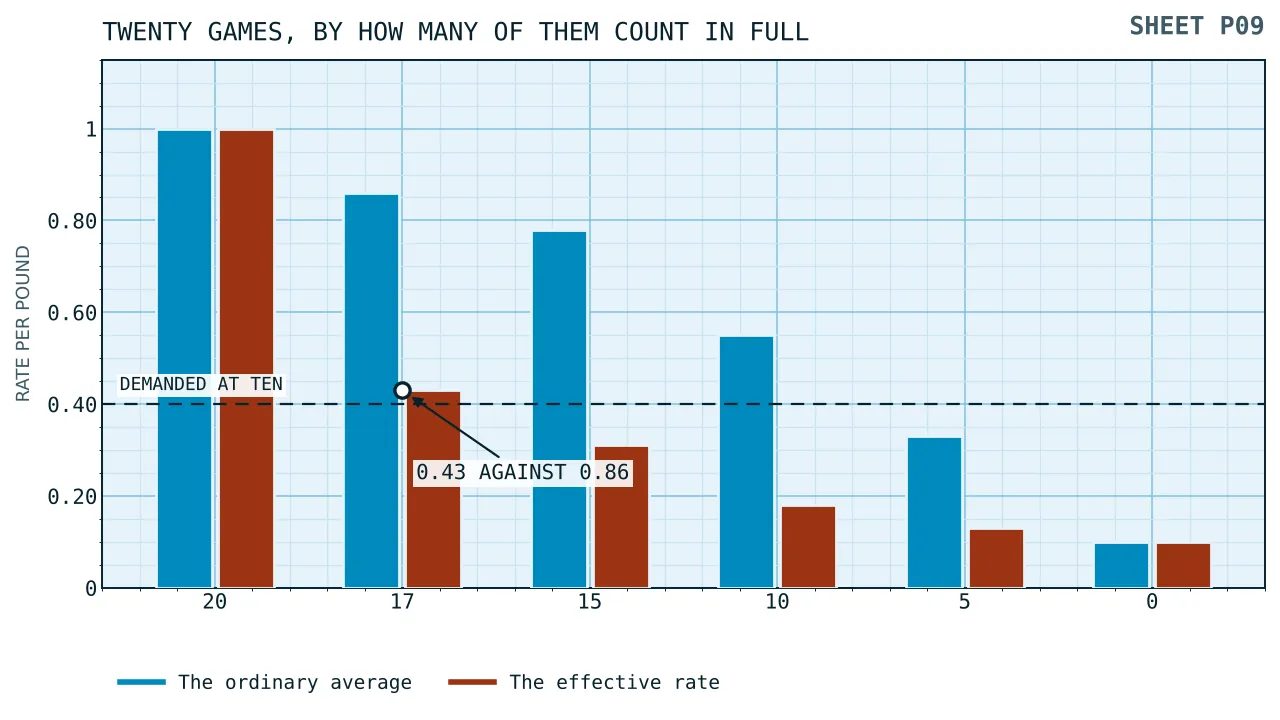
Six versions of one list. Every row holds twenty permitted games and the same £480.00 of contribution owed, and the games that are not counting in full are counting at a tenth.
| Counting in full | Ordinary average | Effective rate | Staking | Expected price | At the foot |
|---|---|---|---|---|---|
| All twenty | 1.000 | 1.000 | £480.00 | £19.20 | -£7.20 |
| Seventeen | 0.865 | 0.426 | £1,128.00 | £45.12 | -£33.12 |
| Fifteen | 0.775 | 0.308 | £1,560.00 | £62.40 | -£50.40 |
| Ten | 0.550 | 0.182 | £2,640.00 | £105.60 | -£93.60 |
| Five | 0.325 | 0.129 | £3,720.00 | £148.80 | -£136.80 |
| None of them | 0.100 | 0.100 | £4,800.00 | £192.00 | -£180.00 |
The second and third columns stand side by side for one reason. On the middle four rows they disagree, and they disagree by enough to change what a reader would do. At fifteen in full the average says 0.775, which sounds like a generous list, while the arithmetic says 0.308 and asks for £1,560.00 of staking on a twelve pound credit.
Hours, since the pace of a licensed reel-based game is fixed. At ten pence a press, £480.00 is 4,800 presses and three hours twenty minutes. £1,560.00 is 15,600 presses and ten hours fifty. £2,640.00 is 26,400 presses and eighteen hours twenty. And the bottom row, £4,800.00, is 48,000 presses and thirty-three hours twenty, on a credit of twelve pounds.
5
Where the crossing falls, to the single game
Something reaches the foot only where the effective rate beats one twenty-fifth of the multiple, twenty-five being the reciprocal of a four pence edge. At forty turnovers that asks for 1.60, which no list of any composition can supply, because a staked pound will never count as more than a pound.
At ten turnovers it asks for 0.40, and that is a test a real list can pass or fail. So the interesting question becomes arithmetical and exact: how many games in a list of twenty may count at a tenth before the credit dies in it.
Three may. Four may not.
With three at a tenth and seventeen in full, the reciprocals sum to 47 and the effective rate is 0.426, which clears 0.40. Ten turnovers then want £120.00 of contribution, £6.00 from each game, so the staking is £282.00 at an expected price of £11.28, leaving £0.72.
Add a fourth low game and the reciprocals sum to 56, the effective rate falls to 0.357, the staking rises to £336.00 and the expected price to £13.44. The closing line is minus £1.44. One game out of twenty, swapped from a pound to a tenth, has moved the answer from a small gain to a small loss, under the strictest multiple a British licensee may impose.
£0.72 with three low games, -£1.44 with four
Which is why a top twenty is a weaker thing to read than a game list. The names tell a reader nothing the arithmetic needs. A count of how many of the permitted games carry a cut rate tells them everything, and on this credit the threshold is somewhere between the third and the fourth.
6
What all twenty British games are built to
Whatever their returns and whatever their rates, twenty licensed reel-based games are built to the same standards, and those standards are what make the hours in part 4 calculable at all.
The pace comes first. On a licensed reel-based game the cycle after one game cannot begin inside two and a half seconds of it, and the start control must be let go and pressed once more, which is why a held button achieves nothing. Across 26,400 presses that interval is the whole of the eighteen hours.
Then the things that would otherwise shorten it. No system may take on a game cycle for the player, right across gaming and bingo, its only exception a blind that posts itself at a poker table between players. Nor may a customer be allowed to bring a result forward, which puts turbo out of reach along with slam stop and quick spin, on every remote game whatever its own pace. And no functionality may let a pair of casino games run together, which rules out splitting a long obligation between windows.
Then the stake, which statute bounds on reels and nowhere else in the casino. A single cycle may carry at most five pounds, or two where a player is under 25. The Regulations doing that were made on 25 February 2025 and their own text carries no calendar date. The dates are the regulator’s: five pounds from 9 April 2025 and two pounds from 21 May 2025.
Then two rules about what a reader sees. Where a return does not better the total staked, no win-related sound and no win-related animation may go with it, and across tens of thousands of presses that is a great many results left undressed. And designs liable to leave a customer wrong about how likely a result is stand prohibited, two being named: an ordinary loss replaced by a near miss, and a real device simulated on probabilities other than the ones it really has.
Last, the figure itself. Results must be acceptably random, a compensated game is refused, any intervention that would move the probabilities is barred, and the outcomes have to distribute as the theoretical figures predict. A game already running may not have its rules, its payouts or its probabilities rewritten. Those are the requirements that let this sheet treat 96 per cent as an arithmetical input rather than a boast.
7
Ten turnovers, and the list no ceiling reaches
Two provisions govern the credit itself, both in force since 19 January 2026, and neither of them touches a game list.
The ceiling on the multiple is ten turnovers of bonus funds, and that figure is the only regulated digit on this sheet. The regulator published what the cap was correcting: requirements as high as sixty times had been in use at some licensees. Whether a spin given free is bonus funds for the purpose goes unpublished, and this sheet leaves the gap open both ways, noting only that spin winnings arriving as bonus funds are caught by the limit.
The second provision allows a single incentive one type of gambling product out of casino, bingo, lottery and betting. Twenty slots are twenty casino products, so a list of twenty raises no question under that rule at all; add bingo tickets to the same incentive and it does. Three exemptions sit alongside: an incentive may carry two products from inside one type, the instance given being a scratchcard with a raffle; offers for two products may share an email where consent runs to each of them; and a credit spendable on anything a customer likes falls outside the ban.
What no provision reaches is the twenty rates, and that is the gap the whole of this sheet measures. What the ceiling speaks to is the multiple, and bonus funds. Weighting was put before the consultation that produced it, recorded, and left where it was. So a licensee may demand exactly ten turnovers, comply to the letter, and hand a reader a list whose effective rate is 0.100 and whose effective multiple is therefore a hundred.
The terms do owe a reader something. The provision on incentives applies the moment a licensee holds out an advantage of any kind, money or goods or services, and asks for conditions that are clear, fair and transparent and that anyone offered the thing can reach easily. A twenty-name list published in one place with the rates published in another sits awkwardly against that, and no published rule says how far apart is too far.
8
Reading a list of twenty
Five readings, and the second is the one no top twenty ever supplies.
| What to establish | On this credit |
|---|---|
| Credit, and the multiple on it | £12.00 at 40x |
| How many permitted games cut the rate | decides it |
| Contribution owed, W times B | £480.00 |
| Effective rate, by reciprocals | 0.182 at ten low |
| Staking, and the clock at 10p | £2,640.00, 18h 20m |
Work the second line by counting rather than averaging. Count the permitted games, count how many of them carry a cut rate, add one for each full-rate game and ten for each tenth-rate game, and divide the count of games by that total. The answer is the rate the list behaves like, and comparing it with the multiple over twenty-five is the whole test.
Where a list is longer or shorter than twenty the method does not change, because the reciprocals do the work and the count only sets the denominator. Where a list gives bands rather than figures, take the worst band that covers a game the credit may be spent on, since a credit cleared on the games a reader actually opens is not cleared at the best rate in the document.
Three cautions before anybody treats a figure here as a prediction. Every total is a mean over many repetitions of such a credit, and the commonest single outcome of twelve pounds is nothing whatever. A term outside the expression can close the answer with the rates, the returns and the multiple all untouched, a cap on bonus winnings and a reserved discretion being the two usual candidates. And the regulator has recorded, about sites with no British licence, that payouts get blocked at some of them and withdrawal limits elsewhere are set beyond reach, which is a failure mode no arithmetic on this sheet can price.
A credit spent out here is spent in a room with no Great Britain licence behind it, and the loss is best put as a set of questions. Who fixes the rate on a game list out there? Nobody does. Who sets a ceiling on the multiple? Nobody. What holds the interval between one cycle and the next? Nothing: the island rulebook consulted for this build sets no minimum interval, no stake ceiling and no ceiling on a multiple, and never mentions the rate at which a game counts. What does it say about bonuses? Two sentences, one wanting transparent terms and one wanting promotion that stops short of encouraging excess. And who is bound to verify an identity before the first press? Nobody, until the operator is satisfied about an age.
Lists and rooms either side of this one: online slots UK prices a single reel room at full rate, top 10 best online slots runs the same method over half the count, and pragmatic slots takes a list drawn by supplier rather than by rank. The room holds the set.
Questions
- Which are the best twenty slots for clearing a bonus?
- That is a question about rates rather than about names, and the names are the part a list publishes. What decides a credit is how many of the permitted games carry a cut rate. On £12.00 at ten turnovers, a list with three games at a tenth leaves £0.72 and a list with four leaves minus £1.44, whatever the twenty are called.
- Why is the average of twenty contribution rates misleading?
- Because staking is a sum of reciprocals, not a sum of rates. A game counting at a tenth adds ten to that sum while a game counting in full adds one, so the slow game carries ten times the weight. Ten in full and ten at a tenth average 0.550 and behave like 0.182, which on this credit is £2,640.00 of staking where the average suggests £872.73.
- How do I work out the rate a game list behaves like?
- Count the permitted games. Add one for each game counting in full, two for each counting at a half, five for each at a fifth and ten for each at a tenth. Divide the number of games by that total. The answer is the harmonic mean of the rates, which is the figure to compare against the multiple divided by twenty-five.
- How many games in twenty can count at a tenth before the credit dies?
- Three, at the British ceiling of ten turnovers. Three at a tenth and seventeen in full give reciprocals summing to 47 and an effective rate of 0.426, which beats the 0.40 the test demands, and the credit leaves £0.72. A fourth takes the sum to 56, the rate to 0.357, and the closing line to minus £1.44.
- What does forty times do to a list of twenty?
- It closes the answer whatever the list looks like. Forty turnovers demand an effective rate above 1.60, and no composition of rates can reach it, because a staked pound cannot count as more than a pound. Even a list counting entirely in full closes at minus £7.20, with £480.00 of staking priced at £19.20 against a £12.00 credit.
- How long does the staking take on a mixed list?
- At ten pence a press and the paced minimum of two and a half seconds, £480.00 is 4,800 presses and three hours twenty minutes. A list with ten games at a tenth makes it £2,640.00, 26,400 presses and eighteen hours twenty. With every game at a tenth it is £4,800.00, 48,000 presses and thirty-three hours twenty, on a credit of twelve pounds.
- Do all twenty games have to publish a return to player figure?
- No. Four items, joined by or, are what the standard asks for before anybody commits, and a licensee may discharge it with the margin, with the chance of a winning event, or with a plain account of the mechanics, in place of a percentage. So twenty games may carry twenty different returns with not one of them printed as a percentage.
- Does the ten turnover ceiling cover game weighting?
- No, and that is the gap this sheet measures. It speaks to the multiple and to bonus funds, and weighting was put before the consultation that produced it, recorded, and left where it was. A licensee may demand exactly ten turnovers and hand a reader a list whose effective rate is 0.100, which makes the effective multiple a hundred.
- What is lost on a list of twenty at an offshore casino?
- Such lists sit behind no Great Britain licence, so nobody fixes the rates, nobody caps the multiple, and nothing holds the interval between cycles. The island rulebook consulted here sets no minimum interval, no stake ceiling and no ceiling on a multiple, and never mentions the rate at which a game counts. The regulator has also recorded that some unlicensed sites block payouts or set withdrawal limits too high to be reached.