
Section D Revision 1 Ten sheets Checked 15 October 2026
Matched money
Ten sheets under this heading price a credit that only exists once a reader has handed money over, so every figure on them is quoted per pound paid in. A pound matched once over keeps 40p of itself at forty times and 160p at the ten a British licence allows, which puts the licence at £1.20 a pound on the plainest headline in the section. Each further hundred per cent of match adds 60p to the first figure and takes 60p off the second, and the multiple decides which of those is happening.
£1.20 to £3.40 a pound, the worth of a ten times ceiling across these headlines
What the conditions leave
Every destination on this spike is bought advertising. The site takes a fee if a reader goes on to register, and no figure printed below moves because of it.
The Spin Sheet
Till receipt No 01
Betportal
Lowest multiple here
For every €1 of spin credit at face per €1
Credit
Debit
No Great Britain licence
Licensed in Anjouan, Comoros, run by BetPortal Gaming Ltd, with Excite Ultra Media Ltd, reference ALSI-202601040-FI2.
Terms read 15 October 2026
Open the offer at Betportal, opens in a new tabThe Spin Sheet
Till receipt No 02
WinBeast
Five staged matches
For every €1 of spin credit at face per €1
Credit
Debit
No Great Britain licence
Licensed in Curaçao, operator not named on the site.
Terms read 15 October 2026
Open the offer at WinBeast, opens in a new tabThe Spin Sheet
Till receipt No 03
EliteSpin
Longest spin window
For every £1 of spin credit at face per £1
Credit
Debit
No Great Britain licence
Licensed in Costa Rica, run by PrimeTier Limited.
Terms read 15 October 2026
Open the offer at EliteSpin, opens in a new tabThe Spin Sheet
Till receipt No 04
Crown Jewelz
Multiple unpublished
No total struck
Credit
Debit
No Great Britain licence
Licensed in Curaçao, number not verified, operator not named on the site.
Terms read 15 October 2026
Open the offer at Crown Jewelz, opens in a new tabThe figure at the foot of a receipt is this site's own arithmetic and nothing an operator has published: the credit, less the share a spin gives back at 96 per cent return to player, less what playing the wagering through costs at the same return. It describes the offer, not one reader's afternoon. Where the conditions price above the credit the receipt prints nothing rather than a negative sum, and where a figure the sum needs is unpublished it prints the condition in the operator's words instead.
Three words stand in the amount column where no figure can. Noted is a published condition that takes value away without leaving the sum a figure to take. Unpriced is a condition whose figure nobody has published, or a credit that is not a sum until a deposit of your own sets it. Own money is money of yours, which is never part of a total.
Not one of the operators printed above holds a Great Britain licence, so the duties that licence carries do not reach them. Every online gambling company licensed in Great Britain has to be part of Gamstop Online, and a reader who has shut themselves out through the scheme is therefore not shut out here. The ceiling of ten times the bonus funds on a wagering requirement, in force since 19 January 2026, is a condition of that licence and binds the companies that hold one. Where a dispute goes instead is a matter for the authority named on the receipt, and the Gambling Commission describes what a reader faces without a British licence as a lack of recourse if things go wrong. Nobody under 18 may hold an account at any of them.
Every term printed on a receipt is the operator's own, and each receipt carries the day it was read. The oldest of those readings is 15 October 2026. What binds a reader is the operator's own full terms, and not a line printed here.
1
Two pots, and one of them is yours
A percentage is not a sum of money, and it stays a ratio until somebody supplies the figure it multiplies. The figure it multiplies belongs to the reader, which is the one fact that separates this section from every other part of the site.
Two pots open at the same moment. One holds money that merely changed address, and the other holds an entry that becomes money only when a condition has been discharged. Adding them together and calling the total an offer counts money a reader already had as part of the gift. Keeping them apart is the whole discipline here, and the unit that keeps them apart is a single pound handed over.
Fixed here, and all of it changeable by a reader with a document to hand:
- A payment of £1.00, with whatever credit the offer puts beside it.
- Forty turnovers demanded of the credit, that being the order of figure written out here, with ten times standing as the British ceiling.
- A game returning 96 per cent, which puts four pence of each staked pound on the house side of the ledger.
- Full contribution, one staked pound counting as one pound, until the weighting is named.
- A cycle at 10p, which is what converts an award of spins into a sum of money.
2
Per pound paid in, which makes ten sheets comparable
Everything below is quoted per pound paid in, which is what makes a hundred per cent, four hundred per cent and an award of cycles directly comparable. Take a payment of £1.00 and whatever the offer credits beside it. Call the credit c, state the requirement, and the closing line follows in pence.
A match of a hundred per cent sets c at £1.00, forty turnovers of which is £40.00 of staking and £1.60 of expected cost against £2.00 in the account. Forty pence survives, and nothing about that figure changes when the payment does.
An award of cycles works the same way once the count is divided by the payment: thirty cycles a pound at 10p is £3.00 of face and £2.88 of average winnings. The two families meet on one scale, and the scale is pence kept for each pound a reader handed over.
| The offer, per £1 in | Credit | Turnover owed | Kept at forty times | Kept at ten times |
|---|---|---|---|---|
| Matched once over | £1.00 | £40.00 | 40p | 160p |
| Matched twice over | £2.00 | £80.00 | 0p, 20p owing | 220p |
| Matched three times | £3.00 | £120.00 | 0p, 80p owing | 280p |
| Matched four times | £4.00 | £160.00 | 0p, £1.40 owing | 340p |
| Ten cycles a pound | £0.96 | £38.40 | 42.4p | 157.6p |
| Thirty cycles a pound | £2.88 | £115.20 | 0p, 72.8p owing | 272.8p |
| Forty cycles a pound | £3.84 | £153.60 | 0p, £1.30 owing | 330.4p |
Two readings of that schedule are worth stating. An award of ten cycles for every pound is the gentlest thing in the section and the only award that survives forty turnovers, because 96p of credit is slightly less than a pound of credit and the crossing point sits just the far side of it. And a package handing over forty cycles a pound, which looks like the most generous arrangement on the page, has the deepest shortfall of any of them.
40p kept per £1 paid in on a matched pound at forty times
3
The percentage sets the size, the multiple the sign
The percentage on the front decides how large the effect is. The multiple decides whether the effect is positive. That division of labour is the finding of this section, and it falls out of the site’s one expression once both pots are written as multiples of the payment.
E = B × (1 – (W × (1 – RTP)) / g)
Both pots are then written in terms of the payment: B becomes the percentage times the payment, the payment itself stands outside the expression, and the closing line is the two added at the end rather than at the start.
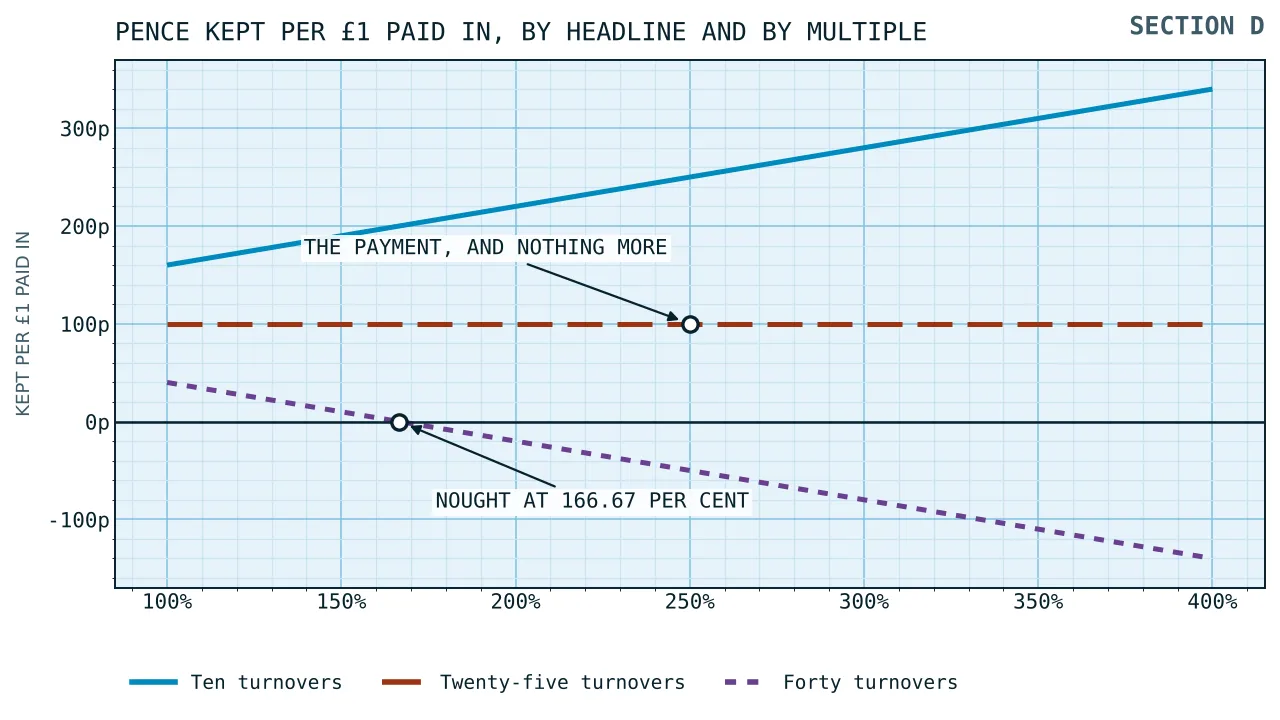
Multiply out per pound and the coefficient on the percentage is one minus the multiple over twenty-five. At ten times that coefficient is plus 0.6, so each extra hundred per cent of match is worth sixty pence a pound. At forty times it is minus 0.6, so each extra hundred per cent costs sixty pence a pound. At twenty-five times it is nought, which means the percentage has no effect whatever and the closing line is the payment itself.
The same sixty pence appears twice with its sign reversed, and that symmetry is the most useful thing in this section. A reader who knows only the multiple can say whether a larger headline is better or worse before reading the percentage at all.
4
Where the plane crosses nought
Set the closing line to nothing and solve for the percentage rather than the multiple. At forty times the answer is 166.67 per cent, so a match above that figure empties the account and leaves a balance of the requirement outstanding. Below it something survives, and the survival shrinks by sixty pence for every hundred points of headline.
At twenty-five times no percentage empties the account and none improves it either, because the credit pays for its own condition exactly. Above twenty-five times every percentage is a cost, and the larger the percentage the larger the cost.
| Headline | Ten times | Twenty-five times | Forty times |
|---|---|---|---|
| A hundred per cent | 160p | 100p | 40p |
| Two hundred per cent | 220p | 100p | 0p |
| Three hundred per cent | 280p | 100p | 0p |
| Four hundred per cent | 340p | 100p | 0p |
The middle column is the quietest row of figures on this site and the one most worth sitting with. A credit of any size, at the crossing point, hands a reader back exactly what they paid in. The percentage bought nothing and cost nothing, and the entire transaction was a long way of leaving the money where it was.
5
The base the multiple bites on
A single conjunction moves more money here than the percentage in the headline does. Where the turnover is asked of the credit alone, the base is the credit. Where it is asked of the deposit and the credit together, the base is both.
The bill multiplies by one plus the percentage, divided by the percentage, which is a ratio that falls as the headline rises. A hundred per cent match sees its bill doubled by that conjunction. Two hundred per cent sees it multiplied by 1.5, three hundred by 1.33 and four hundred by 1.25. So the word costs most where the headline is smallest, which is the reverse of what a reader would expect.
On a matched pound that doubling is decisive. £40.00 of turnover becomes £80.00, the expected cost becomes £3.20 against £2.00 in the account, and forty pence of survival becomes a shortfall of £1.20. The percentage did not move. The noun after the word of did.
Whether a turnover demanded of the deposit too sits inside the ten times ceiling has not been published, and the chain of published wording stops at the noun. The ceiling is written about bonus funds. The deposit is not bonus funds. Nothing beyond that is sourced, in either direction, and a page claiming otherwise is filling a gap from memory.
The contribution rate works on the same base. A game counting thirty pence in the pound leaves the requirement where it is and multiplies the staking needed to satisfy it by more than three, which takes a matched pound from £40.00 of staking to £133.33. That thirty pence is an illustration from a consultation response rather than a market figure, and the sum done with it belongs to this site.
The word and doubles the bill on a matched pound, and adds a quarter on a quadrupled one
6
Up to, and the bend it puts in the schedule
Two words in front of a figure turn a percentage into a schedule with a bend in it. A match quoted at a hundred per cent up to £100 runs at a hundred per cent only while the payment stays under a hundred pounds. Above that the credit stops growing and the effective rate falls away as the payment rises: a £200 payment is matched at fifty per cent and a £400 payment at twenty-five.
The rate is the smaller of the headline percentage and the maximum bonus divided by the payment, which is arithmetic rather than a reading of anybody’s terms. Which means the best payment under a capped match is the one that reaches the cap exactly, and every pound past it buys credit at a falling rate. A reader minded to pay in the maximum should know that the headline percentage applies to none of the money above the bend.
A second ceiling belongs beside that one. No published source sets a standard maximum on bonus winnings, so none is quoted on this sheet. The structure matters anyway. A British licensee may not cap the withdrawal of money a reader paid in. A maximum on what the bonus half may win is a separate clause, and the first protection does not reach it. Both can hold at one cashier on one afternoon.
7
Ten sheets, and what each adds to a match
Four sheets carry a bare percentage, three pair a payment with an award of cycles, two are about where the credit goes, and one prices a whole package at once.
A matched pound is the plainest case in the section and the only headline that leaves anything at forty times, which is 100% deposit bonus. Doubling the credit puts the crossing point just behind the headline, and 200% deposit bonus is where the ladder is read off. Tripling it owes £120.00 of turnover for every pound handed over, which is what 300% deposit bonus works out in full. Quadrupling it is the loudest headline anybody prints and the costliest per pound, priced on 400% deposit bonus.
Where the credit arrives as cycles instead of as a matched sum, the rate per pound paid in is the figure that travels between offers. Thirty cycles a pound is the ratio behind deposit 10 get 300 free spins, and forty cycles a pound is the steeper ratio behind deposit 5 get 200 free spins. Ten cycles a pound is the gentlest of the three, and deposit 10 get 100 free spins prices one cycle end to end.
Two sheets turn on the room the credit is spent in. A bingo sign up bonus owes its turnover without any published return to price it with, and a slots sign up bonus has a statutory definition of a reel behind it. And one sheet prices a match, a ceiling and an award of cycles inside the same document, which is casino welcome bonus.
One rule governs how far such a package may be built. An incentive may not carry two product types with linked and shared terms, and the types named are betting, casino, bingo and lottery. A match with spins attached is casino twice over, so it stays inside one type. A match with bingo tickets attached does not, and that is the line the bingo sheet sits against.
8
What a licence is worth on a matched pound
Some of what a Great Britain licence puts under a matched pound can be priced in pence, and the rest can only be named. Both halves are worth having in that order, because the priced half is the argument and the named half is the exposure.
The priceable part is the ceiling on the multiple. Ten times instead of forty is worth 120p a pound on a matched pound, 220p where the match doubles, 280p where it trebles and 340p where it quadruples. That range, £1.20 to £3.40 for every pound paid in, is the arithmetic of a licence rather than a slogan about one. It arrives on 19 January 2026, by way of Social Responsibility Code 5.1.1, across every licence but gambling software and gaming machine technical, and the regulator’s stated reason was requirements running as high as sixty times.
The unpriceable part is longer and it bears directly on money a reader already owns.
Borrowed money is kept out of it. Credit cards are refused for gambling payments by every British licensee, a money service business in the middle included, and the rule dates from 14 April 2020. Light-touch financial vulnerability checks attach to a net monthly deposit above a threshold. A threshold of £500 a month arrived on 30 August 2024, and 28 February 2025 cut it to £150. A limit on what goes in has to be offered and prompted, presented as the default rather than an option, reduced the moment it is asked for and raised only after a day has passed. A withdrawal from money a reader paid in may not be capped, and a request to withdraw may not be followed by the offer of a cancellation. Identity is settled before any play rather than at the window, and a demand the licensee could have made sooner may not be sprung on a withdrawal. A complaint runs eight weeks at the outside and then escalates to an adjudicator from an approved list. And membership of Gamstop Online comes with the British licence rather than by choice.
A cashier without a Great Britain licence owes none of it, and that is the position at this end of the market. The offers under this heading hold no Great Britain licence, so the ceiling that would have been worth £1.20 a pound is not there. The Curaçao policy read for this site carries no equivalent of the ten times ceiling and no stake limit, and its whole text on bonuses asks for transparent terms and no aggressive promotion.
Curaçao is stricter on one point, which is worth saying because it cuts the other way: lowering a deposit limit there takes effect immediately, while a rise waits seven days. Its self-exclusion is operator-level, covering that operator’s own domains and no further, with a year as the shortest period, while the scheme a British licence compels membership of works from a single place. No sentence here helps anybody around a protection they have set up for themselves, and the numbers that help stand below.
One published outcome is worth carrying into any reading of a match’s terms. A discretion kept by the house over closing an account or taking winnings back earned a £170,000 penalty on 3 July 2025, against the operator trading as Fafabet, for a breach of the fair and open condition. The regulator fined the operator and required an outside audit of its controls. It did not declare the clause unenforceable, and no page should say that it did.
9
Five readings before the money goes
Five readings settle a matched offer, and nobody does the first one.
- Separate the pots. Write down what the payment is and what the credit is, and never add them.
- Divide by the payment so the answer is in pence per pound, which makes any two offers comparable.
- Read the multiple, and find whether it bites on the credit alone or on the payment as well.
- Read the maximum bonus, and work out which payment reaches it exactly.
- Compare the quotient of the multiple and the contribution rate against twenty-five: below it the percentage is working for the reader, above it the percentage is working against them.
What that method will not do is turn an expectation into a payment. Forty pence a pound is a mean, and the commonest single result behind that mean is the whole lot gone. Treating it as a return misreads the arithmetic rather than the offer.
Six other sections make up the rest of this site, each cut by the debit that settles it.
- The multiple prices a credit that costs nothing to obtain, where the play-through settles everything.
- Nothing asked back takes the requirement away and prices whatever is left holding the offer.
- The floor asks what the smallest acceptable payment buys once a flat charge has had its share.
- The rail prices the method of paying in, before any bonus exists at all.
- Off the register names, duty by duty, what goes missing without a British licence.
- The room prices the place the credit is spent, its pace, and the shape of its prizes.
How a receipt is struck works the arithmetic behind each total, and the front page of The Spin Sheet lists all seven sections.
Questions
- Does a matched balance count as money?
- A percentage has no value until the sum it multiplies is named, and the sum belongs to the reader. Ten pounds paid in against a hundred per cent match leaves a balance of £20.00, half of which arrived in the account and half of which merely changed address. The credit is an entry that becomes money once a turnover condition has been met, and it can become nothing instead. Adding the two and quoting the total is how a matched offer flatters itself.
- What does a matched pound actually leave?
- Forty pence per pound paid in, where forty turnovers are asked of the credit and the game returns 96 per cent. A pound of credit owes £40.00 of staking, the edge takes £1.60 of it, and £2.00 was in the account, so 40p survives. On a tenner that is £4.00, on fifty pounds £20.00, and the ratio never shifts with the size of the payment.
- Is a bigger percentage a better offer?
- It depends entirely on the multiple, and the direction is set before the percentage is read. Each extra hundred per cent of match is worth 60p a pound where the requirement is ten times, and costs 60p a pound where it is forty. At twenty-five times the percentage makes no difference at all, because the credit exactly pays for its own condition. So a bigger headline is better under a British ceiling and worse out here.
- Which headline is the one that leaves nothing?
- 166.67 per cent, at forty turnovers on a 96 per cent game. Above that figure the account empties and part of the requirement is still outstanding, and below it something survives. The general form is one divided by the multiple times the house edge, less one, so a ten times requirement has no such crossing point and every percentage survives it.
- What does wagering on the deposit and bonus do?
- It doubles the bill on a matched pound. The base the turnover is taken on becomes the payment plus the credit rather than the credit alone, so the bill multiplies by one plus the percentage over the percentage: twice at a hundred per cent, 1.5 times at two hundred, 1.33 at three hundred and 1.25 at four hundred. The conjunction therefore costs most on the smallest headline, which is the opposite of what the headline sizes suggest.
- What do the words up to actually do?
- Up to is a bend in the schedule rather than a decoration. A hundred per cent up to £100 runs at a hundred per cent while the payment is under a hundred pounds, and above that the credit stops growing while the payment does not. A £200 payment is matched at an effective fifty per cent and a £400 payment at twenty-five. The payment that reaches the maximum exactly is the one where the headline rate is actually being paid.
- How do I compare a spins package with a percentage?
- Thirty cycles for each pound paid in is one rate, forty cycles is another, and ten cycles is a third, which is enough to place three packages in order without reading a single total. At 10p a cycle those rates carry £3.00, £4.00 and £1.00 of face per pound, and 96 per cent of each is what the arithmetic works on. The count on the front of an award is only meaningful once it has been divided by the payment that unlocks it.
- What does a British licence add to a match?
- The offers under this heading hold no Great Britain licence, and on a matched pound the missing ceiling alone is worth between £1.20 and £3.40 for every pound paid in, depending on the headline. The rest cannot be priced and can be named: no bar on paying by credit card, no vulnerability check at a monthly threshold, no prompt to set a deposit limit as the default, no protection against a cap on withdrawing a deposit balance, and no place in Gamstop Online.
- Can a match be paid in bingo tickets and casino credit at once?
- Not inside a single incentive with linked and shared terms. Lottery, bingo, casino and betting are the types the rule lists, and two of them may not share the terms of one incentive. Slots count as casino, so a match carrying free spins has not left the one product type. A match paired with bingo tickets crosses two, and the mixed-product ban arrived on the same day as the ten times ceiling.