
Sheet P12 Revision 1 Checked 15 October 2026
Free slots no deposit
A reel run for nothing settles at £0.00 at every multiple and every weighting, since nought staked returns nought. Fifteen credited cycles at 10p are another object altogether: £1.44 of average winnings, £0.86 expected against a ten times requirement, and nothing whatever at forty.
£0.00 off a demonstration reel, £0.86 off a credited fifteen
What the conditions leave
Every destination on this spike is bought advertising. The site takes a fee if a reader goes on to register, and no figure printed below moves because of it.
The Spin Sheet
Till receipt No 01
Betportal
Lowest multiple here
For every €1 of spin credit at face per €1
Credit
Debit
No Great Britain licence
Licensed in Anjouan, Comoros, run by BetPortal Gaming Ltd, with Excite Ultra Media Ltd, reference ALSI-202601040-FI2.
Terms read 15 October 2026
Open the offer at Betportal, opens in a new tabThe Spin Sheet
Till receipt No 02
WinBeast
Five staged matches
For every €1 of spin credit at face per €1
Credit
Debit
No Great Britain licence
Licensed in Curaçao, operator not named on the site.
Terms read 15 October 2026
Open the offer at WinBeast, opens in a new tabThe Spin Sheet
Till receipt No 03
EliteSpin
Longest spin window
For every £1 of spin credit at face per £1
Credit
Debit
No Great Britain licence
Licensed in Costa Rica, run by PrimeTier Limited.
Terms read 15 October 2026
Open the offer at EliteSpin, opens in a new tabThe Spin Sheet
Till receipt No 04
Crown Jewelz
Multiple unpublished
No total struck
Credit
Debit
No Great Britain licence
Licensed in Curaçao, number not verified, operator not named on the site.
Terms read 15 October 2026
Open the offer at Crown Jewelz, opens in a new tabThe figure at the foot of a receipt is this site's own arithmetic and nothing an operator has published: the credit, less the share a spin gives back at 96 per cent return to player, less what playing the wagering through costs at the same return. It describes the offer, not one reader's afternoon. Where the conditions price above the credit the receipt prints nothing rather than a negative sum, and where a figure the sum needs is unpublished it prints the condition in the operator's words instead.
Three words stand in the amount column where no figure can. Noted is a published condition that takes value away without leaving the sum a figure to take. Unpriced is a condition whose figure nobody has published, or a credit that is not a sum until a deposit of your own sets it. Own money is money of yours, which is never part of a total.
Not one of the operators printed above holds a Great Britain licence, so the duties that licence carries do not reach them. Every online gambling company licensed in Great Britain has to be part of Gamstop Online, and a reader who has shut themselves out through the scheme is therefore not shut out here. The ceiling of ten times the bonus funds on a wagering requirement, in force since 19 January 2026, is a condition of that licence and binds the companies that hold one. Where a dispute goes instead is a matter for the authority named on the receipt, and the Gambling Commission describes what a reader faces without a British licence as a lack of recourse if things go wrong. Nobody under 18 may hold an account at any of them.
Every term printed on a receipt is the operator's own, and each receipt carries the day it was read. The oldest of those readings is 15 October 2026. What binds a reader is the operator's own full terms, and not a line printed here.
1
Two readings, and a credit in only one
One search phrase, two different objects. A reel that accepts no stake is the first. A slots credit that asks for no deposit is the second. Both are free to begin and only the second has money at either end of it.
So the page prices two columns rather than one, and the first column finishes in a single multiplication. That is not an evasion. It is the finding, and a sheet whose job is to strike a total has to be willing to strike one at nought.
Where a figure cannot be sourced this sheet names the gap instead of filling it. Nothing published in Britain fixes the pence a free spin carries. No rule names whoever sets that figure, and no licensee is under a duty to display it. Ten pence therefore stands as a working stake across eighty-five sheets. Substitute whatever figure your own terms carry and the method is unaffected.
Forty turnovers is the requirement this sheet carries through, since a small count in this bracket tends to attract that order of multiple. A British licence will not let the requirement past ten turnovers of the bonus funds, and has not since 19 January 2026. Sixty times is what the regulator put on record as in use at some licensees before it stepped in.
What the two readings hold before anything is priced:
- Column one: no stake, so no face value, no credit and no requirement.
- Column two: fifteen cycles at 10p, a 96 per cent theoretical return, forty turnovers demanded, and a staked pound counting whole until part 4.
- Shared by both: the same reel set, the same paytable, the same arithmetic of how often a slot pays nothing.
- Shared by neither: a deposit. Nothing is paid in on either reading.
2
Nought staked, nought given back
Pricing a demonstration reel takes one line of working and the line is short.
A cycle carrying no stake has a face value of £0.00. Ninety-six pence in the pound of nought is nought, so the average winnings are £0.00 as well. B is therefore nought, and every term to the right of B has been made irrelevant: nought multiplied by any bracket, at any multiple and at any rate of contribution, is nought.
Twelve hours of it would price the same. So would twelve thousand cycles. A quantity that begins at nought cannot be raised by turnover, by a generous requirement or by a room that counts every pound whole.
£0.00 at ten times, at forty and at sixty alike
None of which is a complaint about practising on a reel. It is a statement about which of the two readings has a credit in it. What a reader is getting is cycles watched, a paytable read, and some sense of how long a feature keeps a player waiting. What they are not getting is a distribution of money, because no money entered the distribution.
The regulator puts those games outside gambling in its own terms: no prize is involved, so they are not technically gambling, and it sees no legitimate reason for children to reach them. Both halves of that sentence matter on this page. The first is why the column prices at nought. The second is why part 7 exists.
3
Fifteen cycles, one pound forty-four
It is the credited reading where the standing line earns its keep.
E = B × (1 – (W × (1 – RTP)) / g)
£1.50 sits on the front of fifteen cycles priced at 10p, and £1.44 is what a 96 per cent return averages out of that stake. Call the second figure B. Turnovers demanded of that credit are W. The share a room hands back is RTP. What fraction of a staked pound the room will count is g, and the closing line is E.
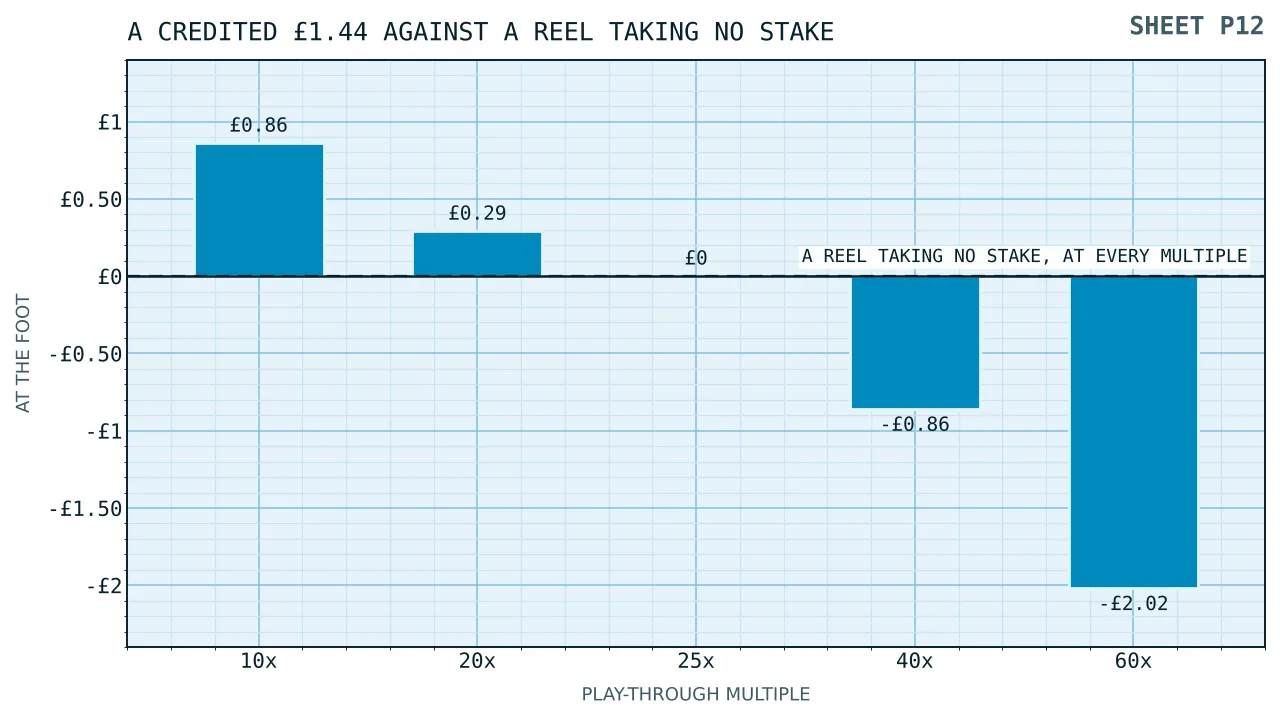
Forty lots of £1.44 come to £57.60 of required staking. Four pence goes out of each of those pounds, which is £2.30, and E arrives at minus £0.86.
By the bracket: 1.60 is what forty edges of four pence add to, and the figure left under one is 1.60, and one less that leaves -0.60.
Three-fifths of £1.44 is £0.86. The closing line is therefore £0.00, the credit having been used up somewhere inside the staking.
Eighty-six pence is nobody’s bill. With no deposit standing behind the cycles, nought is as low as a balance travels; the minus sign measures only how far the condition outran what it was fastened to.
| The requirement | Staking owed | Cycles owed | Expected price | E |
|---|---|---|---|---|
| Ten times | £14.40 | 144 | £0.58 | £0.86 |
| Twenty times | £28.80 | 288 | £1.15 | £0.29 |
| Twenty-five times | £36.00 | 360 | £1.44 | £0.00 |
| Forty times | £57.60 | 576 | £2.30 | -£0.86 |
| Sixty times | £86.40 | 864 | £3.46 | -£2.02 |
Twenty-five is the multiple that empties the credit precisely, and nobody chose it. Put E at nought, watch B leave both sides, and what survives is one divided by the four pence a 96 per cent room keeps. Part 6 shows why that digit is a property of the build rather than a promise from the rulebook.
4
Weighting with nothing to divide into
Contribution is the room’s own term, and on the first reading it has no employment at all. What g divides into is a requirement, and a reel accepting no stake carries none.
Give it a requirement and g becomes the most destructive letter in the line, because its place is underneath the multiple rather than alongside. A letter underneath does not add to an obligation. It divides into one, so a small movement in the rate outweighs a large movement in the multiple.
Something survives only where W divided by g lands under twenty-five. Rearrange it and the test falls on the rate: g has to clear the multiple divided by twenty-five. Forty times asks for £1.60 in the pound, which no room can hand over, a staked pound being unable to count for more than a pound. Ten times asks for better than forty pence.
Priced on this round: at fifty pence in the pound the £57.60 of contribution owed takes £115.20 of staking, costs £4.61, and drops E to minus £3.17. At twenty-five pence the staking is £230.40, the price £9.22, and E minus £7.78. The contribution owed has not budged from £57.60 in either case.
Divide the multiple by the rate and an effective multiple appears, which is the figure a slots offer never carries on its front. Fifty pence in the pound turns forty times into eighty. Twenty-five pence turns it into a hundred and sixty. The wagering line goes on reading forty.
One rate has any provenance behind it at all. Thirty pence in the pound reached the regulator once, in a consultation response describing what a staked pound contributed. It was recorded, and weighting came out of that exercise untouched. No public schedule of the rates now in use exists, so every rate on this page is an input rather than a measurement.
g must clear W divided by 25, or the foot reads nothing
5
Twenty-four minutes, and a clock left unstated
Cycles owed work out as the count on the front, times the requirement, times the return. Forty times on fifteen cycles gives 576.
RTS 14D sets the floor between them: two and a half seconds must pass from one slot game starting before the next may be commenced, and the start control needs releasing before it is pressed once more, so a held button begins nothing. Five hundred and seventy-six presses at that spacing occupy 1,440 seconds, or twenty-four minutes. The fifteen cycles given away take thirty-seven and a half.
Under forty seconds of gift against twenty-four minutes of obligation puts the two at thirty-eight to one, which is W multiplied by the return and nothing else. That holds whether a cycle costs a penny or costs fifty pence, the presses being counted off the credit and the credit off the price.
No clock is given for the first column, and the reason is a gap in the sources rather than a gap in the page. The pacing standard is written about a game cycle on a licensed gambling system, and the regulator’s own account of a free-to-play version is that no prize is involved so it is not technically gambling. Nothing in this sheet’s evidence states what pace such a version must keep, so no figure is offered for one.
Three further standards keep the twenty-four minutes where they are. Automation goes under RTS 8A, which wants a commitment to every single game cycle, and the one thing it lets through is a poker blind going on by itself. RTS 14E leaves a customer no handle on how soon a result lands. Turbo, quick spin and slam stop are struck out by name, at any native game speed. RTS 14C will not have functionality that sets casino games going at once, split and multiple screens with it, so running the reel set four times over is no route to six minutes.
RTS 14F is the one a reader will feel over 576 presses rather than measure. A return no larger than the whole stake gets no celebratory sound and no win animation, which across a credited round of this size is a great many results not dressed as wins. The guidance names three replacements for the fanfare: the sum awarded in figures, the lines that paid shown for a moment, and one brief sound at the point of crediting.
6
What a reel for nothing will tell you
RTS 3 is the standard setting out what a licensed game owes a reader ahead of any commitment, and sites like this one habitually overstate it.
Under RTS 3C, whatever a customer might reasonably need for an informed view of their chances has to be within easy reach ahead of a commitment to gamble. Then it lists four items, and the list is joined by the word or rather than by the word and. One item is a description of the mechanics, of how a winner is arrived at and of how prizes get handed out. Another is the house edge, otherwise the margin, four pence in the pound on the figure used here. The percentage returned to a player is the third. The probability of winning events occurring is the fourth.
Publish the margin and the standard is satisfied with no percentage printed at all. Nobody should read the rulebook as a duty to publish a return, and this sheet does not. Where the choice does fall on a percentage, the guidance asks for the average theoretical figure rather than anything observed.
Around 3C sit three more. Rules accurate, sufficient and easily available before any commitment is 3A. Enough on screen as the game runs for a player to follow the state of it is 3B. Potential prizes and payouts, or the method that settles them, available ahead of a commitment, is 3D. The requirement ends at that letter, there being no 3E.
Which bears directly on the first column. A demonstration reel is ordinarily the same reel set with the same paytable, and it will show a reader how a feature is triggered, how long the dry spells run and what the top symbol pays. What it will not do is convert 96 per cent into money, because a percentage is a share of a stake and no stake was accepted.
The incentive provision reaches the second column instead. Three adjectives are asked of an incentive’s conditions, and a fourth thing of their placing: clear, transparent, fair, and no trouble to reach for whoever was offered the incentive. A contribution schedule three clicks away from the headline sits awkwardly against that last limb, though no source puts a number on how many clicks are too many.
7
Identity before a game with no prize
Nothing is staked on the first reading and nothing is deposited on the second, and a British licensee still establishes who a player is before either.
Three items have to be in hand first, and taking them in the order a form rarely uses: the date of birth, then the address, then the name attached to both. The condition says the information must include those and is not restricted to them, so the three are a floor rather than a list.
The reach is the part that matters here. Gambling on a bonus is inside the rule, and so is a free bet. So is reaching the no-stake versions of the games a licensee runs on its own website. Three reasons are given for the check: age, self-exclusion status, and confirming that a customer is who they say. An age check once had a seventy-two hour window around it, and the window has gone.
On the date, the care is worth taking. The announcement carries 7 February 2019 and says the new rules come into force on 7 May without printing a year. The article’s own date makes 7 May 2019 the only available reading, which is how this sheet gives it, and the year is not presented as something the source states.
At the far end of the account the same condition shuts a second door. A withdrawal must not become the occasion for a document request that could reasonably have been made earlier. Anti-money-laundering material is to be sought promptly, not held back until a payout is on the table. Three examples are published: a household bill, a passport and a driving licence. Which of them a business asks for is not something the regulator specifies.
One source note, because this page leans on a consumer guide older than most of its material. Publication was 23 September 2020, with an update in April 2022, on the thirteenth. Today’s wording on identity lives in the licence condition, and that is the source of the three items named earlier.
8
A reel with no register behind it
Spend a credit where no Great Britain licence applies and the losses can be named one duty at a time. Put them as a series of questions with one answer.
Who holds a wagering requirement down to ten turnovers of bonus funds out here? Nobody. Who keeps a single slots cycle under five pounds, or under two where a player has yet to reach 25? Nobody. Who makes two and a half seconds pass before the next cycle may begin? Nobody. Who bars automation, bars turbo, and bars two casino games running at once? Nobody. Who verifies the date of birth, the address and the name before a reel with no prize in it may turn? Nobody. Who approves the body that would hear a complaint after eight weeks of getting nowhere? Nobody.
Read the island rulebook consulted for this build and the absences are the striking part. No cap on a multiple appears in it. No ceiling on a cycle appears in it. A minimum interval is not in it. Automatic play is not barred by it. Nothing in it touches a fanfare for a return that merely matches a stake. Two sentences is the whole of its treatment of bonuses: transparency in the terms, and a bar on pushing a promotion hard enough to drive excessive play.
A familiar reel set proves nothing about a licence, which is worth saying twice on a page about free slots. A warning notice to the industry, dated the twentieth of January 2025, records games from licensed suppliers running on websites that hold no licence. The same notice sets down what else such a website may carry: controls on money laundering and social responsibility that are not adequate, unfair practices, trouble with data privacy, fraud, and a habit of going after people who have already self-excluded.
The blocking scheme hangs on the British licence and on nothing else. Every online gambling business holding one must be part of Gamstop Online, and the scheme’s own terms are blunt about the boundary: where an organisation never joined, a registration will not keep a person out. The offshore equivalent bars a player from one operator together with the domains it owns, begins at a year, and once confirmed it stands until the period runs out. Nothing written here will help anybody defeat a block of any kind, and the free routes are set out at the foot of this sheet.
9
Reading both offers before either
Six readings settle both columns, and the first of them decides which column a reader is in.
| What to read | On this sheet |
|---|---|
| Is a stake accepted at all | Decides B |
| Cycles, and the stake each carries | 15 at £0.10 |
| Credit, after the return | £1.44 |
| W, as the wagering line gives it | 40x |
| g, as the game schedule gives it | 1.00 |
| E, and the foot | -£0.86, so £0.00 |
Do the first line and the demonstration column is over. No stake accepted means B is nought, which means E is nought, which means the remaining four readings have nothing to act on. That is twenty seconds of work and it is the most useful twenty seconds on the page.
On the credited column, divide W by g and set the answer against twenty-five. Under it, something is expected at the foot and the round is worth finishing. Over it, nothing is the answer, and all that remains open is how many minutes the nothing takes. Forty divided by one is forty, so this round is a long way over.
Two limits on all of it. The figure is a mean. Over fifteen cycles the commonest single result is nothing at all, so a mean of this sort speaks about many rounds and not about one. And a condition standing outside the bracket can shut the answer down while W, g and the return sit exactly as they were: a ceiling on what the bonus is permitted to win, or a discretion reserved by the operator in its own favour.
Neighbouring sheets take the parts this one passes over. Online slots UK sets out the room itself, top 10 best online slots prices a game list rather than a game, mobile slots puts the same presses on a thumb, and Big Bass slots runs the arithmetic across a band of returns because one named family publishes none. Every sheet in the section is listed at The room.
Questions
- What are free slots with no deposit actually worth?
- It depends which of two objects the phrase has found. A reel accepting no stake is worth £0.00, because the face value is nought and 96 per cent of nought is nought, and no multiple or contribution rate can lift it. A credited round of fifteen cycles at 10p is worth £1.44 of average winnings, which forty times reduces to nothing and ten times leaves at £0.86.
- Why does a demonstration reel price out at nothing?
- Because a return percentage is a share of a stake, and no stake was taken. The face value of a cycle with nothing on it is £0.00, so B is £0.00, so every term to the right of B in the arithmetic has nothing to act on. Twelve thousand cycles would price the same as one. The regulator puts such games outside gambling in its own terms, since no prize is involved.
- So is practising on a free reel of any use?
- For some things, yes, and this sheet is precise about which. A reader sees the paytable, learns how a feature is triggered, and gets a feel for how long the dry spells run. What they do not see is a distribution of money, because none entered the distribution. The reel will not turn a 96 per cent return into pounds, and in any case no published rule settles a spin’s value in pence.
- What does the room do to a credited round of fifteen?
- Forty lots of £1.44 come to £57.60 of required staking, out of which four pence in the pound is expected to go, which is £2.30. That overruns the credit by £0.86, so the foot reads £0.00. Where the ceiling of ten applies the staking is £14.40, the expected price £0.58, and £0.86 is expected to survive.
- How high does the contribution rate have to be?
- Above the multiple divided by twenty-five, on a 96 per cent return. Forty times asks for £1.60 in the pound, which cannot exist, since a staked pound is unable to count for more than a pound. Ten times asks for better than forty pence. At fifty pence in the pound this round needs £115.20 of staking instead of £57.60, and E falls from minus £0.86 to minus £3.17.
- How long does the wagering take?
- Twenty-four minutes at the licensed floor, because 576 cycles are owed and RTS 14D makes two and a half seconds pass from one slot game starting before the next may be commenced. The fifteen cycles given away take thirty-seven and a half seconds. Automation is barred, turbo is barred, and two games at once is barred, so none of the twenty-four minutes compresses.
- Must a licensed site publish the return percentage?
- No, and that is the most misread thing in the whole rulebook. RTS 3C holds four items and the joining word is or: the probability of winning events occurring; the percentage returned to a player; the house edge, otherwise the margin; or a description of the mechanics with how a winner is arrived at and prizes handed out. Publish the margin and the standard is satisfied with no percentage printed anywhere. Where a percentage is chosen, the guidance wants the average theoretical figure.
- Will my identity be checked before a game that takes no stake?
- At a British licensee, yes. Gambling on a bonus is inside the rule. A free bet is inside it too, and so is reaching the no-stake versions of the games a licensee runs on its own website. Three items have to be in hand first: date of birth, address, and the name attached to both. The reasons given are age, self-exclusion status and confirming identity, and the seventy-two hours operators once had to complete an age check are gone.
- What is missing from a free reel with no Great Britain licence?
- Put it as questions. Who holds the multiple to ten turnovers of bonus funds out here? Nobody. Who keeps a slots cycle under five pounds, or two below the age of 25? Nobody. Who makes two and a half seconds pass between cycles, bars automation and bars turbo? Nobody. Who verifies the date of birth, the address and the name before a reel with no prize turns? Nobody. Two sentences on bonuses and not a single cap: that is the island rulebook consulted for this build.
- Does a well-known game mean the site is licensed here?
- It means nothing of the sort. A notice to the industry dated the twentieth of January 2025 sets down games from licensed suppliers running where no licence applies, next to controls on money laundering and social responsibility that fall short, unfair practices, trouble with data privacy, fraud, and a habit of going after people who have already self-excluded. Recognising a reel set tells a reader nothing about whose hands the money is in.