
Section F Five sheets Checked 15 October 2026 Revision 1
The floor
A pound at 10p a cycle buys ten cycles, 96p of expectation and twenty-five seconds of licensed slot time. Match it once over and a ten times requirement leaves 60p of the credit, which is sixty pence for every pound handed over. A flat fifty pence handling charge takes half of that pound and a twentieth of a tenner, and it is the only term on the page that does not shrink when the payment does.
10 cycles, 96p back, 25 seconds, and 60p of licence, for each £1 at the floor
What the conditions leave
Every destination on this spike is bought advertising. The site takes a fee if a reader goes on to register, and no figure printed below moves because of it.
The Spin Sheet
Till receipt No 01
Betportal
Lowest multiple here
For every €1 of spin credit at face per €1
Credit
Debit
No Great Britain licence
Licensed in Anjouan, Comoros, run by BetPortal Gaming Ltd, with Excite Ultra Media Ltd, reference ALSI-202601040-FI2.
Terms read 15 October 2026
Open the offer at Betportal, opens in a new tabThe Spin Sheet
Till receipt No 02
WinBeast
Five staged matches
For every €1 of spin credit at face per €1
Credit
Debit
No Great Britain licence
Licensed in Curaçao, operator not named on the site.
Terms read 15 October 2026
Open the offer at WinBeast, opens in a new tabThe Spin Sheet
Till receipt No 03
EliteSpin
Longest spin window
For every £1 of spin credit at face per £1
Credit
Debit
No Great Britain licence
Licensed in Costa Rica, run by PrimeTier Limited.
Terms read 15 October 2026
Open the offer at EliteSpin, opens in a new tabThe Spin Sheet
Till receipt No 04
Crown Jewelz
Multiple unpublished
No total struck
Credit
Debit
No Great Britain licence
Licensed in Curaçao, number not verified, operator not named on the site.
Terms read 15 October 2026
Open the offer at Crown Jewelz, opens in a new tabThe figure at the foot of a receipt is this site's own arithmetic and nothing an operator has published: the credit, less the share a spin gives back at 96 per cent return to player, less what playing the wagering through costs at the same return. It describes the offer, not one reader's afternoon. Where the conditions price above the credit the receipt prints nothing rather than a negative sum, and where a figure the sum needs is unpublished it prints the condition in the operator's words instead.
Three words stand in the amount column where no figure can. Noted is a published condition that takes value away without leaving the sum a figure to take. Unpriced is a condition whose figure nobody has published, or a credit that is not a sum until a deposit of your own sets it. Own money is money of yours, which is never part of a total.
Not one of the operators printed above holds a Great Britain licence, so the duties that licence carries do not reach them. Every online gambling company licensed in Great Britain has to be part of Gamstop Online, and a reader who has shut themselves out through the scheme is therefore not shut out here. The ceiling of ten times the bonus funds on a wagering requirement, in force since 19 January 2026, is a condition of that licence and binds the companies that hold one. Where a dispute goes instead is a matter for the authority named on the receipt, and the Gambling Commission describes what a reader faces without a British licence as a lack of recourse if things go wrong. Nobody under 18 may hold an account at any of them.
Every term printed on a receipt is the operator's own, and each receipt carries the day it was read. The oldest of those readings is 15 October 2026. What binds a reader is the operator's own full terms, and not a line printed here.
1
Two floors, and one of them advertised
A cashier publishes a smallest acceptable payment, and an offer publishes a smallest qualifying one, and the two figures are rarely the same. Only the first of them gets advertised, which is what makes this section necessary.
Five sheets sit under this heading, and each of them starts from a payment somebody is actually willing to make rather than from a headline somebody is willing to print. Every figure below is quoted for each pound handed over, so a reader can scale it to whatever the cashier in front of them will take.
Fixed on this sheet, and every one of them a figure a reader can replace:
- A cycle at 10p, which is what turns a payment into a count.
- A game returning 96 per cent, so a complete pass of a balance costs four pence in the pound.
- A handling charge of 50p, used as a worked figure because no rule fixes one and no source publishes a market rate for it.
- Forty turnovers where a bonus is involved, with ten times standing as the ceiling a British licence sets.
- Payments of £1, £3, £5 and £10, which are the four this section is built around.
2
What a pound at the floor buys
Take the payment, divide by 10p, and the count is there: a pound buys ten cycles. One journey of the balance through the reels comes to four pence in each pound, where the game returns 96 per cent, and no smaller toll exists. Twenty-five seconds is what a pound buys at the pace a British slot has to keep, because ten cycles at 2.5 seconds apiece cannot be hurried.
Each of those scales exactly with the payment, which is why they are quoted as rates rather than as totals. A payment of three pounds buys thirty cycles, twelve pence of toll and a minute and a quarter. A payment of ten pounds buys a hundred cycles, forty pence of toll and four minutes and ten seconds.
| Paid in | Cycles | Toll on one pass | Clock at the floor | 50p as a share | Matched, kept at ten times |
|---|---|---|---|---|---|
| One pound | 10 | 4p | 25 s | 50.0% | 60p |
| Three pounds | 30 | 12p | 1 min 15 s | 16.7% | £1.80 |
| Five pounds | 50 | 20p | 2 min 5 s | 10.0% | £3.00 |
| Ten pounds | 100 | 40p | 4 min 10 s | 5.0% | £6.00 |
Nothing in that schedule is a judgement about whether a small payment is wise. It is a statement of what the payment converts into. Four of those quantities rise in step with the money and one of them does not, and the odd one out is the subject of part 3.
25 seconds of licensed slot time per £1 paid in
3
A charge in pounds does not shrink
A percentage shrinks when the payment shrinks. A charge quoted in pounds does not, and that single asymmetry decides most of this section.
Fifty pence is a fifth of the cycles a pound buys and a twentieth of the cycles a tenner buys, so the same charge is five cycles either way. Five cycles, every time, is a useful way to hold it, because the count is fixed while the share of the payment is not. Half of a one pound payment, a sixth of three pounds, a tenth of a fiver and a twentieth of a tenner: one charge, four verdicts.
| Paid in | What 50p takes | Cycles it costs |
|---|---|---|
| One pound | 50.0% | 5 |
| Two pounds | 25.0% | 5 |
| Three pounds | 16.7% | 5 |
| Five pounds | 10.0% | 5 |
| Ten pounds | 5.0% | 5 |
| Twenty pounds | 2.5% | 5 |
There is nothing in the published rules that fixes a handling charge, and none is quoted here as a market figure. Fifty pence is used as a worked figure so the shape of the thing can be seen, and a reader with a different charge in front of them should divide it by 10p and count cycles.
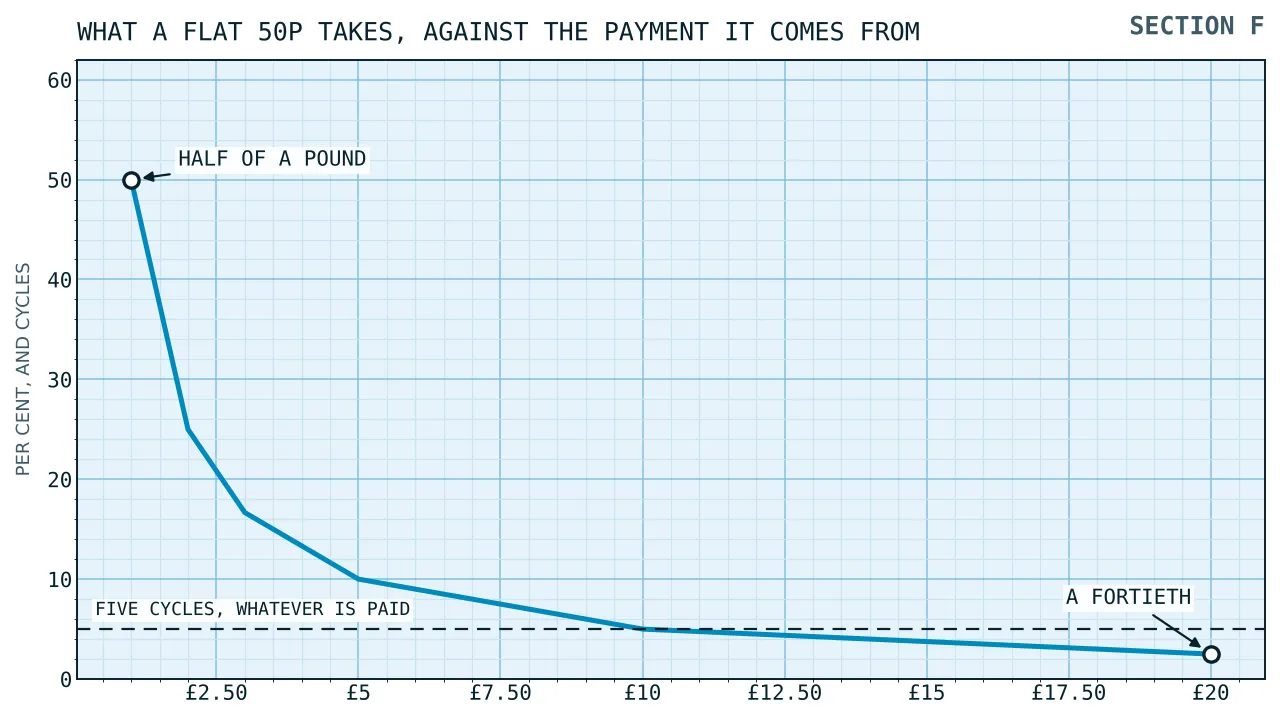
Five cycles, at any payment, is what 50p costs
4
The stake ceiling is bigger than the payment
The lawful ceiling on a slot stake is bigger than most of the payments in this section. A pound cannot reach a five pound stake, so the stake ceiling has nothing to work on at the floor. A five pound payment is exactly one cycle at the lawful maximum, and a ten pound payment is two.
So the span of this section runs from a fifth of one maximum stake to two of them, which is a useful thing to know about the ceilings that get quoted most often. The two ceilings are £5 and £2, the second for a player under twenty-five, and both are on online slots rather than on casino games generally. The Commission puts them in force from 9 April 2025, with the lower of the two following on 21 May. A reader staking 10p a cycle is fifty times under the first of them and the ceiling is doing nothing whatever for them.
What is doing something is the pace. Ten cycles cannot be run inside twenty-five seconds, and nothing may run them without a fresh commitment each time. Quick spin, slam stop and turbo are all barred by the same rulebook, so twenty-five seconds is a floor that holds whatever a reader does with the buttons.
5
Below the qualifying line, £0.00
Below the qualifying line a bonus is worth exactly nothing, and the arithmetic has no gradient there at all. Where a cashier accepts a pound and an offer wants ten, nine pounds separate a reader from any credit whatever, and the credit is a step rather than a slope.
That nine pounds is not a cost. It is money that moves from being a reader’s to being at risk, which is a different thing and ought to be said as one. What the step buys is itself worth computing. Ten pounds matched once over is £10.00 of credit, worth £6.00 of expectation at a ten times requirement and nothing at forty.
So the honest summary is that the gap buys £6.00 of expectation under a British licence and nought at the requirements written out here, in exchange for nine pounds of exposure either way. A reader who would not have paid ten pounds without the offer has been moved by the offer, and the figure that moved them is worth nothing at the requirements written out here.
One rule sits directly behind that gap. A promotion’s significant conditions are to be carried plainly and prominently wherever leaving one out would mislead, and the advertising regulator’s own list puts the deposit or wagering requirement among them. A qualifying payment is a significant condition by that list, not a detail.
£0.00 of credit below the line, £6.00 of expectation above it at ten times
6
Five sheets, and what each floor runs into
A pound is where a flat charge does its worst, and 1 pound deposit casino prices the charge against the ten cycles the payment buys. Three pounds is the figure most often below an offer’s qualifying line, and £3 minimum deposit casino uk prices a credit of nought. Five pounds is one cycle at the lawful maximum stake, which is the coincidence £5 deposit casino is built on.
Two sheets take the same payments to cashiers with no British licence behind them, where the ceiling that would have left something is simply absent. Six pounds on a matched tenner is what that absence costs, and non gamstop casinos uk 10 deposit sets the figure out. The same arithmetic on a fiver produces one figure twice with its sign reversed, which is where non gamstop casinos with £5 deposit starts.
Where the national scheme is itself the obstacle, the useful answer is support rather than a way round, and no sheet here offers one. The scheme cannot reach an operator that takes no part in it, and that is a limit it publishes about itself rather than a door it leaves open.
7
Getting a small balance out again
A small balance has a harder time leaving than arriving, and the terms that govern the exit are not the ones in the headline. A minimum withdrawal set above the balance prices the balance at nothing, and no arithmetic is involved in that at all.
The sum a reader paid in is protected on the way out, since a British licensee may put no maximum on withdrawing it, and the regulator’s example of a barred term names a daily figure and a weekly one. Nor may a cancellation be offered after a withdrawal has been requested, which protects a reader against undoing their own decision.
Proportion is the thing a small payment runs into. A complaint about three pounds travels the same eight weeks as a complaint about three thousand. Three working days is the outside limit for acknowledging a complaint, cut to twenty-four hours where the gambling runs around the clock, and the process closes with a final letter pointing at an approved adjudicator. Six months is the window for raising it, so a reader who notices a problem late is not shut out. Against a three pound dispute, an eight-week process is a fair description of why small sums go uncontested.
Offshore the timetable looks similar on paper and the authorship differs. The Curaçao policy gives a player six months to complain at no charge, four weeks for an answer and one extension of four more, with alternative dispute resolution free to the player. What it also does is contemplate the operator setting the parameters of that process, including whether a minimum claim value is needed before anything can be escalated at all. On a three pound balance, a minimum claim value is the whole question.
8
Which duties bite at a pound
Not every duty a Great Britain licence imposes is worth the same at the floor, and sorting them by the size they start to bite at is the most honest way to show it.
Some scale with the money. A ten times ceiling instead of forty is worth sixty pence for each pound matched, so sixty pence on a pound and six pounds on a tenner. The ban on capping a withdrawal from a deposit balance is worth whatever the balance is, which at the floor is small and is still the whole of it. The financial vulnerability check does not exist at the floor at all, because it attaches to net deposits above a monthly figure, and that figure is £150 a month.
Some scale with the cycles. A slot cycle with 2.5 seconds under it is twenty-five seconds on a pound and four minutes ten on a tenner. The bar on autoplay and the bar on turbo, quick spin and slam stop go the same way, since each applies per cycle and a pound buys ten of them.
Some do not bite at the floor in any amount. The stake ceilings of £5 and £2 sit above most of these payments, so they protect nobody at a 10p cycle.
And some are worth precisely the same on a pound as on a thousand. Identity settled before any play. No credit card accepted for gambling. A prompt to set a limit, with the limit the default. Eight weeks and an approved adjudicator. A place in Gamstop Online.
That last group is the one a small payment should be judged by, because the protections that scale with money are nearly worthless at the floor and the ones that do not scale are worth the whole of what they are worth. A cashier holding no Great Britain licence owes not one of them, and that is the ground these five sheets stand on.
The Curaçao policy read for this site has no wagering ceiling, no stake limit, no minimum interval between cycles and no bar on automatic play, and its text on bonuses runs to two requirements. It is stricter in one place, which deserves saying: cutting a deposit limit there is immediate, and raising one waits a week. Self-exclusion in that regime covers a single operator and its own domains, for a year at the shortest.
Duty is not the dividing line. It attaches to a player’s country of residence instead of to the place a licence came from, and the rate charged on a remote gaming operator’s profits became 40 per cent on 1 April 2026. What divides the two sides is the list above.
9
Three readings before a small payment
Three readings settle a small payment, and the first is a division.
- Divide the payment by the price of a cycle, which converts money into the only unit that matters.
- Divide any flat charge by the same figure, which converts the charge into cycles and makes it comparable.
- Read the offer’s qualifying payment, which is a different number from the cashier’s minimum and the one that decides whether a bonus exists at all.
Where a bonus does exist, the rest of the arithmetic belongs to another section of this site, and the sections are cut by whichever debit settles the bottom line.
- The multiple, where one term settles the whole answer and the count on the front settles none of it.
- Nothing asked back, where the requirement has been struck out and the cost has gone elsewhere.
- Matched money, where the percentage is a coefficient on a reader’s own payment.
- The rail, where the method of paying in carries a price of its own.
- Off the register, where the absent licence is the subject rather than the background.
- The room, where the return, the pace and the prizes are settled by the game itself.
All seven are listed on The Spin Sheet, the front page of this site, and How a receipt is struck is where the arithmetic lives.
Questions
- What does the smallest acceptable payment actually buy?
- Ten cycles, 96p of expectation and twenty-five seconds, for every pound handed over at 10p a cycle. The cycles come from dividing the payment by the price of one. The 96p is what a game returning 96 per cent gives back over a single pass. The twenty-five seconds is ten cycles at the 2.5 seconds a British slot must leave between them, and it is a minimum rather than an estimate.
- Why does a flat charge matter more than a percentage?
- Because a percentage shrinks with the payment and a figure in pounds does not. Fifty pence is always five cycles at 10p, whatever the payment, but it is half of a one pound payment, a sixth of three pounds, a tenth of a fiver and a twentieth of a tenner. The charge is the same and the verdict is four different verdicts. No published rule fixes a handling charge, so the fifty pence here is a worked figure and not a market one.
- Is a three pound payment enough to claim a bonus?
- A cashier’s smallest acceptable payment and an offer’s smallest qualifying payment are two different numbers, and only the first is advertised. Where the qualifying figure stands above what was paid in, the credit is £0.00 and there is no gradient to it: the bonus does not arrive in part. The gap has to be crossed in full before any credit exists, and the right question is what the credit at the far side is actually worth.
- Does the £5 stake limit protect a small balance?
- Not at a small payment. The ceilings are £5 a cycle, and £2 for a player under twenty-five, and they are online slots rules rather than casino rules generally. A reader staking 10p is fifty times beneath the first of them, so the protection has nothing to act on. A five pound payment is exactly one cycle at the lawful maximum, which is the only point in this section where the two figures meet.
- How long does a small balance last?
- Twenty-five seconds for each pound, at the pace a British licence requires, and one complete pass is all a balance gets before the house edge has been taken from it. A pound through a 96 per cent game leaves 96p after one pass, 92p after two and under 70p after nine. Repetition rather than any single clause is what empties a small balance, and the arithmetic of it is unforgiving in a way no headline mentions.
- Can a small balance be withdrawn?
- The term to find is the figure beneath which a cashier declines to pay anything out, because a figure above the balance makes that balance unreachable without touching the arithmetic. Under a British licence the money paid in cannot have a maximum put on its withdrawal, and a cancellation may not be offered once the request has gone in. Neither protection exists where there is no British licence behind the cashier.
- Is it worth complaining about three pounds?
- The clock is the same whatever the sum. Three working days to acknowledge, or twenty-four hours where gambling is offered at any hour, and the whole process finished inside eight weeks, ending in a letter that explains the route to an approved adjudicator. The matter can be raised up to six months after the event, and the adjudication costs the player nothing. Against three pounds that process is disproportionate, which is the honest reason small sums go uncontested.
- What is given up at a cashier with no British licence?
- On a matched payment the missing ceiling alone is worth sixty pence for every pound handed over, so 60p on a pound and £6.00 on a tenner. The duties that do not scale are the ones that cost a small payment most: identity settled before any play, no credit card taken for gambling, a prompt to set a deposit limit with the limit as the default, eight weeks and an approved adjudicator, and a place in Gamstop Online. Each of those is worth the same on a pound as on a thousand.
- What if the national scheme is the reason for looking?
- Then the useful answer is support rather than a payment. The scheme is plain that it cannot help where an operator takes no part in it, and that is a fact about the scheme rather than an invitation. The number for the National Gambling Helpline, which GamCare runs, is in the note at the foot of this sheet, and the line is staffed through every hour of the year. A free route to blocking software is published by GamCare for anybody who uses the helpline or its own support services.