
Sheet P Revision 1 Checked 15 October 2026
The room
Eighteen pounds of room credit at forty turnovers owes £720.00 of contribution. A reel that counts a pound as a pound settles that with 7,200 presses and five hours, at £28.80 of expected cost against £18.00 credited. The room supplies the divisor, and the divisor is the entire difference between £10.80 kept and £10.80 owed.
£10.80 kept at ten turnovers, £10.80 owed at forty
What the room leaves at the foot
Every destination on this spike is bought advertising. The site takes a fee if a reader goes on to register, and no figure printed below moves because of it.
The Spin Sheet
Till receipt No 01
Betportal
Lowest multiple here
For every €1 of spin credit at face per €1
Credit
Debit
No Great Britain licence
Licensed in Anjouan, Comoros, run by BetPortal Gaming Ltd, with Excite Ultra Media Ltd, reference ALSI-202601040-FI2.
Terms read 15 October 2026
Open the offer at Betportal, opens in a new tabThe Spin Sheet
Till receipt No 02
WinBeast
Five staged matches
For every €1 of spin credit at face per €1
Credit
Debit
No Great Britain licence
Licensed in Curaçao, operator not named on the site.
Terms read 15 October 2026
Open the offer at WinBeast, opens in a new tabThe Spin Sheet
Till receipt No 03
EliteSpin
Longest spin window
For every £1 of spin credit at face per £1
Credit
Debit
No Great Britain licence
Licensed in Costa Rica, run by PrimeTier Limited.
Terms read 15 October 2026
Open the offer at EliteSpin, opens in a new tabThe Spin Sheet
Till receipt No 04
Crown Jewelz
Multiple unpublished
No total struck
Credit
Debit
No Great Britain licence
Licensed in Curaçao, number not verified, operator not named on the site.
Terms read 15 October 2026
Open the offer at Crown Jewelz, opens in a new tabThe figure at the foot of a receipt is this site's own arithmetic and nothing an operator has published: the credit, less the share a spin gives back at 96 per cent return to player, less what playing the wagering through costs at the same return. It describes the offer, not one reader's afternoon. Where the conditions price above the credit the receipt prints nothing rather than a negative sum, and where a figure the sum needs is unpublished it prints the condition in the operator's words instead.
Three words stand in the amount column where no figure can. Noted is a published condition that takes value away without leaving the sum a figure to take. Unpriced is a condition whose figure nobody has published, or a credit that is not a sum until a deposit of your own sets it. Own money is money of yours, which is never part of a total.
Not one of the operators printed above holds a Great Britain licence, so the duties that licence carries do not reach them. Every online gambling company licensed in Great Britain has to be part of Gamstop Online, and a reader who has shut themselves out through the scheme is therefore not shut out here. The ceiling of ten times the bonus funds on a wagering requirement, in force since 19 January 2026, is a condition of that licence and binds the companies that hold one. Where a dispute goes instead is a matter for the authority named on the receipt, and the Gambling Commission describes what a reader faces without a British licence as a lack of recourse if things go wrong. Nobody under 18 may hold an account at any of them.
Every term printed on a receipt is the operator's own, and each receipt carries the day it was read. The oldest of those readings is 15 October 2026. What binds a reader is the operator's own full terms, and not a line printed here.
1
Two numbers the terms do not own
The terms of an offer fix two numbers and the room fixes two others, and only one of those pairs is ever printed in large type. A set of terms names the credit and names the multiple. Both are decided before a reader has chosen anything.
The room names two things instead: how much of each pound put through it the condition will accept, and how much of the long run the games give back. Neither of the room’s two numbers is a condition, which is why neither appears in the headline and why both decide the outcome.
Sixteen sheets hang under this one, and each of them is a room with its own pair. Eighteen pounds of credit is the figure held throughout. At ten pence a press that is 180 presses of face value, and it is a credit rather than a deposit, so the reader has put up nothing at all behind it.
Held throughout, each with its reason:
- A credit of £18.00, which is 180 presses at ten pence.
- Ten pence a press, the smallest unit the arithmetic needs.
- A return of 96 pence in the pound, which is the figure this sheet substitutes wherever a room publishes none.
- Forty turnovers, because that is the size of condition drafted once nobody is enforcing a ceiling, and ten set against it as the licensed maximum.
- A weight of one where the room is a reel, since a reel hands the condition the whole pound.
An offer of this shape comes from a company that sits outside the British licence altogether, and part 9 says which of the room’s tolerances therefore go unset.
2
The room is a divisor
Contribution owed is the multiple times the credit, and staking owed is that divided by the weight. Eighteen pounds at forty turnovers owes £720.00 of contribution, and what the room does to it is arithmetic of the plainest kind.
Count a pound as a pound and £720.00 of contribution is £720.00 of staking. Count a pound as fifty pence and the same obligation wants £1,440.00 through the games. Count a pound as ten pence and it wants £7,200.00, which is four hundred times the credit.
| What the room counts a pound as | Contribution owed | Staking owed | Expected cost | At the foot |
|---|---|---|---|---|
| A whole pound | £720.00 | £720.00 | £28.80 | nothing, and £10.80 owed |
| Fifty pence | £720.00 | £1,440.00 | £57.60 | nothing, and £39.60 owed |
| Twenty-five pence | £720.00 | £2,880.00 | £115.20 | nothing, and £97.20 owed |
| Ten pence | £720.00 | £7,200.00 | £288.00 | nothing, and £270.00 owed |
The condition did not change in any of those three statements. What changed was the denominator underneath it.
3
The weight a room has to beat
One expression settles what the credit is worth once the staking has been done.
E = B × (1 – (W × (1 – RTP)) / g)
Weight sits underneath the multiple in that line, which is why a small weight is the same thing as a large multiple. A room returning 96 pence keeps four, so expected cost is four hundredths of the staking: £720.00 of staking costs £28.80, and the £18.00 credit ends £10.80 short.
Ten turnovers instead, and the staking is £180.00, the cost £7.20, and £10.80 of the credit reaches the foot. The same £10.80 is therefore what ten turnovers keep and what forty turnovers owe, and the whole distance between the two is a licence.
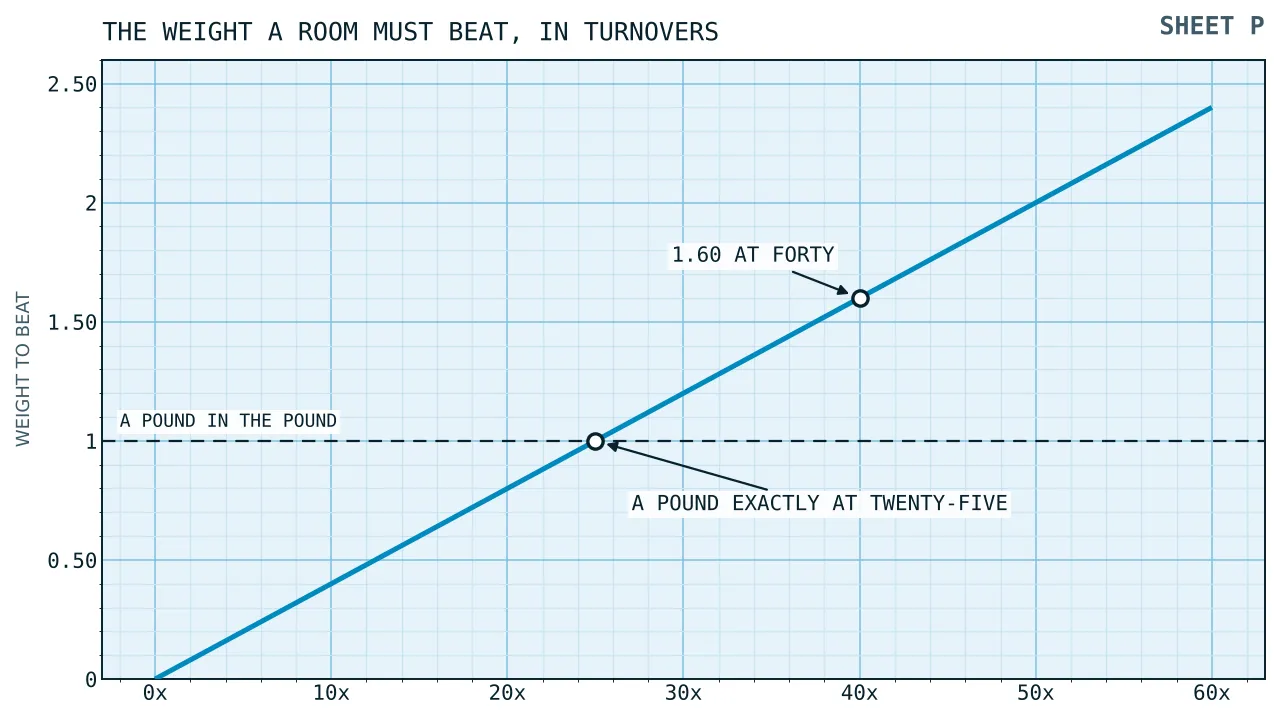
Survival has one condition and it is an inequality. A penny of the credit comes through only where the weight stands above the multiple divided by twenty-five.
g > W / 25, at 96 pence in the pound
At ten turnovers the weight has to beat 0.40, which a reel does comfortably. At twenty-five turnovers it has to beat 1.00, which is a pound exactly. Above twenty-five turnovers it has to beat a pound, and a pound holds a hundred pence, so no room anywhere clears the condition. Which fixes the ceiling on the whole of this part of the tree at twenty-five, with or without a regulator.
| The condition in turnovers | Weight the room has to beat | Whether a pound reaches it |
|---|---|---|
| Ten turnovers | 0.40 | Yes, with sixty pence to spare |
| Twenty turnovers | 0.80 | Yes, with twenty pence to spare |
| Twenty-five turnovers | 1.00 | Only exactly, and exactly leaves nought |
| Thirty turnovers | 1.20 | No |
| Forty turnovers | 1.60 | No, and short by sixty pence |
| Sixty turnovers | 2.40 | No, and short by a pound and forty |
4
A list is not its own average
A credit confined to a list of games is not a credit at one weight. Spread the obligation evenly over the list, taking an equal share of it off each game, and the list behaves like the reciprocal of the mean of the reciprocals.
Take four games counting at a pound, at fifty pence, at twenty-five pence and at twenty pence in the pound. Their ordinary average is 0.4875, and nobody staking across the set ever meets that figure. The reciprocals are one, two, four and five. They total twelve over four games, so the set behaves like 0.3333.
| The game’s rate | Its share of the obligation | Staking that share needs |
|---|---|---|
| A pound in the pound | £180.00 | £180.00 |
| Fifty pence in the pound | £180.00 | £360.00 |
| Twenty-five pence in the pound | £180.00 | £720.00 |
| Twenty pence in the pound | £180.00 | £900.00 |
| The list in total | £720.00 | £2,160.00 |
| What the ordinary average predicts | £720.00 | £1,476.92 |
On £720.00 of contribution the ordinary average predicts £1,476.92 of staking and the set actually wants £2,160.00. Six hundred and eighty-three pounds and eight pence is the price of taking the mean of a divisor, which is a thing nobody should do.
0.4875 on the average, 0.3333 in the arithmetic
5
Five hours, and the clock behind them
A room keeps a clock, and under a British licence the clock is written into the game rather than into the terms. A reel carries a floor of 2.5 seconds, counted from when a cycle begins until another may be set going. Casino games that are not reels, peer-to-peer poker excepted, are held to five seconds, a figure the regulator’s own update list dates to 17 January 2025.
Automation is out, because a customer has to commit separately to each cycle, and the one exception written into the guidance concerns blinds posted for a player in poker against other players. Nor may a customer bring the result forward, which disposes of slam stop, of quick spin and of turbo together.
Seven thousand two hundred presses is what £720.00 comes to at ten pence each, and at 2.5 seconds apiece that is 18,000 seconds, or five hours to the minute. Put the identical obligation on a dealt table at five seconds a cycle and the floor doubles to ten hours.
The ceiling on a stake runs the other way, because it is a reel rule and nothing else. Two pounds and five pounds are limits on a reel cycle, so a dealt table has a clock over it and no ceiling at all, and a clock without a ceiling does not bound the money.
7,200 presses, 18,000 seconds, five hours on £18.00
6
Sixteen rooms, one question each
Sixteen rooms, sorted by what each one does to the divisor rather than by what it is called.
Where the room is the whole building
What a casino licence actually installs in a building, priced on a credit, is at online casino uk. How one room sorts above another once a credit is involved, and on which figure, is at best gambling sites. Which readings in a room’s first week carry a date, and which carry none, is at new casino sites. What a pocket-sized screen moves, and what it does not move at all, is at mobile casinos.
Where nobody publishes the return
The return a dealt table would have to pay for a credit to survive, where no table publishes one, is at live casino uk. Ticket money with nothing paid in behind it, billed on a borrowed reel figure, is at bingo no deposit bonus. What a ticket room owes a reader before the first call, and which word in the rule does the work, is at online bingo. Two offers that share a name, one of them holding a credit and one holding none, are at free slots no deposit.
Where a list decides the weight
What a list of twenty eligible games behaves like, as against what it averages, is at top 20 slots uk. What a list of ten is worth once its slowest members are weighted by how slow they are, is at top 10 best online slots. A credit confined to one studio’s library, and how many pence a pound would need to contain, is at pragmatic slots. What a release with no history behind it owes a reader on its first day is at new online slots.
The reel room, counted in presses and in units
The one room where a staked pound normally counts as a whole pound, priced per second, is at online slots uk. A condition counted out in presses of a thumb and in bursts of five minutes is at mobile slots. One game family, a return left blank, and a closing line that crosses the rule, are at big bass slots. A room keeping its books in a coin, where the fraction kept does not change, is at bitcoin slots.
7
The figure a room need never print
The second of the room’s two numbers is the one a licensee may lawfully never print. Something has to be easy to reach before any commitment, and the standard describes it as whatever would let a customer judge the chances sensibly, then names four candidates.
A conjunction decides the whole of this. The four candidates are alternatives, so any one of them discharges the duty: an account of the mechanics together with the way winners and prizes get settled, or the house edge, or how likely a winning event is, or the return to player percentage.
A room satisfying that standard with a house edge has published nothing a reader can put into the inequality in part 3. Where players face each other, the guidance says the mechanics on their own will serve. Where tickets and certain lotteries are concerned, it says an account of how the prizes get shared out will serve. Which is why this sheet substitutes 96 pence in the pound and says so every time rather than pretending the figure was read off a page.
Three further requirements sit beside it. Rules have to be available before any commitment, accurate, and sufficient to cover the whole of them. Mid-game, the display has to carry whatever a customer needs in order to know where the game currently stands, and lotteries are outside that requirement. The prizes themselves, or the calculation behind them, also have to be within reach before anybody commits.
8
One product, and ten turnovers
Two rules came into force on the same day and both of them bear on a room. That day is the nineteenth of January 2026. From that date, ten turnovers of bonus funds is as far as a condition may go, and an incentive may hold only a single product type.
The four types the rule names are betting, casino, bingo and lottery. So a match with free reel spins attached stays inside one type, because reels are a casino product, while a match with tickets attached crosses two.
Three carve-outs cut the other way from a reader’s expectation. Two products from inside a single type are fine, a raffle sitting beside a lottery scratchcard being the regulator’s illustration. Two offers may share an email, one for betting and one for casino, where the customer’s marketing consent covers both products. A credit left to the customer to spend wherever they choose falls outside the ban entirely, and the regulator’s figure for that is ten pounds across betting and casino.
The stated aim is narrow: it is the mixing that happens within one incentive, where one set of terms is shared between the products.
9
Twelve tolerances, and four readings
Twelve tolerances, and what each of them is worth on £18.00 of credit. Every line in the left column is set by a British licence and by nothing else.
| Part of the room | What a British licence sets | What £18.00 of credit meets without one |
|---|---|---|
| The interval between reel cycles | 2.5 seconds at the very least | 7,200 presses with no floor beneath the five hours |
| The interval on other casino games | Five seconds, peer-to-peer poker excepted | A dealt cycle as quick as the software can manage |
| The stake over one reel cycle | £5.00, dropping to £2.00 where the player has not turned twenty-five | A credit of £18.00 could be one cycle |
| Who commits to a cycle | The customer, separately, every single time | Automation, and the five hours gone with it |
| The time to a result | Not shortenable at the customer’s end | Turbo, quick spin and slam stop all available |
| A return at or below the stake | No winning sound and no winning picture | Ten pence back on a ten pence press dressed as a win |
| A losing outcome | Not to be swapped for a near miss | A loss built to read as an almost |
| The generator | Acceptably random, with a compensated game refused | Probabilities nobody has undertaken to leave alone |
| Two games at once | Functionality for simultaneous play refused | £720.00 of contribution run across two screens |
| The rules mid-play | Payouts and probabilities held still, with any change put to the customer | A term saying the game rules may change at any time |
| Before the first commitment | The mechanics, plus any single item from a list of four about the chances | Two sentences, both of them about bonuses |
| The multiple and the products inside it | Ten turnovers, and one product type only | Forty turnovers, so £10.80 is owed rather than kept |
The island policy’s mandatory list has eight headings and not one of those twelve lines is among them. It wants an age verified, information kept reachable, a self-assessment available, behaviour tracked, deposit limits offered, self-exclusion and a cooling-off period both left for the player to trigger, training given to staff and to marketing partners, and marketing held to general principles. Bonuses get two sentences in it. One asks for transparent communication of the terms. The other asks that promotion stop short of driving play to excess.
Four readings price any room, and three of them are available before a credit is claimed. Read the weight the games carry, the return the room publishes if it publishes one, the interval between cycles, and the ceiling over a single stake. Divide the multiple by twenty-five and the answer is the weight the room has to beat. Where the second reading is missing the inequality has to be run across a band, and the band this sheet runs is centred on 96 pence in the pound.
Six other sections cut the tree a different way. The multiple takes offers whose outcome rests on the play-through and nothing beside it, and Nothing asked back takes the ones carrying no play-through at all. Matched money prices a credit per pound of the reader’s own, and The floor asks what a cashier’s smallest acceptable sum buys. The rail charges for the journey before any of this starts, and Off the register sets out what a licence is worth, duty by duty. How a receipt is struck carries the working behind each total, and the front page is The Spin Sheet.
Questions
- Which two numbers belong to the room?
- The share of a staked pound the condition will accept, and the proportion the games give back across the long run. Neither is ever the headline. The terms name the credit and name the multiple, both settled before a reader chooses anything. Contribution owed is the multiple times the credit; staking owed is that figure divided by the weight. So £18.00 at forty turnovers owes £720.00 of contribution whatever room it is spent in, and the staking behind that £720.00 runs from £720.00 to £7,200.00 depending on nothing but the divisor.
- Why is a small weight the same thing as a large multiple?
- Because the weight sits underneath the multiple in the line that prices a credit, so halving the one and doubling the other produce the identical bill. Count a pound as fifty pence and £720.00 of contribution wants £1,440.00 through the games, which is what eighty turnovers at a whole pound would have wanted. A reader comparing two offers on the multiple alone is reading a numerator and ignoring a denominator, and the denominator is the half nobody prints in large type.
- What weight does a room have to clear?
- Whatever the multiple comes to once twenty-five has been divided into it, at a return of 96 pence in the pound. At ten turnovers that is 0.40, which a reel clears comfortably. At twenty-five turnovers it is 1.00, which is a pound exactly, and exactly leaves nought. Above twenty-five turnovers the demand is for more than a pound holds, so no room anywhere clears it. That fixes the ceiling on this whole part of the tree at twenty-five turnovers, with or without a regulator in the picture.
- Why does nothing survive forty turnovers?
- Because forty turnovers want a weight of 1.60 and a pound holds a hundred pence. Put in money: £18.00 of credit at forty turnovers owes £720.00 of contribution, a room returning 96 pence keeps four, so the expected cost is £28.80 against £18.00 credited and the foot reads £10.80 short. At ten turnovers the same credit owes £180.00, costs £7.20, and brings £10.80 through. The identical figure is what ten turnovers keep and what forty turnovers owe, and the distance between the two is one licence.
- Is a list of games worth its average?
- No, and the gap is large enough to change a decision. Spread the obligation evenly over a list, taking an equal share of it off each game, and the list behaves like the reciprocal of the mean of the reciprocals. Four games counting at a pound, fifty pence, twenty-five pence and twenty pence average 0.4875 and behave like 0.3333, because the reciprocals are one, two, four and five. On £720.00 of contribution the average predicts £1,476.92 of staking while the set wants £2,160.00. The difference is £683.08.
- How long does a condition take in a licensed room?
- Long enough that the hours are part of the price. A reel carries a floor of 2.5 seconds, counted from when a cycle begins until another may be set going, and a customer has to commit separately to every cycle, so automation is out. Nor may a customer bring the result forward. Seven thousand two hundred presses is what £720.00 comes to at ten pence each, and at 2.5 seconds apiece that is 18,000 seconds, or five hours to the minute. On a dealt table at five seconds a cycle the floor doubles.
- Can a licensed room decline to publish what it pays back?
- It can, and a conjunction is the reason. Something has to be easy to reach before any commitment, described as whatever would let a customer judge the chances sensibly, and the standard then names four candidates as alternatives. Any one of them discharges the duty: the mechanics with the way winners and prizes get settled, or the house edge, or how likely a winning event is, or the return to player percentage. A room satisfying it with a house edge has published nothing a reader can put into the inequality, which is why this sheet substitutes 96 pence in the pound and says so.
- What does a room without a British licence leave unset?
- Twelve tolerances, and the arithmetic needs two of them. The interval between cycles, the ceiling over a stake, who commits to each cycle, whether a result can be hurried, whether a sub-stake return may be celebrated, whether a loss may be dressed as a near miss, whether the generator may compensate, whether two games may run at once, whether the rules may move mid-play, what has to be legible beforehand, the multiple, and how many product types one incentive may hold. The island policy’s mandatory list has eight headings and not one of those twelve lines is among them.