
Sheet O02 Revision 1 Checked 15 October 2026
Non gamstop casinos no deposit bonus
Fifty spins at a tenth of a pound is £5.00 of face stake and £4.80 of average winnings. A ceiling of ten would leave £2.88 of that standing. At forty times it leaves nothing, and the last £72.00 of the condition has to be staked out of the reader’s own pocket, because on a no deposit round there is no deposit to take it from.
£2.88 kept at ten times, and £72.00 of staking owed by the reader at forty
What a nothing-down round leaves at the foot
Every destination on this spike is bought advertising. The site takes a fee if a reader goes on to register, and no figure printed below moves because of it.
The Spin Sheet
Till receipt No 01
Betportal
Lowest multiple here
For every €1 of spin credit at face per €1
Credit
Debit
No Great Britain licence
Licensed in Anjouan, Comoros, run by BetPortal Gaming Ltd, with Excite Ultra Media Ltd, reference ALSI-202601040-FI2.
Terms read 15 October 2026
Open the offer at Betportal, opens in a new tabThe Spin Sheet
Till receipt No 02
WinBeast
Five staged matches
For every €1 of spin credit at face per €1
Credit
Debit
No Great Britain licence
Licensed in Curaçao, operator not named on the site.
Terms read 15 October 2026
Open the offer at WinBeast, opens in a new tabThe Spin Sheet
Till receipt No 03
EliteSpin
Longest spin window
For every £1 of spin credit at face per £1
Credit
Debit
No Great Britain licence
Licensed in Costa Rica, run by PrimeTier Limited.
Terms read 15 October 2026
Open the offer at EliteSpin, opens in a new tabThe Spin Sheet
Till receipt No 04
Crown Jewelz
Multiple unpublished
No total struck
Credit
Debit
No Great Britain licence
Licensed in Curaçao, number not verified, operator not named on the site.
Terms read 15 October 2026
Open the offer at Crown Jewelz, opens in a new tabThe figure at the foot of a receipt is this site's own arithmetic and nothing an operator has published: the credit, less the share a spin gives back at 96 per cent return to player, less what playing the wagering through costs at the same return. It describes the offer, not one reader's afternoon. Where the conditions price above the credit the receipt prints nothing rather than a negative sum, and where a figure the sum needs is unpublished it prints the condition in the operator's words instead.
Three words stand in the amount column where no figure can. Noted is a published condition that takes value away without leaving the sum a figure to take. Unpriced is a condition whose figure nobody has published, or a credit that is not a sum until a deposit of your own sets it. Own money is money of yours, which is never part of a total.
Not one of the operators printed above holds a Great Britain licence, so the duties that licence carries do not reach them. Every online gambling company licensed in Great Britain has to be part of Gamstop Online, and a reader who has shut themselves out through the scheme is therefore not shut out here. The ceiling of ten times the bonus funds on a wagering requirement, in force since 19 January 2026, is a condition of that licence and binds the companies that hold one. Where a dispute goes instead is a matter for the authority named on the receipt, and the Gambling Commission describes what a reader faces without a British licence as a lack of recourse if things go wrong. Nobody under 18 may hold an account at any of them.
Every term printed on a receipt is the operator's own, and each receipt carries the day it was read. The oldest of those readings is 15 October 2026. What binds a reader is the operator's own full terms, and not a line printed here.
1
Five pounds of face, £4.80 of average
A no deposit round is the smallest thing this site prices, and it is the only thing here whose face value a reader never pays. Fifty cycles at a tenth of a pound sends £5.00 of stake across the reels, paid for by the cashier throughout. A 96 per cent slot returns an average £4.80 out of that, the twenty pence gap being the toll on one pass.
So £4.80 is the credit this page works on, not five pounds. The spins are the whole gift, no money of the reader’s sits behind them, and the second of those facts decides this page.
Something has to be said ahead of the arithmetic, and it is an absence in the record rather than a quantity. No primary source fixes what a free spin is worth. Nothing states a minimum, nothing states a maximum, and no rule says who sets it. The number of pence behind a spin is a commercial choice, which is why a tenth of a pound here is this sheet’s stated assumption and not a standard.
What surrounds the round is the subject. Behind a no deposit offer of this description sits a business with no Great Britain licence, and that licence amounts to a list of duties carrying figures and dates rather than a seal. Part 8 runs the list in the conditional, duty by duty, as what would have applied. Parts 2 and 3 cost the largest absence first.
Fixed here, with the reason beside each:
- Fifty spins, each at a tenth of a pound, giving £5.00 of face stake.
- A 96 per cent slot, so the round averages £4.80 of winnings and B reads £4.80 rather than five pounds.
- Forty times for the play-through, which is the order of condition that gets written where no British register governs, and ten times beside it as the licensed maximum.
- Weighting at one, slots counting in full against a condition.
- No deposit anywhere in the arrangement, which is the point of the key and the reason part 3 exists.
2
Two pounds eighty-eight, then nothing
One expression carries the whole of it, and the only quantity in dispute is W.
E = B × (1 – (W × (1 – RTP)) / g)
Spins are the whole of what was given, so B is their average winnings of £4.80, with RTP at 0.96 and weighting at one.
At ten, which no British licensee may exceed, the condition wants £48.00 of turnover. The toll on that turnover is £1.92, so £2.88 of the credit should come through.
At twenty-five the arithmetic reaches nought exactly: £120.00 of turnover costs £4.80 in expectation, which is the credit to the penny.
At forty, the figure written out here, the condition wants £192.00 of turnover at an expected cost of £7.68. Which exceeds the credit by £2.88, so the credit dies and the round prices at nought.
| Multiple in words | Turnover wanted | Expected cost | Comes through | Owed past the credit |
|---|---|---|---|---|
| Nothing asked back | £0.00 | £0.00 | £4.80 | none |
| Ten times, the licensed outer figure | £48.00 | £1.92 of edge | £2.88 | none |
| Twenty-five times, where it touches nought | £120.00 | £4.80 of edge | £0.00 | none |
| Forty times, modelled here | £192.00 | £7.68 of edge | £0.00 | £2.88 |
| Sixty times, a level the regulator has seen | £288.00 | £11.52 of edge | £0.00 | £6.72 |
The ten in the second row has a date. From the nineteenth of January 2026 a licensee may not require bonus funds to travel further than ten times over before withdrawal is possible, and the provision speaks of bonus funds in exactly those words. Is a spin credit itself bonus funds for that purpose? No source this site may cite settles it, so neither does this sheet. Where a spin’s winnings land as bonus funds, ten times over is as far as they may be sent.
The bottom row is the regulator’s own observation. Setting out the case for a ceiling it recorded multiples as high as sixty times in use at some licensees, and no other market multiple in this site’s material comes from the regulator rather than from an assumption.
Twenty-five times is where £4.80 of credit reaches exactly £0.00
3
Seventy-two pounds of the condition is yours
Here is what makes a no deposit round different from every matched offer on this site, and it is arithmetic rather than opinion.
On a matched offer the overrun falls on the deposit. The credit runs out part way through the condition, and the expected cost beyond that point is met by the player’s own money sitting in the same balance. There is nothing of the sort behind a round of free spins, so the question becomes who stakes the rest of the turnover.
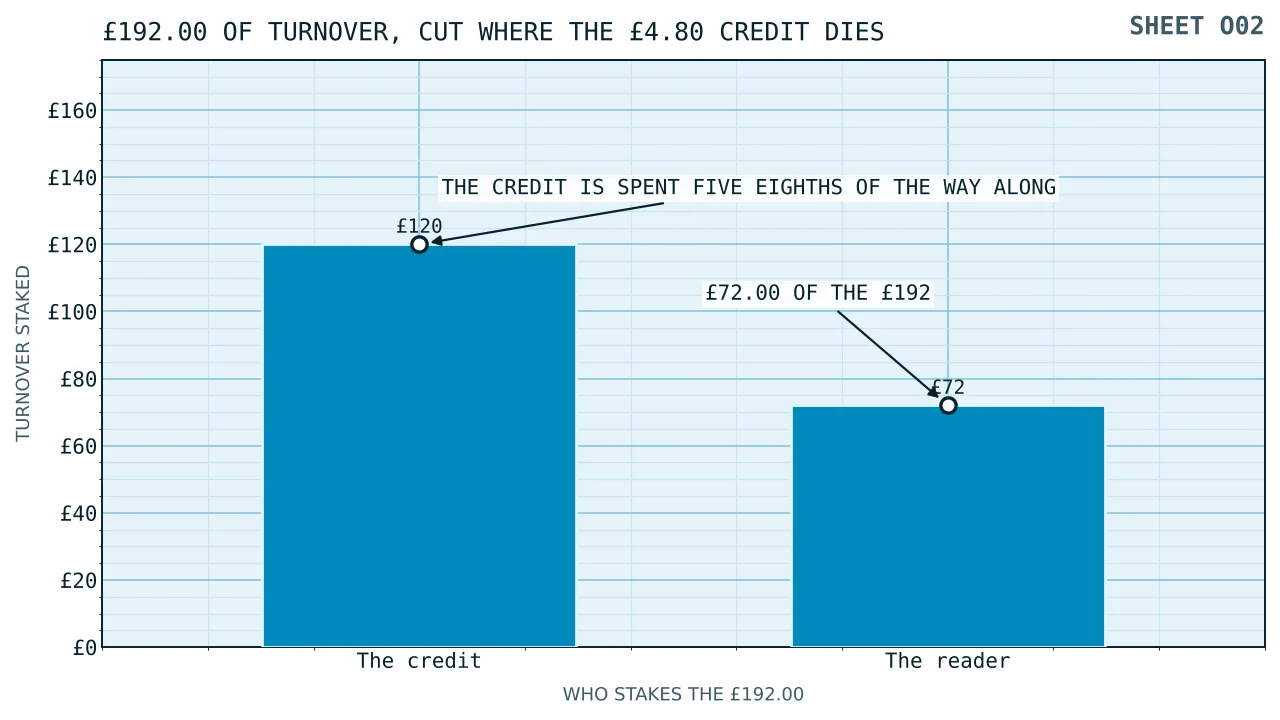
Trace it. The condition asks £192.00 through the games. Expected cost accrues at four pence in the pound, so the £4.80 of credit is exhausted after £120.00 of staking, which is five-eighths of the way along. The remaining £72.00 of turnover cannot come from a credit that no longer exists. It comes from the reader, at an expected cost of £2.88, and only then does anything become withdrawable.
Which is the honest statement of what a no deposit offer at forty times is. It is not a free five pounds. It is a conditional five pounds whose condition, taken to its end, requires seventy-two pounds of the reader’s own staking after the credit has died. A reader who stops when the credit dies keeps nothing and has staked nothing of their own, which is the better of the two outcomes.
| Stage of the condition | Turnover | Share of the whole | Staked out of |
|---|---|---|---|
| Up to the point the credit dies | £120.00 | 62.5 per cent | The credit, which is used up by it |
| After the credit has died | £72.00 | 37.5 per cent | The reader, at £2.88 of expected cost |
| The whole condition | £192.00 | 100 per cent | Both, in those proportions |
Under a ceiling of ten none of that arises. Forty-eight pounds of turnover costs £1.92 against a credit of £4.80, so the credit survives the whole condition with £2.88 to spare and the reader stakes nothing of their own at any point. The licence is the difference between a round that can be completed on the house and a round that cannot.
4
Four spin counts, priced through
Spin counts in this corner run from a handful to several hundred, and the arithmetic scales exactly, because every quantity in it is proportional to the count.
| The round | Face stake | Average winnings | Kept at ten times | Reader’s staking at forty times |
|---|---|---|---|---|
| Twenty spins | £2.00 | £1.92 of edge | £1.15 | £28.80 |
| Fifty spins | £5.00 | £4.80 | £2.88 | £72.00 |
| One hundred spins | £10.00 | £9.60 | £5.76 | £144.00 |
| Two hundred spins | £20.00 | £19.20 | £11.52 | £288.00 |
The last column is the one a bigger count does not improve. Doubling the spins doubles what a ceiling of ten would have preserved, and it also doubles the staking a reader must put up out of their own money once the credit has died at forty times. Two hundred spins is a larger gift and a larger obligation in the identical proportion.
5
What a headline is allowed to omit
Everything above turns on three terms: the count, the spin value and the multiple. On the British side of the register, all three are things an advertisement has to put where a reader will meet them.
Rule 8.17 of the advertising code wants every applicable significant condition put across clearly and prominently in promotional material, wherever an omission is the sort of thing that misleads. Four sorts of condition count as significant in a gambling promotion, and every one of them is a line on the offer this page is about.
- Who may take it up. New customers only, an age restriction, a restriction by location.
- What has to be deposited or wagered. Which on a no deposit round is the multiple, and at forty times it is £192.00 of turnover.
- How long there is to claim the offer and to use it.
- Minimum odds or bet types, which a slots round does not engage.
The gambling regulator puts the same point with a sharper consequence attached. Conditions of that weight belong within the advertisement and beside its headline figure, wherever a reader arrives and wherever a reader registers; where prominence fails, the advertisement counts as misleading. Its own advice to a player is to look for exactly what a headline hides, naming any restriction on an introductory offer, such as a level of spend required before a bonus is paid.
Three published adjudications show what the standard means in practice, and none of them concerns a spin value. A £10 free bet conditional on answering a text message before a stated hour was adjudicated on 17 July 2024, the missing deadline treated as a significant condition likely to mislead. An excluded payment method tucked into the small print of the full terms was held insufficiently prominent on 31 July 2024. And a five pound voucher that was not valid on one named day of the racing calendar, with the advertisement silent about it, was found on 27 August 2025 to have breached the code.
A proportionality rule sits alongside. A reward is to be proportionate to what a player has actually spent in money and in time, offers may not grow faster as spending grows, and repetitive or frequent participation must not be encouraged. The regulator’s single example of something that may pass comes hedged: a one-off reward, given once fifty pounds has been wagered, and acceptable only where a free bet at that level of spend is not unusual for the type of gambling concerned.
None of which reaches a cashier outside the British register. Away from it rule 8.17 falls away, so do the four sorts of significant condition, so does the prominence test, and so does the code provision wanting an incentive’s terms clear, transparent, fair and within easy reach. What stands in their place, where the Caribbean licence is named, is one sentence asking for bonus terms to be communicated transparently with clear conditions, and a second asking that promotion not encourage excessive gambling. The word significant does not appear. Neither does prominence.
6
Nothing down means no deposit balance
The British rule a reader most often hears about withdrawals turns out to be the one rule a no deposit round cannot use, and the reason is worth stating precisely.
That rule is about the deposit balance. A licensee is barred from imposing a term, from using one, from enforcing one and from relying on one, wherever its object or its effect is a ceiling over what a consumer draws from that balance. Fifty pounds within any one day, five hundred within any one week: that is the clause the regulator prints as the sort which may not be used. Money in that balance, winnings and all, is the player’s to take whenever they want it, and whatever limit is put on how big or how many the withdrawals are must be reasonable.
On a no deposit round there is no deposit balance. Nothing was paid in, so the rule has nothing to attach to, and what the round produces instead is winnings off a bonus. Two consequences follow, and both are sourced by what is not published rather than by what is.
- Nothing published turns bonus winnings into bonus funds, and nothing published fixes a standard maximum win over a bonus. This sheet therefore states neither as a figure.
- A win cap over a bonus and an unfettered right over a deposit balance are able to coexist, since the two bite on different money. A reader looking at a win cap should check which of the two the term is about.
Away from the register neither half applies. The regulator has described what it finds there instead: payouts stopped outright, and withdrawal limits set so high that reaching them is impossible. On a round of this size that second device is decisive and needs no refusal in words. Average winnings of £4.80 cannot clear a payout floor of £20.00 without the balance quadrupling first, and a floor of £50.00 wants it to grow more than tenfold. It sets down grave worries about data protection as well, identity theft and fraud among the named risks, with nothing to fall back on once matters have gone wrong.
£4.80 of average winnings against a £50.00 floor needs a tenfold win
The duty on the money, incidentally, does not follow the licence. An operator putting remote gambling in front of a person whose usual home is here owes British gaming duty from wherever it sits, Remote Gaming Duty taking 40 per cent of its profits for accounting periods from 1 April 2026 onwards. So a cashier with no licence can be inside the scope of a British tax and outside every duty in part 8. As to the player, the revenue’s manual has it that betting and gambling are not in themselves a trade, so winnings do not amount to trade income. Nothing here is tax advice.
7
The scheme, and what fixes its edge
Readers reach a key of this shape by several routes, and one of them is a live self-exclusion. Styled Gamstop, and Gamstop Online in full since a refreshed identity in November 2025, the scheme blocks the accounts a registered person holds at gambling websites and apps, and charges nothing for it.
The edge of that block is set by a rule about licences, not by anything the scheme chooses. A Great Britain licence brings compulsory membership of Gamstop Online with it, so the register reaches exactly as far as the licence reaches and no further.
Its terms carry the sentence that matters most to anybody reading this, and it is a sentence against its own reach: help with exclusion runs to participating operators and no further. That is a limit on what a registered person is protected from. It is not a suggestion, and nothing on this sheet will help anybody act on it.
The British regulator has described what tends to be true of a website with no licence. Controls against money laundering and controls for social responsibility may both be inadequate. The exposures it names are data privacy difficulties, unfair practices and fraud. Its notice of 20 January 2025 records such websites frequently singling out vulnerable customers, among whom it names the self-excluded. Anybody who found this page because an exclusion is holding is inside the group being described.
Two further points keep the account straight. Gambling facilities provided without an operating licence offend against the 2005 Act, and section 33 is drafted about the provider from beginning to end. No matching offence of taking part as a customer appears anywhere in the Act, so protection rather than liberty is what a reader surrenders at a place like that. The regulator is also open about how far its reach goes. On the revenue at stake, it has written that full dismantling of the ecosystem is unlikely ever to happen. On effect, it reports traffic down 32 per cent across a hundred and sixty websites picked out for enforcement action.
8
Twelve duties in the conditional
Each line below would have governed this round had it been offered under a British licence. None of them governs it as things stand, and none of them appears in the Caribbean policy this sheet read. The right column gives what each would have been worth on fifty spins at a tenth of a pound.
| What a licence would have required | What it would have been worth on this round |
|---|---|
| The multiple would have stopped at ten | £2.88 of expectation instead of nothing, and £144.00 of turnover never owed |
| A cycle would have been capped at £5.00, and at £2.00 for anybody under twenty-five | A 10p cycle sits far below either figure, so this is the one duty the round does not need |
| Cycles would have been 2.5 seconds apart at least | Fifty of them could not be got through inside 125 seconds |
| Nothing would have run automatically or at speed | Fifty separate commitments, with no autoplay, no turbo and no slam stop |
| A return no bigger than the stake would not have been dressed up | 10p coming back on a 10p cycle gets displayed and no more |
| Near misses would not have been manufactured | No losing outcome standing in for another losing outcome |
| Two games could not have run at once | One reel set at a time, by design rather than by choice |
| Identity would have been settled first | Before the first free spin, since the rule reaches bonus play and prize-free play |
| A financial limit would have been the default | A ceiling of the reader’s own, reducible at once and raisable only after a day |
| One product type to an incentive | A spins round could not have shared its terms with bingo tickets |
| Significant conditions would have been prominent | The multiple, the window and the eligibility printed beside the headline |
| A grievance would have ended at an approved body | Eight weeks to answer it, six months to raise it, independence after that |
That Caribbean policy is not empty, and saying so is part of measuring rather than arguing. Self-exclusion is required there. Cooling-off there has to be one click away at twenty-four hours, at seven days, at a month and at three months, with no email and no approval wanted, effective the moment it is taken, and an operator may neither question the choice nor dangle a bonus to put it off. A deposit limit comes down at once there, while going up takes seven days, six more than Great Britain demands as a minimum. Affiliates, too, are reached head on there: by contract that binds, by audit for compliance, and by penalty where compliance fails, none of which the British regulator’s advertising pages attempt. What is missing is every figure in the schedule above.
9
If a registration is why this came up
Part of the traffic to a key like this one is people with a live registration who have found that it holds. The part that follows is for them, it outweighs everything above it, and there is nothing in it that helps anybody get past anything.
The figures make the case on their own. Fifty spins at a tenth of a pound are worth £2.88 in expectation under a ceiling of ten and £0.00 at forty times. Two hundred spins are worth £11.52 and £0.00. At forty times the condition also wants £72.00 of the reader’s own staking on a fifty spin round and £288.00 on a round of two hundred, all of it after the credit has died. Nothing in that range of outcomes is worth a defeated registration, and the money would be at a cashier where no ceiling binds a multiple, no payout is owed on request, and no approved independent body can be reached.
Three published things cost nothing and do work:
- The helpline. One telephone number, free, never closed: 0808 8020 133, which is GamCare’s National Gambling Helpline, taking calls about the caller or about a friend or a relative. Live chat and WhatsApp work as well as the telephone, and the international form is +44 8088 020 133.
- The blocker. Gamban is a blocker, layered across gambling sites and apps in the tens of thousands, licensed once for every major device platform, and its download routes are named as Google Play and the Apple App Store. Its own site publishes a seven-day trial and no British free route, so the free British route is not the software company’s.
- The three together. TalkBanStop ties the three: GamCare for Talk, Gamban for Ban, the national scheme for Stop. Gamban is free, GamCare publishes, for anyone who calls the helpline or takes up its support and treatment. What publishes that is a news item dated 12 April 2021, silent on how long the free access lasts, so no length is stated here.
On a registration already in place, two things from the scheme’s own terms, last updated 20 May 2026. Sign-up offers four terms: six months, a year, five years, and five years renewing automatically, with that renewal able to be switched off only during a five-year term’s closing six months. And an exclusion does not lapse by itself: where nothing is done at the end of a period it carries on for as long as a further seven years. The site’s page about keeping control is Staying in control.
Nearby sheets. The same absences priced on a deposit, with a schedule of sixteen questions a licence answers, are at best non gamstop casinos. Why an identity check exists, and what postponing it to the exit costs, is set out at no kyc casinos. The regulators themselves, one at a time, are at non uk casinos. A stake large enough to break the house assumption is handled at high roller online casinos, and what independence does to an exclusion is at independent casinos not on gamstop. Off the register indexes this part of the tree. The working behind each total is set out by How a receipt is struck, which is the method sheet for the whole site.
Questions
- What does a fifty spin round with nothing down come to?
- Five pounds of face stake and £4.80 of average winnings, where each spin is a tenth of a pound and the slot returns 96 per cent. The credit this page works on is therefore £4.80 rather than five pounds. No primary source fixes what a free spin is worth, so the tenth of a pound used here is a stated assumption and not a standard. Behind an offer of this description sits a business with no Great Britain licence, and that licence amounts to a list of duties carrying figures and dates rather than a seal.
- How much does the absent ceiling cost on a no deposit round?
- Two pounds eighty-eight. At ten times, which no British licensee may exceed, the condition wants £48.00 of turnover; the toll on that is £1.92, so £2.88 of the £4.80 credit should come through. At forty times it wants £192.00 of turnover at an expected cost of £7.68, which exceeds the credit by £2.88, so the credit dies and the round prices at nought. At twenty-five times the arithmetic lands on exactly £0.00.
- Why does having no deposit make the overrun worse?
- Because there is nothing behind the credit to absorb it. On a matched offer the expected cost beyond the credit is met by the player’s own money in the same balance. Here the condition asks £192.00 through the games, the £4.80 credit is exhausted after £120.00 of staking, five-eighths of the way through, and the remaining £72.00 of turnover has to be staked by the reader at an expected cost of £2.88 before anything becomes withdrawable. A reader who stops when the credit dies keeps nothing and has staked nothing of their own, which is the better of the two outcomes.
- Does a bigger spin count improve the arithmetic?
- It scales it in both directions, because every quantity is proportional to the count. Twenty spins give £1.92 of average winnings, keep £1.15 at a ceiling of ten, and ask £28.80 of the reader’s own staking at forty times. Fifty spins give £4.80, keep £2.88 and ask £72.00. One hundred give £9.60, keep £5.76 and ask £144.00. Two hundred give £19.20, keep £11.52 and ask £288.00. A larger round is a larger gift and a larger obligation in the identical proportion.
- What is a headline allowed to leave out away from the register?
- Everything the British advertising rules make it print. Rule 8.17 wants every applicable significant condition put across clearly and prominently in promotional material, wherever an omission is the sort of thing that misleads. Four sorts count as significant in a gambling promotion: who may take it up, how long there is to claim it and to use it, what has to be deposited or wagered, and any minimum odds or bet types. On this round the third of those is £192.00 of turnover. The gambling regulator adds that where prominence fails the advertisement counts as misleading. Away from the register none of it applies.
- Why is the withdrawal rule no help on a no deposit round?
- Because the British rule is about a deposit balance and there is not one. A licensee is barred from imposing, using, enforcing or relying on a term wherever its object or its effect is a ceiling over what a consumer draws from that balance, and fifty pounds within any one day with five hundred within any one week is the clause the regulator prints as forbidden. Nothing was paid in here, so the rule has nothing to attach to, and what the round produces is winnings off a bonus. Nothing published turns bonus winnings into bonus funds or fixes a standard maximum win, so this sheet states neither as a figure.
- Can a cashier simply refuse to pay out £4.80 of winnings?
- Nothing in the British prohibition reaches it, and the regulator has described what it finds instead: payouts stopped outright, and withdrawal limits set so high that reaching them is impossible. On a round of this size the second device is decisive and needs no refusal in words. Average winnings of £4.80 cannot clear a payout floor of £20.00 without the balance quadrupling first, and a floor of £50.00 wants it to grow more than tenfold. It sets down grave worries about data protection as well, identity theft and fraud among the named risks, with nothing to fall back on once matters have gone wrong.
- Why does the national scheme not cover these sites?
- Because its edge is set by a rule about licences rather than by anything the scheme chooses. A Great Britain licence brings compulsory membership of Gamstop Online with it, so the register reaches exactly as far as the licence reaches and no further. Its terms carry the sentence that matters most here, and it is a sentence against its own reach: help with exclusion runs to participating operators and no further. Its notice of 20 January 2025 records such websites frequently singling out vulnerable customers, among whom it names the self-excluded.
- Which duties would have applied under a British licence?
- Twelve of them bear on a round like this. The multiple would have stopped at ten, worth £2.88 with £144.00 of turnover never owed. Cycles would have sat 2.5 seconds apart at the very least, so fifty of them could not be got through inside 125 seconds. Nothing would have run automatically or at speed. A return no bigger than the stake would not have been dressed up, and near misses would not have been manufactured. Identity would have been settled before the first free spin, because the rule reaches bonus play and prize-free play. A financial limit would have been the default. Significant conditions would have been printed beside the headline. And a grievance would have ended at a body the regulator approved.
- What should I use if a live registration is why I am here?
- Three published things that cost nothing. One telephone number, free, never closed: 0808 8020 133, which is GamCare’s National Gambling Helpline, taking calls about the caller or about a friend or a relative. Gamban is a blocker, layered across gambling sites and apps in the tens of thousands, licensed once for every major device platform. TalkBanStop ties the three: GamCare for Talk, Gamban for Ban, the national scheme for Stop. Gamban is free, GamCare publishes, for anyone who calls the helpline or takes up its support and treatment. What publishes that is a news item dated 12 April 2021, silent on how long the free access lasts, so no length is stated here.