
Sheet O04 Revision 1 Checked 15 October 2026
Non uk casinos
A headline of 120 per cent on £30.00 credits £36.00. Ten times leaves £21.60 of it expected; forty times leaves nothing and runs £21.60 past the credit. The licence that fixes which of those two figures applies is decided by where the player is, not by where the company is, and that is the only sentence on this page that surprises anybody.
£21.60 either way on £36.00, decided by a licence and not by a flag
What a foreign licence leaves at the foot
Every destination on this spike is bought advertising. The site takes a fee if a reader goes on to register, and no figure printed below moves because of it.
The Spin Sheet
Till receipt No 01
Betportal
Lowest multiple here
For every €1 of spin credit at face per €1
Credit
Debit
No Great Britain licence
Licensed in Anjouan, Comoros, run by BetPortal Gaming Ltd, with Excite Ultra Media Ltd, reference ALSI-202601040-FI2.
Terms read 15 October 2026
Open the offer at Betportal, opens in a new tabThe Spin Sheet
Till receipt No 02
WinBeast
Five staged matches
For every €1 of spin credit at face per €1
Credit
Debit
No Great Britain licence
Licensed in Curaçao, operator not named on the site.
Terms read 15 October 2026
Open the offer at WinBeast, opens in a new tabThe Spin Sheet
Till receipt No 03
EliteSpin
Longest spin window
For every £1 of spin credit at face per £1
Credit
Debit
No Great Britain licence
Licensed in Costa Rica, run by PrimeTier Limited.
Terms read 15 October 2026
Open the offer at EliteSpin, opens in a new tabThe Spin Sheet
Till receipt No 04
Crown Jewelz
Multiple unpublished
No total struck
Credit
Debit
No Great Britain licence
Licensed in Curaçao, number not verified, operator not named on the site.
Terms read 15 October 2026
Open the offer at Crown Jewelz, opens in a new tabThe figure at the foot of a receipt is this site's own arithmetic and nothing an operator has published: the credit, less the share a spin gives back at 96 per cent return to player, less what playing the wagering through costs at the same return. It describes the offer, not one reader's afternoon. Where the conditions price above the credit the receipt prints nothing rather than a negative sum, and where a figure the sum needs is unpublished it prints the condition in the operator's words instead.
Three words stand in the amount column where no figure can. Noted is a published condition that takes value away without leaving the sum a figure to take. Unpriced is a condition whose figure nobody has published, or a credit that is not a sum until a deposit of your own sets it. Own money is money of yours, which is never part of a total.
Not one of the operators printed above holds a Great Britain licence, so the duties that licence carries do not reach them. Every online gambling company licensed in Great Britain has to be part of Gamstop Online, and a reader who has shut themselves out through the scheme is therefore not shut out here. The ceiling of ten times the bonus funds on a wagering requirement, in force since 19 January 2026, is a condition of that licence and binds the companies that hold one. Where a dispute goes instead is a matter for the authority named on the receipt, and the Gambling Commission describes what a reader faces without a British licence as a lack of recourse if things go wrong. Nobody under 18 may hold an account at any of them.
Every term printed on a receipt is the operator's own, and each receipt carries the day it was read. The oldest of those readings is 15 October 2026. What binds a reader is the operator's own full terms, and not a line printed here.
1
Thirty pounds, and whose rules apply
This key asks about the flag on the company rather than about the offer, so the page answers both, in that order. The offer first, because the offer carries the money.
At ten pence a cycle, thirty pounds buys 300 of them. Across one complete pass of that sum a slot paying 96 per cent is expected to hand back £28.80, leaving £1.20 with the house. Those three quantities do not move with the flag, and no page about jurisdictions should pretend they do.
What moves with the flag is every condition wrapped around them. A key of this kind attracts offers issued by companies with no Great Britain licence, and the absence shows up in figures rather than in adjectives: a multiple with no ceiling, a cycle with no maximum, a balance with no right of exit, and a grievance with nowhere final to go. Part 5 groups those by what each one protects.
Then the question the key actually asks. Which rules apply to a British player at a company abroad is not a matter of opinion, because the statute answers it in two subsections and a date. Part 3 sets that out. The short version is that the British requirement follows the player, which cuts in a direction most readers do not expect.
What this sheet holds fixed, and why:
- Ten pence a cycle, so £30.00 is 300 cycles.
- A slot paying 96 per cent, putting the toll on one pass at £1.20.
- A headline of 120 per cent, more than a match and less than a double, a shape this corner of the market prints often enough, giving £36.00 of credit.
- Forty times for the condition, with ten times run alongside as the figure a British licence would have forced.
- g held at one, slots counting at full value.
2
Twenty-one pounds sixty, twice over
One line prices the credit under either regime, with W as the only difference.
E = B × (1 – (W × (1 – RTP)) / g)
Put £36.00 in for B. Nought point nine six is the return, and one is the weighting.
With W at ten, the condition calls for £360.00 of turnover. The edge on that comes to £14.40, and £21.60 of the credit is expected to survive.
With W at forty, turnover owed is £1,440.00 and the edge on it £57.60. The credit covers the first £900.00 of that staking before it is used up, and the remaining £540.00 has to come out of the deposit, at a further £21.60 of expected cost.
So the same quantity appears on both sides of the licence. Twenty-one pounds sixty is what a ceiling of ten keeps, and twenty-one pounds sixty is what its absence takes away, with £1,080.00 of staking and £43.20 of edge lying between the two runs.
| The condition | Turnover called for | Edge on it | Survives | Taken from the deposit |
|---|---|---|---|---|
| Ten times, the British ceiling | £360.00 | £14.40 | £21.60 | nothing |
| Twenty times | £720.00 | £28.80 | £7.20 | nothing |
| Twenty-five times, the break-even | £900.00 | £36.00 | £0.00 | nothing |
| Forty times, this sheet’s assumption | £1,440.00 | £57.60 | £0.00 | £21.60 |
The ten in the first row has been a licence condition since the nineteenth of January 2026, when a play-through ceiling took effect. Nothing resembling it appears in any offshore rulebook read for this build. In the material behind this site the only market multiple the British regulator supplies is its own note that play-through had been running to sixty times at some licensees, which on £36.00 would call for £2,160.00 of turnover and overrun the credit by £50.40.
Sixty times on £36.00 overruns the credit by £50.40
3
The requirement that follows the player
Here is the part of this subject that is settled law rather than commentary, and it runs the opposite way to the assumption behind the key.
Where facilities for gambling are provided, inside or outside the United Kingdom, is immaterial to the licensing requirement: the Act says so in terms. Remote gambling is then caught on either of two limbs. One is that at least one piece of remote gambling equipment used in providing the facilities sits in Great Britain. The other is that no such equipment sits here but the facilities are used here. The second limb carries a test of knowledge, biting where the person knows, or ought to know, that use in Great Britain is happening or is likely.
That arrangement has a date. Those two subsections replaced the original wording with effect from 1 November 2014 for specified purposes, and before that the offence reached remote gambling only where equipment stood in Great Britain. A reader working from an older understanding of offshore gambling is working from the position as it was more than a decade ago.
Two consequences follow, and they point in different directions. A company abroad that knows its facilities are used here is inside the licensing requirement whether it holds a licence or not, so offering without one is unlawful rather than merely unregulated. And the offence is drafted about the provider. The Act creates no matching offence of taking part in remote gambling as a customer, so the schedule in part 5 is what a reader surrenders at such a company, rather than anything bearing on their own liability.
Advertising carries an offence of its own. A person commits one by advertising unlawful gambling, meaning gambling which, to take place as advertised without offending the Act, would or might need a licence, notice, permit, registration or exception that is not in place. Three limits are worth stating exactly. A reasonable belief that the gambling was lawful is a defence to some charges. For one class of conduct the offence bites only where the person knew or should have known. And somebody in the business of transmitting communications, with no control over their content, does not commit it merely by carrying them. Where an advertisement is displayed or made accessible, the offence is committed on each day any part of that display occurs.
4
Six jurisdictions, and what each publishes
Calling a company abroad unregulated is lazy, and calling it regulated is worse. The method here is to open each regulator’s own material, record what it states, and record what it does not. Two of the six publish real rulebooks. One could not be read at all.
| Where | What its own material states | What it does not state |
|---|---|---|
| The Caribbean island regulator | A foundation incorporated on 19 April 1999, an ordinance on games of chance in effect from 24 December 2024, a responsible gaming policy dated 21 February 2025, a complaints policy dated 18 June 2025 | No ceiling on a play-through, no stake maximum, no minimum game cycle, no bar on automation. Its own online gaming portal read as offline when opened |
| Malta | An authority operating under its Gaming Act and directives, an enforcement register, a searchable register of licensees, and a formal route for a player to lodge a complaint against a licensee | No complaint time limit, no residency restriction, no statement of its own powers’ limits, and no word on whether an operator is bound by its decision |
| Anjouan | A body publishing on a commercial domain and not a governmental one, licensing in two categories, a public register of licensed entities, a verification tool, and pages headed for player complaints and for authorised dispute providers | No ordinance, Act or regulation named anywhere. The complaint page returned an error when fetched, so its contents, its time limits and its remedies are unknown here |
| Kahnawake | A commission seated in the Mohawk Territory in Quebec, five licence types under its regulations on interactive gaming, and complaints, queries and investigations received and reviewed by the commission itself | Nothing beyond what its own site sets out, which is where this sheet stops |
| Costa Rica | Nothing. No gambling regulator’s own website could be located | Everything. No statement about what its law requires appears on this sheet, because no primary source was read |
| Gibraltar | Nothing reachable. Three attempts at the official gambling pages returned errors | Any regulator fact at all. Separately, two Gibraltar-incorporated licensees stand on the British regulator’s own enforcement list |
That last cell is the useful one for this key. Being incorporated in a particular place and holding a British licence are different facts, and the companies the British regulator fines are the ones holding the British licence. A flag is not a licence.
The island rulebook deserves fairness, because it is not a blank. Self-exclusion is required, operator by operator and across that operator’s domains, rather than market-wide. Cooling-off must be one click away at four lengths and take effect at once. A deposit limit falls immediately and rises only after seven days, which is six days longer than the British wait. Affiliates are bound through contracts, audits and penalties, which British advertising material does not attempt. Complaints run six months to lodge and eight weeks to answer. What the rulebook has nowhere is a figure for any of the things priced in part 2.
One caution on dates. The island regulator’s own pages disagree with each other about when its ordinance took effect, one section giving a 2025 date for the same instrument. The date used here is 24 December 2024, supported by two of its three statements, and the discrepancy is recorded rather than hidden.
5
Six things a licence protects
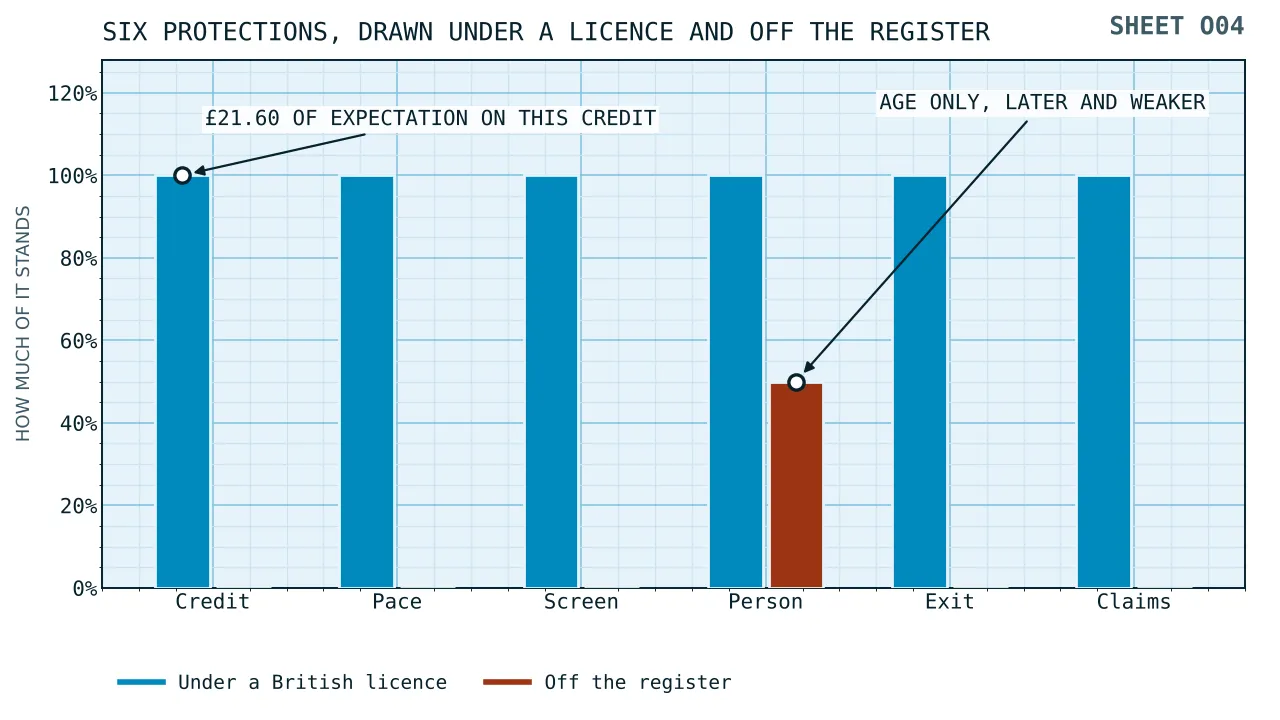
The duties a British licence imposes read as a list of twenty unrelated rules, which is why they are easy to wave away. Grouped by what each protects, they come to six things, and five of the six carry a figure on this deposit.
| What is protected | What Great Britain imposes | What it is worth here |
|---|---|---|
| The value of the credit | A play-through ceiling of ten times the bonus funds, and one gambling product type to an incentive | £21.60 of expectation, £1,080.00 of turnover not owed, and casino credit that cannot be tied to bingo under shared terms |
| The pace of the play | A slot cycle held to £5.00, and to £2.00 for the under-25s, 2.5 seconds between cycles, with automation, turbo and slam stop all barred | Six lawful cycles at the adult maximum, and 750 seconds as the floor on 300 cycles of this size |
| What the screen may claim | No manufactured near miss, no celebration where the return does not exceed the stake, no simultaneous games, no change to rules or probabilities mid-play, and outcomes that must be acceptably random with no compensation | A 10p cycle returning 10p is reported rather than dressed, and a losing outcome stays the outcome it was |
| The person depositing | Identity established before any play, credit cards barred, a financial limit offered as the default, and light-touch affordability checks once net deposits exceed £150.00 monthly | Five payments of this size reach that monthly threshold, and none of them may arrive on borrowed money |
| The way out | No term capping withdrawals from a deposit balance, and no option to cancel a withdrawal once requested | £28.80 expected back from one pass, payable when asked for rather than when convenient |
| The way to complain | Six months to raise one, eight weeks to answer it, and a final letter pointing to an independent body the regulator has approved | A grievance about £36.00 of credit with a stage beyond the other party’s own choosing |
Only one of those six has anything standing against it offshore, which is the protection of the person: the island policy does require age to be established, in a weaker form and at a later moment. The other five have no counterpart anywhere in the material read for this build.
6
Where the scheme’s edge is drawn
A key about companies abroad is also a key about the national self-exclusion scheme, because the two questions have one answer.
The scheme is written Gamstop, and Gamstop Online is its full name, adopted in November 2025 with a refreshed identity, though most search phrases still carry the older capitals. The National Online Self Exclusion Scheme Limited carries it, registered number 10504973, from 3 Greengate, Cardale Park, Harrogate, HG3 1GY. The Remote Gambling Association brought it into being during June 2017, asked to do so by the Gambling Commission and by the department whose brief covers media, culture and sport, and March 2020 turned membership into a condition attached to the licence of every operator that takes business from residents here. Betting shops are covered by a service of their own, so a single registration will not do both.
Its boundary is a licensing boundary. An online gambling company holding a British licence has no choice but to join, which is what makes this the same subject as part 3: without the licence a company stands outside the scheme by construction and not by preference. Its terms say so against itself: assistance extends to exclusion from the services of participating operators, and for an organisation that has not joined it records an inability to keep anybody away. That describes the edge of a protection, and this sheet offers nobody a way across it.
A warning notice of 20 January 2025 adds what a reader of this key should weigh. A website with no licence may have money laundering controls and social responsibility controls that are both inadequate, exposing customers to fraud, to unfair practices and to difficulties over data privacy, and websites of that sort often go after vulnerable customers, including people who have registered a self-exclusion. The same notice records something else that bears directly on judging a company by its games: the regulator has become aware of casino games made by licensed suppliers appearing on unlicensed websites. A familiar reel proves something about the supplier and nothing whatever about the site.
That is not theoretical. A Malta-incorporated supplier settled at £4.75m, dated 23 July 2026, the regulator having traced its games to six websites holding no licence but reachable from here. Between December 2023 and November 2024 the visits to them ran into large volumes. Three failures were found: risks of money laundering and terrorist financing not identified and assessed; controls not maintained to keep its games away from British consumers through operators with no licence; and customer due diligence requirements unmet. Serious weaknesses in the money laundering risk assessment had been exposed, said the regulator’s director of enforcement, who added that suspension of the licence had been considered.
7
The duty, and the money behind a licence
Two things make the difference between a British licence and a foreign one visible in pounds. One is a tax that follows the player. The other is a list of penalties.
The tax follows the player
British gaming duty is charged by reference to where the customer usually lives. Wherever its own base, a company offering remote gambling other than spread betting to somebody normally resident in Britain owes one or more of these duties, and Remote Gaming Duty bites on the profit from that play, reckoned as stakes taken less winnings paid. The rate reads 40 per cent for accounting periods beginning on or after 1 April 2026. From 1 April 2019 it read 21 per cent, and before that 15. Outside the United Kingdom and outside a group, a company generally has to appoint a representative the revenue approves, the exception being a base in an exempt jurisdiction, which includes Norway, Gibraltar and the EU member states.
Which gives a precise thing to say about a company abroad that most writing on this subject gets wrong. Taking a British player’s thirty pounds puts it inside the scope of a British duty. Scope of a duty is one thing and a licence is another, and the scope brings along not one of the six protections in part 5.
For the player the position arrives by absence rather than by a charging provision. The revenue’s manual records betting and gambling as not amounting, of themselves, to a trade, so winnings are not trade income. The authority is a 1925 decision about a man who lived entirely off bets struck at starting prices: no trade, the judge held, observing that a habit attracts no tax. Neither a system, nor a study of form, nor living on the proceeds turns it into one. Nowhere does a government page declare winnings untaxed in terms. Nothing above speaks to anybody’s own position, and none of it amounts to tax advice.
The licence is enforced with published money
A licence is something that can be removed, which is a difference worth showing in figures. On the British regulator’s published enforcement list, within a single twelve-month span, land-based casino operators were to pay £5m on 7 October 2026; a Gibraltar-incorporated licensee £609,104 on 20 August 2026; a supplier £4.75m on 23 July 2026; another Gibraltar-incorporated licensee £900,000 on 30 June 2026; and a single operator £10m on 22 October 2025. Five suspensions sit on the same list, the earliest dated 30 October 2025 and the latest 21 September 2026.
Set that against the regulator’s own candour about reach. Its own writing concedes that the revenue involved makes complete dismantling of the illegal ecosystem improbable, while recording traffic down by 32 per cent at the hundred and sixty websites it had selected for action. Enforcement is real, and it is enforcement against licensees. A company with nothing to suspend is not reached by it.
8
What is checkable, and what is not
Three things a reader can establish in a minute, and three things nobody can establish at all.
The checkable first. Three registers are published: licensed businesses, personal licences, premises. Each can be searched and downloaded. So are public statements, regulatory actions and the answers to freedom of information requests. The instruction to a player is exact. Confirm that the business holds a Commission licence. Find the licensed status the website should be showing. Click through from it into the register. Then check that the entry standing there, activities and website domain names included, matches the site being looked at. No date and no reading guide appear on the register page, so a reader should note the day of the check themselves, and should attribute to the regulator no interpretation it has not published.
The scale on the licensed side is worth a figure, because it is the thing a foreign company is being measured against. Gross gambling yield for Great Britain ran to £17.5 billion across April 2025 to March 2026, or £13.2 billion with reported lotteries removed. Remote casino, betting and bingo accounted for £8.3 billion of it, 6.9 per cent up, online casino games for £5.7 billion and slots by themselves for £4.8 billion. Licensed operators numbered 2,154 on 31 March 2026, between them holding 3,097 licensed activities. Active accounts stood at 25.7 million when the latest reporting quarter closed. All of it was published on 17 September 2026.
Now the three that cannot be checked, which is where most writing on this market comes unstuck.
- Which licence a named company holds. Not one primary source states it, so what a licence requires is described here and no licence is ever attached to a name.
- How many companies hold a given foreign licence. No count could be cited with a date, so none appears here.
- How multiples, withdrawal caps or spin values are distributed across the market. Nothing published measures them. Forty times is modelled throughout as an assumption and labelled as one. The contrast this page draws is structural instead: Great Britain has a ceiling of ten, and the island rulebook has no ceiling anywhere in it.
9
If the register is the obstacle
A proportion of the people who search for companies outside the United Kingdom are doing it because a British registration is working. This section is addressed to them and contains no way round it.
The arithmetic is the argument and it does not need help. A 120 per cent headline on thirty pounds is worth £21.60 where the ceiling is ten and nothing at forty times, by which point £540.00 of the condition is being staked from the deposit. Five of the six protections in part 5 are absent altogether, the sixth is weaker and later, the complaint route may be shaped by the other party, and in two of the six jurisdictions above this sheet could not read a regulator’s own material at all. No version of those numbers is worth a defeated registration, and a different flag does not change one of them.
What is published, free, and effective:
- TalkBanStop is the route to look at first, because it joins the other two. GamCare supplies Talk in the form of the National Gambling Helpline. Gamban supplies Ban, blocking software described there as covering as many as fifteen devices and usable right across a household. The national scheme supplies Stop. GamCare publishes that Gamban is free of charge to anybody ringing the helpline or taking up GamCare’s support and treatment services, on a page dated 12 April 2021 that gives no length for the access, so no length is given here.
- The helpline on its own: 0808 8020 133, free, open at every hour of every day in the year, with the telephone, live chat and WhatsApp as routes in, and calls about somebody else as welcome as calls about yourself. A professional may make a referral with the person’s consent.
- The software on its own. A layered approach is what Gamban uses, covering gambling sites and apps by the tens of thousands, under one licence across all major device platforms. The only no-charge arrangement its own site publishes is for residents of one American state, so the no-charge British route is the one TalkBanStop publishes.
Two features of a live registration, from terms last updated on 20 May 2026. Four periods are offered at registration. Six months is the shortest. A year comes next. Five years is the longest single term, and the fourth option is that same five years renewing by itself, with the renewal removable only inside a five-year run’s final six months. And an exclusion cannot be ended early: the terms put in capitals that deactivation is not available until the minimum period has run out. Staying in control is where this site writes about using all of it.
Related reading. The same absences priced as sixteen questions a licence answers sit at best non gamstop casinos. Spins claimed with no deposit at all are priced at non gamstop casinos no deposit bonus. What the timing of an identity check is worth sits at no kyc casinos. The page where the stake assumption itself has to shift is high roller online casinos, and the island licence itself is the subject of non gamstop curacao casino sites. Off the register is the section index, and How a receipt is struck gives the method behind every quantity above.
Questions
- Do British rules reach a casino company based abroad?
- Where facilities for gambling are provided, inside or outside the United Kingdom, is immaterial to the licensing requirement, and the Act says so in terms. Remote gambling is caught on either of two limbs: that at least one piece of remote gambling equipment used in providing the facilities sits in Great Britain, or that no such equipment sits here but the facilities are used here. The second limb carries a test of knowledge, biting where the person knows, or ought to know, that use in Great Britain is happening or is likely. Those subsections took effect from 1 November 2014 for specified purposes.
- What does a 120 per cent headline on £30.00 come to?
- Thirty-six pounds of credit, and twenty-one pounds sixty either side of the licence. With W at ten the condition calls for £360.00 of turnover, the edge on that comes to £14.40, and £21.60 of the credit is expected to survive. With W at forty, turnover owed is £1,440.00 and the edge on it £57.60; the credit covers the first £900.00 of staking before it is used up, and the remaining £540.00 has to come out of the deposit at a further £21.60 of expected cost. Between the two runs sit £1,080.00 of staking and £43.20 of edge.
- Does playing at one make me an offender?
- The offence is drafted about the provider. A company abroad that knows its facilities are used here is inside the licensing requirement whether it holds a licence or not, so offering without one is unlawful rather than merely unregulated. The Act creates no matching offence of taking part in remote gambling as a customer. The schedule of protections this sheet sets out is what a reader surrenders at such a company, rather than anything bearing on their own liability. Advertising unlawful gambling is a separate offence, committed on each day any part of a display occurs.
- Which foreign regulators actually publish a rulebook?
- Two of the six read for this build. The Caribbean island regulator presents itself as a foundation set up on 19 April 1999, with an ordinance on games of chance in effect from 24 December 2024, a responsible gaming policy and a complaints policy, though its own online gaming portal read as offline when opened. Malta operates under its Gaming Act and directives, with an enforcement register, a searchable register of licensees and a formal route for lodging a complaint. The Anjouan complaint page returned an error when fetched. No Costa Rican regulator website could be located. Three attempts at Gibraltar’s official gambling pages returned errors.
- What are the six things a British licence protects?
- The value of the credit, through a play-through ceiling of ten times with one product type to an incentive, worth £21.60 here and £1,080.00 of turnover never owed. The pace of play, through a slot cycle held to £5.00 and 2.5 seconds between cycles, which makes 750 seconds the floor on 300 cycles. What the screen may claim, through the bans on manufactured near misses, on celebration where the return does not exceed the stake, and on simultaneous games. The person depositing, through identity, the credit card bar, financial limits and affordability checks. The way out, through the prohibition on capping a deposit balance. And the way to complain, through eight weeks and an approved independent body.
- Does a game I recognise tell me anything about the site?
- Nothing at all, and the regulator has said so in a warning notice: it has become aware of casino games made by licensed suppliers appearing on unlicensed websites. The enforcement behind it is recent. A Malta-incorporated supplier settled at £4.75m, dated 23 July 2026, the regulator having traced its games to six websites holding no licence but reachable from here. Between December 2023 and November 2024 the visits to them ran into large volumes. Three failures were found: risks of money laundering and terrorist financing not identified and assessed; controls not maintained to keep its games away from British consumers through operators with no licence; and customer due diligence requirements unmet.
- Why does a British self-exclusion not cover a company abroad?
- Because its boundary is a licensing boundary. An online gambling company holding a British licence has no choice but to join, so without the licence a company stands outside the scheme by construction and not by preference. Its terms say so against itself: assistance extends to exclusion from the services of participating operators, and for an organisation that has not joined it records an inability to keep anybody away. The regulator adds that unlicensed websites often go after vulnerable customers, including people who have registered a self-exclusion.
- Does anybody pay British tax on money staked abroad?
- The company does, and liability is charged by reference to where the customer usually lives. Wherever its own base, a company offering remote gambling other than spread betting to somebody normally resident in Britain owes one or more of these duties, and Remote Gaming Duty bites on the profit from that play, reckoned as stakes taken less winnings paid, at 40 per cent for accounting periods beginning on or after 1 April 2026. Taking a British player’s thirty pounds therefore puts a company inside the scope of a British duty, which is not the same as holding a licence and carries none of the protections with it.
- What can I actually verify before I deposit?
- The register, and little else. Three registers are published: licensed businesses, personal licences, premises, each of them searchable and downloadable. The instruction to a player is exact. Confirm that the business holds a Commission licence. Find the licensed status the website should be showing. Click through from it into the register. Then check that the entry standing there, activities and website domain names included, matches the site being looked at. No date and no reading guide appear on the register page, so note the day of the check yourself. No primary source states which licence a named company holds, how many hold a given foreign licence, or how multiples and withdrawal caps are distributed.
- What if a British registration is why I am looking abroad?
- Use the published route, which costs nothing. TalkBanStop joins the other two: GamCare supplies Talk in the form of the National Gambling Helpline, Gamban supplies Ban as blocking software, and the national scheme supplies Stop. GamCare publishes that Gamban is free of charge to anybody ringing the helpline or taking up GamCare’s support and treatment services, on a page dated 12 April 2021 that gives no length for the access, so no length is given here. The helpline on its own is 0808 8020 133, free, open at every hour of every day in the year, with the telephone, live chat and WhatsApp as routes in, and calls about somebody else as welcome as calls about yourself.