
Sheet M01 Revision 1 Checked 15 October 2026
Free spins no deposit
Fifty spins priced at 10p are £5.00 at face and £4.80 of average winnings once a 96 per cent return is applied. A forty times play-through bills £7.68 against that £4.80. The line at the foot is nought, and every step of it is below.
£0.00 left from £4.80 of credit at forty times
What the conditions leave
Every destination on this spike is bought advertising. The site takes a fee if a reader goes on to register, and no figure printed below moves because of it.
The Spin Sheet
Till receipt No 01
Betportal
Lowest multiple here
For every €1 of spin credit at face per €1
Credit
Debit
No Great Britain licence
Licensed in Anjouan, Comoros, run by BetPortal Gaming Ltd, with Excite Ultra Media Ltd, reference ALSI-202601040-FI2.
Terms read 15 October 2026
Open the offer at Betportal, opens in a new tabThe Spin Sheet
Till receipt No 02
WinBeast
Five staged matches
For every €1 of spin credit at face per €1
Credit
Debit
No Great Britain licence
Licensed in Curaçao, operator not named on the site.
Terms read 15 October 2026
Open the offer at WinBeast, opens in a new tabThe Spin Sheet
Till receipt No 03
EliteSpin
Longest spin window
For every £1 of spin credit at face per £1
Credit
Debit
No Great Britain licence
Licensed in Costa Rica, run by PrimeTier Limited.
Terms read 15 October 2026
Open the offer at EliteSpin, opens in a new tabThe Spin Sheet
Till receipt No 04
Crown Jewelz
Multiple unpublished
No total struck
Credit
Debit
No Great Britain licence
Licensed in Curaçao, number not verified, operator not named on the site.
Terms read 15 October 2026
Open the offer at Crown Jewelz, opens in a new tabThe figure at the foot of a receipt is this site's own arithmetic and nothing an operator has published: the credit, less the share a spin gives back at 96 per cent return to player, less what playing the wagering through costs at the same return. It describes the offer, not one reader's afternoon. Where the conditions price above the credit the receipt prints nothing rather than a negative sum, and where a figure the sum needs is unpublished it prints the condition in the operator's words instead.
Three words stand in the amount column where no figure can. Noted is a published condition that takes value away without leaving the sum a figure to take. Unpriced is a condition whose figure nobody has published, or a credit that is not a sum until a deposit of your own sets it. Own money is money of yours, which is never part of a total.
Not one of the operators printed above holds a Great Britain licence, so the duties that licence carries do not reach them. Every online gambling company licensed in Great Britain has to be part of Gamstop Online, and a reader who has shut themselves out through the scheme is therefore not shut out here. The ceiling of ten times the bonus funds on a wagering requirement, in force since 19 January 2026, is a condition of that licence and binds the companies that hold one. Where a dispute goes instead is a matter for the authority named on the receipt, and the Gambling Commission describes what a reader faces without a British licence as a lack of recourse if things go wrong. Nobody under 18 may hold an account at any of them.
Every term printed on a receipt is the operator's own, and each receipt carries the day it was read. The oldest of those readings is 15 October 2026. What binds a reader is the operator's own full terms, and not a line printed here.
1
What the round is worth at face
Three figures settle a no deposit spins round. The count of spins is the one on the front. The cash value of a single spin and the play-through multiple are the two that decide the answer, and both of those sit further down the document.
Fifty spins at 10p is a face of £5.00. Nothing pays out at face. A spin pays what the game returns, so fifty cycles at 10p on a 96 per cent slot average £4.80 of winnings. That £4.80 is the credit this sheet prices, and it is B in the line that follows.
Nothing published in Great Britain fixes what a spin is worth in pence. The regulator’s own material says nothing about who sets that value, nothing about what has to be disclosed about it, and nothing about a floor or a ceiling on it. The 10p above is therefore an assumption made here so that the arithmetic has somewhere to start, and it is not a figure read off the market.
What a licensed site does owe a player is information before the first wager. RTS 3C asks that a game’s rules, its house edge, its return to player percentage, or the probability of its winning events be easily available at that point. The four are joined by the word or, so a British licence can be satisfied without a return to player percentage being printed anywhere.
Five assumptions, named so a reader can change them and rerun the line:
- A spin is priced at 10p, and the stake through the play-through is held at that same 10p.
- The slot returns 96 per cent.
- Game weighting counts at 100 per cent until part 5, where it does not.
- The multiple is forty times. Ten times is the ceiling a Great Britain licence allows, and sixty times is what the regulator recorded some licensees applying before that ceiling arrived. Forty sits between the two and is the working figure here.
- Nothing is deposited, so the only money exposed is the credit itself.
2
The one line, substituted
One expression carries the whole sheet.
E = B × (1 – (W × (1 – RTP)) / g)
B is the credit at face. W is the play-through multiple. RTP is the return to player, as a share of one. g is the game weighting, also as a share of one. E is what the credit is expected to leave behind.
Put the round of fifty into it:
E = £4.80 × (1 – (40 × 0.04) / 1)
E = £4.80 × (1 – 1.60)
E = -£2.88
Two intermediate sums make that readable. Staking owed is forty lots of £4.80, or £192.00, before a penny can come out. Four pence in every pound of that staking is expected to stay with the house, which comes to £7.68. Set £7.68 of cost against £4.80 of credit and the shortfall is £2.88.
A negative E is not a debt. Nothing was paid in, so nothing beyond the credit is exposed, and the credit runs out before the staking is finished. The loss stops at £4.80 and the line at the foot reads £0.00. The -£2.88 measures the overrun instead: how far the condition reaches past the thing it was attached to.
£192.00 of staking owed against £4.80 of credit
That overrun is what this part of the site is built to measure. The figure on the front is not a small sum with a string attached. It is a string longer than the sum.
3
Ten times to sixty times, priced
W is the term in that line with the widest spread in practice, so the credit is priced below against seven values of it. B stays at £4.80, RTP at 96 per cent, g at one.
| Multiple | Staking owed | Expected cost | Left at the foot | Overrun |
|---|---|---|---|---|
| 10x | £48.00 | £1.92 | £2.88 | £0.00 |
| 15x | £72.00 | £2.88 | £1.92 | £0.00 |
| 20x | £96.00 | £3.84 | £0.96 | £0.00 |
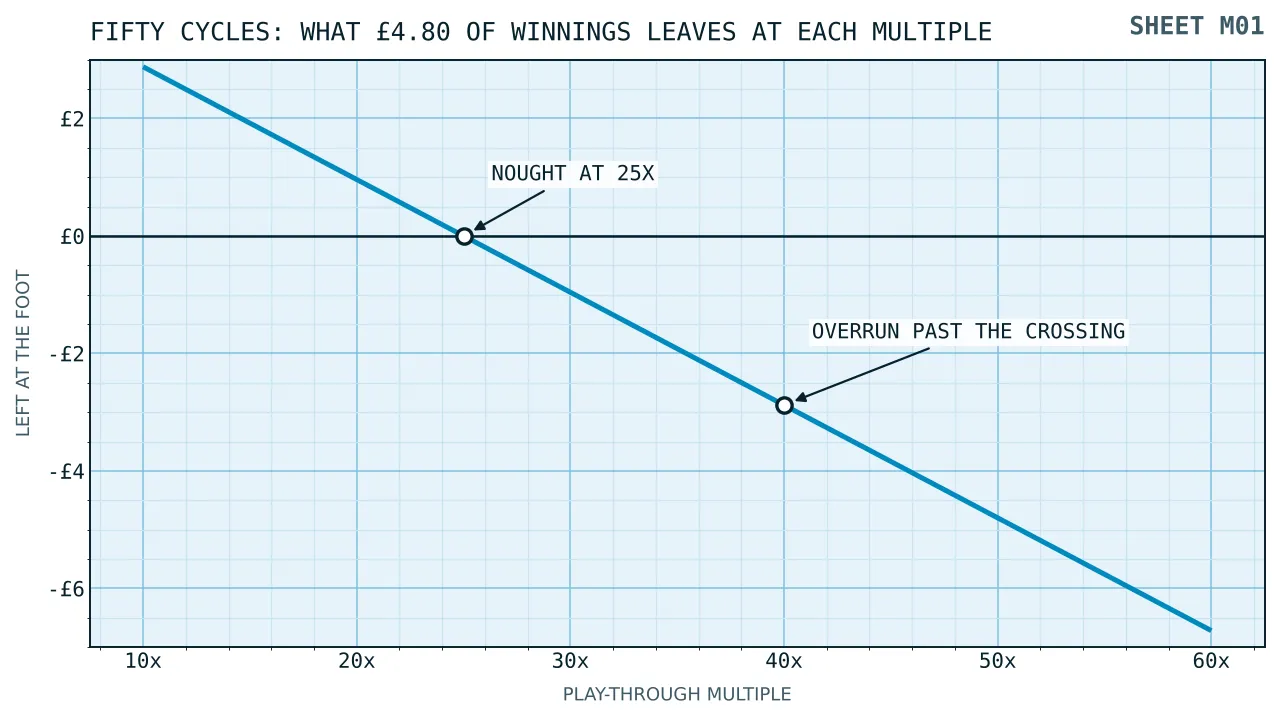
| 25x | £120.00 | £4.80 | £0.00 | £0.00 |
| 30x | £144.00 | £5.76 | £0.00 | £0.96 |
| 40x | £192.00 | £7.68 | £0.00 | £2.88 |
| 60x | £288.00 | £11.52 | £0.00 | £6.72 |
Left at the foot reaches nought at twenty-five times, and no accident of these particular pence puts it there. Set E to nought and the line resolves to a single answer, W = 1 / (1 – RTP). At 96 per cent that is twenty-five exactly. The break-even multiple is the reciprocal of the house edge and nothing else whatever.
Which promotes the return to player from a detail beside the terms to a lever on them:
- 95 per cent returns, and the credit breaks even at twenty times.
- 96 per cent returns, and it breaks even at twenty-five.
- 97 per cent returns, and it holds to 33.3 times.
One percentage point of return moves the break-even multiple by five, and the next point moves it by more than eight. A round of spins pinned to a 95 per cent game is not the same instrument as the identical round on a 97 per cent game. Bonus terms seldom print the two figures anywhere near each other.
4
What the stake moves and what it leaves alone
There is no stake term in that line at all. The size of a spin appears nowhere in it, and that absence is the result rather than a hole in the working.
Staking owed is W × B / g. It is a quantity of money, not a count of cycles. Stake twice as much per cycle and the same £192.00 arrives in half the cycles, at the same expected cost of £7.68. The foot does not shift by a penny.
Time shifts. At 10p a cycle, £192.00 is 1,920 cycles. RTS 14D puts a floor of 2.5 seconds between the start of one game and the moment the next can be commenced on a slot. So 1,920 cycles cannot be got through in less than 4,800 seconds. Eighty minutes, and a minimum rather than an estimate.
At 20p a cycle it is 960 cycles and forty minutes, and the foot still reads £0.00.
Nor can those cycles be handed over to a machine and left running. RTS 8A will not let one game cycle begin without a fresh commitment from the player, and its guidance excepts a single thing: blinds posted automatically at a peer-to-peer poker table. Eighty minutes of play-through is 1,920 separate decisions to keep going.
The clock written into a set of bonus terms is usually the wrong thing to worry at. A twenty-four-hour window holds 34,560 cycles at that 2.5-second floor, which buys £3,456.00 of staking at 10p a cycle. The window would have to close a very long way before it bit harder than W. Expiry is what settles some kinds of promotion. It does not settle this one.
The 2.5 seconds and the bar on autoplay are both conditions of a Great Britain licence. The Curaçao responsible gaming policy read for this sheet sets no minimum game cycle and no autoplay bar, so on the offshore side the same £192.00 can be run through with neither floor beneath it.
1,920 cycles, 80 minutes, at the 2.5-second floor
5
Weighting, the debit inside the multiple
g is the term a reader skips and the one most likely to turn a survivable multiple into a dead one.
A game counting at 30 per cent puts 30p towards the requirement for every pound staked on it. The requirement has not changed: forty times £4.80 is still £192.00 of contribution owed. Reaching that contribution now takes £640.00 of staking.
E = £4.80 × (1 – (40 × 0.04) / 0.30)
E = £4.80 × (1 – 5.3333)
E = -£20.80
£640.00 of staking at four pence in the pound is £25.60 of expected cost against £4.80 of credit. The overrun is £20.80, a little over seven times what it was at full weighting, and the headline count of spins never moved.
Now take the ceiling a Great Britain licence allows, ten times, and leave the weighting where it is. Staking owed falls to £160.00, expected cost to £6.40, and the foot reads -£1.60. A multiple comfortably inside the regulated ceiling still prices at nothing once the weighting works against it. Worth sitting with for a moment: the ceiling binds W, and g is not capped at all.
The 30 per cent is a worked rate and must be read as one. It appears on the regulator’s own consultation response as a respondent’s illustration, in which each pound wagered contributes thirty pence towards a requirement, and the Commission recorded the submission without going on to act on weighting. No primary source publishes a current table of contribution rates. So the three lines above are this sheet’s own arithmetic run against that quoted rate, and not anybody’s finding about the market.
£640.00 of staking to clear £192.00 of contribution at 30 per cent
Time follows the money upward. £640.00 at 10p a cycle is 6,400 cycles, and 2.5 seconds apiece makes 16,000 seconds of it: four hours, twenty-six minutes and forty seconds, taken in 6,400 separate commitments.
6
Debits the one line cannot see
E prices the play-through. Four things written into a set of bonus terms sit outside it, and two of them can take the answer to nought on their own.
A ceiling on what the credit may win
No primary source publishes a standard maximum-win cap on bonus winnings, so no figure for one is quoted here. The structure is still worth getting straight, because two rules are easy to run together. A holder of a Great Britain licence cannot put a maximum on the sum a player draws out of a deposit balance. The regulator’s specimen of a term it bars runs: you may withdraw up to £50 per day and up to £500 per week. That protection covers a player’s own money. A ceiling on what a bonus may pay out is a separate object, and the deposit-balance rule does not reach it. Both can be true of one cashier at one moment.
A clause that lets the house walk away
Taichi Tech Limited, trading as Fafabet, was fined £170,000 on 3 July 2025 over the terms attached to its new casino promotions. The offending line read: Fafabet have the right at their own discretion to close accounts or forfeit winnings. The Commission found the fair and open licensing condition breached, held that terms of that shape lack transparency and can leave a consumer with an unfair outcome, and made the operator buy an independent third-party audit covering its controls on money laundering and on safer gambling. Of everything sourced for this site, that is the sharpest published outcome squarely about the terms of a casino bonus. It does not make a clause of that shape void. The operator was fined; the term was not struck down.
Conditions nobody showed the reader
CAP Code rule 8.17 asks that every significant condition applying to a promotion be stated prominently and plainly, in any case where dropping one would be likely to mislead. What the advertising regulator counts in a gambling promotion comes to four items: who qualifies, by newness, by age or by where they are; what must be paid in or wagered; how long there is to claim and to use; and any floor on odds or restriction on the type of bet. Each of them is a printed line on a no deposit spins round, and the Commission supplies the consequence: significant conditions shown without sufficient prominence make the advertisement a misleading one.
Three rulings give the shape of it. A £10 free bet ruled on 17 July 2024 hung on answering a text message by a set hour, which the advertisement nowhere mentioned. On 31 July 2024 a payment method the offer excluded sat in small print among the full terms and was held insufficiently prominent. On 27 August 2025 a £5 voucher turned out to be void on 14 March, the Cheltenham Gold Cup being run that day, and the voucher itself said nothing of it.
The word on the front
The advertising regulator’s advice is that a promotion should not be described as free where a customer has to put their own money up to qualify for it. A no deposit round passes that test at the door and meets it again at the foot. Nothing was staked to claim the spins, and £7.68 of expected cost was fastened to them on the way in.
7
What a Great Britain licence puts underneath
Everything above is arithmetic, and arithmetic does not care who is running the game. What differs is what sits under the arithmetic. Offers at this end of the market hold no Great Britain licence, and the loss stops being a slogan the moment the duties are named one at a time.
The ceiling on W
From 19 January 2026, Social Responsibility Code 5.1.1 stops a licensee setting W higher than ten. The provision defines the requirement as wagers that must total a particular value before funds turn withdrawable, which is W multiplied by B under another name. On £4.80 of credit, ten times is £48.00 of staking, £1.92 of expected cost and £2.88 at the foot. The regulator’s stated reason for the cap was that some licensees were applying up to sixty times, which on the same credit is £288.00 of staking and a £6.72 overrun. Scope runs to all licences bar gaming machine technical and software, so it reaches every remote casino licence in Britain.
One caveat, and it bites hardest on a page about spins. Bonus funds is what the cap names, and that is the whole of its wording. Nobody has published whether a spin counts as bonus funds in its own right. This much is safe: once the winnings off a spin land in an account as bonus funds, ten times is as far as the requirement may go. Past that, neither direction is honest.
Knowing the player before the first cycle
Licence condition 17.1.1 will not let a licensee take a wager until it has settled who it is dealing with: date of birth, address and name, obtained and verified first. The regulator’s announcement of the rules carried the age check across to play funded by a bonus or a free bet, and across to free-to-play versions of games as well. The same condition stops the check being sprung at the moment of withdrawal, where it could reasonably have been asked for earlier. Timing is where the Curaçao responsible gaming policy parts company with it: no deposit and no wager by anyone the operator is not satisfied has turned eighteen, and then a government-issued identity check pinned to that regime’s own know-your-customer and anti-money-laundering milestones rather than to a first wager.
A rulebook with arithmetic in it
No wagering cap, no stake cap, no minimum game cycle, no bar on autoplay, and nothing stopping a win fanfare over a return no larger than the stake, appears anywhere in that Curaçao policy. Its entire word on bonuses runs to two lines: that they be communicated transparently with clear terms and conditions, and that operators not encourage excessive gambling through aggressive bonus promotions. No ten-times equivalent, no bar on mixing products inside one incentive, and no list of the conditions that count as significant.
Somewhere to go when it goes wrong
A complaints route does exist on the offshore side, and a page claiming otherwise is simply wrong. Curaçao gives a player six months to lodge a complaint free of charge and gives the operator four weeks to answer, extendable once by a further four, so eight weeks in all. Great Britain arrives at eight weeks by a different road. Neither regulator decides the dispute. The British one calls itself no ombudsman, without power to settle a gambling complaint or recover anybody’s stake, and the Curaçao authority says it will not make decisions on complaints about gambling transactions on an operator’s own websites. Where the two regimes part is who writes the terms of the escalation. In Britain the Commission approves the alternative dispute resolution entities and a licensee may use only an approved one, and the approved list names eight. The Curaçao policy expressly contemplates the operator setting the parameters, including whether the outcome binds the player and whether a minimum claim value is needed to escalate at all.
The block that works from one place
Every online gambling company licensed in Great Britain must be part of Gamstop Online, because the licence is the thing that puts them there. The scheme states its own limit without dressing it up: it cannot help prevent a registered person reaching gambling services provided by organisations that do not take part. Curaçao requires self-exclusion as well, but at the level of a single operator and its domains, with a minimum period of one year against the six months offered at registration in Britain. Nothing on this sheet assists a return to a site a reader has locked themselves out of, and the help numbers stand in the note at the foot.
The duty that follows the player
Remote Gaming Duty is charged on an operator’s profits, at 40 per cent on or after 1 April 2026, and it follows where a player usually lives rather than where a licence was issued. An operator outside the United Kingdom offering remote gaming to somebody who usually lives here falls inside that charge whether or not it holds a British licence. So duty is not where the two sides come apart. The duties owed to a player are.
8
Pricing a round yourself
Six lines, and the fourth and fifth are the ones nobody does.
| What to do | On these figures |
|---|---|
| Count the spins, price one | 50 at £0.10 |
| Multiply by the return | £4.80 |
| Read W out of the terms | 40x |
| Credit times W, over g | £192.00 |
| Take the house edge of that | £7.68 |
| Subtract, and floor at nought | £0.00 |
Run the same six lines on a smaller round and the shape repeats. Twenty spins at 10p is £2.00 at face and £1.92 of average winnings. Ten times leaves £1.15. Forty times overruns by £1.15. The sign flips and the size holds, because one less 0.40 and one less 1.60 stand the same distance from nought in opposite directions. Four times the ceiling costs exactly what the ceiling would have paid.
Two cautions on spending the answer.
A positive E is an expectation and not a payment. £2.88 at ten times is the mean of a distribution whose single commonest outcome is nothing whatever. The line says what a credit of that size is worth repeated a great many times. It does not say what one round will do once, and no honest arrangement of the figures can.
And figures are figures, not terms. Read W, g, the win ceiling and the window out of the document actually in front of you, drop them into the one line in part 2, and the answer belongs to you rather than to this sheet. Where that answer is nought, it has at least been reached in pounds and pence.
Three sheets alongside this one run the identical method on other headline counts: 5 free spins no deposit, where the face is small enough that the ceiling matters more than the multiple, 100 free spins no deposit, where the staking owed passes four figures, and slots free spins, where the weighting does most of the work. The index for The multiple holds the rest.
Questions
- What is a free spins no deposit offer actually worth in cash?
- On the figures worked here, nothing. Fifty spins priced at 10p carry a face of £5.00 and average £4.80 of winnings at a 96 per cent return. A forty times play-through owes £192.00 of staking, whose expected cost is £7.68. That is £2.88 more than the credit, so the credit is used up and the line at the foot reads £0.00.
- How do I price the play-through myself?
- Take the credit, multiply by the multiple, and the product is the staking owed. Then take the house edge of that staking as the cost. At £4.80 of credit and forty times, the staking is £192.00 and the cost at a 96 per cent return is £7.68. Subtract the cost from the credit. A negative answer means the condition is larger than the thing it is attached to, and the foot is nought.
- At what multiple does a no deposit round price at nothing?
- Twenty-five times, at a 96 per cent return. The break-even multiple is one divided by the house edge, so at 95 per cent it is twenty times and at 97 per cent it is 33.3 times. Anything above the break-even figure leaves nought whatever the headline count of spins happens to be.
- Does the ten times wagering cap cover free spins?
- Not something anyone can answer cleanly. Social Responsibility Code 5.1.1 holds a wagering requirement to ten times the bonus funds from 19 January 2026, and bonus funds is what the provision names. Whether a spin counts as bonus funds in its own right is not published. Once the winnings off a spin land in an account as bonus funds, ten times is as far as the requirement may go, and no claim past that is honest in either direction.
- Does a bigger stake clear the play-through more cheaply?
- No. The stake does not appear in the calculation at all. Staking owed is the credit times the multiple divided by the weighting, which is an amount of money rather than a number of cycles. Doubling the stake halves the cycles and halves the time, and leaves the expected cost and the foot exactly where they were.
- How long does a forty times play-through take on a 10p spin?
- Eighty minutes at the quickest, on a site holding a Great Britain licence. £192.00 of staking at 10p a cycle is 1,920 cycles, and RTS 14D puts a floor of 2.5 seconds between the start of one game and the moment the next may be commenced on a slot. That is 4,800 seconds. RTS 8A also wants a fresh commitment before every cycle, so it is 1,920 separate decisions rather than one.
- What does game weighting do to a no deposit round?
- It multiplies the staking without touching the requirement. At a contribution rate of 30 per cent, forty times £4.80 is still £192.00 of contribution owed, but it takes £640.00 of staking to reach, at an expected cost of £25.60. Even ten times, the ceiling a British licence allows, prices at minus £1.60 once the weighting is 30 per cent. The cap binds the multiple and nothing caps the weighting.
- Do no deposit spins work the same way without a British licence?
- The arithmetic is identical and the protections underneath it are not. Offers at this end of the market hold no Great Britain licence, so the ten times cap, the 2.5-second minimum game cycle, the bar on autoplay, and the slot stake ceilings, £5 from twenty-five years old and £2 under it, do not reach them. The Curaçao rulebook read for this sheet carries none of those, and its whole word on bonuses is that terms be transparent and promotions not aggressive.