
Sheet D01 Revision 1 Checked 15 October 2026
Casino welcome bonus
A package of 100 per cent up to £100 and 100 spins hands a £20 payment in £29.60 of credit. Forty times bills £1,184.00 of staking, whose expected cost is £47.36, and £2.24 of the original £20 survives that. The working is set out below.
£2.24 survives a £20 payment in at forty times
What a welcome package leaves
Every destination on this spike is bought advertising. The site takes a fee if a reader goes on to register, and no figure printed below moves because of it.
The Spin Sheet
Till receipt No 01
Betportal
Lowest multiple here
For every €1 of spin credit at face per €1
Credit
Debit
No Great Britain licence
Licensed in Anjouan, Comoros, run by BetPortal Gaming Ltd, with Excite Ultra Media Ltd, reference ALSI-202601040-FI2.
Terms read 15 October 2026
Open the offer at Betportal, opens in a new tabThe Spin Sheet
Till receipt No 02
WinBeast
Five staged matches
For every €1 of spin credit at face per €1
Credit
Debit
No Great Britain licence
Licensed in Curaçao, operator not named on the site.
Terms read 15 October 2026
Open the offer at WinBeast, opens in a new tabThe Spin Sheet
Till receipt No 03
EliteSpin
Longest spin window
For every £1 of spin credit at face per £1
Credit
Debit
No Great Britain licence
Licensed in Costa Rica, run by PrimeTier Limited.
Terms read 15 October 2026
Open the offer at EliteSpin, opens in a new tabThe Spin Sheet
Till receipt No 04
Crown Jewelz
Multiple unpublished
No total struck
Credit
Debit
No Great Britain licence
Licensed in Curaçao, number not verified, operator not named on the site.
Terms read 15 October 2026
Open the offer at Crown Jewelz, opens in a new tabThe figure at the foot of a receipt is this site's own arithmetic and nothing an operator has published: the credit, less the share a spin gives back at 96 per cent return to player, less what playing the wagering through costs at the same return. It describes the offer, not one reader's afternoon. Where the conditions price above the credit the receipt prints nothing rather than a negative sum, and where a figure the sum needs is unpublished it prints the condition in the operator's words instead.
Three words stand in the amount column where no figure can. Noted is a published condition that takes value away without leaving the sum a figure to take. Unpriced is a condition whose figure nobody has published, or a credit that is not a sum until a deposit of your own sets it. Own money is money of yours, which is never part of a total.
Not one of the operators printed above holds a Great Britain licence, so the duties that licence carries do not reach them. Every online gambling company licensed in Great Britain has to be part of Gamstop Online, and a reader who has shut themselves out through the scheme is therefore not shut out here. The ceiling of ten times the bonus funds on a wagering requirement, in force since 19 January 2026, is a condition of that licence and binds the companies that hold one. Where a dispute goes instead is a matter for the authority named on the receipt, and the Gambling Commission describes what a reader faces without a British licence as a lack of recourse if things go wrong. Nobody under 18 may hold an account at any of them.
Every term printed on a receipt is the operator's own, and each receipt carries the day it was read. The oldest of those readings is 15 October 2026. What binds a reader is the operator's own full terms, and not a line printed here.
1
What £20 actually buys
A welcome package is two instruments wearing one headline. There is a percentage fastened to whatever you pay in, and there is a fixed count of spins that arrives whatever you pay in. They behave in opposite directions, and reading them as a single advertised sum is the first mistake available.
Take the shape most commonly dressed as a welcome: a match of 100 per cent, ceilinged at £100, with 100 spins alongside it. Pay in £20.00 and the cash half credits £20.00, because the percentage multiplies your payment and not the ceiling. The spin half credits nothing in cash at all. It credits 100 cycles priced at 10p, which is £10.00 of face.
Face is not winnings. Run 100 cycles at 10p through a slot returning 96 per cent and the average comes back at £9.60. So the credit this sheet prices is £20.00 plus £9.60, a total of £29.60, against a payment of £20.00 that was yours already and stays yours in the arithmetic throughout.
That last clause does the work of this whole section. Your £20.00 is not a winning and never becomes one. It is money that moved from one account to another, and any honest total has to carry it as a debit of yours rather than a credit of theirs. A headline that adds your payment to the match and announces a larger number is adding your wallet to their offer.
Four assumptions hold across every figure on this sheet, and changing any of them changes the answer:
- A spin is priced at 10p. No rule in Great Britain fixes that value, so 10p is a working figure chosen here and nothing more.
- The slot returns 96 per cent, and every stake runs at full weight.
- The play-through multiple is forty times, because forty is what this corner of the market asks. Ten is the most a British licence permits.
- The requirement falls on the credit alone. Where a cashier writes it against the payment as well, part 6 prices that separately.
2
Up to is a ceiling you pay to reach
Two small words sit between a reader and the number on the front. A match advertised up to £100 pays £100 to precisely one kind of customer: the one who has already handed over £100. Everybody else gets their own payment back in bonus form and a ceiling they never touch.
Worth stating as a ratio, because the ratio is fixed and the ceiling is decorative. At 100 per cent, the cash credit equals the payment. Pay in a fiver and the credit is a fiver. The £100 on the front describes the largest payment the cashier will match, not the smallest sum it will hand you.
The spins behave the other way about. One hundred spins arrive whether the payment is £5.00 or £100.00, so their £9.60 of average winnings is a fixed quantity divided across a payment you choose. On a fiver that is 192 pence of credit per pound paid in. On a hundred it is 9.6 pence. The spins look generous at the bottom of the range and vanish at the top.
Put those two movements together and the package has a shape that nobody advertises. The cash half is flat per pound. The spin half falls steeply per pound. The play-through, which arrives next, is charged on both halves at once.
£9.60 of spin winnings, fixed, whatever you pay in
3
£29.60 put through the one line
The site works every total from a single expression, and this is its substitution on a welcome package.
E = B × (1 – (W × (1 – RTP)) / g)
Read the terms right to left for once. g is the weighting a game carries, taken at one here. RTP is the slice a slot hands back, 96 per cent. W counts the turnovers demanded before anything comes out, forty of them. B is the credit itself, £29.60 where the payment was £20.00. E is the expected residue.
E = £29.60 × (1 – (40 × 0.04) / 1)
E = £29.60 × (1 – 1.60)
E = -£17.76
Two intermediate quantities make that legible. Turning £29.60 over forty times means putting £1,184.00 across the reels. Four pence in every pound of that is expected to stay with the house, and four pence of £1,184.00 comes to £47.36. Set that against £29.60 and the condition exceeds the thing it hangs on by £17.76.
Now comes the part this section of the site exists for. On a no-payment offer the shortfall has nowhere to go and the answer stops at nothing. Here there is somewhere for it to go. Your £20.00 is sitting in the same balance, and the staking draws on whatever is there. So the expected close is £20.00 less £17.76, which is £2.24.
Eleven per cent of a £20.00 payment, expected, after a package whose headline reads one hundred pounds and a hundred spins.
The clock deserves a line of its own. Divide £1,184.00 by a 10p stake and the count of cycles is 11,840. A slot on a British licence owes 2.5 seconds to every cycle before another can be commenced, which pins 11,840 of them to 29,600 seconds at absolute minimum. Eight hours and thirteen minutes, and a floor rather than a forecast.
£1,184.00 of staking owed on a £20.00 payment
4
£14.40, and why that figure governs
Fix the package and vary only the payment, and the whole thing collapses to one number.
At forty times and 96 per cent, every pound of credit costs £1.60 to clear and is worth £1.00, so sixty pence of it is overrun. The cash half of the match generates sixty pence of overrun per pound paid in, against a pound paid in, which leaves forty pence. The spin half generates £5.76 of overrun flat, because sixty per cent of £9.60 does not move with the payment.
So the expected close is forty pence per pound paid in, less a flat £5.76. Set that to nothing and the payment solves to £14.40. Below it the package is expected to take everything you put in and keep reaching. Above it, something comes back.
That is a strange shape for an offer aimed at new customers, and it is worth naming plainly. The smaller your payment, the worse this package treats it, because the fixed spins drag a fixed cost behind them while your money shrinks underneath. A fiver meets £5.76 of flat overrun and £3.00 of proportional overrun against £5.00 of its own, and closes at nothing with £3.76 still owing.
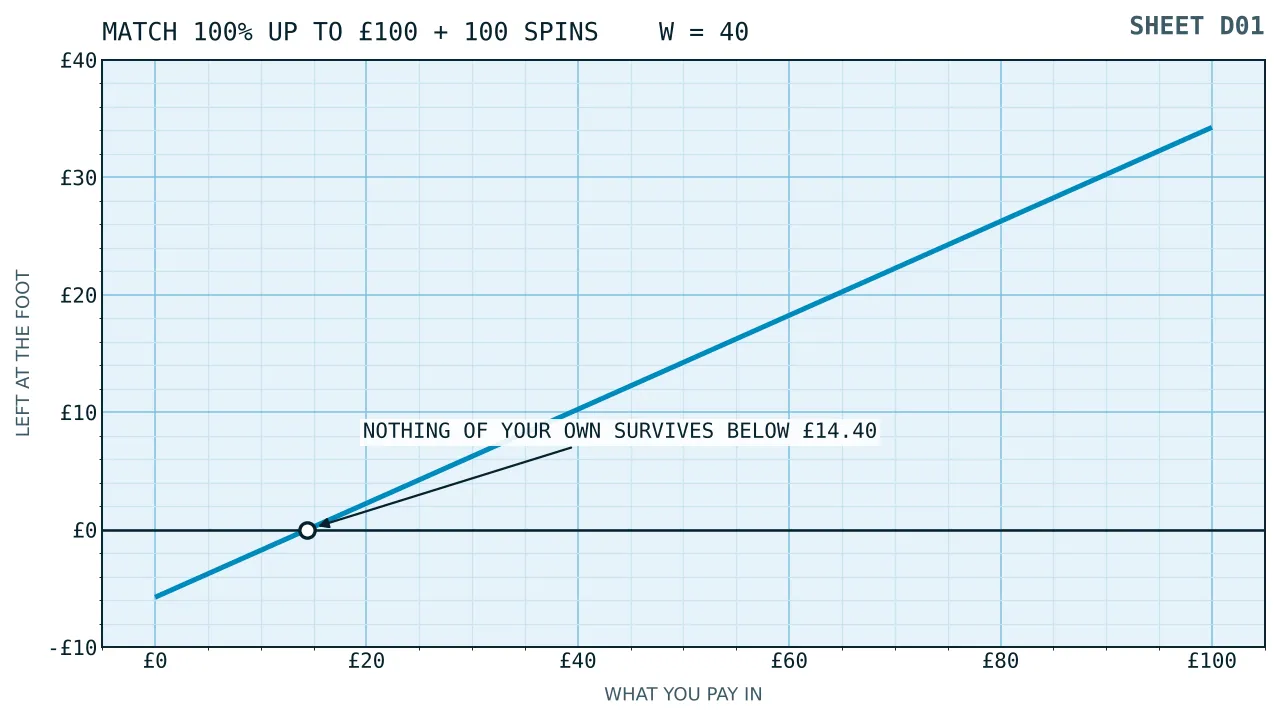
5
Five payments in, priced to the penny
The schedule runs the same package against five sums, holding forty times, 96 per cent and full weight throughout. Credit is the cash match plus £9.60 of average spin winnings. Expected cost is four pence in the pound of the staking owed.
| Paid in | Credit | Staking owed | Expected cost | Expected close |
|---|---|---|---|---|
| £5.00 | £14.60 | £584.00 | £23.36 | £0.00 |
| £10.00 | £19.60 | £784.00 | £31.36 | £0.00 |
| £20.00 | £29.60 | £1,184.00 | £47.36 | £2.24 |
| £50.00 | £59.60 | £2,384.00 | £95.36 | £14.24 |
| £100.00 | £109.60 | £4,384.00 | £175.36 | £34.24 |
Three things fall out of that schedule and none of them is on the advertisement.
The first is the pair of noughts at the top. A fiver and a tenner both close at nothing, and they do it for different reasons of degree rather than of kind: the fiver is £3.76 short and the tenner £1.76 short of covering what the package costs to clear.
The second is that the best treatment goes to the largest payment, which inverts how these offers are usually described. At £100.00 the expected close is £34.24, and a third of what went in is expected to come back out. That is still a loss of £65.76 against not playing at all.
The third is the staking column, which nobody reads and which decides everything. At £100.00 paid in, the turnover demanded is £4,384.00. Forty-three times the money that went in, and 43,840 cycles at 10p, which the 2.5-second floor stretches to a little over thirty hours of commitment.
6
Conditions the arithmetic cannot see
E prices the turnover and is blind to everything else. Four clauses that routinely accompany a welcome offer fall outside its reach, and a couple of them are capable of emptying the total with no help from W whatever.
A requirement written against your payment too
Where the wagering is set against the sum you paid in as well as the credit, the base doubles under a 100 per cent match. On £20.00 paid in with £29.60 credited, a requirement on the whole balance is forty times £49.60, or £1,984.00 of staking at a cost of £79.36. Against £49.60 in the account, that closes at nothing with £29.76 still owing. That single conjunction between your money and theirs outweighs the percentage printed on the front.
How the British cap treats that wording has not been settled in public. The ten-times limit is written about bonus funds, and the regulator has published no worked case covering a requirement that also reaches the player’s own balance. State the chain of published wording and stop there.
A lid on what the bonus may return
Nothing published fixes a standard maximum win on bonus money, so this sheet quotes no figure for one. Two rules do sit close enough to be run together, and separating them matters on a page about matched money. Rule one bars a British licensee from putting any maximum at all on what is withdrawn from a deposit balance. Fifty pounds daily with five hundred weekly is the specimen the regulator prints as an offending term. Rule one covers the £20.00 you paid in. Rule two does not exist: a lid on what £29.60 of bonus may return is a separate instrument, and nothing in the deposit-balance protection reaches it.
Terms nobody showed you before you clicked
Licence condition 7.1.1 sets four tests on a British operator, and both of its first two run through one statute. Fairness is measured against the 2015 Consumer Rights Act; so is transparency; a term flunking either test puts the licensee in breach. Third, contract terms have to be made available easily instead of buried. Fourth, a material change needs announcing before it bites. Unfair commercial practices are barred throughout as well, on the definition carried by the 2024 Digital Markets, Competition and Consumers Act.
Prominence is the advertising side of the same problem. Under CAP Code rule 8.17 a significant condition belongs where a reader meets it, in any case where dropping it would be likely to mislead. Run the regulator’s own catalogue backwards and it comes to a floor on odds or a bar on certain bet types, then the window for claiming and using, then the money or turnover demanded, then the gate on eligibility by age, by location, or by having no account already. Every item in that catalogue is a printed line on a welcome package, and the Commission supplies the penalty clause: an advertisement whose significant conditions lack prominence is a misleading one.
A clause letting the house walk away
Put a figure on that discretion. Fafabet is a trading name and Taichi Tech Limited is the company behind it. What it paid on 3 July 2025 was £170,000, over one line in the bonus rules attached to its new casino promotions: a discretion kept back to close an account or strip winnings out of it. The penalty is 5,743 times the £29.60 of credit priced here. Fair and open was the condition held to have been breached; wording of that shape was described as short on transparency and capable of producing an unfair result for a consumer; an audit by an independent third party across anti-money-laundering and safer gambling controls came with the penalty. Nothing in that outcome voids a clause of that kind. Money changed hands and the term was not struck out.
7
What a British licence would put under this
None of the working above turns on who owns the room, because a 96 per cent slot behaves identically wherever it is hosted. The jurisdiction decides something else: the set of obligations sitting under the arithmetic. A package of this shape, out here, carries no Great Britain licence at all, and the cost of that is better counted duty by duty than summarised in an adjective.
The ceiling on the multiple
Social Responsibility Code 5.1.1 stopped a British licensee setting wagering above ten times the bonus funds, with effect from 19 January 2026. Run the £29.60 of this package at ten rather than forty and the staking falls to £296.00, the cost to £11.84, and the expected close rises from £2.24 to £37.76. Thirty-five pounds and fifty-two pence of difference, from one term, on one package, on a payment of twenty pounds.
Curaçao’s responsible gaming policy, version 1.0 and dated 21 February 2025, gives incentives two sentences and then moves on. Terms attached to a promotion are to be put clearly and transparently. Aggressive bonus promotions are not to be used to push excessive play. There is no number anywhere in it, so the £35.52 computed a paragraph ago is the measure of what a missing ceiling is worth on one twenty pound payment.
The register you can check in a minute
What the Commission asks a player to do takes about a minute. A licensed status should appear on the site; it should click through to the public register; and the domain names and activities entered there should be the ones you are actually looking at. No date appears on the register page and no reading guide comes with it, so record the day you checked. A familiar game settles nothing either way. Games built by licensed suppliers have been found running on sites with no licence, and a payment of £4.75m was agreed in July 2026 by Evolution Malta Holding Limited after half a dozen unlicensed websites reachable from Great Britain were found carrying its games.
The block that runs from a single place
Nobody joins Gamstop Online out of generosity. A British licence puts an operator in it, and that single fact is why the scheme is exhaustive in one half of this market and missing altogether from the other. Where the scheme stops is written into its own terms: it cannot prevent a registered person from reaching gambling services provided by organisations that have not joined. Curaçao requires exclusion as well, but operator by operator across that operator’s domains, and its shortest period runs a year against the six months British registration offers. No line anywhere on this sheet helps a reader back through a door they closed on themselves, and the help lines stand at the foot.
Duty, which follows you rather than the licence
Residence settles the duty, not the licence. On or after 1 April 2026 Remote Gaming Duty takes 40 per cent of an operator’s gaming profit, and a company anywhere at all offering remote gaming to a customer who usually lives here is inside the charge whether or not it troubled to get licensed. So tax does not divide the two sides of this market. What a customer is owed divides them.
8
Pricing a package before you take it
Six lines will price a package of this shape. The third and the fifth are the two nobody troubles with.
| What to do | On these figures |
|---|---|
| Match the percentage to your own sum | £20.00 |
| Price the spins and apply the return | £9.60 |
| Add the two halves into B | £29.60 |
| Multiply B by W over g | £1,184.00 |
| Take the house edge of that | £47.36 |
| Subtract from what you hold | £2.24 |
Two warnings before anybody banks a number like that.
An expected close is an average, not a cheque. £2.24 describes what a package shaped this way is worth across a very large number of repetitions. One go at it most commonly returns nothing whatever, and the expression in part 3 is silent on that spread by construction.
Terms are also not figures. The W, the g, the lid on a win and the length of the window all have to be read off whatever document a cashier has actually put up, substituted, and resolved. Then the total is yours. Reaching nothing in pounds and pence beats reaching it in adjectives.
Three sheets alongside this one hold the same method against sharper headlines. 100% deposit bonus strips the spins away and prices the percentage on its own, 400% deposit bonus shows the largest multiplier producing the smallest residue, and deposit 10 get 100 free spins runs the spin half without any cash match beside it. The index for Matched money carries the rest.
Questions
- What does a casino welcome bonus actually leave on £20?
- Expected survival on the package worked here is £2.24 out of the £20. Capped at £100, a match of 100 per cent credits £20 against a £20 payment, while 100 spins priced at 10p average £9.60 on a slot returning 96 per cent, giving credit of £29.60. Multiplied by forty that is £1,184.00 to be put across the reels, of which the house edge expects four pence in every pound, or £47.36. That leaves £17.76 of shortfall, charged against the £20 you handed over.
- Why does the headline say up to £100 when the match pays £20?
- Because up to names a ceiling on the match and not a sum anybody is handed. At 100 per cent the credit equals whatever you pay in, so a £20 payment credits £20 and a £5 payment credits £5. Reaching the £100 on the front means paying in £100 of your own first, which is a larger commitment rather than a larger gift.
- Is my own deposit counted as winnings in these figures?
- No, and that is the point of pricing a match separately from a no-deposit offer. The money you pay in was yours before the offer existed and stays a debit of yours in every total on this sheet. Only the match and the average winnings from the spins are treated as credit, which is why the expected close is measured against what you handed over rather than against nought.
- How small a deposit makes a welcome package not worth taking?
- On this package, anything under £14.40. The cash half of a 100 per cent match leaves forty pence per pound paid in at forty times, while the fixed 100 spins drag a flat £5.76 of overrun behind them whatever you pay. Forty pence per pound covers £5.76 at exactly £14.40, so below that figure the whole payment is expected to go and the condition keeps reaching past it.
- How long does the play-through on a welcome package take?
- On the £20 case, eight hours and thirteen minutes is the floor. Dividing £1,184.00 of staking by a 10p stake gives 11,840 cycles. Each of those owes 2.5 seconds to RTS 14D before another may be commenced, and 11,840 lots of 2.5 seconds comes to 29,600 seconds. Autoplay is barred by RTS 8A, so all 11,840 are separate decisions to carry on rather than one instruction left running.
- Does wagering the deposit as well as the bonus change much?
- It changes the answer more than doubling the headline would. On £20 paid in and £29.60 credited, a requirement set against the whole balance is forty times £49.60, which is £1,984.00 of staking at a cost of £79.36. That closes at nothing with £29.76 still owing. Whether the British ten-times cap reaches a requirement written that way has not been published, so no page can say that it does or that it does not.
- What would the same package leave under a British licence?
- £37.76 against the £2.24 computed out here, on the same £20. Since 19 January 2026 a wagering requirement set by a British licensee cannot pass ten times the bonus funds, under Social Responsibility Code 5.1.1. Ten lots of £29.60 is £296.00 of staking and £11.84 of expected cost, so the ceiling is worth £35.52 on this package alone.
- Which protections are missing from an unlicensed welcome offer?
- A package of this shape carries no Great Britain licence, so a specific set of obligations misses it. Ten times is as far as a wagering requirement may go, which on £29.60 of credit would mean £296.00 of staking in place of £1,184.00. Two gambling products may not share one incentive. Name, address and date of birth get verified before any play at all, play funded by a bonus included. Reel games are stake-capped at £5, or £2 below twenty-five years old. Cycles are floored at 2.5 seconds and nothing may run them automatically. A deposit balance cannot be capped on the way out, and a withdrawal once requested cannot be offered back. Gamstop Online membership comes with the licence. Curaçao’s rulebook carries none of it.
- Can I check whether a casino holds a British licence?
- Yes, and the regulator asks you to do exactly that. A licensed status should be displayed, it should click through to the public register, and the activities and domain names entered there should match what is in front of you. Because the register page states no date and offers no reading guide, write down when you looked. Recognising the games proves nothing at all. Titles built by licensed suppliers have been found running where no licence exists, and six such websites reachable from Great Britain ended with Evolution Malta Holding Limited agreeing in July 2026 to pay £4.75m.