
Sheet R02 Revision 1 Checked 15 October 2026
Crypto casino
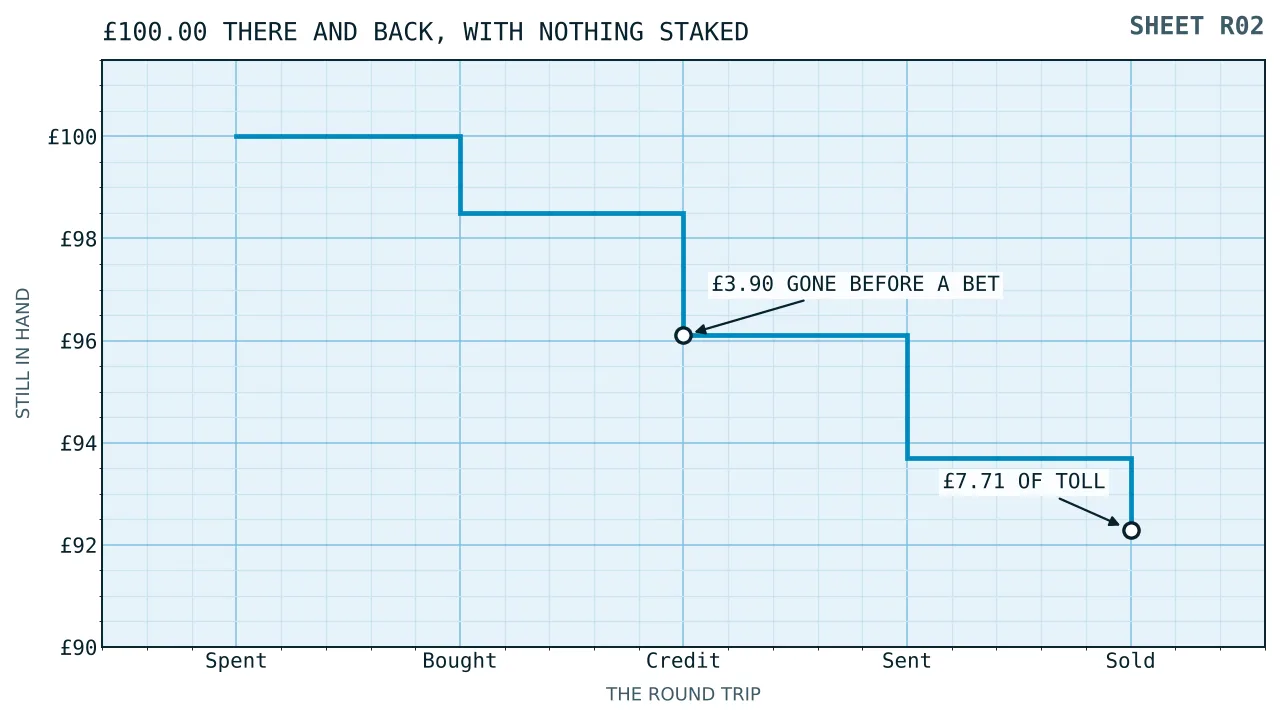
Spend £100.00 on coin and £96.10 reaches the table, on the two charges modelled here. Send the same money back out without placing a bet and £92.29 returns. That £7.71 is the price of the rail, and it is settled before any bonus has been read.
£7.71 of toll on a £100.00 round trip, no bet placed
What is left once the rail is paid
Every destination on this spike is bought advertising. The site takes a fee if a reader goes on to register, and no figure printed below moves because of it.
The Spin Sheet
Till receipt No 01
Betportal
Lowest multiple here
For every €1 of spin credit at face per €1
Credit
Debit
No Great Britain licence
Licensed in Anjouan, Comoros, run by BetPortal Gaming Ltd, with Excite Ultra Media Ltd, reference ALSI-202601040-FI2.
Terms read 15 October 2026
Open the offer at Betportal, opens in a new tabThe Spin Sheet
Till receipt No 02
WinBeast
Five staged matches
For every €1 of spin credit at face per €1
Credit
Debit
No Great Britain licence
Licensed in Curaçao, operator not named on the site.
Terms read 15 October 2026
Open the offer at WinBeast, opens in a new tabThe Spin Sheet
Till receipt No 03
EliteSpin
Longest spin window
For every £1 of spin credit at face per £1
Credit
Debit
No Great Britain licence
Licensed in Costa Rica, run by PrimeTier Limited.
Terms read 15 October 2026
Open the offer at EliteSpin, opens in a new tabThe Spin Sheet
Till receipt No 04
Crown Jewelz
Multiple unpublished
No total struck
Credit
Debit
No Great Britain licence
Licensed in Curaçao, number not verified, operator not named on the site.
Terms read 15 October 2026
Open the offer at Crown Jewelz, opens in a new tabThe figure at the foot of a receipt is this site's own arithmetic and nothing an operator has published: the credit, less the share a spin gives back at 96 per cent return to player, less what playing the wagering through costs at the same return. It describes the offer, not one reader's afternoon. Where the conditions price above the credit the receipt prints nothing rather than a negative sum, and where a figure the sum needs is unpublished it prints the condition in the operator's words instead.
Three words stand in the amount column where no figure can. Noted is a published condition that takes value away without leaving the sum a figure to take. Unpriced is a condition whose figure nobody has published, or a credit that is not a sum until a deposit of your own sets it. Own money is money of yours, which is never part of a total.
Not one of the operators printed above holds a Great Britain licence, so the duties that licence carries do not reach them. Every online gambling company licensed in Great Britain has to be part of Gamstop Online, and a reader who has shut themselves out through the scheme is therefore not shut out here. The ceiling of ten times the bonus funds on a wagering requirement, in force since 19 January 2026, is a condition of that licence and binds the companies that hold one. Where a dispute goes instead is a matter for the authority named on the receipt, and the Gambling Commission describes what a reader faces without a British licence as a lack of recourse if things go wrong. Nobody under 18 may hold an account at any of them.
Every term printed on a receipt is the operator's own, and each receipt carries the day it was read. The oldest of those readings is 15 October 2026. What binds a reader is the operator's own full terms, and not a line printed here.
1
What £100.00 of coin puts on the table
A coin deposit is advertised as the cheap rail and the fast one. Neither claim is tested here. What is tested is the gap between the sum a reader decides to gamble with and the sum the cashier eventually shows, because that gap is spent before a single condition of a bonus has had a chance to apply.
Two charges open it. The first is taken where the coin is bought, as the difference between the price quoted and the price filled, and it is almost never shown as a line on a confirmation. The second is paid to the network that carries the coin from the exchange to the cashier, and it is a flat sum rather than a percentage, which matters more than anything else on this page.
This sheet models the buying charge at 1.5 per cent and the network charge at £2.40 a transfer. Spend £100.00 and £1.50 goes at the exchange, leaving £98.50 of coin. Send that to the cashier and £2.40 goes to the network, so £96.10 is credited. Three pounds ninety has disappeared, and the cashier’s screen will show it as the whole of your deposit.
Both figures are assumptions and are labelled as such deliberately. Nothing in the sourced material behind these pages fixes a spread, a network charge or a confirmation time for any coin. Exchanges publish schedules of their own and networks price themselves by how busy they are, and neither of those qualifies as a source here, so the two numbers above are modelling and should be swapped for whatever your own confirmations say.
Where £100.00 goes on the way in:
- £1.50 at the exchange, taken inside the price rather than beside it.
- £2.40 to the network, flat, whatever the size of the transfer.
- £96.10 credited, and this is the figure every later calculation starts from.
2
The two charges no cashier quotes
Read a banking page at an offshore cashier and the coin column usually says the same thing: no fee. That statement is true and almost useless. The cashier charges nothing, and the cashier is the third party in a chain of three.
The exchange is the first, and its charge hides in the price. A reader who buys at the price shown and sells at the price shown has paid for both sides of the book without ever seeing a number for it. At 1.5 per cent a side, a round trip costs three pence in the pound before the network has been paid anything at all.
The network is the second, and its charge behaves nothing like a percentage. A flat £2.40 is 2.4 per cent of a hundred pounds, 12 per cent of twenty pounds, and 24 per cent of ten. That inversion is the one thing worth carrying away from this page: the smaller the deposit, the more of it the rail eats, and the cashier’s own minimum deposit is often set low enough to make the toll absurd.
| Spent | At the exchange | To the network | Credited | Toll |
|---|---|---|---|---|
| £10.00 | £0.15 | £2.40 | £7.45 | 25.5% |
| £20.00 | £0.30 | £2.40 | £17.30 | 13.5% |
| £50.00 | £0.75 | £2.40 | £46.85 | 6.3% |
| £100.00 | £1.50 | £2.40 | £96.10 | 3.9% |
| £250.00 | £3.75 | £2.40 | £243.85 | 2.5% |
Nothing in that schedule depends on a game, a bonus or a multiple. It is the cost of arriving.
£2.40 flat is 25.5 per cent of a £10.00 deposit and 2.5 per cent of £250.00
3
A match is struck on what arrived
Here is the consequence nobody mentions. A percentage match is calculated on the credited figure, because that is the only figure the cashier can see. So the rail’s charge is paid twice: once out of the deposit and once out of the bonus it would have earned.
Take a hundred per cent match on the deposit in part 1. Credited: £96.10. Matched: £96.10. Balance to play with: £192.20. Had the whole £100.00 reached the table, the balance would have been £200.00. The rail cost £3.90 of money and £3.90 of headline, so £7.80 in total, which is 7.8 per cent of the sum the reader intended to gamble with.
Doubling runs both ways. On a two hundred per cent match the same £3.90 of toll costs £11.70 of balance; on a three hundred per cent match, £15.60. A generous headline magnifies the rail’s charge rather than absorbing it, which is the opposite of how a large percentage is usually sold.
The same effect decides what a deposit has to be to qualify at all. Where a promotion asks for a hundred pounds paid in, a hundred pounds spent will not do it: the credited figure is £96.10 and the offer does not trigger. Clearing a qualifying bar on this rail means spending £104.06 to be credited with a hundred, and a reader who does not know the toll will miss the bar by a margin that looks like a technicality and costs the whole bonus.
4
The line, run on the credited figure
The toll is settled. What is left is the condition, and the condition has a price too.
E = B × (1 – (W × (1 – RTP)) / g)
Four terms, and on a coin rail only one of them holds a surprise. The weighting g is one while slots count in full. RTP is 0.96. W is forty, which is the order of multiple asked for in this corner of the market. B is the surprise: not the hundred pounds that left your account but the £96.10 that reached the table.
In words, before the sums. Forty times an edge of four pence comes to 1.60; a bracket of one less 1.60 closes at minus 0.60; and minus 0.60 of £96.10 is minus £57.66.
In sums, the bonus owes forty lots of £96.10, so £3,844.00 has to pass across the tables. A twenty-fifth of any turnover is what a 96 per cent game is expected to keep, and a twenty-fifth of £3,844.00 is £153.76. Set that beside £96.10 of credit: the overrun is £57.66 and the foot reads £0.00.
Hold the credit still and lower W to ten, the lawful maximum in Britain. Turnover falls to £961.00, the expected cost to £38.44, and the expectation rises to £57.66. Same magnitude, opposite sign, and no coincidence: four times a ceiling costs what the ceiling would have paid.
| Multiple | Turnover | Expected |
|---|---|---|
| 10x | £961.00 | £57.66 |
| 20x | £1,922.00 | £19.22 |
| 25x | £2,402.50 | £0.00 |
| 40x | £3,844.00 | £0.00 |
Twenty-five is where the expectation hits nought, and it gets there because the break-even multiple is one over the house edge and nothing else. The size of the deposit cannot move it. The toll on the rail cannot move it either, which is the one piece of good news on this page: the rail changes how much credit you have, not the multiple at which credit stops being worth anything.
5
The journey home, costed
A withdrawal in coin is the deposit run backwards, and it is charged twice more.
Suppose the best case: the multiple is ten, the condition is cleared, and £57.66 of expectation is sitting in the account. The cashier sends it, and the network takes its flat £2.40, leaving £55.26 of coin. Sell at the exchange and 1.5 per cent goes inside the price, so £54.43 arrives as money. Five and a half per cent of the win has gone on the way out.
Now the plainer measurement, with the games taken out altogether. Spend £100.00, deposit it, change your mind, withdraw the lot: the cashier credits £96.10, the network takes £2.40 going back, the exchange takes 1.5 per cent of what is left, and £92.29 returns. Seven pounds seventy-one for touching nothing.
£100.00 out, £92.29 back, 7.71 per cent for a round trip
Hold that figure against the bonus arithmetic and the proportions become clear. The round-trip toll of £7.71 is larger than the entire expected value of a £10.00 bonus at the regulated ceiling, which is £6.00. On this rail, a small bonus is not worth the journey that collects it.
6
Why the price swing is the smaller worry
Coin pages tend to lead on volatility. It deserves a paragraph rather than a page, because volatility is symmetrical and a toll is not.
A balance held in coin can gain or lose while the condition is being worked off, and over the hours a forty times requirement takes, the sterling value of £96.10 can move either way by a good deal more than the £3.90 the rail charged to get it there. But that movement has no expected sign. Over many deposits it adds nothing and subtracts nothing, which makes it noise around the answer rather than part of it.
The toll has a sign. It is paid every time, in one direction, and on the figures modelled here it comes to £7.71 for a round trip of a hundred pounds. Four round trips cost more than £30.00, and the deposit never changed size.
Where volatility does bite is the unit a condition is written in. If the requirement is expressed in coin, a fall in the price does not reduce the number of units that have to be staked, so the sterling cost of clearing it moves while it is being cleared. A sibling sheet works that effect through in detail at best bitcoin casino, where the denomination is the subject rather than an aside, and usdt casino takes the opposite case, a unit that barely moves against the dollar and still moves against the pound.
7
The rulebook that is not behind this rail
Coin cashiers are, with few exceptions, outside the British system altogether. A site of the sort a search for this rail turns up holds no Great Britain licence, and the honest way to show what that costs is to take the duties that would otherwise apply and price them against the figures above.
Identity, and when it is settled
A British licensee has to know who it is dealing with before anything is staked: condition 17.1.1 makes it obtain and verify the details, and sets a floor of three of them, a name with an address and a date of birth. When those rules were announced, the age test was carried over to bonus-funded play and to the free versions of the games as well. Moving £96.10 down a network needs an address of a different sort and nothing else, which is most of this rail’s appeal and the whole of its exposure. The island policy consulted for this build wants an operator satisfied that a player has turned eighteen before any deposit or wager, and then hangs the document check on its own money-laundering milestones rather than on a first spin.
A ceiling on the multiple
Forty times is not lawful in Britain at all. Since 19 January 2026 no licensee may put wagering above ten times whatever the bonus funds come to, and on a credit of £96.10 that is the distance between £961.00 and £3,844.00 of turnover across the tables. The reason given for the ceiling was that wagering had reached sixty times in places. The offshore policy read here carries nothing of the sort at any figure, so the forty modelled on this page is a commercial choice, and so would eighty be.
A clock on a complaint
Where a payment goes wrong at a licensed cashier the timings are fixed: three working days to acknowledge, cut to twenty-four hours where the tables never shut, eight weeks to finish, and then a route out to one of eight dispute entities on the regulator’s approved list. Six months is the least a player gets to raise the matter at all. Curaçao’s complaints policy sits closer to that than most readers would guess, matching both the six months and the eight weeks, but it allows the operator to write the terms of the escalation, the binding effect on the player and any minimum value a claim must reach among them. A payout of £54.43 is precisely the size of claim a minimum value is there to shut out.
What the regulator says it sees
The Commission’s own description of the unlicensed market is not a general warning but a list: inadequate anti-money-laundering and social responsibility controls, exposure to fraud and to data privacy trouble, and the targeting of people who have self-excluded through the national scheme. Its enforcement team has named blocked payouts and withdrawal limits set so high they cannot be reached. On a rail whose transfers cannot be recalled, a blocked payout is not a dispute. It is an ending.
8
Working out your own toll
Five figures, three of which are on the exchange’s confirmation rather than the cashier’s banking page.
| What to read | Here |
|---|---|
| Money that left the bank | £100.00 |
| Coin held after buying | £98.50 |
| Figure on the cashier screen | £96.10 |
| Turnover the terms demand | £3,844.00 |
| A twenty-fifth of that turnover | £153.76 |
Subtract the third line from the first and you have the entry toll in pounds. Divide it by the first and you have it as a rate, which is the only form in which it can be compared with a bonus percentage. On the figures here that rate is 3.9 per cent going in, and 7.71 per cent for the full return journey.
One caution about the expectation. A positive E is a mean across a great many attempts, and the commonest single outcome of a bonus at the regulated ceiling is nothing whatever. A toll is not a mean. It is taken on the way in and taken again on the way out, and the arithmetic of this page is reliable in exactly the places the arithmetic of the bonus is not.
Other rails in this section price differently and the method does not change. Ethereum casino works the flat toll in detail, since that is where a fixed charge is most visible. Crypto casino no deposit bonus is the case where the toll is larger than the offer. For a rail with a bank behind it instead, visa casino prices the delay rather than the charge. The index at The rail carries the others.
Questions
- How much does a £100 coin deposit really cost?
- On the charges modelled here, £3.90 to arrive and £7.71 for a round trip with no bet placed. A 1.5 per cent charge at the exchange takes £1.50, so £98.50 of coin is bought, and a flat £2.40 goes to the network, so the cashier credits £96.10. Withdrawing the whole balance again costs another £2.40 to the network and another 1.5 per cent at the exchange, which returns £92.29.
- Why do cashiers say coin deposits are free?
- Because the cashier charges nothing, and the cashier is the third party in a chain of three. The exchange takes its charge inside the price it fills, and the network takes a flat sum for carrying the transfer. Neither appears on the banking page, and neither is published by any primary source behind this site, which is why both figures used here are named as modelling rather than fact.
- Does the deposit toll change what a bonus is worth?
- It changes how large the bonus is, and leaves the multiple where credit stops paying exactly as it was. A percentage match is struck on the credited figure, so £3.90 of toll on a £100.00 spend takes £3.90 off a hundred per cent match too, which is £7.80 of balance. Break-even stays at twenty-five times, since that figure is one divided by the house edge and no toll can shift it.
- Is a small coin deposit worth making?
- The schedule in part 2 argues against it. A flat £2.40 is 25.5 per cent of a £10.00 spend, 13.5 per cent of £20.00 and 2.5 per cent of £250.00, so the toll shrinks as the deposit grows. Hold a £10.00 bonus to the British ceiling of ten and its expectation is £6.00, which is less than the £7.71 that a hundred pound round trip costs out here.
- What happens if the coin price moves while I am wagering?
- Nothing with an expected sign. A balance held in coin can gain or lose over the hours a forty times requirement takes, and across many deposits that movement adds and subtracts nothing, so it is noise around the answer. The toll is different: it is paid every time and only in one direction. Where a requirement is written in coin rather than in pounds, a price fall does raise the sterling cost of clearing it.
- Why did my deposit miss the qualifying amount?
- Because a qualifying bar is read against the credited figure. Spend £100.00 on the charges modelled here and £96.10 arrives, so a promotion wanting a hundred pounds paid in does not trigger. Reaching a credited hundred means spending about £104.06. Missing a bar by that margin looks like a technicality and costs the whole bonus.
- What does a 40x requirement cost on a £96.10 credit?
- It demands £3,844.00 of turnover, and a twenty-fifth of that turnover, £153.76, is what a 96 per cent game expects to keep. Against £96.10 of credit the shortfall comes to £57.66 and the foot is £0.00. Lower W to ten, the lawful maximum in Britain, and the same credit demands £961.00 of turnover, costs £38.44 and leaves £57.66 expected.
- What am I giving up by playing at a coin cashier?
- A site reached this way holds no Great Britain licence, so nothing in the British rulebook applies to it. Set against the figures on this page that means no ten times ceiling, so forty is a choice and so is eighty; no requirement to verify a name, an address and a date of birth before play, bonus play included; no fixed clock on a complaint about a payment; and no obligation to join Gamstop Online. Curaçao’s complaints policy does give six months and eight weeks, but it allows the operator to set the terms of escalation, including a minimum claim value.
- Is there any way to recall a transfer once it is sent?
- None. A network transfer carries no sender-side recall at all, and that is the structural difference from paying by debit card. It tells most where a payout is simply never made: enforcement officials at the regulator have described unlicensed sites blocking payments and setting withdrawal limits nobody could reach. On this rail no issuer stands behind the player to pull anything back.