
Sheet R03 Revision 1 Checked 15 October 2026
Best bitcoin casino
Two hundred pounds of coin reaches a cashier as £194.50 on the charges modelled here. A half match on that is £97.25, and clearing forty times it means £3,890.00 across the tables, which takes 27 hours at the slowest legal pace. The unit those hours are counted in is not the pound.
£194.50 credited from £200.00 spent, then 27 hours of unit risk
What survives the chain and the condition
Every destination on this spike is bought advertising. The site takes a fee if a reader goes on to register, and no figure printed below moves because of it.
The Spin Sheet
Till receipt No 01
Betportal
Lowest multiple here
For every €1 of spin credit at face per €1
Credit
Debit
No Great Britain licence
Licensed in Anjouan, Comoros, run by BetPortal Gaming Ltd, with Excite Ultra Media Ltd, reference ALSI-202601040-FI2.
Terms read 15 October 2026
Open the offer at Betportal, opens in a new tabThe Spin Sheet
Till receipt No 02
WinBeast
Five staged matches
For every €1 of spin credit at face per €1
Credit
Debit
No Great Britain licence
Licensed in Curaçao, operator not named on the site.
Terms read 15 October 2026
Open the offer at WinBeast, opens in a new tabThe Spin Sheet
Till receipt No 03
EliteSpin
Longest spin window
For every £1 of spin credit at face per £1
Credit
Debit
No Great Britain licence
Licensed in Costa Rica, run by PrimeTier Limited.
Terms read 15 October 2026
Open the offer at EliteSpin, opens in a new tabThe Spin Sheet
Till receipt No 04
Crown Jewelz
Multiple unpublished
No total struck
Credit
Debit
No Great Britain licence
Licensed in Curaçao, number not verified, operator not named on the site.
Terms read 15 October 2026
Open the offer at Crown Jewelz, opens in a new tabThe figure at the foot of a receipt is this site's own arithmetic and nothing an operator has published: the credit, less the share a spin gives back at 96 per cent return to player, less what playing the wagering through costs at the same return. It describes the offer, not one reader's afternoon. Where the conditions price above the credit the receipt prints nothing rather than a negative sum, and where a figure the sum needs is unpublished it prints the condition in the operator's words instead.
Three words stand in the amount column where no figure can. Noted is a published condition that takes value away without leaving the sum a figure to take. Unpriced is a condition whose figure nobody has published, or a credit that is not a sum until a deposit of your own sets it. Own money is money of yours, which is never part of a total.
Not one of the operators printed above holds a Great Britain licence, so the duties that licence carries do not reach them. Every online gambling company licensed in Great Britain has to be part of Gamstop Online, and a reader who has shut themselves out through the scheme is therefore not shut out here. The ceiling of ten times the bonus funds on a wagering requirement, in force since 19 January 2026, is a condition of that licence and binds the companies that hold one. Where a dispute goes instead is a matter for the authority named on the receipt, and the Gambling Commission describes what a reader faces without a British licence as a lack of recourse if things go wrong. Nobody under 18 may hold an account at any of them.
Every term printed on a receipt is the operator's own, and each receipt carries the day it was read. The oldest of those readings is 15 October 2026. What binds a reader is the operator's own full terms, and not a line printed here.
1
What the word best can mean in pounds
Nobody can rank a cashier for a stranger, and this sheet does not try. What can be done is to say which quantities a comparison would have to be made of, and then to work them out, so that the word stops being an adjective and becomes a column of figures.
On a coin rail there are four such quantities, and only one of them is usually advertised. The advertised one is the headline percentage of the match. The other three are the charge taken where the coin is bought, the flat charge paid to the network for carrying it, and the multiple fastened to the bonus once it lands. A cashier with a smaller headline and a cheaper exit beats a cashier with a larger headline every time, and the figures below show by how much.
The modelling for this sheet runs as follows. Two hundred pounds goes in. The buying charge is 1.2 per cent, taken inside the price rather than shown beside it, so £2.40 goes there and £197.60 of coin is held. Carrying it to the cashier costs a flat £3.10, so £194.50 is credited. A fifty per cent match on that credited figure is £97.25 of bonus, and forty times is the multiple this sheet works at unless a page says otherwise.
Every charge in that paragraph is an assumption. The fact sheet standing behind this site carries no published figure for a spread, a network charge, a block interval or a required count of confirmations, and will not supply one, so each number here is this sheet’s own modelling and is meant to be replaced by the figures printed on your own two confirmations.
The four quantities a comparison actually turns on:
- The buying charge, which is invisible because it sits inside the price.
- The carrying charge, which is flat and therefore brutal on small sums.
- The multiple, which decides whether the credit is worth anything at all.
- The exit, which is charged all over again in the other direction.
2
Two hundred pounds, and what the chain keeps
Three parties handle the money and only the last of them shows a figure to the player. The exchange keeps £2.40. The network keeps £3.10. The cashier keeps nothing at the door and displays £194.50, which it will describe as your deposit.
Five pounds fifty is 2.75 per cent of the sum that left the bank. That rate is not fixed, and the reason it is not fixed is the flat charge in the middle: it is the same £3.10 whether two hundred pounds is sent or twenty.
| Spent | Buying charge | Carrying charge | Credited | Kept by the chain |
|---|---|---|---|---|
| £20.00 | £0.24 | £3.10 | £16.66 | 16.7% |
| £50.00 | £0.60 | £3.10 | £46.30 | 7.4% |
| £100.00 | £1.20 | £3.10 | £95.70 | 4.3% |
| £200.00 | £2.40 | £3.10 | £194.50 | 2.8% |
| £500.00 | £6.00 | £3.10 | £490.90 | 1.8% |
A reader comparing cashiers on the headline alone is comparing the one number that does not move with the size of the deposit, while the three that do go unexamined.
£5.50 kept by the chain on £200.00, and the same £3.10 of it on £20.00
3
A minimum written in a unit that moves
Cashiers on this rail usually set their smallest deposit in the coin rather than in sterling. That looks like a formality and it is not, because a minimum fixed in the unit is a minimum that changes in pounds every hour of every day while the price moves underneath it.
Work it in the direction that matters. Suppose a cashier asks for a smallest deposit worth £50.00 at the moment the figure was set, and suppose the price of the unit then falls by a fifth. The minimum is unchanged in the unit and is now worth £40.00, so the bar has dropped. Let the price rise by a fifth instead and the same minimum wants £60.00, which is a twenty per cent increase in the entrance fee that nobody announced and nobody published.
The qualifying deposit on a bonus behaves the same way, and the trap is sharper because a bonus either triggers or does not. A deposit sent to clear a bar set in the unit can arrive a few pence short of it, after the two charges in part 2, and the promotion then simply does not apply. The money is in the account. The offer is not.
There is a straightforward defence, and it is arithmetic rather than advice. Work out what the cashier’s minimum is worth in pounds at the moment you are about to send, add the carrying charge to it, divide by one less the buying charge, and send that. On the figures modelled here, clearing a credited £194.50 needed £200.00 to leave the bank, and clearing a credited two hundred would have needed £205.57.
4
The half match, priced
Three charges paid, and the condition still unread. The condition is priced by one expression, the same one used throughout this section.
E = B × (1 – (W × (1 – RTP)) / g)
Start with the letter that moves. A fifty per cent match on £194.50 makes it £97.25. W is forty. RTP is 0.96, the figure this site uses for a slot unless a particular game is named. The weighting g holds at one.
Spelled out before it is totalled: an edge of four pence multiplied forty times is 1.60, which turns the bracket into minus 0.60, and six-tenths of £97.25 taken away is minus £58.35.
The two intermediate sums are the ones worth remembering. Turnover demanded is forty lots of £97.25, which is £3,890.00. A game returning 96 per cent keeps a twenty-fifth of whatever crosses it, and a twenty-fifth here comes to £155.60. A condition costing £155.60 is attached to a credit of £97.25, so the credit is exhausted first and the foot is £0.00.
Keep B where it is and bring W down to ten, the furthest a British cashier is allowed. Turnover demanded drops to £972.50, its expected cost to £38.90, and £58.35 is expected to remain. Everything after this part of the sheet happens to that £58.35.
| Multiple | Turnover demanded | Expected to remain |
|---|---|---|
| 10x | £972.50 | £58.35 |
| 20x | £1,945.00 | £19.45 |
| 25x | £2,431.25 | £0.00 |
| 40x | £3,890.00 | £0.00 |
5
Twenty-seven hours of exposure
Turnover is measured in money rather than in spins, and money of that size still has to travel through spins, which take time. On a rail whose balance is denominated in something that moves, time is a term in the calculation.
At a stake of 10p a cycle, the £3,890.00 demanded at forty times is 38,900 cycles. On a slot at a British cashier, 2.5 seconds has to elapse from a game starting before the following cycle may be commenced, which stops 38,900 of them being compressed into less than 97,250 seconds. Call it 27 hours and 50 seconds, and call it a floor rather than an estimate.
Two things follow. The first is that no licensed cashier can shorten it: autoplay is barred outright by the standard on automatic play, which requires a fresh commitment to every single cycle, and the standard on product design forbids turbo, quick spin and slam stop, so the 38,900 cycles are 38,900 separate decisions. The second is that a cashier outside the British system is bound by none of that. Neither the 2.5-second floor nor the bar on automatic play appears in the offshore rulebook consulted for this build, so the same turnover can be put through faster, with the player committing once.
And it is in those hours that the unit moves. Twenty-seven hours of price movement sits on top of £97.25 of credit whose sterling value nobody has fixed.
38,900 cycles, 27 hours and 50 seconds at the 2.5-second floor
6
A drift of six per cent, costed
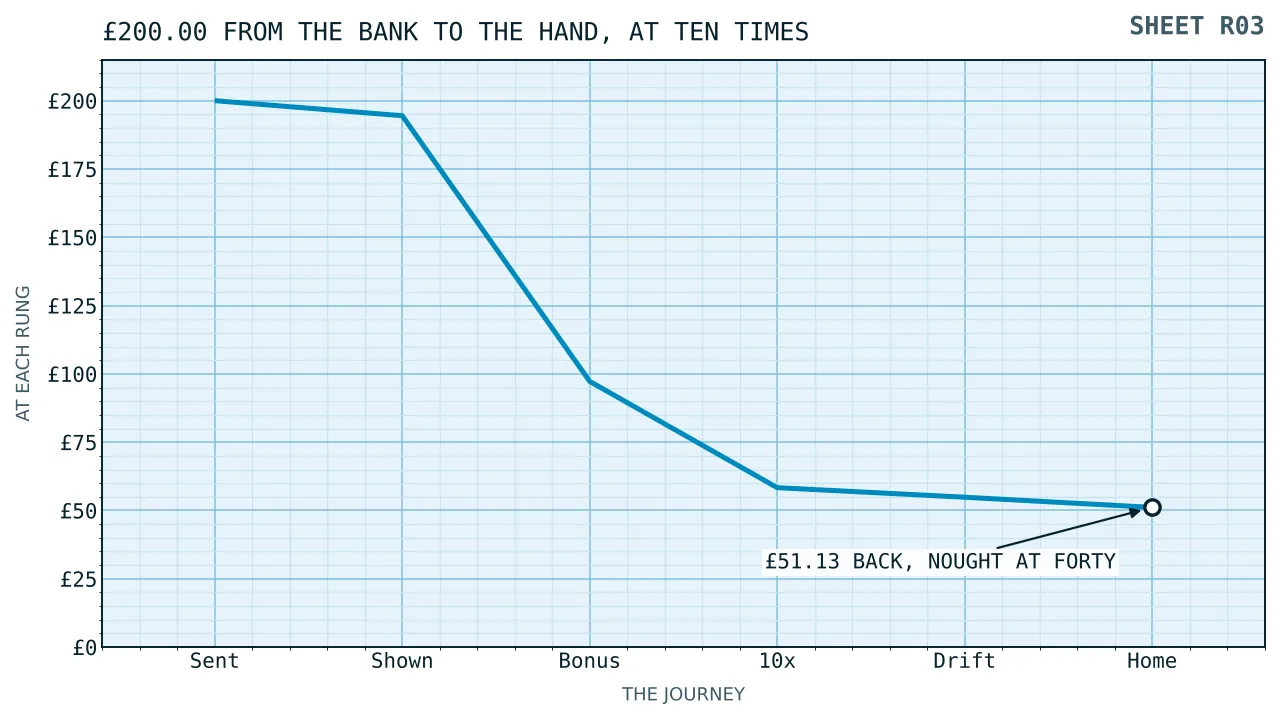
Suppose the best case from part 4: the multiple was ten, the condition is cleared, and £58.35 of expectation stands in the account. Suppose also that the unit has lost six per cent of its sterling price over the day it took to get there. Six per cent is a modelled figure and a modest one.
The balance is denominated in the unit, so its sterling value falls with it: £58.35 becomes £54.85. Then the exit is charged. The network takes its flat £3.10, leaving £51.75 of coin, and the selling charge of 1.2 per cent takes £0.62, so £51.13 arrives as money.
Line the journey up and the arithmetic of this rail is complete. £200.00 was spent; £194.50 was credited; £97.25 of bonus was earned; the best lawful multiple leaves £58.35 of expectation; the drift takes it to £54.85; and the chain hands back £51.13. At the forty times this sheet actually models, the same journey ends at £0.00 and the whole £200.00 is gone.
Drift is symmetrical and the charges are not, which is the proportion a reader should hold on to. A six per cent rise would have added £3.50 rather than taking it away. The £5.50 on the way in and the £3.72 on the way out are certain, in that order, every time.
7
Where the British rulebook would have stood
A cashier that settles in coin is almost never inside the British system, and a site of the sort this search produces holds no Great Britain licence. Rather than assert what that costs, here are four rules with this page’s own figures put through them.
The multiple, capped at a quarter of what is modelled
A British cashier may not require wagering of more than ten times a bonus, a limit dated 19 January 2026. On £97.25 that is a demand for £972.50 of turnover instead of £3,890.00, and an expectation of £58.35 instead of nothing. The regulator set the figure after finding wagering as high as sixty times in use, which on this bonus would be £5,835.00 across the tables. No ceiling of any size is written into the island rulebook consulted here.
The pace, and the stake per cycle
Two British rules would have governed part 5. The 2.5-second floor between slot cycles is one; a statutory cap on the stake is the other, at £5.00 a cycle from the age of twenty-five and £2.00 below it, in force from 9 April and 21 May 2025 respectively and confined to online slots rather than to casino games generally. Neither pace nor stake is limited anywhere in the offshore policy read for this build, so the £3,890.00 could be put across in large stakes at speed, which shortens the exposure and raises the variance.
Who you are, and when they ask
Before a wager is placed at a licensed cashier, condition 17.1.1 wants the player’s particulars obtained and checked, and the three it insists on are a date of birth, a name and an address. The same condition stops the request being held back for the moment of a payout. A coin deposit carries none of that, and on the way back out it is the cashier that decides when to ask.
The scheme, and what it cannot reach
A British licence is the thing that puts a company inside Gamstop Online, and that is why the scheme is careful to publish its own boundary: a registration does not reach a company that never joined it. The island policy requires self-exclusion from one operator and its domains, not from a register, and it starts at a year. Nothing on this sheet helps anybody around a block, and the numbers for help are at the foot.
8
Reading your own two confirmations
The figures that decide this page are not on the cashier’s banking screen. They are on the exchange’s fill and on the network’s transaction record, and both are available to anybody who looks.
| Where to look | Reading |
|---|---|
| Bank statement, debit | £200.00 |
| Exchange fill, after the spread | £197.60 |
| Network record, fee paid | £3.10 |
| Cashier screen, balance | £194.50 |
| Bonus terms, the multiple | 40x |
| Turnover that implies | £3,890.00 |
Take the fourth reading from the first for the entry toll. Divide the last by twenty-five for the expected cost of the condition. Those two numbers, side by side, are the comparison the word in this page’s title is reaching for, and they are usually an order of magnitude apart: £5.50 of toll against £155.60 of condition.
Which is the finding, put plainly. The rail is the smaller of the two debits on a deposit of this size, and it is still larger than most readers assume. The multiple is where the money actually goes, and the unit the hours are counted in is a third thing again, uncertain in both directions rather than merely expensive.
Neighbouring sheets run the identical method on the rails next door. Crypto casino prices the round trip with no bet placed at all. Ethereum casino is the clearest case of a flat charge, since there it is quoted in a unit of its own. Usdt casino removes the price movement and leaves the currency leg standing, which is instructive. The section index at The rail lists the rest.
Questions
- How do I compare bitcoin cashiers without guessing?
- On four quantities rather than one. The headline percentage is the advertised figure; the other three are the charge taken where the coin is bought, the flat charge paid for carrying it, and the multiple fastened to the bonus. On the modelling here £200.00 spent becomes £194.50 credited, a fifty per cent match makes £97.25 of bonus, and forty times that bonus demands £3,890.00 of turnover costing £155.60. A smaller headline with a cheaper exit beats a larger headline most of the time.
- Why was my deposit a few pence short of the bonus minimum?
- Because the bar is read against the credited figure, and two charges stand between the money leaving your bank and the figure the cashier sees. Here £2.40 goes inside the buying price and a flat £3.10 goes to the network, so £200.00 arrives as £194.50. To clear a credited two hundred you would have had to send £205.57. The money is in the account either way, but the promotion does not apply.
- Does a minimum deposit quoted in coin change over time?
- In pounds it changes constantly, because the unit does. A minimum worth £50.00 when it was set is worth £40.00 after a fifth is knocked off the price and £60.00 after a fifth is added. Nobody announces that and no cashier publishes it. The defence is arithmetic: price the minimum in pounds at the moment of sending, add the carrying charge, and divide by one less the buying charge.
- What does forty times cost on a £97.25 bonus?
- It demands £3,890.00 of turnover. A game returning 96 per cent keeps a twenty-fifth of whatever crosses it, which is £155.60 here, so the credit is exhausted long before the condition is and the foot reads £0.00. Bring the multiple down to the British ceiling of ten and the demand is £972.50 of turnover, the expected cost £38.90, and £58.35 is expected to remain.
- How long does a 40x requirement actually take?
- At 10p a cycle, £3,890.00 of turnover is 38,900 cycles. On a slot at a British cashier 2.5 seconds must elapse from a game starting before the next cycle may be commenced, so 38,900 of them take at least 97,250 seconds, which is 27 hours and 50 seconds. Automatic play is barred, and turbo and slam stop with it, making those 38,900 separate decisions. None of that reaches a cashier outside the British system.
- How much does a six per cent price fall cost me?
- On the best case worked here, £3.50. An expectation of £58.35 held in the unit becomes £54.85 after a six per cent fall, and then the exit takes a flat £3.10 and a selling charge of £0.62, so £51.13 arrives. A six per cent rise would have added £3.50 instead. The drift has no expected direction; the £5.50 going in and the £3.72 coming out are certain.
- Is the rail or the bonus the bigger cost?
- At this size, the bonus condition by a wide margin. The chain keeps £5.50 of a £200.00 deposit, which is 2.75 per cent, while forty times on the resulting £97.25 of bonus carries an expected cost of £155.60. The toll is the certain debit and the condition is the large one, and a reader who prices only the first has looked at the smaller number.
- What protections does a coin cashier not owe me?
- A site found through a search of this kind holds no Great Britain licence, so four things in particular are absent. Wagering is not capped at ten times, dated 19 January 2026, so forty is a choice. The 2.5-second pace floor and the slot stake caps of £5.00 from twenty-five and £2.00 below it, live from 9 April and 21 May 2025, do not apply. Identity need not be settled before play under condition 17.1.1. And there is no obligation to belong to Gamstop Online, whose own terms say a registration cannot reach companies outside the scheme.