
Sheet R05 Revision 1 Checked 15 October 2026
Usdt casino
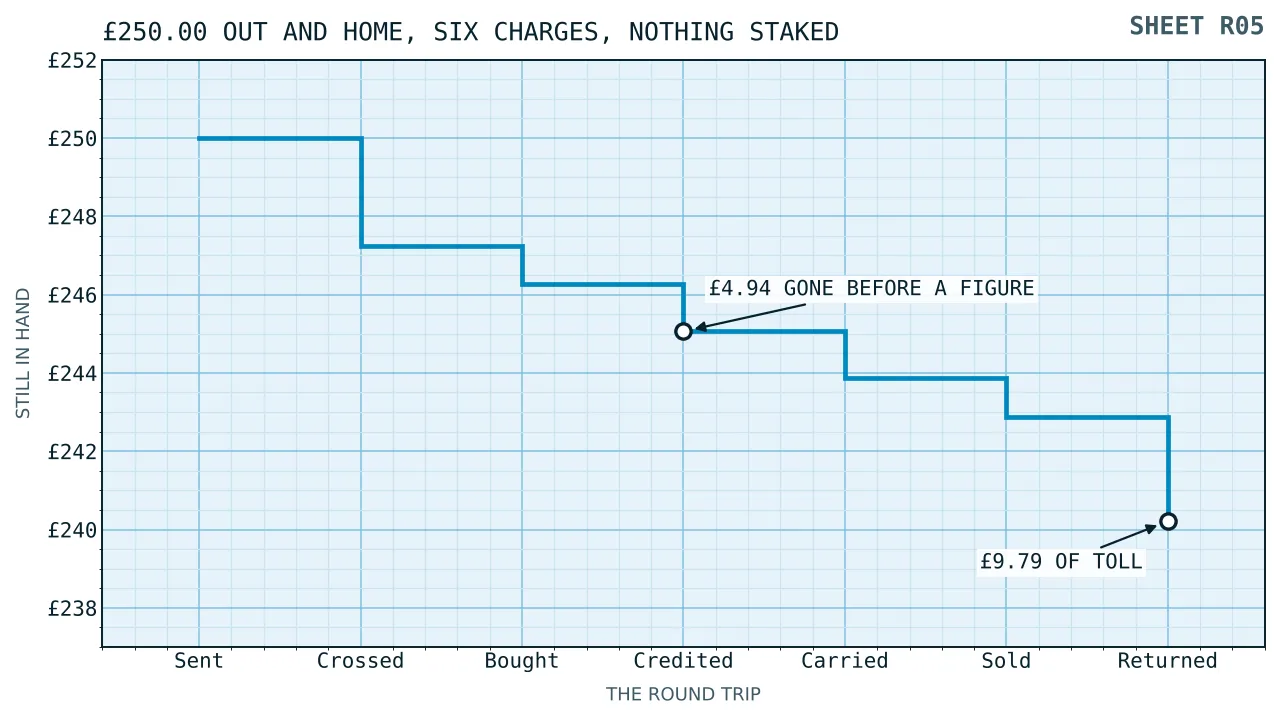
A unit that holds its value against the dollar still has to be bought with pounds. Send £250.00 and £245.06 is credited; bring it home untouched and £240.21 comes back. That £9.79 is the currency leg, and the stability of the unit does nothing about it.
£9.79 to carry £250.00 in and out again, 3.92 per cent
What the currency leg leaves to price
Every destination on this spike is bought advertising. The site takes a fee if a reader goes on to register, and no figure printed below moves because of it.
The Spin Sheet
Till receipt No 01
Betportal
Lowest multiple here
For every €1 of spin credit at face per €1
Credit
Debit
No Great Britain licence
Licensed in Anjouan, Comoros, run by BetPortal Gaming Ltd, with Excite Ultra Media Ltd, reference ALSI-202601040-FI2.
Terms read 15 October 2026
Open the offer at Betportal, opens in a new tabThe Spin Sheet
Till receipt No 02
WinBeast
Five staged matches
For every €1 of spin credit at face per €1
Credit
Debit
No Great Britain licence
Licensed in Curaçao, operator not named on the site.
Terms read 15 October 2026
Open the offer at WinBeast, opens in a new tabThe Spin Sheet
Till receipt No 03
EliteSpin
Longest spin window
For every £1 of spin credit at face per £1
Credit
Debit
No Great Britain licence
Licensed in Costa Rica, run by PrimeTier Limited.
Terms read 15 October 2026
Open the offer at EliteSpin, opens in a new tabThe Spin Sheet
Till receipt No 04
Crown Jewelz
Multiple unpublished
No total struck
Credit
Debit
No Great Britain licence
Licensed in Curaçao, number not verified, operator not named on the site.
Terms read 15 October 2026
Open the offer at Crown Jewelz, opens in a new tabThe figure at the foot of a receipt is this site's own arithmetic and nothing an operator has published: the credit, less the share a spin gives back at 96 per cent return to player, less what playing the wagering through costs at the same return. It describes the offer, not one reader's afternoon. Where the conditions price above the credit the receipt prints nothing rather than a negative sum, and where a figure the sum needs is unpublished it prints the condition in the operator's words instead.
Three words stand in the amount column where no figure can. Noted is a published condition that takes value away without leaving the sum a figure to take. Unpriced is a condition whose figure nobody has published, or a credit that is not a sum until a deposit of your own sets it. Own money is money of yours, which is never part of a total.
Not one of the operators printed above holds a Great Britain licence, so the duties that licence carries do not reach them. Every online gambling company licensed in Great Britain has to be part of Gamstop Online, and a reader who has shut themselves out through the scheme is therefore not shut out here. The ceiling of ten times the bonus funds on a wagering requirement, in force since 19 January 2026, is a condition of that licence and binds the companies that hold one. Where a dispute goes instead is a matter for the authority named on the receipt, and the Gambling Commission describes what a reader faces without a British licence as a lack of recourse if things go wrong. Nobody under 18 may hold an account at any of them.
Every term printed on a receipt is the operator's own, and each receipt carries the day it was read. The oldest of those readings is 15 October 2026. What binds a reader is the operator's own full terms, and not a line printed here.
1
Stable against the dollar, and that is all
A dollar-referenced unit is sold on one property: it does not move. That property is real, it is narrower than it sounds, and the gap between the claim and the property is where this sheet does its work.
What the unit holds steady is its relationship with the dollar. A British player does not hold dollars. Pounds have to become dollars before they can become the unit, and the unit has to become dollars again before it can become pounds, and each of those two crossings is priced by somebody. Removing the price swing of a volatile coin does not remove the currency, it isolates it.
So this is a page about a charge with a sign on it rather than a risk with two directions. A volatile coin can go up as easily as down while a condition is being cleared. A currency crossing has never in its life refunded anybody. It is taken going out and taken coming back, which makes it the most predictable debit in this whole section.
Three charges are modelled here and all three are assumptions. The crossing between sterling and dollars is set at 1.1 per cent, the exchange’s own charge for turning the one into the other at 0.4 per cent, and the network charge for carrying the unit at a flat £1.20. A conversion spread sits nowhere in the sourced record behind this site and neither does a network charge, so these are this sheet’s figures, offered to be replaced by whatever your own statements show.
Two risks, often confused, and only one of them has a sign:
- A price swing, which is as likely to help as to hurt and averages out across many deposits.
- A currency crossing, which is charged in one direction only and is charged again on the way home.
2
Three charges and a currency, on £250.00
Follow £250.00 along the chain in the order it is actually charged.
The sterling leaves a bank and crosses into dollars, and 1.1 per cent of it stays behind: £2.75 gone, £247.25 left. Those dollars buy the unit, and 0.4 per cent goes at the exchange: £0.99 gone, £246.26 left. The unit is carried to the cashier for a flat £1.20, so £245.06 is credited.
Four pounds ninety-four has gone, which is 1.98 per cent of the deposit, and not one line of it appears on the cashier’s banking page. The cashier charged nothing. It is the two crossings and the carriage that charged, and they charged before any bonus had been applied to anything.
| Sent | Currency leg | Exchange | Carriage | Credited |
|---|---|---|---|---|
| £25.00 | £0.28 | £0.10 | £1.20 | £23.42 |
| £50.00 | £0.55 | £0.20 | £1.20 | £48.05 |
| £250.00 | £2.75 | £0.99 | £1.20 | £245.06 |
| £1,000.00 | £11.00 | £3.96 | £1.20 | £983.84 |
The carriage shrinks as a proportion and the two crossings do not, which is the opposite of the pattern on a volatile coin. Here the percentage charges dominate at every size above about fifty pounds, and they are the charges a reader can neither see nor avoid by depositing less often.
£4.94 of £250.00 gone before the cashier has shown a figure
3
The match on £245.06
A cashier matches its own screen, and its screen says £245.06. A hundred per cent match therefore adds £245.06 of bonus rather than £250.00, so the currency leg has quietly cost £9.88 of balance on a deposit where it took £4.94 of money.
Nobody notices four pounds ninety-four on two hundred and fifty. The reason to notice is what the figure does next: it is multiplied by the headline, and then whatever survives is multiplied by the multiple. A hundred per cent match doubles it, a two hundred per cent match trebles it, and at three hundred per cent the same crossing has cost £19.76 of balance.
It also decides whether a tier is reached at all. Offers at this end of the market tend to step: one percentage up to a figure, a better one above it. A deposit sent to land exactly on a step will land under it, because the step is read against the credited figure. Reaching a credited £250.00 on these charges takes £255.04 out of a bank account, and the five pounds of difference is the price of the tier.
4
What a steady unit does not fix
Everything so far has been currency. The condition is a separate debit, and the debit is struck by this.
E = B × (1 – (W × (1 – RTP)) / g)
Look at W, since that is where a steady unit stops being any help. B is £245.06, the credited figure matched in full. RTP is 0.96. The weighting g is one, slots at their whole value. W is forty, which is the kind of multiple written into terms away from the British register.
Put into words: forty multiplied by an edge of four pence is 1.60; the bracket therefore holds minus 0.60; and 0.60 of £245.06 is £147.04, with a minus in front of it.
The working figures are these. Forty lots of £245.06 is £9,802.40 of wagering owed before a withdrawal is permitted. Divide any turnover by twenty-five and you have the expected loss on a 96 per cent game, so the expected loss here is £392.10. Against £245.06 of bonus, the condition costs about one and three fifths of the bonus itself, and £0.00 survives to the foot.
A licensee in Britain stops at ten, by a code provision that took effect on 19 January 2026. At ten the wagering owed is £2,450.60, the expected loss £98.02, and the expectation £147.04 in the player’s favour. Nine thousand eight hundred pounds of wagering and two and a half thousand are not variations on a theme. They are different products with the same headline.
| Multiple | Wagering owed | Expectation |
|---|---|---|
| 10x | £2,450.60 | £147.04 |
| 20x | £4,901.20 | £49.01 |
| 25x | £6,126.50 | £0.00 |
| 40x | £9,802.40 | £0.00 |
Nought arrives at twenty-five whatever the deposit, because the multiple that wipes out a credit is one divided by the house edge. A steady unit cannot move that figure. Nor can a volatile one. It is a property of the game and not of the rail.
5
Home again, at £9.79 for standing still
Take the best lawful case. The multiple was ten, the wagering is finished, and £147.04 of expectation stands in the account.
Carriage out takes £1.20, leaving £145.84. The exchange takes 0.4 per cent turning the unit back into dollars: £145.26. The crossing back into sterling takes 1.1 per cent: £143.66 arrives. Three pounds thirty-eight of the win went on getting it home, which is 2.3 per cent.
Now take the case with no gambling in it at all, which is the cleanest measurement of a rail there is. Send £250.00, have £245.06 credited, change your mind and withdraw the lot. Carriage, exchange and crossing take £1.20, then £0.98, then £2.67, and £240.21 returns.
£250.00 there and back is £9.79, and nothing was staked
Nine pounds seventy-nine is 3.92 per cent of the deposit for touching nothing. Set it beside the figure a reader is likely to be comparing cashiers on. A hundred per cent match looks like a hundred per cent of value and prices, at forty times, at nought. The round trip prices at minus £9.79 and prices there every single time.
6
Which link in the chain is worth changing
Three charges, and they do not reward the same attention.
The carriage is the one readers worry about and the smallest of the three above fifty pounds. On £250.00 it is £1.20, which is 0.48 per cent, and it halves again as a rate every time the deposit doubles. Choosing a cheaper chain to carry the unit saves pennies at this size.
The exchange charge is middling: £0.99 on the way in and £0.98 on the way out, so about £1.97 for the pair.
The currency crossing is the large one. £2.75 going out and £2.67 coming back is £5.42, well over half the whole toll, and it is the charge nobody looks for because it is taken inside a rate rather than shown as a fee. A reader who wants to know what this rail costs should start with the two crossings and treat the rest as rounding.
And the comparison that puts all three in proportion: the condition. Forty times on £245.06 carries an expected loss of £392.10, which is forty times the entire round-trip toll. The rail is the certain debit; the multiple is the enormous one. A page that priced only the rail would have been looking at two per cent of the problem.
7
What follows the player, and what stays behind
Where this unit is accepted the cashier holds no Great Britain licence, with rare exceptions, and the position is worth stating precisely rather than loudly. One thing does follow a British player offshore. Several things do not.
The thing that follows
British gaming duty is fixed by where the player lives and not by where the paperwork was issued. Offer remote gaming to a person whose ordinary home is in this country and the charge applies, from anywhere, levied on the operator’s profit, which is stakes taken less winnings handed back, at 40 per cent from April 2026. Registration is generally required of an operator abroad, along with an approved representative here unless it sits in an exempt jurisdiction. So a cashier taking £245.06 off a British resident is inside the tax net while standing outside the licensing one.
The things that stay behind
Everything owed to the player, which is the part that matters here. Ten instead of forty as the multiple, worth the distance between £2,450.60 and £9,802.40 of wagering owed on this bonus. A prohibition on terms that dole a balance out in instalments, of which the regulator prints one example: fifty pounds in a day, five hundred in a week. A rule that a cashier may not hand a requested withdrawal back to be cancelled. And an identity settled ahead of a first wager rather than at a payout.
Two further absences belong on a page about a chain of three parties. Games from licensed suppliers have been found running on unlicensed sites, which the Commission has said in terms, so a familiar game on a lobby proves nothing whatever about who is holding the money. There is a price attached to the point as well. A supplier agreed in July 2026 to pay £4.75m, its games having shown up on six websites that carried no licence and were reachable from Britain all the same.
The scheme, and its published boundary
British licensing is what enrols a company in Gamstop Online, which is why the scheme publishes the limit of its own reach: it cannot stand between a registered person and a company that is not a member. The island policy read for this build asks for self-exclusion at the level of an operator and its own domains, starting at a year and running to a lifetime, and it cannot be revoked part way through. Nothing in this section helps anyone past a block, and the help lines are at the foot of the sheet.
8
Reading your own currency leg
The charge this page is about is the hardest of the three to see, because it is never written as a charge. It is the difference between two rates, and finding it takes one subtraction.
| Reading | Here |
|---|---|
| Sterling that left the account | £250.00 |
| Units bought, valued in sterling | £246.26 |
| Figure the cashier displayed | £245.06 |
| Sterling back after a full withdrawal | £240.21 |
Take the second reading from the first and you have the crossing plus the exchange. Take the third from the second and you have the carriage. Take the fourth from the first and you have the whole cost of the rail, in pounds, with no gambling anywhere in the calculation. On these figures that last subtraction gives £9.79.
One caution, which applies to every expectation across this site. A positive E is a mean taken over a great many attempts, while the likeliest single outcome of a bonus at any multiple is nothing. Tolls do not behave like that. The toll is the only certainty on the page, and the certainty points the wrong way.
Comparable sheets: crypto casino for the rail with the price swing left in, ethereum casino for the case where a flat charge decides everything, and skrill/neteller/trustly casino for the same journey made through a wallet and a bank instead of a network. The rest of the section is indexed at The rail.
Questions
- If the unit is stable, why does the rail cost anything?
- Because stability is measured against the dollar and a British player holds pounds. Sterling has to cross into dollars before it can buy the unit, and the unit has to go back the same way to become sterling again. On the charges modelled here that crossing takes £2.75 of £250.00 going out and £2.67 coming back, which is £5.42 and more than half the whole toll.
- What reaches the table from a £250 deposit?
- £245.06. The currency crossing takes 1.1 per cent, so £2.75 goes and £247.25 remains; the exchange takes 0.4 per cent, so £0.99 goes and £246.26 remains; and carriage takes a flat £1.20. That is £4.94 in total, or 1.98 per cent, and none of it appears on the cashier’s banking page because the cashier charged nothing.
- What does a round trip cost with no bet placed?
- £9.79, which is 3.92 per cent of £250.00. Deposit and the chain keeps £4.94; withdraw the whole balance and carriage takes £1.20, the exchange £0.98 and the crossing back into sterling £2.67, so £240.21 returns. It is the cleanest measurement of a rail available, because no game is involved in it.
- Does a stablecoin reduce the wagering requirement?
- Not by a penny. A multiple belongs to the bonus terms and a break-even belongs to the game, and a break-even sits at one divided by the edge, which with four pence of edge is twenty-five. Forty times on £245.06 owes £9,802.40 of wagering and an expected loss of £392.10, and the steadiness of the unit has no bearing on either number.
- How much does the match lose to the rail?
- Twice what the deposit loses. The match is calculated from the displayed balance, which is £245.06, so £245.06 of bonus is added where £250.00 was intended, and the £4.94 the chain kept turns into £9.88 of balance that never existed. Two hundred per cent makes it £14.82 and three hundred per cent £19.76. A bigger headline enlarges the hole along with everything else.
- Why did my deposit fall short of a bonus tier?
- Because a tier is read against the credited figure, not against what left your bank. Sending exactly £250.00 credits £245.06, so a tier set at two hundred and fifty is missed. Clearing a credited £250.00 takes £255.04 out of the account on these charges. The money is in the balance either way; the better percentage is not.
- Which of the three charges is worth shopping around for?
- The currency crossing, by a wide margin. Carriage is £1.20 on £250.00, which is 0.48 per cent and halves as a rate each time the deposit doubles. The exchange takes about £1.97 for the pair of legs. The crossing takes £5.42 of the £9.79, and it is the one charge never written as a fee, because it hides inside a rate.
- Does an offshore cashier escape British tax?
- No, and the tax is one of the few things that does travel with a British player. Gaming sold to a person whose ordinary home is in this country attracts the duty from wherever it is sold, charged on the operator’s profit, which is stakes taken less winnings handed back, at 40 per cent from April 2026, with registration and usually an approved representative in this country required. Revenue crosses. The player’s protections stay put.
- What protections am I without on this rail?
- Where this unit is accepted the cashier holds no Great Britain licence, so four protections in particular are missing. The multiple is not held to ten, which is how forty times and £9,802.40 of wagering owed become possible where £2,450.60 would have been the limit. Nothing bars a term that doles a balance out in instalments, and the British example of a forbidden one allows fifty pounds in a day and five hundred in a week. A requested withdrawal may be handed back for cancellation. And the identity check may wait until a payout is asked for.