
Sheet R07 Revision 1 Checked 15 October 2026
Credit card casino
Borrowed money arrives whole and bills later. A £45.00 draw carries a modelled £3.90 of cost behind it, which is 8.7 per cent of the deposit before a reel has turned. Matched in full, the same £45.00 is expected to leave £27.00 where the multiple stops at ten and nothing at all where it reads forty.
£3.90 of cost behind a £45.00 draw, 8.7 per cent before the first spin
What borrowing costs before the terms begin
Every destination on this spike is bought advertising. The site takes a fee if a reader goes on to register, and no figure printed below moves because of it.
The Spin Sheet
Till receipt No 01
Betportal
Lowest multiple here
For every €1 of spin credit at face per €1
Credit
Debit
No Great Britain licence
Licensed in Anjouan, Comoros, run by BetPortal Gaming Ltd, with Excite Ultra Media Ltd, reference ALSI-202601040-FI2.
Terms read 15 October 2026
Open the offer at Betportal, opens in a new tabThe Spin Sheet
Till receipt No 02
WinBeast
Five staged matches
For every €1 of spin credit at face per €1
Credit
Debit
No Great Britain licence
Licensed in Curaçao, operator not named on the site.
Terms read 15 October 2026
Open the offer at WinBeast, opens in a new tabThe Spin Sheet
Till receipt No 03
EliteSpin
Longest spin window
For every £1 of spin credit at face per £1
Credit
Debit
No Great Britain licence
Licensed in Costa Rica, run by PrimeTier Limited.
Terms read 15 October 2026
Open the offer at EliteSpin, opens in a new tabThe Spin Sheet
Till receipt No 04
Crown Jewelz
Multiple unpublished
No total struck
Credit
Debit
No Great Britain licence
Licensed in Curaçao, number not verified, operator not named on the site.
Terms read 15 October 2026
Open the offer at Crown Jewelz, opens in a new tabThe figure at the foot of a receipt is this site's own arithmetic and nothing an operator has published: the credit, less the share a spin gives back at 96 per cent return to player, less what playing the wagering through costs at the same return. It describes the offer, not one reader's afternoon. Where the conditions price above the credit the receipt prints nothing rather than a negative sum, and where a figure the sum needs is unpublished it prints the condition in the operator's words instead.
Three words stand in the amount column where no figure can. Noted is a published condition that takes value away without leaving the sum a figure to take. Unpriced is a condition whose figure nobody has published, or a credit that is not a sum until a deposit of your own sets it. Own money is money of yours, which is never part of a total.
Not one of the operators printed above holds a Great Britain licence, so the duties that licence carries do not reach them. Every online gambling company licensed in Great Britain has to be part of Gamstop Online, and a reader who has shut themselves out through the scheme is therefore not shut out here. The ceiling of ten times the bonus funds on a wagering requirement, in force since 19 January 2026, is a condition of that licence and binds the companies that hold one. Where a dispute goes instead is a matter for the authority named on the receipt, and the Gambling Commission describes what a reader faces without a British licence as a lack of recourse if things go wrong. Nobody under 18 may hold an account at any of them.
Every term printed on a receipt is the operator's own, and each receipt carries the day it was read. The oldest of those readings is 15 October 2026. What binds a reader is the operator's own full terms, and not a line printed here.
1
The one rail a British cashier refuses
Every other way of paying in has a price in pence. This one has a price in pence only where nobody licensed is standing behind the cashier, because in Britain the method is not accepted at all. Under licence condition 6.1.2 a licensee may not settle a gamble from a credit card, and the bar dates from 14 April 2020.
So the cost of arriving here splits in two. At a licensed cashier it is not a charge but a refusal, and £45.00 of borrowed money simply does not reach the table. Away from the register it is a charge, and the rest of this sheet prices it.
The prohibition is wider than most readers assume, and listing it backwards makes the shape clearer. Outside it sit host licences, gambling software licences and the gaming machine technical kind. Inside it sit the non-remote licences for betting intermediation, for pool betting and for general betting, and every remote licence there is, the ancillary remote lottery and ancillary remote betting ones included. Put a money service business into the chain and the position does not move, since the condition’s second sentence names that route as well.
Where the card is accepted at all, the cashier behind it holds no Great Britain licence. What goes missing with it is itemised rather than vague. Nobody out there is held to a ten times ceiling on a wagering requirement, nobody must establish where a customer lives, when they were born and what they are called before the first spin, nobody belongs to the national self-exclusion scheme, and nobody is obliged to pass an unresolved complaint to an adjudicator a British regulator has approved. The card is the least of what changes.
Why borrowing is the odd rail in this section:
- Every other charge here is a deduction, taken out of the deposit on the way past.
- This one is a debt, added behind the deposit and payable later.
- So the deposit looks whole on the cashier’s screen while the cost is still accruing somewhere else.
2
£3.90 standing behind a £45.00 draw
Two charges are modelled here and both are assumptions, stated so a reader can swap in the figures on their own statement. The first is a handling charge on a cash-like draw, set at three per cent of the sum or £3.00, whichever comes out larger. The second is interest from the day of the draw with no interest-free window, set at two per cent a month.
No source this site may cite publishes either figure, and no cashier publishes them because neither is the cashier’s to publish. They belong to the card, which is the whole oddity of the rail: the party charging for the journey is not the party at the other end of it.
On £45.00 the handling charge is £3.00, because three per cent of forty-five pounds is £1.35 and the floor is the bigger number. A month of interest adds £0.90. Total cost of arriving: £3.90 against a deposit of £45.00, which is 8.7 per cent, and £3.00 of that £3.90 would have been charged on a draw of any size.
Nothing is deducted on the way in. The cashier shows £45.00 and will match £45.00, so this is the one rail in the section where the bonus is calculated on the full sum the reader intended to deposit. The charge turns up on a statement afterwards, which is why it is so often left out of the sum altogether.
3
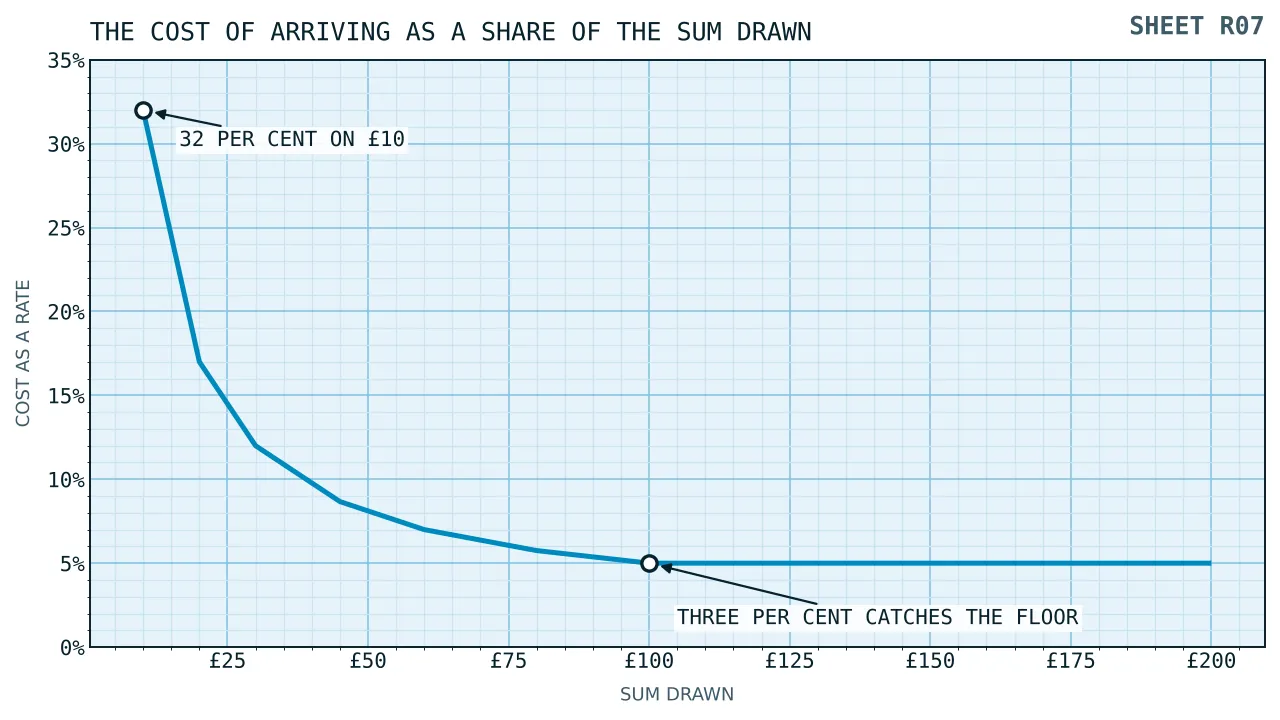
A floor of £3.00 makes the rate climb
A percentage charge keeps its rate whatever the sum. A floor underneath a percentage keeps its amount instead, and the rate then rises as the deposit shrinks. The two behave as one charge up to the point where they cross, and on these figures they cross at a hundred pounds exactly.
| Drawn | Handling | A month of interest | Cost of arriving | As a rate |
|---|---|---|---|---|
| £10.00 | £3.00 | £0.20 | £3.20 | 32.0% |
| £20.00 | £3.00 | £0.40 | £3.40 | 17.0% |
| £45.00 | £3.00 | £0.90 | £3.90 | 8.7% |
| £100.00 | £3.00 | £2.00 | £5.00 | 5.0% |
| £200.00 | £6.00 | £4.00 | £10.00 | 5.0% |
Below a hundred pounds the reader sets the rate by choosing the sum, and the cashier has nothing to do with it. Above a hundred pounds the rate settles and stops falling, because from there on both charges are proportions and proportions do not care how big the number is.
The handling charge is also levied once per draw rather than once per evening, which prices the habit of topping up. Three draws of £15.00 meet the floor three times and hand the card £9.00 of handling where a single draw of £45.00 hands it £3.00. Same money on the table, same evening, and £6.00 of difference to show for it.
A £3.00 floor is 30 per cent of £10.00 and 3 per cent of £100.00
4
£27.00 at ten times, nothing at forty
Now the bonus. A full match on £45.00 credits £45.00, slots return 96 per cent as they do on every sheet here, and the multiple is the only quantity left to vary. Forty times is the order of multiple that terms reach for where no British register applies, and ten, the licensed ceiling, is kept alongside it for scale.
| Multiple | Turnover owed | Expected cost of it | Left standing | After the £3.90 |
|---|---|---|---|---|
| 10x | £450.00 | £18.00 | £27.00 | £23.10 |
| 20x | £900.00 | £36.00 | £9.00 | £5.10 |
| 25x | £1,125.00 | £45.00 | £0.00 | minus £3.90 |
| 40x | £1,800.00 | £72.00 | £0.00 | minus £3.90 |
Read the last column rather than the one before it. The fourth column is what the bonus is expected to be worth; the fifth is what the whole transaction is expected to be worth, borrowing included, and only the fifth is the question a reader actually faces. At twenty-five times the credit dies exactly, because twenty-five lots of four per cent is a hundred per cent of it, and from that multiple onwards the £3.90 is the only figure left on the sheet.
The overrun at forty times is worth naming too. The expected cost of £1,800.00 of turnover is £72.00, and the credit stands at £45.00, so £27.00 of the expected cost has nothing to come out of except the reader’s own deposit. That is the mechanism by which a bonus becomes a charge on the money it was attached to.
5
The line, with the entrance charge outside it
One expression settles what a credit is worth, and it has not changed from one of these sheets to the next.
E = B × (1 – (W × (1 – RTP)) / g)
Borrowing is absent from it, and so the credit stands at £45.00 undiminished, nothing having been taken out on the way in. W is the multiple the terms fasten to it, the return sits at 0.96, and the weighting is one, so slots count pound for pound against the condition.
Substituting forty: four pence of edge, multiplied by that forty, comes to 1.60, which drives the whole expression to minus six-tenths, and six-tenths of £45.00 is £27.00 travelling the wrong way. Negative expectation does not mean a negative balance, since a balance stops at nought. It means the credit is gone before the condition is met, and the arithmetic has £27.00 of overrun left over to spend out of the deposit.
What the expression does not contain is the £3.90. The entrance charge is not part of B and it is not part of the bracket, so it has to be subtracted from E afterwards, by hand, every time. A reader who leaves it out is comparing a bonus against a free deposit, and there is no such thing on this rail.
So the line at the foot has two parts rather than one. At ten times: £27.00 of expectation, less £3.90 of borrowing, is £23.10. At forty times: £0.00 of expectation, less the same £3.90, is a loss of £3.90 on top of whatever the deposit itself does.
6
Where the bonus stops covering the fee
There is a multiple at which the two figures meet, and it can be solved for rather than guessed at. Expectation on a full match is the credit multiplied by one minus four pence times the multiple. Set that equal to £3.90 and the multiple comes out at 22.8.
Under twenty-three times, then, the bonus is expected to be worth more than the borrowing cost and the transaction has a positive line at the foot. Over it, the borrowing is the larger figure and the bonus cannot pay for the privilege of having been offered. At the forty times this sheet models, the gap is not marginal: nought against £3.90.
22.8 times: above it, £45.00 of credit is worth less than £3.90
That threshold moves with the size of the draw, and it moves the wrong way for small ones. A floor of £3.00 is a larger share of a ten pound draw, so the bonus on a ten pound draw has to clear a stiffer test: expectation of £3.20 on a credit of £10.00 needs the multiple under 17. Raise the draw to two hundred pounds and the test relaxes to 23.75, since the charges there are proportionate and so is the credit.
Which is the useful finding on this page, and it is not the one a reader comes looking for. The question is not whether borrowing to gamble is expensive in itself. It is whether the multiple written into the terms is low enough for the offer to cover the charge, and at the multiples usual on this side of the register it is not.
| Drawn | Breaks even at |
|---|---|
| £10.00 | 17.0x |
| £45.00 | 22.8x |
| £100.00 | 23.8x |
| £200.00 | 23.8x |
7
What would have happened before a fourth draw
British rules do not only refuse the card. They also watch the sums going in, and the watching is threshold-based, which makes it arithmetic rather than atmosphere.
A light-touch check now runs on an online customer whose net deposits in a month pass £150.00. It began at £500.00 a month, in force from 30 August 2024, and the £150.00 figure replaced it from 28 February 2025. Count the draws modelled here against it: one is £45.00, three are £135.00 and still under, and the fourth takes the month to £180.00 and over the line by £30.00.
Two things are worth saying plainly about those checks, because both are published and both are widely misdescribed. The heavier financial risk assessments are a different thing and are still being piloted rather than run: no consumer is touched while that goes on, and neither the pilot nor the lighter check marks a credit file.
Then the limit. On the British standard a financial limit is put as the default course rather than as a favour. The prompt arrives while the account is being opened, or else at the first payment, declining it takes a positive act and then a confirmation of that act, and a reduction to a limit already set goes through at once. Had a reader set a daily limit of £15.00, the second draw in this sheet’s topping-up example would have been refused and a £3.00 floor never paid.
None of that apparatus follows a card into an offshore cashier. The island policy read for this build sets no minimum game cycle, no cap on a stake, no ceiling on a wagering requirement and no deposit figure at which anybody looks at what is being spent. It does require deposit limits to exist, and on one narrow point it is stricter than Britain, since a request to raise a limit there waits seven days against at least twenty-four hours here. A seven-day wait on a limit nobody prompted you to set is worth very little.
8
Four readings, two of them on a statement
The sum on this rail cannot be done from the cashier’s screen alone, which is what makes it easy to skip. The third and the fourth of them are on a card statement, which the reader will not see until the spins are over.
| Reading | Here |
|---|---|
| Drawn on the card | £45.00 |
| Credited by the cashier | £45.00 |
| Handling charge on the statement | £3.00 |
| Interest, one month, no free period | £0.90 |
| Expected value at forty times | £0.00 |
Add the third and fourth readings together, divide by the first, and that rate is what belongs beside a headline percentage whenever two offers are weighed against each other. A bonus percentage and an entrance rate are measured in the same units for once, which is the only reason they can be set against each other at all.
Then the arithmetic this sheet exists to do, in place of advice. Work out the expected value of the credit at the multiple actually printed in the terms, not at the multiple a reader would like. Subtract the cost of arriving. If the answer is below nought, every spin after that is being bought with borrowed money at the rate on the statement, and the bonus has stopped being the reason the deposit was made.
And the usual caution about means. Twenty-three pounds ten is a mean across many repetitions rather than a payment anybody receives, and the likeliest single result on a credit of forty-five pounds, at any multiple at all, is a balance of nought. The £3.90, by contrast, is not an average. It is a charge, it is certain, and it is already on the account.
Adjacent sheets take the same method along different rails. A prepaid voucher has no statement behind it and no way back, which is priced at paysafecard casino down to the stranded remainder. For a debit card, where the entrance is free and the delay sits at the exit, see visa casino; for the scheme whose own withdrawal of a payment facility is a published consequence for an unlicensed business, mastercard casino. Wallets, including the ones that can be funded from a card, are priced at skrill/neteller/trustly casino. The whole section is indexed at The rail.
Questions
- Can I use a credit card at a British licensed casino?
- No, and the refusal is a licence condition rather than a commercial choice. Condition 6.1.2 forbids a licensee to settle any gamble from a credit card, a bar that dates from 14 April 2020. Putting a money service business into the chain makes no difference, because the condition’s second sentence names that route as well. Where a cashier does take the card, no Great Britain licence stands behind it.
- What does a £45.00 draw actually cost to make?
- On the charges modelled here, £3.90. Handling is three per cent of the sum or £3.00, whichever is larger, which on forty-five pounds means the £3.00 floor rather than the £1.35 the percentage would have given. A month of interest at two per cent, with no interest-free window on a cash-like draw, adds £0.90. That is 8.7 per cent of the deposit, and the deposit itself still arrives whole.
- Why does a small draw cost proportionately so much more?
- Because the floor under the percentage keeps its amount while the deposit changes. A £3.00 floor is 30 per cent of a ten pound draw, 6.7 per cent of a forty-five pound one and 3 per cent of a hundred pound one, at which point the percentage catches the floor and the rate stops falling. Above a hundred pounds both charges are proportions, so the rate settles at 5 per cent including the interest.
- What is £45.00 of bonus worth after the play-through?
- At ten times, as far as a licensed cashier may reach, the condition wants £450.00 staked. The leak on that, at four pence in the pound, is £18.00, so £27.00 is expected to be left standing. At the forty times usual away from the register the turnover owed is £1,800.00, the expected cost £72.00, and the foot reads £0.00 with £27.00 of overrun behind it. Twenty-five times is the multiple at which the credit dies exactly.
- Does the entrance charge come out of the bonus arithmetic?
- It does not, and that is the mistake this sheet is written against. The expression that prices a credit works on the credit, so the £3.90 sits outside it and has to be subtracted from the answer by hand. At ten times the two lines read £27.00 less £3.90, or £23.10. At forty times they read £0.00 less £3.90, which is a loss of £3.90 on top of whatever the deposit does by itself.
- Is there a multiple at which borrowing stops making sense?
- There is, and it can be solved for. Expectation on a full match is the credit multiplied by one minus four pence times the multiple, so setting that equal to £3.90 gives 22.8 on a forty-five pound draw. Under twenty-three times the bonus covers the borrowing. Over it the borrowing is the larger number. On a ten pound draw the test is stiffer still, at 17, because the floor is a bigger share of a smaller sum.
- Would a British cashier have noticed four draws in a month?
- Yes, by threshold rather than by judgement. A light-touch check begins once an online customer has put more than £150.00 of net deposits into a month, the figure having replaced £500.00 from 28 February 2025. Four draws of £45.00 make £180.00 in a month and cross it by £30.00. The heavier financial risk assessments are a separate matter, still piloted rather than run, and the published position is that no consumer is touched by the pilot and no credit file is marked by either.
- What else does the card buy, apart from the deposit?
- Nothing, which is the point of saying so. Away from the British register no ten times ceiling binds a wagering requirement, nobody must establish where a customer lives, when they were born and what they are called before the first spin, the account sits outside the national self-exclusion scheme, and an unresolved complaint has nowhere to go that a British regulator has approved. The island policy read for this build sets no wagering ceiling, no stake cap and no threshold at which deposits are looked at.
- Is a deposit limit any use on this rail?
- More useful here than on any other rail in this section, because the handling charge lands once per draw rather than once per evening. Three draws of £15.00 meet the £3.00 floor three times and cost £9.00 where one draw of £45.00 costs £3.00. A daily limit of £15.00 would have turned away the second of those draws and saved a £3.00 floor with it. On the British standard the prompt to set one lands while an account is opened, or at a first payment, and any reduction to it is implemented immediately.