
Sheet R08 Revision 1 Checked 15 October 2026
Paysafecard casino
A voucher has a face value and a reader has an intention, and the two rarely agree. Wanting £20.00 and buying £25.00 leaves £5.00 behind, a quarter of the deposit gone before the cashier sees any of it. Match the £25.00 in full and twenty times is the multiple at which the bonus exactly repays that £5.00.
£5.00 rounded up on a £20.00 intention, 25 per cent before the first spin
What a fixed face value costs first
Every destination on this spike is bought advertising. The site takes a fee if a reader goes on to register, and no figure printed below moves because of it.
The Spin Sheet
Till receipt No 01
Betportal
Lowest multiple here
For every €1 of spin credit at face per €1
Credit
Debit
No Great Britain licence
Licensed in Anjouan, Comoros, run by BetPortal Gaming Ltd, with Excite Ultra Media Ltd, reference ALSI-202601040-FI2.
Terms read 15 October 2026
Open the offer at Betportal, opens in a new tabThe Spin Sheet
Till receipt No 02
WinBeast
Five staged matches
For every €1 of spin credit at face per €1
Credit
Debit
No Great Britain licence
Licensed in Curaçao, operator not named on the site.
Terms read 15 October 2026
Open the offer at WinBeast, opens in a new tabThe Spin Sheet
Till receipt No 03
EliteSpin
Longest spin window
For every £1 of spin credit at face per £1
Credit
Debit
No Great Britain licence
Licensed in Costa Rica, run by PrimeTier Limited.
Terms read 15 October 2026
Open the offer at EliteSpin, opens in a new tabThe Spin Sheet
Till receipt No 04
Crown Jewelz
Multiple unpublished
No total struck
Credit
Debit
No Great Britain licence
Licensed in Curaçao, number not verified, operator not named on the site.
Terms read 15 October 2026
Open the offer at Crown Jewelz, opens in a new tabThe figure at the foot of a receipt is this site's own arithmetic and nothing an operator has published: the credit, less the share a spin gives back at 96 per cent return to player, less what playing the wagering through costs at the same return. It describes the offer, not one reader's afternoon. Where the conditions price above the credit the receipt prints nothing rather than a negative sum, and where a figure the sum needs is unpublished it prints the condition in the operator's words instead.
Three words stand in the amount column where no figure can. Noted is a published condition that takes value away without leaving the sum a figure to take. Unpriced is a condition whose figure nobody has published, or a credit that is not a sum until a deposit of your own sets it. Own money is money of yours, which is never part of a total.
Not one of the operators printed above holds a Great Britain licence, so the duties that licence carries do not reach them. Every online gambling company licensed in Great Britain has to be part of Gamstop Online, and a reader who has shut themselves out through the scheme is therefore not shut out here. The ceiling of ten times the bonus funds on a wagering requirement, in force since 19 January 2026, is a condition of that licence and binds the companies that hold one. Where a dispute goes instead is a matter for the authority named on the receipt, and the Gambling Commission describes what a reader faces without a British licence as a lack of recourse if things go wrong. Nobody under 18 may hold an account at any of them.
Every term printed on a receipt is the operator's own, and each receipt carries the day it was read. The oldest of those readings is 15 October 2026. What binds a reader is the operator's own full terms, and not a line printed here.
1
A face value is not a sum you choose
Every other rail in this section moves the figure the reader typed. A voucher moves the figure a shop had in stock. The sum is decided at the till, from a ladder of fixed values, and the reader’s own intention has to be rounded up to meet the nearest rung above it.
That rounding is the charge on this rail, and it behaves exactly like a flat fee. Its amount is set by the gap between an intention and a rung, not by the size of the deposit, so it does not shrink as the deposit grows and it does not grow as the deposit grows either. Where the intention lands is the only thing that decides it.
The ladder modelled here runs £10.00, £25.00, £50.00, £75.00 and £100.00, and those five figures are an assumption rather than a sourced fact. No source this site may cite publishes a voucher ladder, and the ladder is a commercial matter that can be redrawn without notice. Substitute the values printed where you buy and every sum below works the same way.
One voucher per deposit is the other assumption, and it is worth stating because it does real work. Each voucher carries its own code, so a deposit assembled from three of them is three purchases and three codes keyed in, and a qualifying deposit on an offer is ordinarily one payment rather than three. The arithmetic that follows prices a single purchase.
What makes a prepaid rail unlike the rest of this section:
- Nothing is deducted from the voucher: the face value arrives whole.
- The charge is the money left over, which never reaches the table at all.
- And the remainder cannot be carried home, because a voucher does not pay anybody back.
2
£5.00 rounded up, or £24.00 if the rung is unkind
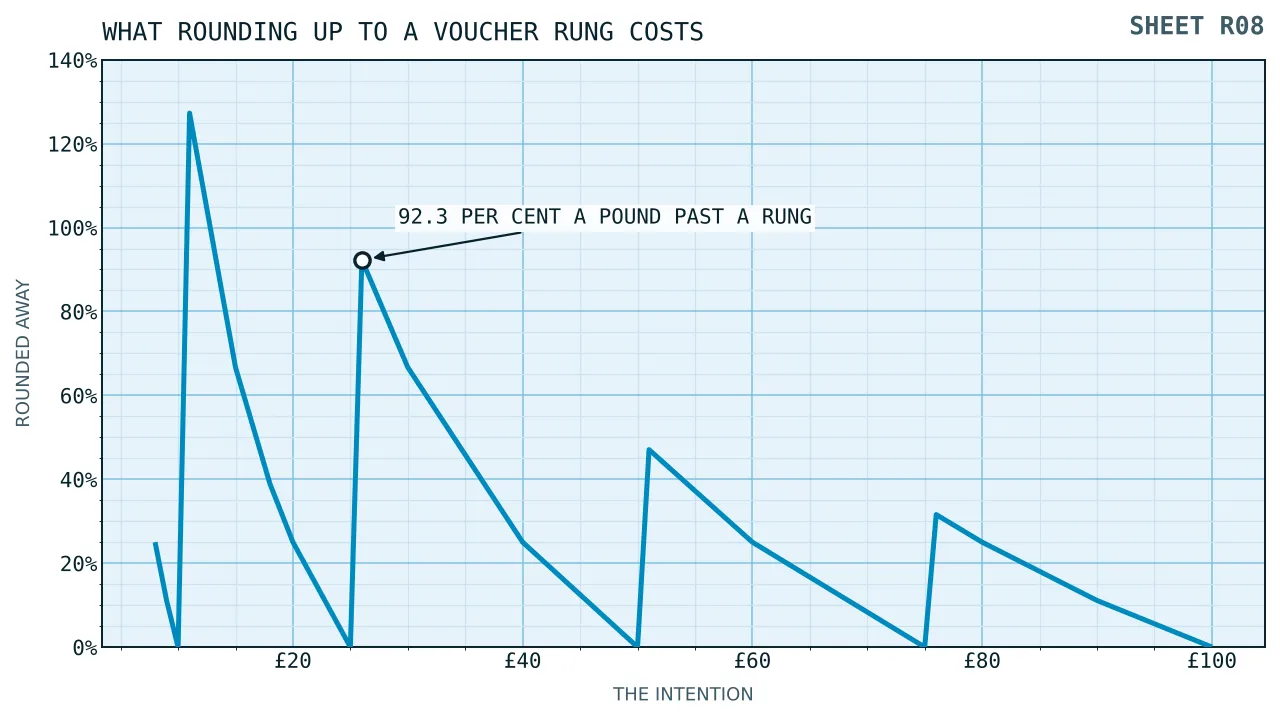
Set five intentions against the ladder and the rate the rounding costs swings between a quarter and nearly the whole of the sum. An intention sitting just above a rung is the expensive case, because the next rung is a long way up.
| Wanted | Face value bought | Rounded up by | As a rate |
|---|---|---|---|
| £8.00 | £10.00 | £2.00 | 25.0% |
| £18.00 | £25.00 | £7.00 | 38.9% |
| £20.00 | £25.00 | £5.00 | 25.0% |
| £26.00 | £50.00 | £24.00 | 92.3% |
| £80.00 | £100.00 | £20.00 | 25.0% |
A reader wanting £26.00 is the worst case on the ladder: one pound past the twenty-five pound rung, fifty pounds is the next value in stock, and £24.00 has to be found for a purchase that was meant to be twenty-six. Ninety-two pence in every pound of the original intention has gone somewhere other than the table.
Two ways out of the rounding exist and both are a cost rather than an escape. Deposit the intended £20.00 and £5.00 strands on the voucher. Deposit the whole £25.00 and there is a quarter more money at stake than the reader had decided to put at stake, which is a cost in exposure rather than in pence. This sheet prices the second case, since that is what most readers do with a balance that cannot come home.
A stranded remainder also loses value by sitting. Model a maintenance deduction of three per cent a month beginning after a year of disuse and the £5.00 is worth £3.47 twelve months later. That figure is modelling, like the ladder, and the direction of travel is the part that is not in doubt.
£24.00 rounded up on a £26.00 intention, 92.3 per cent of it
3
£25.00 of credit against forty times
The deposit has arrived whole, so the bonus is calculated on the whole of it. A full match credits £25.00. Ninety-six per cent is the return assumed throughout and the weighting is one, which leaves the multiple loose and nothing else.
Away from a British ceiling, forty times is the figure that gets written in. Ten times is the ceiling a licensed cashier works under, in force since 19 January 2026, and it is kept in the table for scale rather than because any offer on this rail is likely to use it.
| Multiple | Staking owed | Expected cost | Left standing | Less the rounding |
|---|---|---|---|---|
| 10x | £250.00 | £10.00 | £15.00 | £10.00 |
| 20x | £500.00 | £20.00 | £5.00 | £0.00 |
| 25x | £625.00 | £25.00 | £0.00 | minus £5.00 |
| 40x | £1,000.00 | £40.00 | £0.00 | minus £5.00 |
At forty times the condition wants £1,000.00 staked. The expected cost of staking at this return runs at four pence in the pound, so £40.00 is expected to leak out of a credit of £25.00. The credit cannot cover it, the foot reads £0.00, and £15.00 of the expected cost falls on the deposit instead.
The last column is where this sheet differs from a page about multiples. It carries the rounding across from part 2, so the figure in it is what the whole errand was expected to be worth: £10.00 at the licensed ceiling, nothing at twenty times, and a loss from there upward.
4
The line, with the remainder left outside it
What a credit is worth after its condition has been served comes from one expression, and that expression has never heard of a voucher.
E = B × (1 – (W × (1 – RTP)) / g)
Face values appear nowhere in it, and neither do tills. B is £25.00, the face value having arrived intact. W is the multiple in the terms. The return is 0.96 and the weighting is one, slots counting at full value against the condition.
Taken at forty: the product of the multiple and the four pence of edge is 1.60, so the expression comes out at minus six-tenths of the credit, which is minus £15.00. A balance does not go below nought, so what that minus sign records is a credit exhausted before the condition was met, with £15.00 of staking cost still to be paid out of the reader’s own money.
The rounding is nowhere in the expression. It is no part of B, the money having never reached the account, and no part of the bracket either, since the bracket is about turnover. It has to be taken off E afterwards, which is the subtraction the last column of the table does and nothing on a cashier’s screen does.
Doing it in reverse gives the sharpest figure on the page. Set the expected value of a full match equal to the £5.00 that stranded, and the multiple comes out at exactly twenty. Under twenty times, a voucher deposit with £5.00 left behind is still expected to be worth something. At twenty times the offer repays the rounding and no more. Above it the errand is expected to lose money whatever the slots do.
Twenty times exactly: where £25.00 of credit repays a £5.00 remainder
5
A rail that runs one way only
A voucher is a way in and not a way out. Nothing can be paid back to a code that has already been spent, so winnings have to leave by a rail the reader has not opened yet, which in practice means a bank account or a card.
Two consequences follow and both have figures attached. The first is that the exit is priced separately from the entrance, and the entrance arithmetic above tells a reader nothing about it. The second is that the exit requires something the entrance did not: a name, an account, and documents to tie the two together.
That second point is what makes a prepaid rail structurally awkward rather than merely fiddly. On every other rail in this section the money comes back the way it went out, so whatever was good enough to let the money in is good enough to let it out. Here the test is deferred to the moment of a withdrawal, and a deferred test is a test taken when the player has already staked and has something to lose by failing it.
The £5.00 remainder has the same shape of problem. It is money the reader has paid for, it is not on the table, and it cannot be brought home either. The only thing to be done with it is to spend it somewhere, which is why a rounding on this rail is closer to a loss than to a float.
6
Where the identity check lands
British rules put the check at the entrance, and they do it in a way that reads as designed for exactly the problem part 5 describes.
A licensed cashier settles who a customer is before any play at all, the rule covering a free game and a bonus as surely as it covers staked money. Three things are being established: that the person is of age, that they are not on a self-exclusion register, and that they are who they say they are. A licensee also has to say up front which documents may be wanted, when, and how they should be sent.
Then the limb that matters most to a one-way rail. A licensee may not answer a withdrawal request by asking for something it could sensibly have asked for at the start, and it gathers what the money-laundering rules want at the outset instead of saving the request for the day a payout is sought. The exception is narrow: information genuinely required at that moment by another legal duty.
Which documents are acceptable is not prescribed, and the examples the regulator offers run to household bills, driving licences and passports. Condition 17 is the one an operator risks breaching where a payout waits on identity information nobody asked for at the start. This sheet takes its wording from the licence condition rather than the consumer guide: the guide’s revision is dated 13 April 2022 and its publication 23 September 2020, which makes it older than most of what is cited here.
None of that is advice about documents, and nothing on this page helps anybody sidestep a check. The point here is narrower, and it is a point about money. A check at the entrance costs a reader nothing they have not already decided to spend, and a check at the exit is taken with winnings already hanging on the result.
7
What the voucher does not buy
Cashiers that take a prepaid voucher and attach a welcome offer to it hold no Great Britain licence. What that costs can be set out duty by duty rather than asserted.
| Duty under a British licence | On this rail |
|---|---|
| Wagering requirement capped at ten times | 40x modelled |
| Identity settled before any play | Deferred |
| No cap on withdrawing a deposit balance | Unbound |
| Complaint escalated to an approved adjudicator | Absent |
| Membership of the national self-exclusion scheme | Absent |
The withdrawal lines in that schedule are the ones a prepaid reader should weigh. British regulators have recorded unlicensed sites blocking payouts outright and setting withdrawal thresholds too high to be reached, and an exit that was always going to be a second rail is an exit with more places to fail.
Registration on the island side asks for a tick box, a check on the payment method and a date of birth, with a government-issued document tied to later anti-money-laundering milestones rather than to the first spin. That is a real rulebook rather than an absence, and on one narrow point it binds harder than Britain does: raising a deposit limit there waits a week, where the British wait is at least a day. What it does not contain is any ceiling on a wagering requirement, which is why the forty in part 3 is available at all.
One honest caution to go with the schedule. A complaints route does exist offshore, with a six-month window to bring one and an eight-week clock to answer it, so nobody should write that there is nothing out there. What differs is whose hand writes the terms of that adjudication, and out here it is the operator’s rather than a regulator’s.
8
Three figures to settle at the till
The decision on this rail is taken in a shop, before any cashier is involved, and that is the only cheerful sentence available here. Three figures settle the purchase, and two more settle whether it was worth making.
| What to establish | Here |
|---|---|
| The intention, before the ladder touches it | £20.00 |
| The face value that covers it | £25.00 |
| Rounded up by | £5.00 |
| The multiple in the terms | 40x |
| Expected value of the whole errand | minus £5.00 |
Divide the third figure by the first and the rounding turns into a rate. A rate is the one shape in which it will sit beside a headline percentage. Then take the fourth figure, which is the one nobody reads before buying a voucher, and ask whether a credit carrying that condition is expected to return more than the rate just worked out.
On the figures modelled here the answer is no, and the margin is not close. Twenty times is the point of indifference and the terms say forty, which is the whole of this page’s finding. A reader who wanted the voucher for reasons that have nothing to do with a bonus has lost nothing by reading this far, because the rounding is payable either way.
The last caution is the standard one about averages. Ten pounds at the licensed ceiling is an average over a long run of attempts rather than a sum handed over, and one attempt at twenty-five pounds of credit most often ends on nought. The £5.00 that stranded is not an average. It is already spent, and it is spent whatever happens next.
Along the rest of the section the same method meets different charges. Borrowed money and the handling charge behind it are priced at credit card casino, which is the rail a British licence refuses outright. Where the entrance is free and the waiting is done at the exit, see visa casino and mastercard casino. Wallets, which arrive whole and can still disqualify an offer, are at paypal casino and skrill/neteller/trustly casino. The index for this section stands at The rail.
Questions
- Why does a voucher cost anything if nothing is deducted from it?
- Because the charge is not a deduction, it is the money left over. Face values come off a fixed ladder, so an intention has to be rounded up to the rung above it, and the difference either strands on the voucher or goes on the table as exposure the reader had not decided to take. Wanting £20.00 and buying £25.00 is £5.00 of rounding, which is a quarter of the intended deposit.
- What is the worst the rounding can be?
- On the ladder modelled here, 92.3 per cent, and it happens one pound past a rung. An intention of £26.00 clears the twenty-five pound value by a pound, the next value in stock is fifty pounds, and £24.00 has to be found for a purchase meant to be twenty-six. An intention that lands exactly on a rung costs nothing at all, which is why the rate saw-tooths rather than curving.
- Does the rounding get proportionately cheaper on a bigger voucher?
- Not reliably, because it is a flat amount rather than a percentage. What sets it is the gap between the intention and the rung above, so £80.00 against a hundred pound value costs 25 per cent, exactly the same rate as £8.00 against a ten pound value. The ladder’s spacing decides the rate and the size of the deposit has very little to do with it.
- What is £25.00 of credit worth once the play-through is served?
- At the ten times a licensed cashier works under, the condition wants £250.00 of staking, the expected cost of that staking is £10.00 at four pence in the pound, and £15.00 is expected to remain standing. At forty times the staking owed is £1,000.00 and the expected cost £40.00, so the foot reads £0.00 and £15.00 of that cost lands on the deposit. Twenty-five times is where the credit dies exactly.
- At what multiple does the bonus stop covering the rounding?
- Twenty times, exactly. Take the credit, subtract four pence of leak for each turn of the multiple, and set the answer against the £5.00 of rounding: the multiple that balances it is twenty, with nothing to spare. Under twenty times the errand is expected to be worth something, at twenty it washes, and above it the whole transaction is expected to lose money however the reels fall.
- Can winnings be paid back onto the voucher?
- No. A spent code cannot receive money, so the exit is a different rail from the entrance, usually a bank account or a card. That has two costs. The exit is priced separately, so nothing in the entrance arithmetic tells a reader what leaving will involve, and the exit needs a name and an account where the entrance needed neither.
- Why does a one-way rail matter for identity checks?
- Because it moves the check to the worst moment for the player. British rules put it at the entrance: a licensed cashier settles who a customer is before any play, bonus rounds and free-to-play games included, and a licensee may not answer a withdrawal request by asking for something it could sensibly have asked for at the start. Information wanted for money-laundering purposes is gathered at the outset rather than saved for the day a payout is sought.
- Which documents would a British cashier ask for?
- That is not prescribed, and the examples the regulator offers run to household bills, driving licences and passports. Condition 17 is the one an operator risks breaching where a payout waits on identity information nobody asked for at the start. The consumer guide carrying the plainest wording on this is a good deal older than the rest of what is cited here, its revision dated 13 April 2022 and its publication 23 September 2020, so the licence condition is the better reading.
- What does a prepaid reader give up away from the British register?
- Membership of the national self-exclusion scheme goes, and so do the ten times ceiling on a wagering requirement, identity settled before any play, the rule against rationing a deposit balance on the way out, and escalation of a complaint to an adjudicator from an approved list. Regulators have recorded unlicensed sites blocking payouts and setting withdrawal thresholds too high to be reached, which matters more here than elsewhere because the exit was always going to be a second rail.
- Is there any complaints route at all on this side?
- There is, and saying otherwise would be wrong. The island rulebook read for this build gives a player six months to bring a complaint and the operator eight weeks to deal with it, which matches the British clock. The difference is who sets the terms of the adjudication that follows, and out here that is the operator rather than a regulator, with no approved list to choose from.